How AI Decision-Making is Improving Enterprise Outcomes
Blog
Share 
Grow Your Business with Competitive Intelligence (CI)
 10 November 2023
 Team Beinex
What is Competitive Intelligence (CI)?
Competitive Intelligence (CI) is a systematic process for gathering, analyzing, and applying information about the competitive landscape in which a business operates. It equips organizations with valuable insights, helping them make strategic decisions, mitigate risks, and gain a competitive edge.
Competitive Intelligence services play a vital role in helping businesses gain a strategic advantage through the smart utilization of data and information. By gathering, analyzing, and applying information about the competitive landscape, CI equips organizations with valuable insights, enabling them to make data-driven decisions, mitigate risks, and ultimately outperform their competitors.
To learn more about the benefits of Competitive Intelligence, click here
Why Competitive Intelligence (CI) Matters in Business
In today's fast-paced business world, staying ahead is crucial, and Competitive Intelligence services can be the game-changer your business needs. Here's why Competitive Intelligence matters:
Informed Decision-Making
In the modern business landscape, decisions need to be grounded in data, not guesswork. CI services equip decision-makers with valuable insights that help them make well-informed choices. By analyzing competitor behavior, market trends, and consumer preferences, businesses can develop strategies that are not based on hunches but on hard evidence.
For example, consider a scenario where a tech startup is contemplating the launch of a new product. CI can provide insights into the competitive landscape, revealing what similar products are in development, their features, and their projected market reception. Armed with this data, the startup can make crucial decisions about product design, pricing, and marketing with a higher degree of certainty.
Anticipating Market Changes
The business world is in a constant state of flux. Markets evolve, consumer preferences shift, and disruptive technologies emerge. In this environment, businesses that can anticipate and adapt to change gain a significant advantage. CI allows organizations to do just that.
By monitoring industry trends, tracking competitor movements, and analyzing consumer behavior, businesses can identify early indicators of change. This insight provides a head start in adjusting strategies, launching new products, and capitalizing on emerging opportunities. It's the difference between reacting to change and proactively shaping the market.
For instance, an established retail chain with a robust CI process may spot the growing consumer interest in sustainable and eco-friendly products. Armed with this knowledge, the chain can pivot its product selection and marketing to cater to this demand, staying ahead of competitors who are slower to adapt.
Outsmarting the Rivals
Competition in business is not just a matter of survival; it's a race to outperform rivals. In this race, CI is the secret weapon that enables organizations to outmaneuver their competitors.
By gaining insights into competitors' strategies, strengths, and weaknesses, businesses can develop tactics to gain an edge. For example, a restaurant chain can analyze a competitor's menu changes, pricing strategies, and customer reviews to refine its own offerings and marketing approach. This allows for not only maintaining market share but also expanding it.
Moreover, CI is not just about reacting to competitors; it's also about predicting their moves. By understanding the future direction of the market and the strategies competitors are likely to employ, businesses can position themselves strategically. This foresight is a cornerstone of successful long-term planning.
Examples of Competitive Intelligence (CI) in Action
Competitive Intelligence services are used in various business aspects:
Market Research: Imagine a tech company that monitors competitors' product launches, pricing strategies, and customer reviews to refine its own offerings.
Competitor Analysis:A restaurant chain may analyze its competitors' menu changes, customer reviews, and marketing strategies to refine its own offerings.
Supplier and Vendor Insights:By employing CI, companies can assess their suppliers' performance, ensuring a streamlined supply chain.
Types of Competitive Intelligence
CI comes in various flavors, each with its own focus and strategic horizon:
Tactical CI:This short-term focus involves addressing immediate competitive threats and challenges. For example, a retailer may use tactical CI to respond to a competitor's sudden price drop.
Strategic CI:With a long-term view, strategic CI aims to identify trends, market shifts, and opportunities. An example is a global tech corporation analyzing market trends to position itself as a leader in a specific technology sector.
Product CI: This type focuses on tracking competitors' product development and launches, ensuring companies are aware of what's in the pipeline and can adjust their product roadmaps accordingly.
Pricing CI:It involves tracking competitors' pricing strategies and understanding how they position themselves in the market. Companies can then make informed pricing decisions.
The Role of Competitive Intelligence (CI) in Marketing
Incorporating CI into your marketing strategy is a game-changer. It allows you to align your marketing efforts with the competitive landscape and customer preferences, optimizing your strategies for success. Here's how to do it:
CI is more than a buzzword; it's a strategic imperative for businesses. By incorporating CI into your strategies, you can gain a competitive edge, make data-driven decisions, and secure your position in the market. Whether through market research, competitor analysis, or innovative marketing strategies, CI can be the key to success in today's fast-paced business world.
How Beinex Can Help You
Robust Competitive Intelligence is essential in strategising for your next move, enabling you to anticipate your competitors’ direction and future performance. Our data harvesting team validates the entire data manually before the CI application consumes it. Our clients can easily integrate our CI database with their actual transactional data.
Efficient, Competitive Intelligence analysis can give a significant boost to your strategy. Beinex provides comprehensive competitive intelligence solutions that help businesses gain a competitive edge in their industry. Supercharge your competitive strategy with Beinex!
In today's fiercely competitive business environment, success depends on making informed decisions, staying ahead of market trends, and outsmarting the competition. That's where Competitive Intelligence (CI) comes into play. Here, we'll explore the significance of CI in business, provide real-life examples of CI in action, delve into the various types of CI, and discuss strategies for CI marketing. Let's dive in.
Related Articles

Time-series Analysis in Tableau and 6 Real-world Success Stories
What is Time Series Analysis?
Time series analysis involves examining data that changes over time or where time is a variable in the outcomes. Time isn't just a data point; it's the primary axis on which the data is based.
The main difference with time series analysis is that data is collected at regular time intervals. This helps identify patterns in the data, forming trends, cycles, or seasonal variations. With a consistent time frame of historical data, time series forecasting becomes a valuable tool for predicting future data. Time's crucial role as a variable in data across industries makes time series analysis widely applicable. Explore a few examples outlined below.
6 Real-world Examples of Time Series Analysis in Various Industries
Example 1: Health Authority Enhances Patient Care
Problem: Inefficient resource use and rising costs of care and operations over time.
Solution: Utilizing data analytics, a prominent health authority conducted a comprehensive analysis of patient data. Examining historical data on patient stays, treatments, and conditions, they identified optimal times for administering medication, resulting in reduced average length of stay and cost savings for both patients and the system.
Insight: Time series analysis in healthcare extends beyond patient care to chronic disease research and epidemic-scale studies. Tracking chronic diseases over time and analyzing patient data using time series methods contribute to advancements in the field.
Example 2: Retail Giant Identifies Sales Opportunities
Problem: Slow data analysis affecting decision-making days before events.
Solution: A leading retail giant's front-office team integrated all data sources to gain a comprehensive view. Implementing time series analysis dashboards, they swiftly identified sales opportunities by forecasting against seasonal trends. Proactive measures were taken to increase ticket sales for upcoming events based on real-time insights.
Insight: Time series analysis aids retail giants in making data-driven decisions, predicting consumer trends, and strategizing marketing efforts, ensuring maximum impact.
Example 3: Manufacturing Company Improves Forecasting Accuracy
Problem: Inaccurate and time-consuming operations, manufacturing, and sales forecasting.
Solution: A manufacturing company revamped its forecasting process using time series analysis and modeling. By leveraging better data and faster analysis, they reduced analysis time from one day to one hour. Accurate forecasts in supply chain and manufacturing processes led to significant cost reductions in inventory, supply chain, labor, and capital equipment.
Insight: Time series analysis proves invaluable in optimizing forecasting models, enhancing accuracy, and streamlining operations in manufacturing.
Example 4: Marketing Analytics Scaling for Media Clients
Problem: Evolving marketing technologies making it challenging to quickly analyze information for media clients.
Solution: An analytics firm centralizes over 100 data sources using Tableau, allowing quick data retrieval and the creation of custom dashboards. Time series analysis aids in media forecasting, enabling the firm to develop insightful "what if" analyses. This empowers clients to make informed decisions about marketing investments.
Insight: Time series analysis combined with data centralization is crucial for scaling marketing analytics, providing clients with actionable insights.
Example 5: Streamlining IT Costs Through Self-Service Analytics
Problem: Business decisions based on static reports, consuming time and resources.
Solution: A retail group enables department staff with self-service analytics in Tableau, reducing IT costs by 20%. Time series analysis is applied for accurate forecasting of retail and IT trends, optimizing product orders and resource allocation.
Insight: Time series analysis aids in accurate forecasting for retail and IT trends, optimizing resource allocation, and reducing IT costs.
Example 6: Innovative Use of Data Analytics in Auditing Processes
Problem: Traditional audits were time-consuming and lacked value addition.
Solution: An organization in the energy sector used Tableau to analyze a year's worth of data, uncovering trends in financial processes. This data-driven approach revolutionized their auditing processes, providing deeper insights into the financial health of the organization.
Insight: Time series analysis proves instrumental in data-driven audits, providing a comprehensive view of historical data and uncovering trends for better decision-making.
These real-world examples showcase the versatility and impact of time series analysis across different industries, emphasizing its crucial role in data-driven decision-making and business optimization.

Building Smarter Dashboards with Tableau's AI Features
The Rise of AI-Driven Analytics
Artificial intelligence (AI) has transformed the analytics landscape, enabling organizations to automate complex tasks, identify patterns, and predict future trends. Tableau's AI-powered capabilities are designed to augment human intelligence, streamlining the analytics process and uncovering new opportunities.
Tableau's AI Features: A Brief Dive
1. Tableau Pulse: Powered by AI, Tableau Pulse offers contextual, personalized, and intelligent insights at your fingertips. It redefines data experience by making data accessible to everyone despite their expertise in data visualization tools. The Insights Platform within Tableau Pulse automates the identification of contributors, trends, drivers, and outliers for relevant metrics and streamlines and democratizes data analysis. Tableau Pulse's Metrics Layer lets KPIs and key metrics and KPIs be defined and utilized consistently across the enterprise, creating a unified source of truth for decision-making. Tableau Pulse also offers a Next-Gen Experience by offering intuitive, user-friendly metrics directly into the tools users already work with, such as email or the Tableau web app, enabling users to engage with data in real-time and effortlessly scale insights.
Real-World Application: Employing Tableau Pulse in the supply chain helps track and monitor shipping times, inventory levels, and supplier performance in real time, facilitating informed and proactive decision-making.
2. Tableau Agent: A conversational AI assistant, Tableau Agent facilitates the data journey for new analysts using generative AI to expedite the analysis process from data collection to exploration. Tableau Agent is built on the Einstein Trust Layer, ensuring enterprises' data remains safe and accessible. It streamlines the stages of analysis by effortlessly creating calculations using natural language, making the process easier and faster for technical and non-technical users. It also creates AI-generated descriptions for data sources to convey their objective and essence consistently and informatively.
Real-World Application: In dealing with customer engagement, Tableau Agent helps personalize marketing strategies and campaigns to augment customer interaction based on customer preferences and behavior.
3. Einstein Copilot for Tableau: Quickly identify trends and explore data at every analysis phase with the reliable AI assistant, Eintein Copilot for Tableau. It doesn't matter if you are a novice or a seasoned analyst, as Einstein Copilot for Tableau enhances your Tableau experience by making analytics accessible to facilitate actionable insights and informed decisions. With this feature, you can easily produce AI-generated descriptions of data assets and explore data utilizing natural language directly from Tableau Cloud Web Authoring.
Real-World Application: Utilizing Einstein Copilot streamlines data analysis for business users by offering instant and expert-level insights to the questions asked without needing any technical expertise in data analysis.
4. Tableau Explorer: This feature employs machine learning algorithms to automatically identify key insights, patterns, trends, and correlations within your data. Discovering hidden data insights with AI offers intelligent recommendations for charts, dashboards, visualizations, and dashboards. Further, Tableau Explorer generates data-driven narratives, emphasizing key findings clearly and concisely. It enables users to grasp complex data insights and make informed decisions quickly.
Real-World Application: Using Tableau Explores optimizes operational efficiency by analyzing production data, facilitating the identification of areas of process improvement, and reducing costs.
5. Predictive Analytics: Tableau's predictive models enable you to forecast future outcomes, identify potential risks, and optimize business strategies. Regression analysis identifies relationships between variables while clustering groups similar data points for segmentation. Decision trees visualize complex decision-making processes, making understanding and optimizing outcomes easier.
Real-World Application: Predictive Analytics develops predictive models to forecast revenue and sales, allocate resources efficiently, and analyze data to check for potential setbacks.
6. Natural Language Processing (NLP): Tableau's NLP capabilities allow users to ask questions and receive answers in natural language, simplifying the analytics process. Tableau's Ask Data feature enables users to ask queries in everyday language and get answers instantly. The Explain Data feature automatically describes data patterns and trends and patterns, improving understanding and insight. Besides, text analysis facilitates sentiment analysis, entity recognition, and topic modeling, unlocking valuable insights from unstructured data.
Real-World Application: NLP facilitates the sentiment analysis of customer feedback, that is, analyzing the data from reviews, surveys, and social media to understand customers' sentiments and base decisions accordingly.
7. Automated Data Preparation: Tableau's AI-driven data preparation streamlines data cleaning, joining, and aggregation, freeing up valuable time for analysis. The AI-powered algorithms help identify and rectify errors, propose optimal data formats, and detect inconsistencies and missing values. It ensures data accuracy, completeness, and trustability, allowing users to concentrate on higher-level analysis and decision-making.
Real-World Application: Automating data preparation for financial reports simplifies the process by reducing manual effort and enhancing the accuracy of results.
Organizations across various industries have successfully leveraged Tableau's AI features to:
1. Enhance customer experience as predictive analytics helps identify customer churn patterns.
2. Optimize operations as automated data preparation streamlines supply-chain management.
3. Drive revenue growth as AI-driven insights uncover new business opportunities.
Dashboards that Talk: Revolutionizing Business Insights
Interactive dashboards that engage with you have revolutionized how businesses interact with data, ushering in an era of conversational analytics. Tableau, a pioneer in data visualization, has been at the forefront of this revolution, empowering organizations to unlock hidden insights and drive informed decision-making. With Tableau's natural language processing (NLP) capabilities, users can ask questions and receive answers in a conversational format, eliminating the need for tedious data analysis. This seamless interaction lets stakeholders focus on strategic decision-making rather than getting bogged down in data intricacies. Furthermore, Tableau's automated insights and predictive analytics capabilities allow businesses to forecast trends, identify potential risks, and optimize operations, giving them a competitive edge in today's fast-paced market. The implications of interactive dashboards extend far beyond data analysis, transforming the very fabric of business operations. Executive dashboards can now provide real-time strategic guidance, while sales dashboards can predict performance and identify areas for improvement. Operational dashboards can monitor processes in real time, enabling swift corrective action. Moreover, customer service dashboards can deliver personalized support, fostering enhanced customer experiences. As AI and NLP continue to advance, the possibilities for talking dashboards will only expand, enabling businesses to tap into unprecedented levels of insight and innovation. By embracing these cutting-edge technologies, organizations can unlock new avenues for growth, efficiency, and competitiveness, ultimately redefining the future of business intelligence. With Tableau at the helm, the era of conversational analytics has truly begun, and the potential for transformation is vast.
Building Smarter Dashboards
To harness the full potential of Tableau's AI features, consider the following best practices: 1. Define Clear Objectives: Align your dashboard with key business goals and objectives. 2. Select Relevant Data: Focus on high-quality, relevant data to ensure accurate insights. 3. Leverage AI-Driven Insights: Use Tableau Explorer and predictive analytics to uncover hidden trends. 4. Design Intuitive Visualizations: Create clear, concise dashboards that facilitate decision-making. In today's data-driven landscape, building smarter dashboards is critical for business success. Tableau's AI features empower organizations to unlock hidden insights, drive informed decision-making, and stay ahead of the competition. By embracing these cutting-edge capabilities and following best practices, IT professionals, business leaders, and data analysts can create dashboards that propel business growth and innovation.

Building a Sustainable Future for Your Business A Roadmap for Business Success in the 21st Century
What is ESG?
ESG stands for Environmental, Social, and Governance. It encompasses a company's commitment to operating in a way that considers its impact on the environment, society, and its own governance structure. • Environmental: This pillar focuses on a company's environmental impact, including its carbon emissions, resource consumption, and pollution prevention efforts. Key aspects include climate change mitigation, water conservation, waste reduction, and the transition to renewable energy sources. • Social: This pillar addresses a company's impact on society, encompassing human rights, labor practices, community engagement, and customer health and safety. It includes ensuring fair wages, safe working conditions, respecting human rights throughout the supply chain, and contributing positively to the communities in which the company operates. • Governance: This pillar focuses on a company's leadership, ethics, and transparency. Key aspects include board diversity, executive compensation, anti-corruption measures, and effective risk management.Why is ESG Relevant Today?
The relevance of ESG stems from a confluence of factors. Firstly, investors are increasingly prioritizing ESG factors in their investment decisions. Recognizing the long-term financial risks associated with environmental and social issues, investors are seeking companies that demonstrate strong ESG performance. Secondly, consumers are becoming increasingly aware of sustainability and ethical business practices. They are more likely to support companies that align with their values and prioritize environmental and social responsibility. Furthermore, regulatory scrutiny surrounding ESG issues is intensifying. Governments worldwide are implementing stricter environmental regulations and increasing pressure on companies to disclose ESG information. Finally, strong ESG performance enhances a company's reputation and attracts top talent. By demonstrating a commitment to sustainability and social responsibility, companies can build trust with stakeholders, improve their brand image, and differentiate themselves in the competitive marketplace.The Impact of ESG on Businesses
Integrating ESG principles into business operations can yield significant benefits: 1. Enhanced Financial Performance: • Improved Risk Management: By proactively identifying and mitigating environmental and social risks, companies can enhance their financial stability and reduce their exposure to potential losses. • Increased Access to Capital: Investors are increasingly allocating capital to ESG-aligned investments. This can lead to improved access to capital and potentially lower borrowing costs for companies with strong ESG performance. • Improved Operational Efficiency: Implementing sustainable practices, such as energy efficiency measures and waste reduction initiatives, can lead to cost savings and improved operational efficiency. 2. Enhanced Reputation and Brand Value: • Attracting and Retaining Customers: Consumers are increasingly choosing to support companies with strong ESG credentials. By demonstrating a commitment to sustainability and social responsibility, companies can attract and retain loyal customers. • Attracting and Retaining Talent: Top talent, particularly younger generations, are increasingly seeking employment with companies that prioritize ESG. Strong ESG performance can help attract and retain the most talented employees. 3. Driving Innovation: • Developing Sustainable Solutions: Integrating ESG considerations can drive innovation and the development of new products and services that address environmental and social challenges. This can lead to new revenue streams and competitive advantages. • Companies can further amplify their ESG initiatives by aligning themselves with external sustainability movements. For example, joining the Trillion Trees (1t.org) initiative demonstrates a commitment to large-scale environmental restoration efforts, specifically by contributing to the ambitious goal of conserving, restoring, and growing one trillion trees globally. By participating in this initiative, companies not only contribute to vital environmental restoration efforts but also gain valuable recognition for their commitment to climate action and biodiversity conservation. Similarly, aligning with Pledge 1% (pledge1percent.org) signifies a dedication to philanthropy and social responsibility. This initiative encourages companies to contribute 1% of their equity, employee time, product, or profit to charitable causes. By joining Pledge 1%, companies can actively support non-profit organizations working on critical social issues, such as poverty reduction, education, and healthcare. This demonstrates a commitment to making a positive social impact beyond their core business operations and fosters a strong sense of corporate social responsibility within the company. At Beinex, we are deeply committed to ESG principles and strive to integrate sustainability into all aspects of our business. We believe that strong ESG practices are not only essential for environmental and social responsibility but also crucial for long-term business success. We are actively exploring opportunities to align with external sustainability initiatives such as the Trillion Trees initiative and Pledge 1%. These partnerships will further solidify our commitment to environmental restoration and social impact, allowing us to contribute meaningfully to a more sustainable and equitable future. These external partnerships not only enhance a company's ESG profile but also provide valuable opportunities for collaboration, knowledge sharing, and collective impact. By joining forces with other like-minded organizations and individuals, companies can leverage their resources and expertise to address pressing global challenges and create a more sustainable and equitable future.Making a Net Positive Impact
To effectively integrate ESG into their business strategy, companies must set clear, measurable ESG targets, integrate ESG considerations into all aspects of their operations, and regularly track and report on their progress. Engaging with stakeholders, including customers, suppliers, employees, and investors, is crucial for understanding their expectations and incorporating their feedback into ESG initiatives. Going beyond mere compliance with regulations, businesses can strive to make a net positive impact on society and the environment. • Collaborative Partnerships: Collaborating with other businesses, NGOs, and government agencies to address systemic challenges and drive collective action on sustainability. • Leading by Example: Serving as a role model for other companies in the industry by demonstrating best practices in sustainability and social responsibility. • Investing in Innovation: Investing in research and development of innovative technologies and solutions that address environmental and social challenges.
Prepping the data on Tableau: Five aspects that matter
Data preparation is purging imperfectly formed data, reorganising unclean data, and merging various data sets for analysis. Rows and columns in the data structure must be changed, and data types and values must be cleaned up. The amount of time it takes to find insights directly depends on how quickly and well you prepare your data. The entire process can be sped up by being aware of the extent of the data you're studying and observing the modifications you make to the data.
With the help of Tableau Prep Builder, data can be combined, shaped, and cleaned more quickly and easily for analysis within Tableau. You can swiftly obtain high-quality data using the linear and visual approach when preparing your data.
When ushering in data into a data prep tool, it is always better to know what you're working with and whether you're looking at the complete data set or just a subset. Before you begin cleaning, you might also need to undertake some data research. Five crucial steps are to be taken care of for prepping the data.
Let's have a look:



 One technique to get beyond this obstacle is visualising the data pane in Tableau Desktop as to how it should appear. Do you have columns with the same value in several places? Should each product be in a single field with the sales transactions stated below, or should each product have its column with the sales transactions listed underneath? The latter is more likely, and a pivot is necessary for this situation.
You will be joining the data if you need to combine two tables. By using a join, you can increase the number of fields in your data source that you can investigate. Although a join can be added at any point during the data preparation process, the sooner you use it, the sooner you will comprehend the data set and identify areas that require immediate attention.
 Like appending two data sets together, a union enables you to do so. For instance, you might have an Excel file where each sheet displays transactions from different years. You may maintain the same structure with extra rows by using a union rather than joining the tables.
After your data has been organised, processed, and filtered, it's time to interpret what it is trying to tell you. Tableau Prep connects with your entire business intelligence platform like many other data preparation products. To allow others to begin their analysis, publish the extract to Tableau Server or Tableau Cloud. Bring it into Tableau Desktop to start posing and investigating more in-depth queries. The hardest part of the data analysis process is now complete. It's time to share the breakthroughs that resulted from your hard work.
1. Adjust the data sample size
To speed up your data preparation process and improve performance, you should generally only connect to a small portion of a vast data set. You might occasionally prefer to view the entire data set, and Tableau Prep enables you to do so. If a sample doesn't help you complete your data preparation task, you can try the following:
- a. Boost the size of your data sample: Adjust the sample's row count by returning to the input stage. You can add more rows or include all the data but remember that doing so might make the performance slower. Another word of caution is that utilising a specified number of rows will only return the fastest method the underlying database can find to replace the given rows.
- b. Take random sampling: Tableau Prep automatically chooses the optimal number of rows to return based on the total number of fields in the collection and the data types of those columns. The database level random sampling occurs and returns the specified number of rows. The database returns a sample after inspecting each entry. Not all data sources provide this option, which could also affect performance.
- c. Add a step filter at the input stage: You may ensure that the information pulled into your data set is pertinent to your research by including a filter at the input stage. This improves performance while providing you with a more representative sample.
2.Evaluate the data
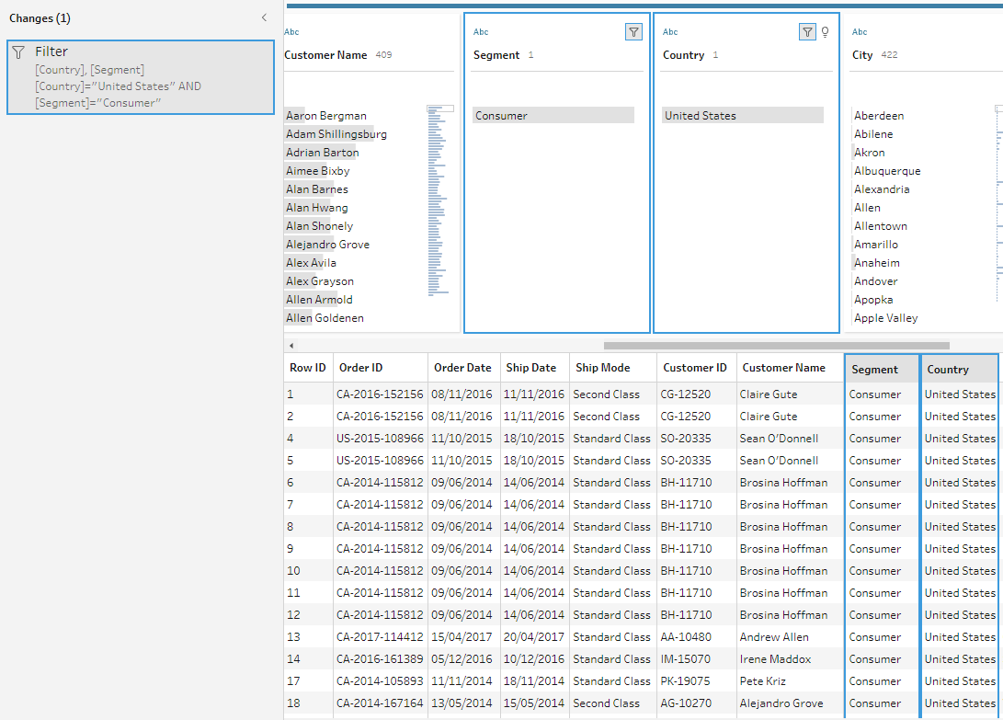
You'll probably want to start by counting the number of distinct values in each field. A simple check at the column header at the top reveals how many states are represented in the data set. You'll also want to understand how various values connect to identify data outliers or problems. You can utilise highlighting in Tableau Prep to find correlations between different fields. The data grid view is condensed to only display the records with the selected value in the chosen field when you click on a value in the profile pane. Tableau Prep highlights the corresponding values in blue, and the values span areas.
3.Filter the data
Limit the fields you import into Tableau Prep to those you'll need for your analysis to maximise the overall effectiveness of your data preparation process. By filtering your data, you can verify that you're performing the proper analysis while saving time. For instance, if you need to look at sales data from the previous two years, you may use the range or relative date filters to limit the date field to that period. You might want to eliminate any incorrect or irrelevant data. A value in the data pane can be excluded with a single click. You can do this at any time during your flow.
4.Assess and tidy up the data
Tableau's data types will have an impact on your analysis. Therefore, it's critical to correctly identify each field before beginning. Even though Tableau allows you to update aliases, alter data types, split lots, and create calculations, it is far simpler to carry out these tasks beforehand, particularly when preparing the data set for someone else. Tableau Prep includes built-in capabilities to aggregate and replace recurring characters or pronunciation, saving you from having to edit each one individually so that you don't have to; these solutions use algorithms to make cleaning easier. Or, if you foresee a missing value, you may manually add it so that it will be included when the flow processes the complete data set. You can apply a computation if you know that a field must be cleaned or filtered, but it takes more than the user interface offers.
5.Understand the data results
Deciding about the final data set's appearance while you begin to prepare your data can be difficult. For Tableau to effectively analyse your data, you might need to merge numerous data sources or pivot your data from columns to rows.
One technique to get beyond this obstacle is visualising the data pane in Tableau Desktop as to how it should appear. Do you have columns with the same value in several places? Should each product be in a single field with the sales transactions stated below, or should each product have its column with the sales transactions listed underneath? The latter is more likely, and a pivot is necessary for this situation.
You will be joining the data if you need to combine two tables. By using a join, you can increase the number of fields in your data source that you can investigate. Although a join can be added at any point during the data preparation process, the sooner you use it, the sooner you will comprehend the data set and identify areas that require immediate attention.
Like appending two data sets together, a union enables you to do so. For instance, you might have an Excel file where each sheet displays transactions from different years. You may maintain the same structure with extra rows by using a union rather than joining the tables.
After your data has been organised, processed, and filtered, it's time to interpret what it is trying to tell you. Tableau Prep connects with your entire business intelligence platform like many other data preparation products. To allow others to begin their analysis, publish the extract to Tableau Server or Tableau Cloud. Bring it into Tableau Desktop to start posing and investigating more in-depth queries. The hardest part of the data analysis process is now complete. It's time to share the breakthroughs that resulted from your hard work.
Top Picks: Tableau 2020.4
As a frequent user of Tableau Desktop and Server, check out my top picks from the list.
• Improved dynamic parameter
• Multiple marks layer support for maps
• Block comments in calculations
• Web authoring enhancements
• Offline map support for Tableau Server
• Tableau Server Management (TSM) improvements
• Multiple key activation on Tableau Server prior to TSM initialization
• Analytics Extension for Tableau Online
• Merge duplicate external assets
• Tableau Prep Builder in the browser
Tableau Desktop
Improved Dynamic Parameter
The dynamic parameter was one of the features which I used extensively starting from 2020.1. The feature allows us to populate parameter values based on a specified field whenever the workbook is opened. We will be able to select only the field with matching data types.
The feature update announced in Tableau 2020.4 gives me more privilege to customize the Dynamic Parameter. I can now set a parameter’s range to a field’s min and max value upon opening the workbook, or when the field’s data source is refreshed.
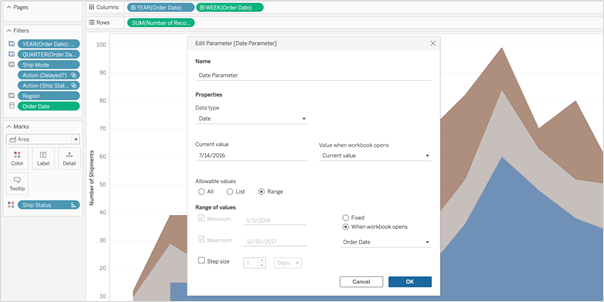 So, whenever I open the workbook or the extract is refreshed, Tableau displays the unique values within the range specified, giving more control over the parameter values displayed.
Multiple Marks Layer Support for Maps
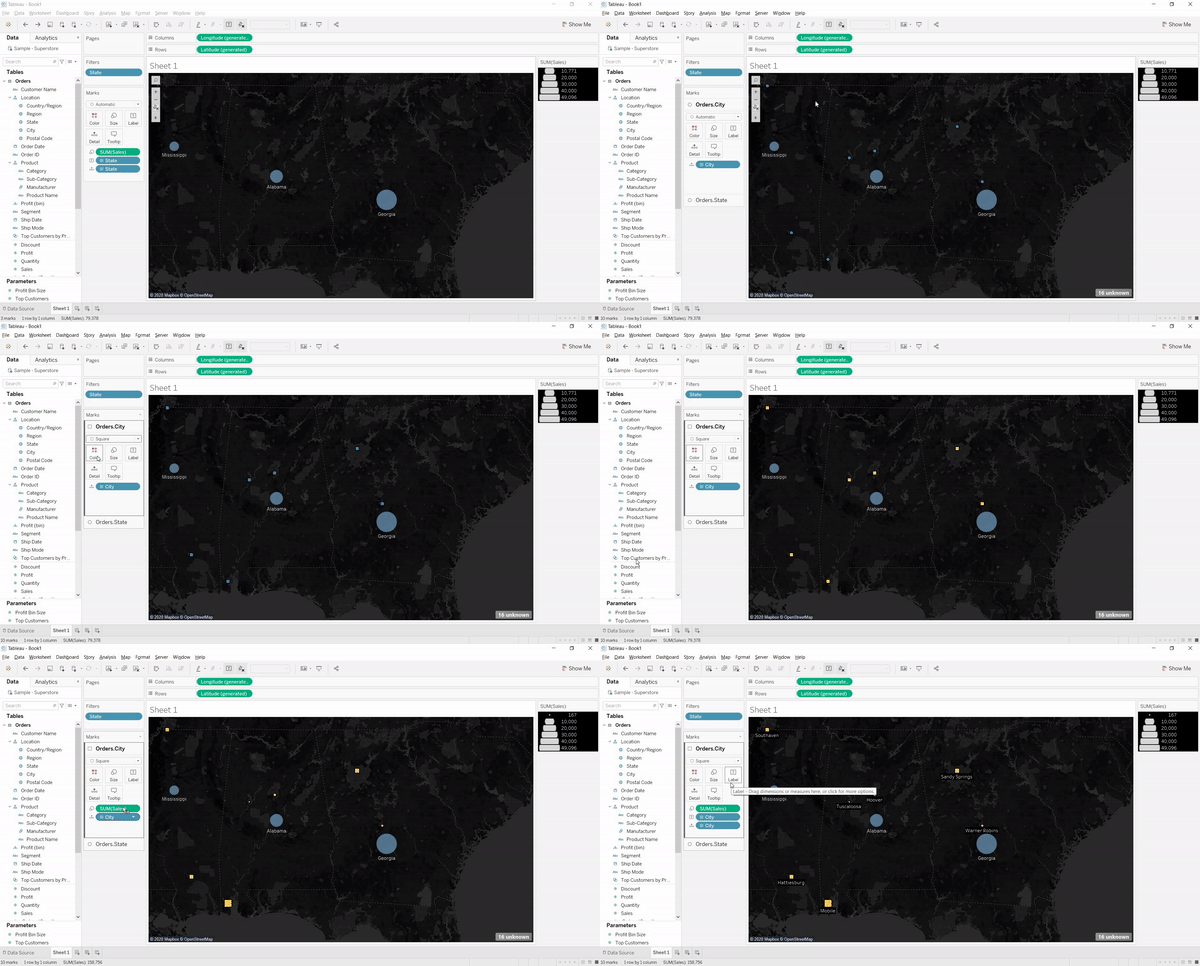
This is an exceptional feature to bring multiple spatial layers and context together to better understand and analyze geospatial data and map views. I will be able to include multiple marks layers from a data source to map visualizations and enhance the geospatial analysis. I can present more context in a single map view and perform further analysis with this feature.
 Block Comments in Calculations
Block comments is a simple yet one of the most useful features for me, which Tableau has announced in 2020.4. I often used to add comments in complex calculations for easy understanding in future references. Earlier, only single-line comments were possible, limiting the description I could add. But from now on, I can add comments of any length to calculation windows with block comments by simply starting the comment with /* and ending with */.
What makes it unique is that the new multi-line block comment feature is consistent with other popular programming languages. This feature is an example of Tableau’s on-going effort to provide its customers with an intuitive user experience.
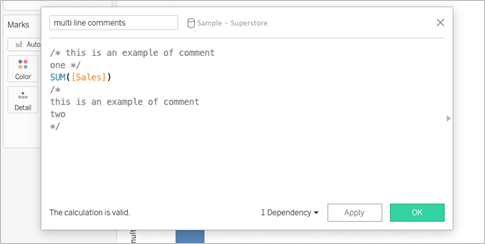 Tableau Server
Web Authoring Enhancements
Starting from Tableau 2020.4, it is possible to author dashboards from the browser just like how we design it in Tableau Desktop. With this web authoring enhancements, I can include Highlight actions, Format Mark Labels, apply filters to worksheets, create fixed sets, and even create extract in my workbooks from the browser itself. I no longer have to make changes from Tableau Desktop and publish it to the server. I can directly do it from the browser itself.
 Offline Map Support for Tableau Server
Rendering dashboards with maps is now faster compared to previous versions. Now, I can create maps using the offline map style in web authoring, ensuring the performance of map views in Tableau Server. Offline map support is a great deal for organizations with strict internet access restrictions, assuring that map view access to all its users.
Tableau Server Management (TSM) Improvements
Tableau Server Administration activities like installation, upgrade and backup are now easy like never before. I can retry installation or upgrade from the last checkpoint in case of an unexpected issue or error during installation or upgrade, saving my efforts to obliterate tableau server.
Backups can be performed twice as fast as previous versions, and I can monitor the progress with the new progress bar giving visibility into what step the backup is on and how much time is remaining.
Backups can also be scheduled using TSM command starting from 2020.4 and that is awesome. I no longer need to prepare batch script and depend on the windows task scheduler to schedule the backups on regular intervals; instead, I can schedule it with just a single command.
Multiple Key Activation on Tableau Server Prior to TSM Initialization
During Tableau Server installation, it is now possible to activate multiple license keys prior to TSM initialization. I will be able to save a lot of time by eliminating the need to restart after the installation is completed to activate multiple licenses and experience a smoother installation.
Analytics Extension for Tableau Online
The power of the Analytics extension is now unlocked in Tableau Online too. The feature was already available in Tableau Server, and it helped us dynamically perform advanced analysis with models and functions in R, Python and other platforms.
Analytics extension in Tableau Online significantly enhances the scope of using Advanced Analytics by the common users.
Merge Duplicate External Assets
Earlier, the Database or Table with similar names used to appear as multiple assets within Tableau Catalog. But, the new feature helps me to merge those multiple assets into a single one. I can manage assets easily and keep an organized view of External assets by merging the common ones.
 Tableau Prep
 Builder in the Browser
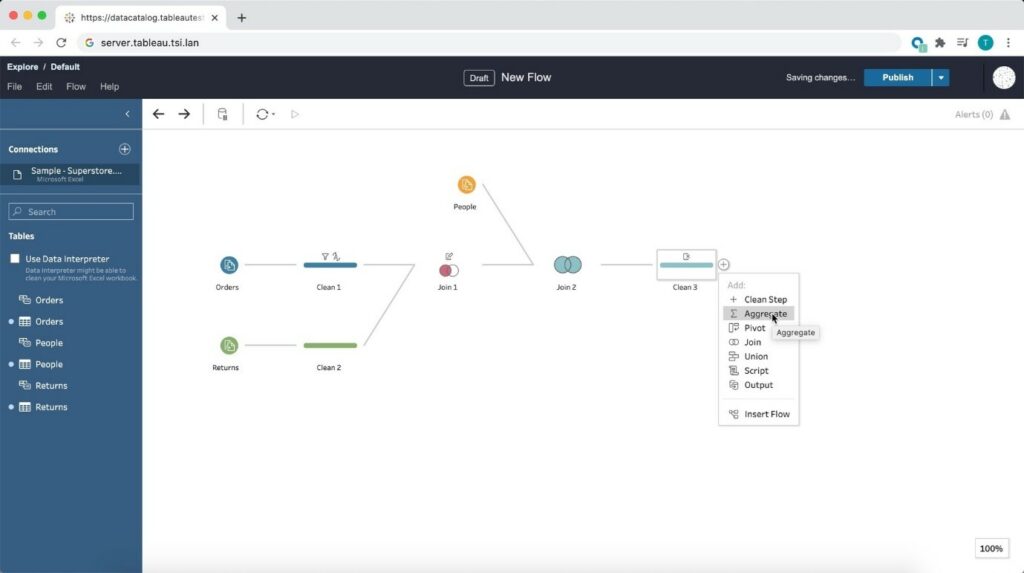
Prepare the data for visualizations from anywhere using a browser! Starting from 2020.4, Tableau is bringing the data prep process into one integrated platform on the web. Now I can easily prepare and manage prep flows from anywhere using a browser.
 Conclusion
Tableau is progressively evolving as a single platform for data preparations, visualization, and collaboration with every update and version release.
Author : Firdous Maqbool
Images Courtesy : Tableau
So, whenever I open the workbook or the extract is refreshed, Tableau displays the unique values within the range specified, giving more control over the parameter values displayed.
Multiple Marks Layer Support for Maps
This is an exceptional feature to bring multiple spatial layers and context together to better understand and analyze geospatial data and map views. I will be able to include multiple marks layers from a data source to map visualizations and enhance the geospatial analysis. I can present more context in a single map view and perform further analysis with this feature.
Block Comments in Calculations
Block comments is a simple yet one of the most useful features for me, which Tableau has announced in 2020.4. I often used to add comments in complex calculations for easy understanding in future references. Earlier, only single-line comments were possible, limiting the description I could add. But from now on, I can add comments of any length to calculation windows with block comments by simply starting the comment with /* and ending with */.
What makes it unique is that the new multi-line block comment feature is consistent with other popular programming languages. This feature is an example of Tableau’s on-going effort to provide its customers with an intuitive user experience.
Tableau Server
Web Authoring Enhancements
Starting from Tableau 2020.4, it is possible to author dashboards from the browser just like how we design it in Tableau Desktop. With this web authoring enhancements, I can include Highlight actions, Format Mark Labels, apply filters to worksheets, create fixed sets, and even create extract in my workbooks from the browser itself. I no longer have to make changes from Tableau Desktop and publish it to the server. I can directly do it from the browser itself.
Offline Map Support for Tableau Server
Rendering dashboards with maps is now faster compared to previous versions. Now, I can create maps using the offline map style in web authoring, ensuring the performance of map views in Tableau Server. Offline map support is a great deal for organizations with strict internet access restrictions, assuring that map view access to all its users.
Tableau Server Management (TSM) Improvements
Tableau Server Administration activities like installation, upgrade and backup are now easy like never before. I can retry installation or upgrade from the last checkpoint in case of an unexpected issue or error during installation or upgrade, saving my efforts to obliterate tableau server.
Backups can be performed twice as fast as previous versions, and I can monitor the progress with the new progress bar giving visibility into what step the backup is on and how much time is remaining.
Backups can also be scheduled using TSM command starting from 2020.4 and that is awesome. I no longer need to prepare batch script and depend on the windows task scheduler to schedule the backups on regular intervals; instead, I can schedule it with just a single command.
Multiple Key Activation on Tableau Server Prior to TSM Initialization
During Tableau Server installation, it is now possible to activate multiple license keys prior to TSM initialization. I will be able to save a lot of time by eliminating the need to restart after the installation is completed to activate multiple licenses and experience a smoother installation.
Analytics Extension for Tableau Online
The power of the Analytics extension is now unlocked in Tableau Online too. The feature was already available in Tableau Server, and it helped us dynamically perform advanced analysis with models and functions in R, Python and other platforms.
Analytics extension in Tableau Online significantly enhances the scope of using Advanced Analytics by the common users.
Merge Duplicate External Assets
Earlier, the Database or Table with similar names used to appear as multiple assets within Tableau Catalog. But, the new feature helps me to merge those multiple assets into a single one. I can manage assets easily and keep an organized view of External assets by merging the common ones.
Tableau Prep
Tableau Prep Builder in the Browser
Prepare the data for visualizations from anywhere using a browser! Starting from 2020.4, Tableau is bringing the data prep process into one integrated platform on the web. Now I can easily prepare and manage prep flows from anywhere using a browser.
Conclusion
Tableau is progressively evolving as a single platform for data preparations, visualization, and collaboration with every update and version release.
Author : Firdous Maqbool
Images Courtesy : Tableau