How AI Decision-Making is Improving Enterprise Outcomes
Blog
Share 
Beinex: A Great Place to Work for the Second Consecutive Time!
 7 March 2024
 Sumi S
At Beinex, we cultivate an exceptional atmosphere for work, learning, and professional growth. Our ethos revolves around a positive culture infused with passion, creating a self-sustaining cycle of success. This unique blend makes working at Beinex both meaningful and enjoyable. The atmosphere exudes a cool vibe, where supporting and respecting each other's individuality is ingrained in our cultural fabric.
Great Place to Work Survey Scores
Our recent Trust Index© results are in, revealing an impressive score of 83! This score reflects the percentage of employees who shared positive responses (rated 4 or 5 on a 5-point scale) to the 59 statements in the survey. It serves as a testament to the trust and positivity within our workplace, showcasing the strength of our team and organizational culture.
Notably, our Trust Index© Feedback on the Credibility of Management stands tall at 85, highlighting the high level of trust and confidence our employees have in the leadership team.
The active participation and honest feedback during the survey were instrumental in achieving these outstanding scores. It's inspiring to witness the alignment of our values and the positive impact it has on the overall trust within our organization.
Here's a brief overview of the key dimensions that contributed to our success:
Respect for People:
Fairness at the Workplace:
Pride:
Camaraderie Between People:
We would also like to express our gratitude to the Great Place to Work® Institute for their rigorous assessment, helping us understand and enhance our workplace culture.
Our Journey Onwards!
Moving forward, we will continue working together to maintain and build upon this foundation of trust. Your dedication, commitment, and contributions have been instrumental in cultivating a positive workplace environment, and we are grateful for each one of you.
Let's continue our journey of success and maintain Beinex as not just a workplace but a great place to work!
About the Great Place to Work Institute
The Great Place to Work® Institute stands as a prominent global management research and consulting firm committed to empowering organisations to achieve their business objectives through the establishment of superior workplaces. Collaborating with over 10,000 organisations worldwide annually, they specialize in assisting companies in creating and sustaining High-Trust, High-PerformanceTM cultures.
During the assessment process, the institute gauged the perceptions of Beinex's employees using the Great Place to Work® Trust Index© Employee Survey. Additionally, they delved into the distinctive culture of our organisation through the Culture Brief© and Culture Audit©, offering invaluable insights that contribute to the continuous enhancement of our workplace environment.
Yay! Beinex Consulting Pvt. Ltd has been certified as a Great Place to Work for the second time in a row! We are glad to acknowledge that it is the collective effort of the whole team that brought us this recognition. The effort Beinex has taken to create a vibrant and inclusive workplace has been rightly assessed.
A heartfelt congratulations to all Beinexians for contributing to this remarkable achievement! Trust, dedication, and commitment have played a role in making Beinex stand out from the rest.
Related Articles

Alteryx Data Preparation: A Key to Successful Data Analytics
Why is Data Preparation Important?
Imagine building a house on a foundation of sand. No matter how impressive the blueprints or construction materials, the structure will be unstable. The same principle applies to data analysis. Inaccurate or incomplete data leads to flawed insights and potentially disastrous business decisions.
Here's how meticulous data preparation benefits organizations:
The Data Preparation Journey: A Step-by-Step Guide
While the specific steps may vary depending on the project, a typical data preparation process involves:
- Acquiring Data: This involves identifying the necessary data, gathering it from various sources (databases, spreadsheets, etc.), and establishing secure, consistent access.
- Exploring Data: Understanding the data's structure and quality is crucial. Analysts use data profiling techniques and visual analytics to analyze data distribution, identify missing values, and uncover potential anomalies.
- Cleansing Data: This is where the magic happens – correcting errors, removing duplicates and outliers, and filling in missing data points to ensure data integrity.
- Transforming Data: Data may need formatting, restructuring, or aggregation to be suitable for the intended analysis. This could involve converting date formats, pivoting tables, or calculating new variables.
Data Preparation for the Age of Big Data and Machine Learning
The rise of Big Data and machine learning has further amplified the significance of data preparation. Machine learning algorithms rely heavily on vast amounts of clean, structured data to learn and make accurate predictions.
The Challenge: Extracting value from Big Data often involves integrating data from diverse sources, each with its own structure and quality issues. Traditional data preparation methods become time-consuming and inefficient when dealing with such massive datasets.
The Solution: Modern data preparation tools like Alteryx offer a solution.
The Power of Alteryx Data Preparation
The Alteryx Analytics Automation Platform streamlines the entire data preparation process, empowering a wide range of users – data analysts, data scientists, and even citizen data scientists – to transform raw data into actionable insights. Here's how Alteryx tackles the data preparation challenge:
Key Alteryx Features for Data Preparation:
Ready to Experience the Beinex -Alteryx Advantage?
Beinex’s premier partnership with Alteryx helps us enable business users to perform mundane tasks of manual data cleansing and transformation in just minutes by automating the process in a simple visual workflow that also covers advanced and predictive analytics. Thousands of organizations globally use Alteryx to deliver quick wins and high-impact business outcomes. Beinex's Alteryx consulting services amplify the transformative potential, providing tailored expertise to ensure maximum value extraction from Alteryx's powerful capabilities.

How to Automate and Improve Your Data Governance Processes for Better Results
What is Data Governance?
Data governance is the process of managing the availability, usability, integrity, and security of data in an enterprise system. It establishes policies, procedures, and standards for how data is collected, stored, used, and shared. It's about ensuring the right data is available to the right people at the right time, in a secure and compliant manner.Why Automate Data Governance?
Automating data governance processes brings several benefits, including: • Improved Data Quality: Automation can identify and correct data errors, inconsistencies, and duplicates, leading to improved data quality and more reliable insights. • Increased Efficiency: Automation streamlines data governance processes, reducing manual effort, freeing up valuable time, and accelerating decision-making. • Reduced Costs: Automation helps reduce the costs associated with manual data governance processes, minimizing errors and the need for rework. • Enhanced Compliance: Automation helps ensure compliance with data privacy regulations, such as GDPR, CCPA, and HIPAA, minimizing risk and potential penalties. • Better Decision-Making: By improving data quality and accessibility, automation enables better, more data-driven decision-making. • Scalability: Manual processes struggle to keep up with growing data volumes. Automation allows your governance framework to scale effectively.How to Automate Data Governance Processes?
Several approaches exist for automating data governance, and often a combination is most effective: • Data Discovery and Classification: Automated tools, like data catalogs, can help discover and classify data based on its content, sensitivity, and other criteria. This is the foundation for understanding your data landscape. • Data Quality Monitoring: Automated tools can continuously monitor data quality, identify potential issues, and trigger alerts for remediation. • Data Lineage Tracking: Automated tools can track the origin and movement of data, providing a clear audit trail and helping to ensure data quality and compliance. This is crucial for understanding how data is transformed and used. • Data Access Control: Automated tools can enforce data access policies, ensuring that only authorized users can access sensitive data, protecting privacy and security. • Data Masking and Anonymization: Automated tools can mask or anonymize sensitive data to protect privacy while still allowing for data analysis and testing. • Metadata Management: Automated tools can capture and manage metadata, providing context and meaning to data assets, making them easier to find and understand.The Role of Data Catalogs like Alation
Data catalogs play a critical role in automating data governance. They act as a central inventory of all data assets, providing a single source of truth about your data. Modern data catalogs like Alation offer: • Automated Data Discovery and Profiling: Automatically scan and profile data sources to identify and catalog data assets. • Data Lineage: Visually map the journey of data from its origin to its consumption, showing transformations and dependencies. • Data Quality Rules and Monitoring: Define and enforce data quality rules and automatically monitor data for compliance. • Collaboration and Knowledge Sharing: Enable data users to collaborate, share knowledge about data assets, and contribute to data governance efforts. • Search and Discovery: Empower users to easily find the data they need, along with relevant metadata and context.Best Practices for Automating Data Governance
• Develop a Data Governance Strategy: Before automating, define clear goals, objectives, and metrics for your data governance program. • Identify Key Stakeholders: Engage business users, IT, compliance, and other stakeholders to ensure alignment and buy-in. • Choose the Right Tools: Select tools that meet your specific needs and integrate with your existing data infrastructure. Consider a platform approach that can address multiple aspects of governance. • Implement a Phased Approach: Start with a pilot project to demonstrate value and refine your approach before scaling to the entire organization. • Focus on Data Literacy: Train your employees on data governance policies, procedures, and the use of automated tools. • Monitor and Evaluate: Continuously monitor the effectiveness of your automated data governance processes and make adjustments as needed.How to Embrace Better Data Governance?
Data governance doesn’t have to be a bottleneck. Organizations can reduce manual workloads, improve compliance, and drive innovation by adopting automation and leveraging tools like data catalogs. Ready to transform your data governance strategy? Get a Free Assessment Now!
An Ultimate Guide on Amazon Bedrock: How Businesses Can Turn Generative AI into Real Business Value
What is Amazon Bedrock?
Amazon Bedrock is a fully managed AWS service designed to help businesses quickly build and deploy generative AI applications. It offers access to a variety of high-performing foundation models from leading AI companies, including AI21 Labs, Anthropic, Cohere, and Stability AI, through a single, unified API.
What makes Bedrock especially appealing to enterprises and fast-growing businesses is that it takes the heavy lifting off their shoulders. There’s no need to manage model training infrastructure, scale servers, or worry about data exposure. You can just focus on building applications; AWS handles the rest.
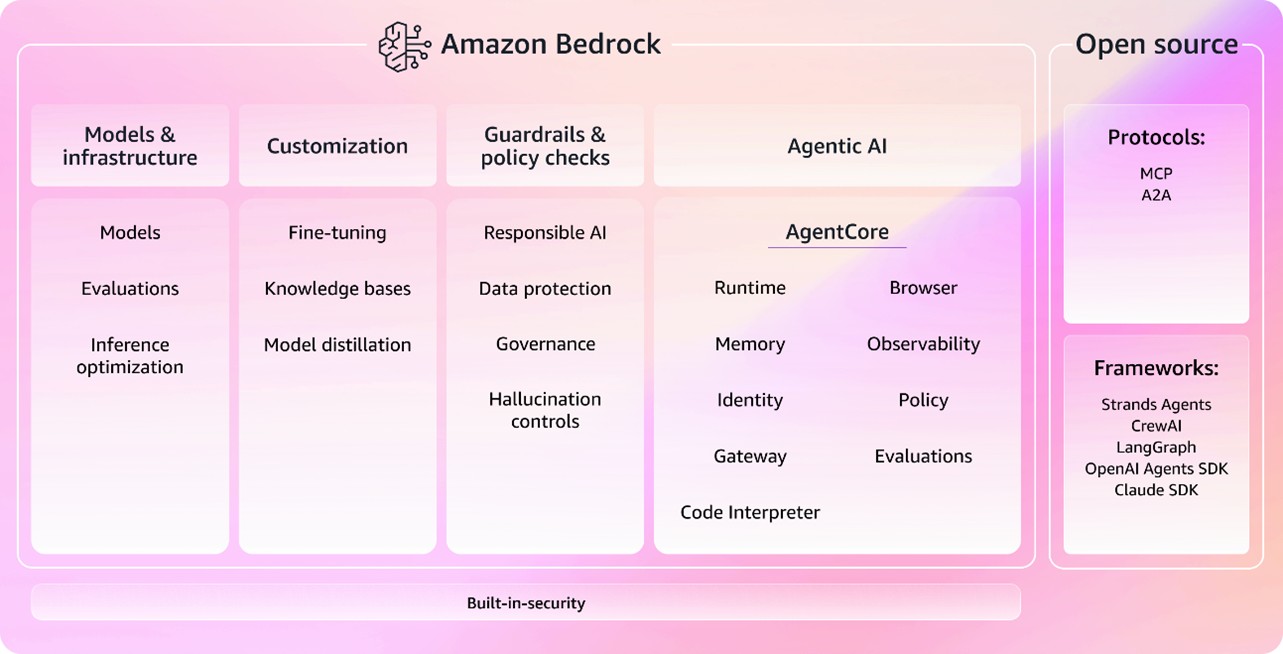 Source: AWS
Key Features of Amazon Bedrock
Let’s break down the key features powering AWS Bedrock:1. Access to Foundation Models
Amazon Bedrock offers ready-to-use models that are pre-trained, reliable, and production-ready, and are capable of tasks like:
- • Conversational AI and chatbots
- • Image generation
- • Text generation and summarization
- • Content classification and analysis
2. Secure Model Customization
Businesses can customize foundation models using their own proprietary data—without that data ever leaving their AWS environment. This is especially critical for industries, such as finance, healthcare, and government, where data governance and compliance matter.
3. Serverless Infrastructure
As Bedrock is completely serverless, there is no need to provision, manage, or scale infrastructure. Applications can also start small and scale instantly with demand, thereby making them ideal for both startups and large enterprises.
4. Single API Integration
Bedrock integrates seamlessly with existing AWS services and enterprise systems via a single API. This feature simplifies development and speeds up time-to-market.
5. Model Playground
AWS provides a Bedrock Playground, a visual interface where users can experiment with text, image, and chat models before deploying them into applications, making it helpful for teams evaluating use cases or testing outputs.
Top Benefits of Choosing Amazon Bedrock for Your Business
Amazon Bedrock stands out because it makes generative AI practical, not just impressive. Here are the top benefits organizations gain by adopting Amazon Bedrock:
Access AI Faster
Teams can start building generative AI applications without deep machine learning expertise, as it removes technical barriers.
Increased Efficiency
Businesses can prototype and deploy solutions faster, thereby accelerating innovation cycles instead of spending months building models from scratch.
Affordable AI Implementation
The cost of building AI capabilities can be significantly reduced by using pre-trained models, especially when compared to developing custom models.
Built for Scale
Bedrock supports enterprise-scale workloads while maintaining performance and reliability powered by AWS infrastructure.
Flexible Across Use Cases
From customer engagement to analytics and creative design, Bedrock supports a wide range of business needs on a single platform.
Real-World Use Cases for Amazon Bedrock
As you are now familiar with Amazon Bedrock, let’s understand how your business is going to benefit through some real-life use cases of Bedrock:
1. Customer Service Automation
Businesses can build AI-powered chatbots to handle order tracking, FAQs, and troubleshooting. It reduces response time, improves customer experience, and allows support teams to focus on complex issues.
2. Marketing and Content Creation
Marketing teams can generate blog drafts, social media copy, email campaigns, and product descriptions more quickly, freeing up time for strategy and creativity.
3. Product and Experience Personalization
Bedrock-powered applications can deliver personalized product recommendations and content, increasing engagement and conversion rates by analyzing customer behavior.
4. Analytics and Business Insights
Amazon Bedrock can summarize complex datasets, generate executive summaries, and highlight trends, making data easier to interpret for leadership teams.
5. Design and Creative Workflows
Design teams can use generative AI for image creation, branding concepts, and campaign visuals, speeding up ideation and iteration without replacing creative control.
Summing Up
If you are looking to move beyond experimentation and into real-world AI impact, Amazon Bedrock offers a practical, future-ready foundation. It can support you by providing:
- • Enterprise-grade security and compliance
- • Rapid deployment for competitive markets
- • Scalable solutions without operational complexity
For a free demo, connect with us: https://beinex.com/beinex-amazon-web-services/

Google Cloud Platform: The Future of Business Transformation
Google Cloud Platform is a Google-delivered complete set of cloud computing services. The services extend to networking, storage, application development, computing, Big Data and even more, which operate on the same cloud infrastructure used internally by Google for Gmail, YouTube, and others. What makes GCP a reliable and secure cloud infrastructure to build, test and run applications is the fact that its server has not gone down in years. IT professionals, software developers and cloud administrators can access GCP services online.
Why choose the Google Cloud Platform?
In 2022, Gartner Magic Quadrant Cloud Infrastructure and Platform services named Google as a leader for the fifth time in a row. Google Cloud Platform's global network of data centres spans multiple continents, ensuring low-latency access and redundancy for your applications and data. Therefore, GCP can be the perfect choice for organisations looking for a globally renowned cloud platform known for its wide array of services and offerings. GCP's extensive catalogue of services with unique features can be attributed to the global expansion and recognition of the platform. Some of GCP's significant services include Computing, Storage, Networking, Big Data, Cloud AI, Security and Identity Management, Management Tools, and IoT.
Besides, the following aspects also add to the reasons why GCP is a viable cloud provider for businesses:
- Provides multi-level security to safeguard resources like assets and operating systems
- Has a network infrastructure comprising physical, logistical, and human-resource-related elements, like wiring, routers, switches, and firewalls
- Has proficient experts who provide support on installation and maintenance
Key Benefits of Google Cloud Platform
GCP enables customers to access computer resources located in Google's global data centres at no cost or on a pay-per-use for the services and resources used. GCP hosting plans are cost-effective compared to other platforms and offer superior features.
With features like data encryption, multi-factor authentication, and identity and access management, GCP prioritises the security of client data and applications.
Google's web-based applications provide users with complete accessibility to GCP from virtually anywhere.
GCP delivers enterprise-grade solution architectures and tech strategies to provide scalability and expedite digital transformation.
Google boasts its proprietary network infrastructure, granting users greater control over the functions of GCP. As a result, users experience seamless performance and heightened efficiency across the network.
GCP offers tools for automation, compliance and governance and a secure cloud environment to navigate challenges in cloud operations.
GCP enables organisations to harness the power of AI to automate processes, gain data-driven insights and employ machine learning for innovation.
With services like Bigtable and Cloud Storage, GCP benefits organisations in managing extensive data and facilitating real-time data processing and analysis.
Real-World Business Challenges & GCP Solutions
GCP’s suite of solutions assists organisations in tackling challenges in the dynamic business landscape effectively. Some common challenges in business and their respective GCP solutions are briefed below.
GCP equips your business with analytics tools and robust data storage to manage extensive data effectively and derive valuable insights.
With development and deployment tools like Cloud Functions and Google App Engine, GCP enables organisations to expedite development and gain a competitive edge.
GCP’s extensive global network infrastructure aids businesses by ensuring the applications reach across the world seamlessly.
With its suite of security tools for threat detection, data encryption and access and identity management, GCP safeguards data and applications with multi-level security.
In the event of unanticipated disruptions that halt business operations, GCP ensures business continuity with its backup options and disaster recovery solutions, making critical applications and data accessible.
X (formerly Twitter), eBay, PayPal, and 20th Century Fox are some of the top users who have leveraged the transformative potential of Google Cloud Platform. Being a globally recognised brand for its speed, performance, security, reliability and innovation, the Google Cloud Platform is a beacon of digital transformation for businesses navigating the challenges of the data-driven digital era. As companies venture on their journey with GCP, the prospects are endless. This partnership empowers businesses with the tools, resources, and support needed to thrive in a dynamic landscape. Whether achieving operational efficiency, reducing costs, or delivering superior customer experiences, GCP catalyses change.
What can Beinex do for you?
Beinex is now a service partner of GCP and is helping businesses advance their digital transformation endeavours by leveraging GCP’s AI capabilities, cloud infrastructure, and data analytics. Beinex offers clients expert guidance in deploying proactive solutions and using Google Cloud to make more informed data-driven decisions. This approach enables them to overcome business challenges and fosters competitiveness, efficiency, and growth. At Beinex, we deploy Google Cloud Platform as a service and the infrastructure as a service, enabling organisations to streamline access to a broader array of services and resources, resulting in cost efficiency and improved quality.

Top Cybersecurity Trends 2025: The Key Shifts Every Business Must Know
Top Cybersecurity Trends
The cybersecurity measures are uncompromising, and leaders should be informed about the changing trends and update frequently. Here are some important cybersecurity trends that are going to help you:
1. The Rise of Cybersecurity Threats in the Automotive Industry
Sophisticated software in modern cars provides smooth communication and cutting-edge functions, including driver assistance systems, engine timing, and cruise control. However, cars are also vulnerable to potential hacking threats due to their reliance on automation and the internet. Strict cybersecurity safeguards are required, especially for self-driving or autonomous vehicles, as these dangers are predicted to increase with the growing use of automated vehicles.
2. Blockchain
Although blockchain technology is most commonly associated with cryptocurrency, it could also revolutionize cybersecurity. Blockchain can offer safe storage for private data by establishing a decentralized database. It is far more difficult for hackers to obtain illegal access because there is no central authority in charge of the data.
3. Quantum Computing
This technology processes data by utilizing the principles of quantum mechanics. Compared to conventional computers, it may potentially tackle complicated problems far more quickly. Despite its early stages, this technology has the potential to completely transform cybersecurity by enabling more secure encryption.
4. Leveraging Artificial Intelligence's Potential in Cybersecurity
Artificial intelligence (AI) has emerged as a vital element for enhancing cybersecurity in various industries. AI has enabled the creation of automated security systems that can perform tasks such as danger identification, facial detection, and natural language processing through machine learning algorithms. Fraudsters, however, also utilize this same technology to create sophisticated attacks designed to circumvent security measures. Despite these difficulties, threat detection systems powered by AI can react quickly to new threats, which is crucial assistance for cybersecurity experts.
5. Mobile Devices: A Common Cyberattack Target
Due to their widespread use, mobile devices have become easy targets for cybercriminals, as proved by the sharp rise in malware and attacks that target personal information and mobile banking services. The risks associated with such breaches are increased by the widespread use of smartphones for various purposes, including communication and financial transactions. With predicted trends indicating an increase in malware and viruses specific to smartphones, mobile security has become a key concern for cybersecurity experts.
6. Improving Cloud Security Protocols
As more businesses adopt cloud services, it is crucial to have robust security measures in place for both data operations and storage. Even with strong security measures in place, cloud providers can still face vulnerabilities due to phishing scams, malicious software, and user error.
Organizations must have robust security measures in place to protect against data breaches and cyber threats. Effective cloud security methods must include encryption, authentication, and regular patching to ensure the confidentiality and integrity of cloud-based data and applications.
7. Data Breach: A Recurring Issue
Even minor software errors can lead to significant risks, which is why data breaches remain a major concern for individuals and organizations worldwide. Regulations such as the CCPA and GDPR emphasize the importance of robust security measures in enhancing data protection and privacy rights. To mitigate the risks of data breaches, it is crucial to ensure compliance with regulations and implement proactive security measures.
8. IoT Safety
The spread of 5G networks has ushered in a new era of connectivity, particularly with the Internet of Things (IoT). IoT devices are vulnerable to external threats and software defects, despite providing previously unheard-of communication capabilities. 5G design is still in its infancy, so identifying and addressing any security flaws will require extensive research. The creation of reliable hardware and software solutions must be a top priority for manufacturers to mitigate the risk of network attacks and data breaches.
9. Using Automation to Improve Cybersecurity
To handle the constantly growing amount of data and simplify security procedures, automation is essential. Security professionals can respond quickly and effectively to new threats due to automation, which provides invaluable assistance in the face of high workloads. For large and complex applications, incorporating security measures into agile development methods ensures the production of more secure software solutions.
10. Targeted Attacks Using Ransomware
Industries that rely on specific software systems are at significant risk from targeted ransomware attacks, which can have devastating consequences. Strong cybersecurity measures are crucial, as pointed out by many recent events. To successfully mitigate risks, organizations must be vigilant for ransomware threats and implement preventive measures.
11. Increasing Cyberwarfare
Cyberwarfare and cyberattacks are increasingly targeting sensitive data and vital infrastructure. Elections and other high-profile events are susceptible to cyberattacks. Thus, extra security is required. A spike in data breaches and the exploitation of political and industrial secrets can be anticipated.
12. Mitigating Insider Threats Through Awareness
Mistakes made by individuals continue to play a significant role in data breaches, particularly in cases involving insider threats within organizations. To address this risk, it's vital to enhance awareness and provide thorough training programs for employees. By empowering staff to recognize and address potential vulnerabilities, companies can foster a strong culture of cybersecurity awareness. This approach is crucial for safeguarding sensitive data and minimizing the impact of insider threats effectively.
13. Resolving Issues with Cybersecurity in Remote Work Settings
As employees transition to remote work, they navigate less secure network configurations, creating new cybersecurity challenges. Companies must prioritize implementing robust security measures, such as multi-factor authentication and secure virtual private networks, to effectively protect remote workers from online attacks.
14. Countering Attacks via Social Engineering
Social engineering assaults, such as phishing and identity theft, continue to pose a serious threat to enterprises by taking advantage of human weaknesses to get private data illegally. Proactive security measures and personnel training are crucial in mitigating the risks associated with social engineering attacks.
15. Using Multi-Factor Authentication (MFA) to Increase Security
By requiring users to submit multiple authentication forms before gaining access to accounts or systems, MFA adds an extra layer of security. This proactive strategy strengthens the entire cybersecurity posture and reduces the likelihood of unauthorized access. Adopting multi-factor authentication (MFA) must be a top priority for organizations to properly defend against cyber threats.
16. Preventing International Attacks
Because they target sensitive data and vital infrastructure, sophisticated state-sponsored attackers pose a serious threat to enterprises. Multi-factor authentication and real-time monitoring are two proactive security techniques that are crucial for preventing these sophisticated attacks.
17. Improving Management of Identity and Access
Organizations can monitor and regulate access to networks and sensitive data by utilizing identity and access management (IAM) policies. To protect against unauthorized access and data breaches, robust authentication, authorization, and access control procedures must be implemented.
18. Monitoring Data in Real Time to Identify Threats Early
By enabling enterprises to identify and react quickly to suspicious activities, real-time data monitoring lowers the risk of cyberattacks and data breaches. To detect such risks and mitigate their effects, automated alerts and log monitoring are crucial.
19. Securing Connected Vehicles Against Cyber Threats
The increasing connectivity of vehicles exposes them to cyber threats, necessitating robust security measures to protect against potential attacks. Encryption, authentication, and real-time monitoring are essential to safeguarding connected vehicles against automotive hacking.
20. Ensuring IoT Device Security
Ensuring robust security measures becomes increasingly crucial as the number of Internet of Things (IoT) devices continues to grow. To guard against potential vulnerabilities, organizations must prioritize the security of their IoT devices and implement regular updates and safeguards.
Summing Up
The future of cybersecurity will see advancements in trends focused on enhancing digital fortifications. AI-driven threat detection, zero-trust platforms, and other automated security measures have immense potential in helping mitigate emerging threats.
With remote working environments on the rise, the focus is likely to shift towards securing endpoints while also increasing data encryption measures. Moreover, continuous monitoring, holistic user training, and proactive threat intelligence will become integral in maintaining robust cloud security.
In short, a collective effort involving industry collaboration, the latest solutions, and adaptive strategies will become increasingly important in ensuring a resilient and well-protected cloud security system.