How AI Decision-Making is Improving Enterprise Outcomes
Blog
Share 
What’s New in Tableau 2025.1: AI-Powered Insights, Multilingual Support, Private Connectivity, and More
 3 July 2025
  Sumi S
 Tableau 2025.1 at a Glance
- • Converse with Tableau Agent in six new languages using conversational AI.
- • Connect Tableau Cloud to AWS data securely with Private Connect.
- • Track KPIs on the go with a redesigned Pulse mobile homepage.
- • Programmatically access published data sources using VizQL Data Service.
- • Explore new features early with Tableau Cloud preview websites.
Let’s dive into the new updates in Tableau 2025.1:
1. Tableau Agent Multilingual Support
Perform multilingual data analysis. It is now possible for users to converse with Tableau Agent (and Tableau Pulse!) in French, Italian, German, Spanish, Japanese, and Portuguese. More people can now access conversational analytics in their native language.
With conversational AI, the Tableau Agent helps users navigate from data curation to exploration and accelerates all phases of analysis with generative AI. Additionally, because it is based on the Einstein Trust Layer, businesses can be assured that their data will remain safe, secure, and accessible only as intended.
2. Private Connect for Tableau Cloud
Use a dedicated, private connection to safely link Tableau Cloud to AWS data. Private Connect establishes a secure connection between Tableau Cloud and AWS data, ensuring your data remains private and is not made publicly available.
3. Revamped Tableau Pulse Homepage on Mobile
The redesigned Tableau Pulse mobile homepage enhances users' ability to engage with data on the go. With a side-by-side view of at least three key metrics, it allows for instant comparison and faster insight generation.
The clean, intuitive interface enables users to easily spot patterns, track trends over time, and take action quickly, without needing to dig through dashboards. Whether you're monitoring sales, operations, or customer engagement, Pulse ensures your most important KPIs are always within reach.
4. API for VizQL Data Services
VizQL Data Service is an innovative API that allows you to access published data sources in Tableau through programmatic queries rather than visualizations. Designed to maximize the versatility of your Tableau assets beyond traditional visualization, VizQL Data Service helps you tap into the analytic power of your data model anywhere.
It facilitates automating data processes by allowing you to run programmed queries directly on your data sources. By utilizing pre-existing Tableau connectivity and data models, you may more effectively design sophisticated, data-driven apps. You can now utilize your data models in any context, breaking free from the confines of visual tools.
5. Tableau Cloud Preview Websites
Tableau administrators can stay ahead of the curve by gaining early access to upcoming updates through release preview sites. This allows teams to test new features in advance, understand functional changes in a hands-on environment, and evaluate how updates will affect their organization’s unique dashboards and workflows—ensuring a smooth transition when the full release goes live.
In a Nutshell
The Tableau 2025.1 release brings a bunch of exciting updates to make working with data easier, smarter, and more secure. Now you can chat with Tableau Agent in multiple languages, get help with data prep and analysis using natural language, and connect securely to your AWS data using Private Connect. The refreshed Pulse homepage on mobile lets you track and compare key metrics at a glance, helping you make faster decisions wherever you are. Plus, with the new VizQL Data Service, developers can now access and use data directly, without relying on traditional dashboards. And if you're a Tableau admin, you get early access to test new features before they go live, so your team is always ready for what’s next.
Source: https://www.tableau.com/en-gb/2025-1-features
The Tableau 2025.1 release is packed with powerful updates designed to make data analysis faster, smarter, and more accessible than ever. From enabling multilingual conversations with Tableau Agent to offering secure, private connections to AWS data via Private Connect, this release redefines how users interact with data.
Related Articles

The Reign of Recommender Engines and Smart Avatars in E-commerce: Leveraging the Benefits
Recommender Engines
Recommender Engines provide suggestions of products based on the interests or requirements of the customers by leveraging AI and Machine Learning technologies. It operates by discovering patterns in data on customer behaviour, which may be gathered directly or indirectly. To put it another way, the AI recommendation engine delivers a collection of recommendations suited to the user's needs, demands, behaviours, and preferences.
Recommender engines are employed to increase sales, boost customer engagement and retention, and provide customised user experiences. According to McKinsey, these approaches can boost a company's sales by 20% and profitability by 30%.
Types of Product Recommendation Engines
The companies should select models that best match their personalisation plans to offer product recommendations to website users. You can choose from the three models given below:
1. Collaborative filtering
The goal of collaborative filtering is to forecast what a person will like based on their similarity to other users by gathering and analysing data on consumer behaviours, interests, and inclinations.
Collaborative filtering uses a matrix-style method to calculate and depict these similarities. It has the benefit of not requiring content analysis or comprehension. It simply chooses which goods to recommend based on what it knows about the consumer.
E-commerce sites reap benefits out of collaborative filtering. For instance, if two users have purchased the same products and have similar interests, the system discovers the similarities and gives shopping suggestions based on them. Later, if either of the same users log in for shopping, it offers tips based on the other person’s interests, as the model knows that both have similar interests. To generate correct recommendations for new users, the engine needs enough customer and traffic data, which is the fundamental component of this strategy.
2. Content filtering
The principle behind content-based filtering is that if you choose one product, you'll probably select the other one as well. To provide suggestions, algorithms compare objects based on a customer preference profile and a description of the item. A series of recommendations are given to the customer based on his preferences and the history of his earlier purchases.
For instance, content-based filtering on YouTube suggests videos to users by gathering data on the related content users have already viewed or searched. It collects data on the content that a specific user has watched, and it then begins to suggest additional content with a related theme based on comparable descriptions.
3. Hybrid Filtering
A hybrid filtering tool examines both content-based and collaborative data using vector equations. It analyses the historical activity data and preferences of the user for whom the recommendations are displayed. In this way, this approach combines the most compelling features of the first two to produce a single, well-rounded answer.
Let’s take the example of Netflix; it considers both the user's interests (collaborative) and the plot, genre or cast of the film or television series (content-based). Then, based on the users' actions, pursuits, and preferences, a collaborative filtering matrix can be utilised to suggest movies or series to them.
3. Hybrid Filtering
A hybrid filtering tool examines both content-based and collaborative data using vector equations. It analyses the historical activity data and preferences of the user for whom the recommendations are displayed. In this way, this approach combines the most compelling features of the first two to produce a single, well-rounded answer.
Let’s take the example of Netflix; it considers both the user's interests (collaborative) and the plot, genre or cast of the film or television series (content-based). Then, based on the users' actions, pursuits, and preferences, a collaborative filtering matrix can be utilised to suggest movies or series to them.
Benefits of Recommender Engines
Product recommendation engines offer your company numerous advantages. Over time, its benefits will offset the expense of putting it into practice. This is how:
1. Customer retention
It is worth emphasising that product recommendation systems are one of the most efficient and widely recognised applications of machine learning in business. When properly configured and implemented, they will boost sales and increase click-through rate as well as customer engagement and other KPIs in every online store. It results from the fact that customising product recommendations and content to the preferences of a specific user has a positive impact on the user's experience with a given website.
2. Increase in sales
When the recommendation system is correctly configured and deployed, product recommendations may lead to an increase in revenues in the online store. Personalising offers increases the likelihood that users will browse the page and stay on it longer. Targeted visitors to the website receive emails or advertisements for suitable products increases the efficacy of marketing campaigns. It reduces the rate of returns and cart abandonments. Finally, the Average Order Value (AOV) and the number of items in carts are both significantly increased by recommendation engines.
3. Customer behaviour detection
The ability to provide a wide range of relevant facts and metrics regarding user behaviour and website traffic is another benefit of personalised recommendation systems. Online store owners who have incorporated recommendation systems have a better grasp of customer behaviour and may adjust the product selection to suit their demands. Customers do not need to spend time browsing through all of the products on the website because those that they could find interesting will be displayed in the recommendation box with suggested products.
Smart Avatars as Advanced Recommender Engines
Currently, recommender engines have a standard text-based user interface as their front end. The arrival of the 3D web and the metaverse, however, will cause that front end to become more avatar-focused over the next years. So, in the near future, you will be greeted by a smart avatar on a shopping website, who will not only have some knowledge of who you are and what you might desire, but it will also engage in dialogue with you to learn more about your wants and assist you in finding the solution. Isn’t that cool? The avatar will ensure that you got a great shopping experience and instantly address any complaints that cross your mind. We are gonna love it, aren’t we?
Summing Up
By presenting products that customers would probably not have otherwise seen, a recommendation system will enhance the shopping experience. The efficiency of recommendation engines as a marketing tool can increase sales, click-through rates, engagements, and consumer happiness. No matter what technology you use, the installation procedure is quick and straightforward and doesn't require any programming experience.
Beinex Offerings
Beinex enables organisations to analyse data, mitigate risks, identify opportunities, make better decisions, and automate processes to drive business excellence powered by innovation and experience. Our AI solutions make your business future-ready and include services like risk sensing and cognitive risk anticipation using Machine Learning (ML), Artificial Intelligence (AI) to assess risk in real-time. Just give it a try, and reach out to us at: https://www.beinex.com/ai-ml-rpa/

IMAGE IN BAR CHART – NEW LEVELS OF TABLEAU VISUALIZATION!
The following blog depicts the technique created by Alex Jones (@jusdespommes) blog about “How to… create a chart from an image in Tableau!”.
Show/Hide Containers
Tableau 2019.2 has introduced an option to show/hide containers (when the container is a floating type). Many experts have come up with different use cases such as hiding and showing the filters, parameters, or even a worksheet with a click which occupies much space in the dashboard using this feature.
This feature is pretty simple to use and comes in handy when we want to save some space in our dashboards.
How to Swap image in Bar Chart?
1.Create a simple bar chart in Tableau 2019.2. We have used “Top 5 Grossing Games Worldwide 2018” to create a bar chart and sorted based on the revenue.
2.Remove the label, header and export the worksheet to image. Worksheet > Export > Image (Choose ‘view’ in Export Image dialog box)
3. Open Photopea, which is an online photo editor and open the saved worksheet image.
File > Open > Image
4. Now, download 2 images from online which we are going to use for bar chart.
5.Copy and paste image 1 on top of the bar image. Now we will be having two layers of images one above another.
(We can even re-position, crop the image if needed)
6.Choose ‘Magic Wand’ from the tool bar at left side. Click on the image, and we can see the selection in dotted lines.
7.Choose the top layer (image 1) and click delete. Now we can able to get the below image.
8.The background of the image needs to transparent. So, delete the below layer (bar chart image) using delete icon at the bottom right corner.
9.Now, choose File > Export as > .PNG to save the image as .png format (this will retain the transparent layer)
10.Repeat the same steps with image 2 to get the same effect.
Note: Keep the same resolution and image size as the previous one.
10.1.Now, open Tableau Desktop and bring in the image as floating type.
11.We have to position the bar chart over the image. To make it easy, decrease the opacity of the bar chart and give border.
12. Add labels and tooltip to the bar chart.
13.Now the dashboard looks like this. We can able to hover on bars to see tooltip.
14.Now, comes the trick of using ‘Show/Hide Containers’ to swap image. Bring a container to floating and add image 2 to the container. (Set the padding to zero)
15.Next, we have to position the both images and the bar chart one above another. To make it easy, use x, y axes and size w, h to position accurately.
Note: Make sure the position of the 3 objects (Use Floating Order) follows the below order as all are in floating.
- Image 1 (Below layer)
- Image 2 inside container (Middle layer – where show/hide option is to be used)
- Bar Chart (Top layer)
16.Choose the container and right click at the top right corner. Enable ‘Add Show/ Hide Button.’ Now we can see a floating button.
17.We can customize the button by adding image and tooltip to buttons.
18.We have used below customized images (created with PowerPoint) for buttons to swap between 2 images.
19.Another simple trick is that we can control the transparency of the image by adjusting the opacity of the bars.
20.Take a look at the final dashboard….

Snowflake Summit: Glimpses of Groundbreaking Data Cloud Developments
Snowflake summit 'The World of Data Collaboration' was held in Las Vegas, Nevada, June 13-16, 2022. It featured the first look at innovations coming to the Data Cloud. Over 200 lectures, practical labs, certification possibilities, and more than 200 Basecamp partners were included in the four-day data Snowflake Summit. Thousands of Snowflake's partners, clients, and industry colleagues were there to network, cooperate, and learn crucial information about Snowflake and new Data Cloud trends.
Here are the four most exciting of Snowflake's latest offerings:
1.Innovative data capabilities that save time and resources
The release of Snowpark for Python, which is currently in public preview, was one of the statements that received the most attention at the summit. Both streaming ingestions using the new Snowpipe Streaming and streaming pipelines with the launch of Materialised Tables generated a lot of interest. These new features demonstrate Snowflake's product philosophy, which strongly emphasises simplicity for partners and customers while delivering value. The declarative model is excellent since it only requires describing the change; Snowflake will handle the rest. They anticipate less data lag, more real-time features, and quicker decision-making.
A new workload, Unistore, that enables users to work seamlessly with transactional and analytical data together in a single platform stirred curiosity in the audience. Unistore can save time and effort in moving data from operational systems and help with low-latency machine learning (ML) inference scenarios. It provides snappy user interfaces, allowing teams to create real-time analytical queries on their transactional data and build transactional business applications directly on Snowflake and offers a unified approach to security and governance.
2.Creating, monetising, and using apps on the Data Cloud
The most intriguing news is the potential of the Snowflake Native Application Framework, which is now in private preview. Anyone may now create applications using the well-known Snowflake core functionality, share and earn money from them through Snowflake Marketplace, and deploy them directly inside a customer's Snowflake account. Customers may keep their data centralised and greatly simplify application acquisition and maintenance. In contrast, application suppliers will have quick visibility to thousands of Snowflake customers globally across the three major clouds. It was a piece of ground-breaking information for all parties.
Bidirectional and multi-source native apps developed by Informatica allow users to combine data from various cloud and enterprise platforms, including IBM, Microsoft, Salesforce, and SAP. So, Snowflake partners and customers can concentrate more on what to build and less on how to build it; Snowflake wants to make the building process more straightforward. Snowflake may not be able to foresee the entire extent of value creation and innovation that would result from this.
3.More options and cloud compatibility
As a customer-focused business, Snowflake constantly strive to strike a balance between giving our consumers options, streamlining processes, and lowering complexity. Providing a consistent user experience and simple governance for data housed in any of the three significant clouds is a crucial objective (AWS, Azure, and Google Cloud). With the help of the Snowflake platform, businesses may create their applications once and deploy them across several major cloud vendors' regions. Companies can migrate data—and now applications—easily between regions or clouds thanks to Snowflake's cross-cloud capabilities. You can use transactional consistency for failover and failback. For both customers and partners, Snowflake is offering a way to make the construction of cross-regional and cross-cloud experiences simpler.
Snowflake's ability to develop an app once and have it function flawlessly across various clouds and locations is a game changer. By enabling the Data Cloud to process data from S3-compatible storage systems, such as on-premises storage providers, Snowflake has also improved choice (currently in development). It also supports interoperability and open file formats as agents of choice. To that aim, Snowflake unveiled the presently under story Apache Iceberg Tables, which will let users select Iceberg as the persistence table type and Parquet as the file format, table by table.
4.Rich data experiences without sacrificing readability for data governance or security
Clients of Snowflake value the data governance and security provided by Snowflake as well as the release of numerous new features and enhancements are appreciated. For instance, with the assistance of Snowflake's new workload Cybersecurity, cybersecurity teams can easily break down data silos, resulting in improved visibility into security incidents, risks, and threats. In short, clients want to create reliable data products and openly share data without relinquishing control of or re-siloing their data. Snowflake accelerates the economic value cycle for partners, clients, and, quite honestly, by doing away with the trade-off.
Snowflake has planned to offer more services connected with data sharing, collaboration with clean data rooms, and Native Applications Framework.
Beinex's partnership with Snowflake
Beinex's partnership with Snowflake enables it to offer clients advanced features like automated tuning and elastic compute with unlimited decoupled computing capability, along with the analytics modernisation services, to help organisations realise exponential Return on Investment. We keep innovating for all our clients and to support businesses around the world to create more possibilities and quality services.

No-Code, Low-Cost Data Automation with Alteryx Designer Cloud
User-friendly Experience
The user-friendly interface enables cross-functional collaboration and creates analytical solutions that improve productivity and efficiency. The award-winning drag-and-drop capabilities of the designer cloud speed up the analytic process with AI/ML-based suggestions that guide users through their data transformations.Smart Processing
Alteryx Cloud Designer empowers users to perform responsive data transformations that can be scaled to any size. With smart data samples, you can access the entire dataset and utilize pushdown processing effectively.Enterprise-grade Platform
A flexible and scalable enterprise-grade platform can help teams as it integrates effortlessly into the existing data and analytics architecture with best-in-class security and governance.Built-in Connectors
Easily connect and transform your data from various sources with built-in connectivity to over 60 sources. This feature is designed for enterprise-grade governance, scalability, and security.All-access Reporting
The new Reporting feature for Designer Cloud offers a drag-and-drop report preview canvas, allowing you to configure report elements and build reports more quickly in the cloud.A Unified Platform
An end-to-end unified analytics platform can be fundamental in building an analytics culture, allowing every user to convert data into business insights with the help of cloud-native data engineering, analytics, and data science.Accessibility
Alteryx cloud designers can easily access and analyze data even by non-technical users without depending on IT or analytics, democratizing data across your organization.Real-time Update
You can make changes to your data in real time using the new Interactive Results Grid, which lets you see and make as you build your workflows and the quality of any dataset using a quality bar and visual data profiling.Private Data Handling
Alteryx Cloud provides customers greater flexibility in the management and storage of their data. The new split-plane solution enables private storage and processing options.Cloud Data Preparation for the Modern Enterprise
Alteryx Designer Cloud allows organizations to streamline their data operations and gain insights more rapidly. Reduce data preparation timelines from hours to minutes while ensuring data quality, accuracy, and governance.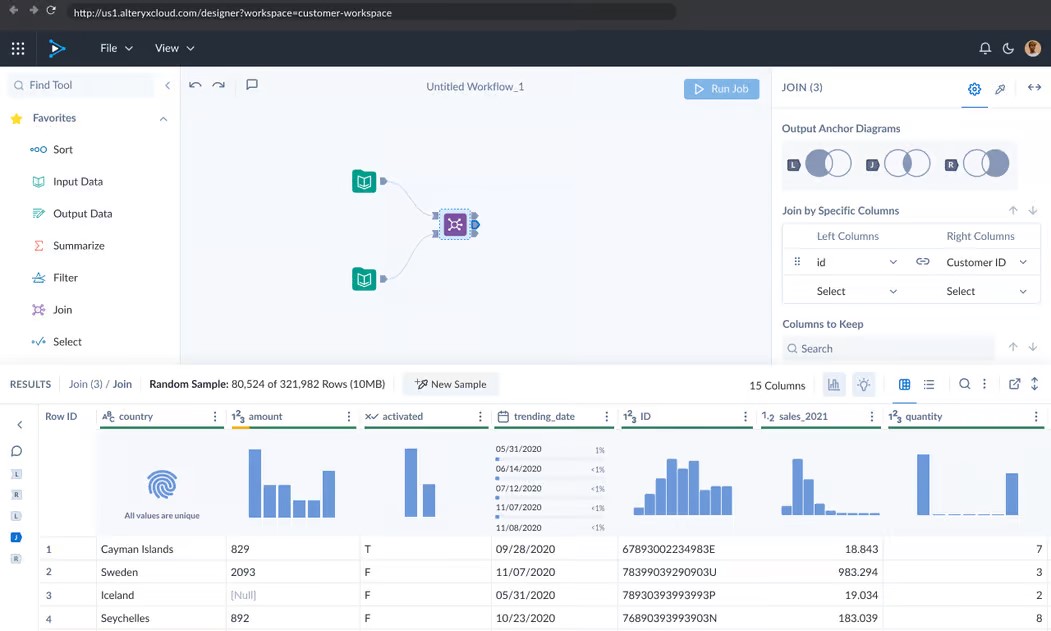
Cleanse, Prepare, and Blend Data Effortlessly
Make data preparation simple for everyone. Designer Cloud enables users to quickly cleanse, profile, prepare, blend, and analyze data without coding knowledge. With user-friendly drag-and-drop tools, individuals can efficiently execute data transformations. To enhance the efficiency of data preparation, AI and machine learning-based suggestions guide users throughout the process. Empower everyone in your organization to make data-driven decisions and achieve insights up to 90% faster.Collaborate in Real Time with Interactive Data Samples
Leverage the collective intelligence of your teams with collaborative workflows that can be easily shared across your organization. Teams can work together in real time, observing and iterating on workflow changes as they happen. Alteryx Designer clouds automatically document each step of the workflow process, ensuring transparency. Users can also leave notes and annotations within workflows. Interactive workflows make this possible while pulling a subset of data, allowing teams to develop without pulling the entire dataset, thereby saving time and resources.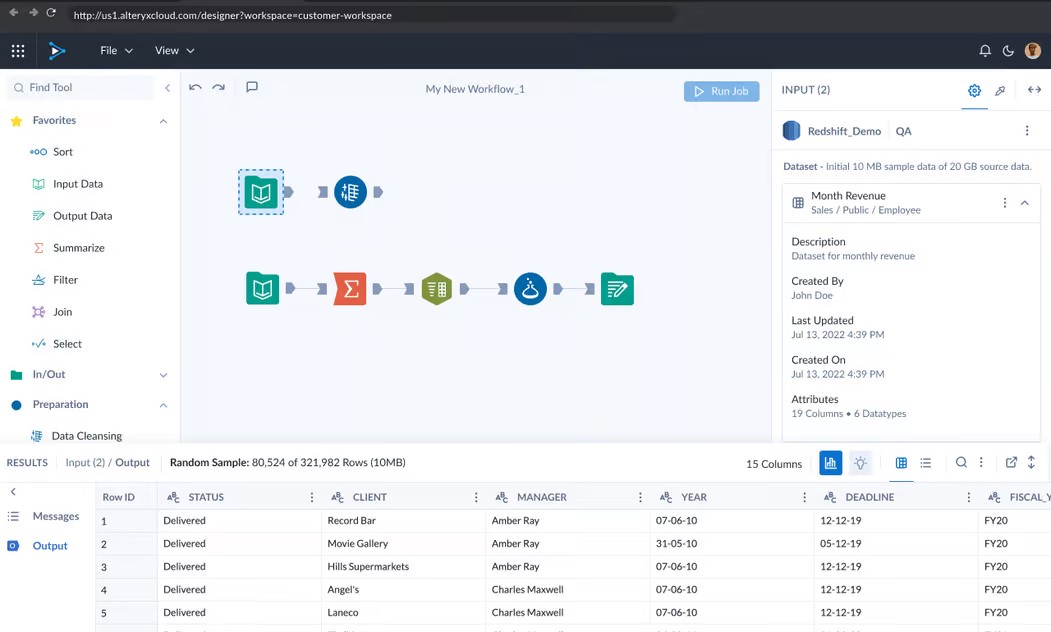 Source: https://www.alteryx.com/products/designer-cloud
Satisfy the Needs of the Enterprise
Designer Cloud is built for the world’s most demanding modern enterprises. Alteryx empowers hundreds of well-known brands across all industries to enable analytics across their organizations with robust security, governance, and scalability. Plus, you can deploy in the cloud environment of your choice, with support for AWS, GCP, Snowflake, and more. With pushdown processing and built-in connectivity to over 60 data sources, you can easily scale your data operations and transform your data from anywhere. No more installations, permissions, machine limitations, or hassle.Alteryx + Beinex Partnership
Being the premier partner of Alteryx, Beinex demonstrates excellence in delivering end-to-end analytics transformation services that revolutionized multiple industries in the Middle East. Experience Alteryx now: Free Alteryx trial
Governing Agentic AI: How Organizations Can Balance Autonomy, Risk, and Accountability
Agentic AI is redirecting AI to autonomous systems that can plan, decide, and execute tasks independently. These AI agents can manage workflows, interact with software systems, and trigger actions without continuous human input. While this autonomy promises efficiency and scalability, it also introduces new governance challenges.
Research shows that 86% of enterprises expect higher risk levels with agentic AI, yet only 2% of organizations currently meet responsible AI standards. This gap highlights a critical reality: organizations must adopt a structured agentic AI governance framework to balance autonomy with accountability.