How AI Decision-Making is Improving Enterprise Outcomes
Blog
Share 
تحليل توقعات الطقس
 9 February 2021
  Team Beinex
 تحليل توقعات الطقس
لوحة معلومات مذهلة تعرض واحدة من حالات استخدام تابلو العديدة من عضو فريقنا وكبير مستشاري تابلو، فازيلا جيركارحول تحليل توقعات الطقس.
هل ستكون هناك عاصفة هذا الأسبوع؟ هل هناك نمط رياح محدد؟ هل ستحتاج إلى حذاء الثلج الخاص بك غدًا؟ هل يجب عليك إحضار مظلة؟
استخدم تحليل توقعات الطقس باستخدام موصل بيانات الويب لتخطيط الأنشطة اليومية وتحليلها والمساعدة في اتخاذ قرارات العمل الكاملة المؤثرة.

-
Related Articles

Coming Soon: Tableau 2022.1 – What Does It Offer New
- List the unused data sources: Data sources imported in a workbook but not used are highlighted by the new feature. The developer can remove these data sources from the data source list to make the workbook faster.
- List of unused fields or data columns: Just like the data sources, workbook optimizer also highlights the data columns not used across the workbook. Removing these at the data source level can help improve the overall performance of the workbook.
- List of sheets not used in the dashboard: It is a common practise that developers tend to create sheets not used in the final dashboard. This creates unnecessary clutter and makes the dashboard slower. The workbook optimiser feature gives a list of such sheets which the user can delete to optimise the performance of the workbook further.
- Highlights lengthy calculations: The feature provides a list of calculations which are too complex and in turn reduce the performance of the dashboard. Simplifying a few of these can improve performance to a great extent.
 Ask Data Phrase Builder: This feature is available on Tableau Server and Tableau Online
Add field would look like as shown in the below screenshot:
Ask Data Phrase Builder: This feature is available on Tableau Server and Tableau Online
Add field would look like as shown in the below screenshot:
 Customize View Data: This feature is available on Tableau Server, Desktop and Tableau Online
This feature enables to reshape the tabular data behind your visualisation in the View data interface. One can create new columns, remove columns from the default view, change the order and sort the data using this feature. This reshaped data can also be exported as csv file to be shared with the team.
Change the root table: This feature is available on Tableau Server, Desktop and Tableau Online
Managing multiple data tables becomes easier and flexible with this new feature. One can swap any table to be the root table with a single click. This allows one to change the layout of the table quickly, reshape the data with a different root table and delete a specific table without deleting child nodes. For e.g., let us assume a user had to create a data source for an analysis using 3 tables namely ‘customers’, ‘orders’ and ‘returns’. The user creates the data model such that ‘customers’ is the root table followed by ‘orders’ and ‘returns’. But after performing some analysis the user realises that ‘orders’ should be the main root table. In such cases the user would have to re-create the data again from scratch but with the new ‘Swap with root table’ feature user can do the changes with a few clicks.
Parameter Enhancements in Tableau Prep
In version 2022.1 Tableau Prep is adding even more places where one can use parameters in the flow as well as user enhancements. Now, one can:
Customize View Data: This feature is available on Tableau Server, Desktop and Tableau Online
This feature enables to reshape the tabular data behind your visualisation in the View data interface. One can create new columns, remove columns from the default view, change the order and sort the data using this feature. This reshaped data can also be exported as csv file to be shared with the team.
Change the root table: This feature is available on Tableau Server, Desktop and Tableau Online
Managing multiple data tables becomes easier and flexible with this new feature. One can swap any table to be the root table with a single click. This allows one to change the layout of the table quickly, reshape the data with a different root table and delete a specific table without deleting child nodes. For e.g., let us assume a user had to create a data source for an analysis using 3 tables namely ‘customers’, ‘orders’ and ‘returns’. The user creates the data model such that ‘customers’ is the root table followed by ‘orders’ and ‘returns’. But after performing some analysis the user realises that ‘orders’ should be the main root table. In such cases the user would have to re-create the data again from scratch but with the new ‘Swap with root table’ feature user can do the changes with a few clicks.
Parameter Enhancements in Tableau Prep
In version 2022.1 Tableau Prep is adding even more places where one can use parameters in the flow as well as user enhancements. Now, one can:
- Get a list of all the parameters in one place rather than finding them in the flow. One can delete these parameters directly from the parameter window rather than to find it in the flow first.
- Include parameter names in exported output files.
- Include parameters in SQL scripts that you run before or after writing the flow output to a database. Include parameters in worksheet names when writing the flow output to Microsoft Excel.
- 1. Improvements in Esri Data Connector
- 2. Addition of new Accelerators
- 3. Added connectors to connect to more data sources

An Ultimate Guide on Amazon Bedrock: How Businesses Can Turn Generative AI into Real Business Value
What is Amazon Bedrock?
Amazon Bedrock is a fully managed AWS service designed to help businesses quickly build and deploy generative AI applications. It offers access to a variety of high-performing foundation models from leading AI companies, including AI21 Labs, Anthropic, Cohere, and Stability AI, through a single, unified API.
What makes Bedrock especially appealing to enterprises and fast-growing businesses is that it takes the heavy lifting off their shoulders. There’s no need to manage model training infrastructure, scale servers, or worry about data exposure. You can just focus on building applications; AWS handles the rest.
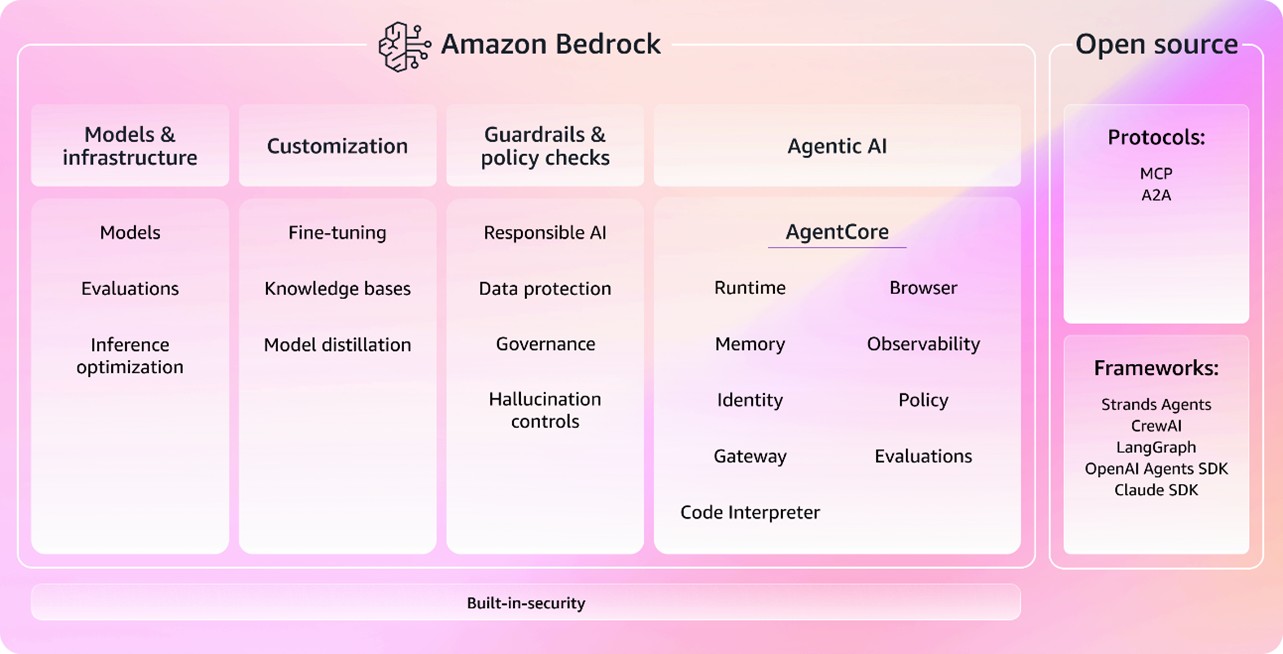 Source: AWS
Key Features of Amazon Bedrock
Let’s break down the key features powering AWS Bedrock:1. Access to Foundation Models
Amazon Bedrock offers ready-to-use models that are pre-trained, reliable, and production-ready, and are capable of tasks like:
- • Conversational AI and chatbots
- • Image generation
- • Text generation and summarization
- • Content classification and analysis
2. Secure Model Customization
Businesses can customize foundation models using their own proprietary data—without that data ever leaving their AWS environment. This is especially critical for industries, such as finance, healthcare, and government, where data governance and compliance matter.
3. Serverless Infrastructure
As Bedrock is completely serverless, there is no need to provision, manage, or scale infrastructure. Applications can also start small and scale instantly with demand, thereby making them ideal for both startups and large enterprises.
4. Single API Integration
Bedrock integrates seamlessly with existing AWS services and enterprise systems via a single API. This feature simplifies development and speeds up time-to-market.
5. Model Playground
AWS provides a Bedrock Playground, a visual interface where users can experiment with text, image, and chat models before deploying them into applications, making it helpful for teams evaluating use cases or testing outputs.
Top Benefits of Choosing Amazon Bedrock for Your Business
Amazon Bedrock stands out because it makes generative AI practical, not just impressive. Here are the top benefits organizations gain by adopting Amazon Bedrock:
Access AI Faster
Teams can start building generative AI applications without deep machine learning expertise, as it removes technical barriers.
Increased Efficiency
Businesses can prototype and deploy solutions faster, thereby accelerating innovation cycles instead of spending months building models from scratch.
Affordable AI Implementation
The cost of building AI capabilities can be significantly reduced by using pre-trained models, especially when compared to developing custom models.
Built for Scale
Bedrock supports enterprise-scale workloads while maintaining performance and reliability powered by AWS infrastructure.
Flexible Across Use Cases
From customer engagement to analytics and creative design, Bedrock supports a wide range of business needs on a single platform.
Real-World Use Cases for Amazon Bedrock
As you are now familiar with Amazon Bedrock, let’s understand how your business is going to benefit through some real-life use cases of Bedrock:
1. Customer Service Automation
Businesses can build AI-powered chatbots to handle order tracking, FAQs, and troubleshooting. It reduces response time, improves customer experience, and allows support teams to focus on complex issues.
2. Marketing and Content Creation
Marketing teams can generate blog drafts, social media copy, email campaigns, and product descriptions more quickly, freeing up time for strategy and creativity.
3. Product and Experience Personalization
Bedrock-powered applications can deliver personalized product recommendations and content, increasing engagement and conversion rates by analyzing customer behavior.
4. Analytics and Business Insights
Amazon Bedrock can summarize complex datasets, generate executive summaries, and highlight trends, making data easier to interpret for leadership teams.
5. Design and Creative Workflows
Design teams can use generative AI for image creation, branding concepts, and campaign visuals, speeding up ideation and iteration without replacing creative control.
Summing Up
If you are looking to move beyond experimentation and into real-world AI impact, Amazon Bedrock offers a practical, future-ready foundation. It can support you by providing:
- • Enterprise-grade security and compliance
- • Rapid deployment for competitive markets
- • Scalable solutions without operational complexity
For a free demo, connect with us: https://beinex.com/beinex-amazon-web-services/

Digital Twins: A Thin Line Between Reality and Virtuality
An actual representative and one fascinating example of digital transformation is the use of "digital twins," which are virtual reproductions of real-world things that have been given artificial intelligence and real-time data. The ‘thing’ can be anything under the moon, from a jet engine to a car. The physical asset's connected sensors gather data that can be transferred onto the virtual model. Now, anyone seeing the digital twin can see essential details regarding how the physical object is faring in the real world. They can, however, be interpreted in various ways, which tends to conceal their accurate, practical application.
A digital equivalent for a physical entity serves as the foundation for digital twins. Every business connection with its clients involves physical elements, from the automotive to the agricultural industries. With the help of digital twins, businesses will be able to extend the advantages of the software world to their physical assets, better meeting the needs of their digital customers.
How do digital twins get to know everything?
The digital data, twins gather from specialists with in-depth topic expertise from other similar assets, helps them learn on their own. After being created, the twins have sensors that enable it to take in any input from its physical twin. This can be used to identify potential problems, gain knowledge, gather feedback on a product, and more. Additionally, they include and use past data to polish their simulations.
The digital twin's architecture
Customarily, digital twins have three layers:
- A connectivity layer that uses SCADA, the Internet of Things, or historians
- A modelling and simulation layer may include a wide range of tools, including artificial intelligence (AI), industry simulators (thermodynamic, fluid-dynamic, chemical, and more), and AI.
- A layer for insight and visualisation that can be created online, with analytics software, or even with mixed reality
The final layer of these three is called "learning feedback," which enables the use of expert feedback and historical data to alter the behaviour of digital twins and the dependability of the physical twin.
Who stands to gain?
Digital twins can contribute to increased productivity in massive engines and intricate machinery. Like industrial settings with cooperative machine systems, digital twins are excellent in enhancing process efficiency. Those sectors that work on large-scale items or projects have the most success with digital twins. Digital twin technology has been used in Formula 1 racing to streamline the competition. Any racing or sports team could employ the digital twin to use a virtual twin in determining areas for strategy and progress.
Consider real estate as another example; a digital twin would link all systems and provide accurate insights and the capacity to evaluate the process. Managers would then be able to refine their plans, improving the structure's viability and effectiveness. Additionally, it would result in lower expenses.
Last but not least, the digital twin notion in healthcare refers to the development of computer models of diseases or even a virtual human body. Customised medications or therapies might be created using a medical twin for each patient. The following industries are going to reap the maximum benefits of digital twins:
- Engineering (systems)
- Automobile manufacturing
- Aircraft production
- Railcar design
- Building construction
- Manufacturing
- Power utilities
- Real estate
- Sports and Racing
- Healthcare
1.Enhance the user experience
Data is essential to comprehend the past, know the present, and anticipate the future. The foundation of any effective user experience programme is effective data management. Digital twins use IoT to collect real-time data from the physical environment. The information gathered is continually analysed, examined, and learned to provide valuable insights. With real-time analytics, businesses may successfully implement user-centric programs.
2.High-quality, innovative products
A competitive advantage that separates the leader from the followers is innovation. Physical asset innovation necessitates significant R&D expenditures. Design, testing, and operation require specialised knowledge due to the high cost of failures. These creative roadblocks can be solved with the help of digital twins. Enterprises can work with the user community to create high-quality offerings in a simulated environment that combines real-time information.
3.Enhance business processes
In terms of consumer annoyance, broken processes and bureaucracy would be at the top. The orchestration, knowledge management, and technological architecture are fragmented and siloed due to the complexity of modern business operations. The numerous systems and processes are brought together under one roof using digital twins, which act as a meta-layer. Digital twins are essential for knowledge management, training, and process optimisation in the complicated future. Additionally, simulations and visualisations support better process management and human learning.
4.Operative flexibility
Operational agility will affect an organisation’s top and bottom lines in a highly competitive marketplace. Black-box algorithms, the enormous amounts of information gathered, and the need for quicker judgments all work against human operators. Digital twins allow a range of diagnostic and prognostic capabilities by utilising enormous amounts of data, technology, and scenario. The human operators can re-enter the process and find strategies for being competitive and flexible.
5.Information security
Information security is a challenge that comes with all the data. Open source, collaborative learning, and knowledge sharing have never had a more compelling argument. We can't advance if data breaches are happening more frequently. Trusted stakeholders could collaborate on a platform provided by digital twins to share information and gain from it. Digital twins can also act as a layer of concealment to protect the confidentiality of the data.
6.Upgraded R&D
Utilising digital twins produces a wealth of data regarding expected performance results, facilitating more efficient product research and creation. Before beginning production, businesses can use this data to gain insights that will help them make the necessary product improvements.
7.Greater effectiveness
Digital twins can aid in monitoring and mirroring production systems even after a new product has entered production to reach and maintain peak efficiency throughout the manufacturing process.
8.Product life cycle
Digital twins can also assist producers in determining how to handle products that have reached the end of their useful lives and require final processing, such as recycling or other actions. They can decide which product materials can be gathered by utilising digital twins.
9.The Future Course
The market for digital twins is increasing, which suggests that even if they are already used in many different industries, demand will persist for a while. The need for digital twins was worth USD 3.1 billion in 2020. It may continue to snowball until at least 2026, rising to a projected USD 48.2 billion, according to specific industry observers.
According to IDC, global spending on products and services that facilitate digital transformation will amount to US$1.97 trillion in 2022, growing at a CAGR of 16.7%. Businesses are transforming the structure of their work to put the client first. Enterprises are taking more significant risks than ever in every aspect of business, from product design to marketing, sales, and even post-sales. Enterprises can use digital twins as a strategy to accomplish the goals of their initiatives for digital transformation.

Strengthening Cloud Security: Exploring New Capabilities in AWS Security
AWS Network Firewall Expansion
AWS Network Firewall, a managed firewall service, now expands its availability to four additional AWS Regions. This expansion ensures that organisations worldwide can benefit from the advanced network protection it provides. With AWS Network Firewall, users can effortlessly enforce network security rules and gain granular control over traffic flow. This enhanced capability fortifies the first line of defence, safeguarding against potential threats and attacks.
Enhanced Management with AWS Security Hub and AWS CloudFormation
AWS Security Hub announces a significant improvement in management capabilities by integrating with AWS CloudFormation. This powerful integration simplifies managing security and compliance resources across the AWS infrastructure. Now, organisations can automate the deployment and configuration of security standards using Infrastructure as Code (IaC) principles, ensuring consistent and secure cloud environments across their operations.
AWS Control Tower Integration
The general availability of AWS Control Tower's integration with Security Hub marks a crucial milestone in maintaining control and compliance over AWS accounts. AWS Control Tower streamlines setting up a well-architected and compliant multi-account environment. With Security Hub integration, administrators gain enhanced visibility and control over security findings, enabling enforcement of centralised governance and security best practices.
You can now activate more than 170 Security Hub detective controls, aligning them with corresponding control objectives from AWS Control Tower. Notably, AWS Control Tower can now detect when a control is disabled in Security Hub, indicating a 'Drifted' control state. This new drift detection capability simplifies the monitoring of control deployment status, enabling you to promptly manage the security posture of your AWS Control Tower environment by taking necessary actions.
Amazon Inspector Code Scans for AWS Lambda Function
Ensuring secure serverless applications are now more accessible with the general availability of Code Scans for AWS Lambda functions. Amazon Inspector Console, a robust security assessment service, now offers code-level security assessments for Lambda functions, identifying vulnerabilities and potential security risks. This capability empowers developers to take proactive measures to strengthen the security posture of their serverless applications.
Amazon Verified Permissions
With the introduction of Amazon Verified Permissions, AWS simplifies the permissions management process for cloud resources. Organisations can streamline security audits and compliance checks, saving time and effort. This capability provides an extra layer of confidence, ensuring that only authorised users can access and modify critical resources.
Utilise your current identity provider, responsible for managing users and groups, to effectively manage application permissions and control access. With this integrated authentication and authorisation solution, applications utilising Amazon Cognito now benefit from seamless policy validation based on attributes in Amazon Cognito while also being able to authorise requests using Amazon Cognito tokens.
AWS Security Hub Automation Rules
AWS Security Hub Automation Rules introduce a game-changing capability for proactive incident response. Users can now define automated actions responding to security events, enabling faster and more efficient incident resolution. This empowers organisations to respond swiftly to potential security threats and minimise the impact of security incidents.
AWS Global Partner Security Initiative
Security is a shared responsibility, and AWS takes a collaborative approach to empower its users and partners in fortifying their cloud security. The AWS Global Partner Security Initiative provides valuable insights, resources, and tools to help partners enhance their security offerings and better protect their customers' data. This initiative fosters a more robust security ecosystem and builds trust among AWS users worldwide.
AWS continues to demonstrate its commitment to cloud security with these latest capabilities. As organisations navigate an ever-changing threat landscape, the robustness of AWS security offerings ensures that cloud environments remain fortified and data remains secure. By leveraging these new features and capabilities, users can confidently embrace the cloud's potential without compromising security.
Beinex Offering
Beinex is an AWS consulting partner, and we empower customers to host their BI solutions and much more on the cloud. Our cloud migration experts bring in best-in-class stability and reliability by understanding your business strategy and working closely with you to deploy AWS infrastructure as a service.

13 Key Snowflake Features: Traits that Take It to the Top
A Compact List of Snowflake Features
- Decoupling of storage and compute in Snowflake
- Auto-Resume, Auto-Suspend, Auto-Scale
- Workload Separation and Concurrency
- Snowflake Administration
- Cloud Agnostic
- Semi-structured Data Storage
- Data Exchange
- Time Travel
- Cloning
- Snowpark
- Snowsight
- Security Features
- Snowflake Pricing
Let’s deep-dive:
1. Decoupling of storage and compute in Snowflake
Snowflake's decoupling of storage and compute features facilitates virtual warehouses and storage as separate entities. Leveraging this functionality of Snowflake, businesses can achieve greater flexibility in choosing the compute of their choice and incrementally pay for what they store and compute. Users can scale up / down or in/out based on the business SLA requirement. Scale up – Scale-out features do not require downtime and are almost instant.
2. Auto-Resume, Auto-Suspend, Auto-Scale
Snowflake's auto-resume and auto-suspend features provide minimal administration. Using auto-resume, Snowflake starts a compute cluster when a query is triggered and suspends compute clusters after a set time of inactivity. These two features ensure performance optimisation, cost management, and flexibility.
In business circumstances where more users are querying heterogeneous queries, setting up auto-scaling can help automatically expand the number of clusters from 1 to 10 at an increment of 1 based on the volume of queries sent to a compute simultaneously.
3. Workload Separation and Concurrency
Concurrency is no longer a problem for Snowflake, unlike traditional data warehouses with concurrency issues where users and processes must compete for resources. Because of Snowflake's multi-cluster architecture, concurrency is not an issue anymore.
This architecture also helps to divide workloads into their virtual warehouse and channel the traffic to each virtual warehouse (compute) by functions or departments.
4. Snowflake Administration
A data cloud as a service is provided by Snowflake (DWaas). Businesses can set up and administer a system without significant assistance from DBA or IT teams. Unlike the on-premise platforms, neither hardware commissioning nor software installation patch-update is s necessary. Snowflake manages software updates and introduces new functions and patches without downtime.
Snowflake automatically creates micro-partitioning. This feature reduces the requirement of manually indexing and clustering tables though these are available features in Snowflake.
5. Cloud Agnostic
Being a cloud-agnostic platform, Snowflake can migrate its workloads with other cloud providers. So, Snowflake is accessible on all three cloud providers: AWS, Azure, and GCP. Customers can easily integrate Snowflake into their existing cloud architecture and choose to deploy in locations preferred by their companies.
6. Semi-structured Data Storage
The requirement to manage semi-structured data, often in JSON format, gave rise to NoSQL database solutions. Data pipelines are created to extract attributes from JSON and mix them with structured data. By leveraging VARIANT, a schema on read data type, Snowflake's design enables storing structured and semi-structured data in the exact location. Both organised and semi-structured data can be stored using the VARIANT data type. Snowflake eliminates the need for data extraction pipelines by automatically analysing data, extracting properties, and saving it in a columnar format.
Snowflake can connect to staging areas like s3 bucket, Azure blob or GCP blob storage to retrieve and transform files stored in these platforms. This is regardless of the cloud Snowflake is hosted. A snowflake-managed staging area is also available. Tasks/ Streams or Snowpipe can be set to retrieve data at a scheduled time or almost instantly, respectively. Snowflake can work with CSV, JSON, XML, Avro, ORC, and Parquet file formats. Snowflake can also store metadata of unstructured data stored in the staging area.
7. Data Exchange
A wide range of data, data services, and applications are available on the Marketplace. From some of the world's top data and solution suppliers, you can find, assess, and buy data, data services, and apps through Marketplace. Direct access to data ready for querying and pre-built SaaS connections virtually eliminates the expenses and delays associated with conventional ETL operations and integration. The risk and hassle of duplicating and relocating outdated material should be avoided. Instead, you can receive automatic updates that are close to real-time and have secure access to shared, controlled, and live data.
8. Time Travel
One of the distinctive Snowflake elements is time travel. You may follow the evolution of data through time by using time travel. All accounts have access to this Snowflake feature, free and enabled by default for everyone. Additionally, this Snowflake feature allows you to retrieve a Table's historical data. At any moment throughout the previous 90 days, one can access the table's appearance.
Time travel encompasses the undrop feature. If an object has not been removed yet by the system, a dropped object can be recovered using the undrop command in Snowflake. When an object is undropped, it returns to its original condition. The option to undrop schemas or tables is also available.
9. Cloning
The clone capability allows us to quickly duplicate anything, including databases, schemas, tables, and other Snowflake objects, in almost real time. Therefore, cloning an object involves editing its metadata rather than duplicating its storage contents. You can quickly produce a clone of the whole production database for testing purposes.
10. Snowpark
With the help of the Snowpark feature, data scientists and data engineers proficient in Python, Scala, R, and Java may create and manage their codes in Snowflake. Snowpark helps to employ the computing capabilities of Snowflake to retrieve, transform, train and apply data science models on the data stored in Snowflake, which has a more apparent performance advantage,
11. Snowsight
The new Snowflake web user interface, Snowsight, replaces the traditional Snowflake SQL Worksheet and enables you to easily construct basic charts and dashboards that can be shared or explored by many users, do data validation while loading data and conduct ad-hoc data analysis. The Snowflake dashboards tool is an excellent option because it works well for individuals or small group users in an organisation who wish to generate straightforward visualisations and share information among themselves.
12. Security Features
Snowflake assures security for its users through the following methods:
- • By adding IP addresses to a whitelist, you may control network policies and limit who can access your account.
- • By supporting several authentication techniques, including federated authentication and two-factor authentication for SSO.
- • Using a hybrid approach of role-based access control and discretionary access control. In role-based access control, privileges are assigned to roles which are then transferred to users. Still, in discretionary access control, each object in the account has an owner who controls access to the object. This hybrid strategy offers a substantial level of flexibility and control.
AES 256 strong encryption is used to automatically encrypt all data, both in transit and at rest.
13. Snowflake Pricing
The advantages of Snowflake pricing are:
- • Pay for actual consumption only.
- • We can cut back on resource use to save costs.
- • Flexible payment. We can either pay on-demand or in advance (pre-purchased).
- • Scale up or down the use of cloud services, computing, and data storage automatically based on your needs.
- • There are no chances of overbuying or overprovisioning.
Optimisation of Snowflake spending through integration with innovative cost-monitoring platforms.
Snowflake stands as an ideal and popular choice because of its unique and updated features. It is also available across many data cloud providers and regions, making it accessible and suitable for all organisations. Why wait? Let’s experience Snowflake. Try now: https://beinex.com/snowflake/.