How AI Decision-Making is Improving Enterprise Outcomes
Blog
Share 
Transform Your Snowflake Operations with Beinex: Achieve Cost Efficiency, Real-Time Insights, and Accelerated Innovation
 29 November 2024
  Sumi S
 Cost Optimization
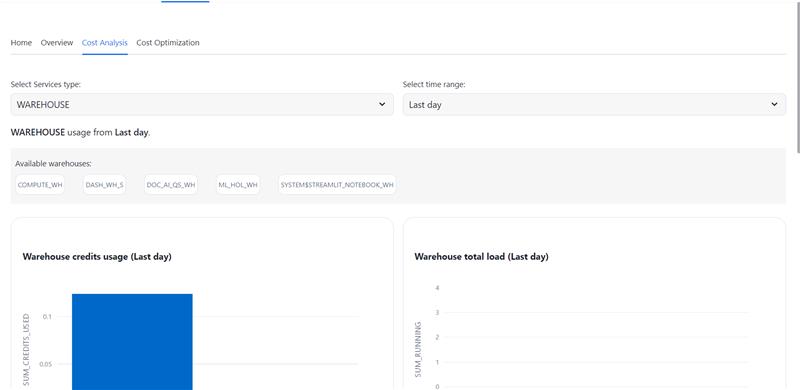
- • Real-time and Historical Cost Analysis: Leverage granular cost insights to identify and mitigate resource inefficiencies.
- • Precision Cost Attribution: Accurately pinpoint the root causes of cost deviations within your Snowflake environment.
- • Optimized Resource Utilization: Receive data-driven recommendations to optimize resource allocation and minimize unnecessary expenditures.
- • Proactive Cost Management: Implement preventative measures to avoid unexpected cost spikes and ensure adherence to budget constraints.
Learn more: https://app.snowflake.com/marketplace/listing/GZT8Z14W95T/beinex-consulting-llc-cost-optimizer
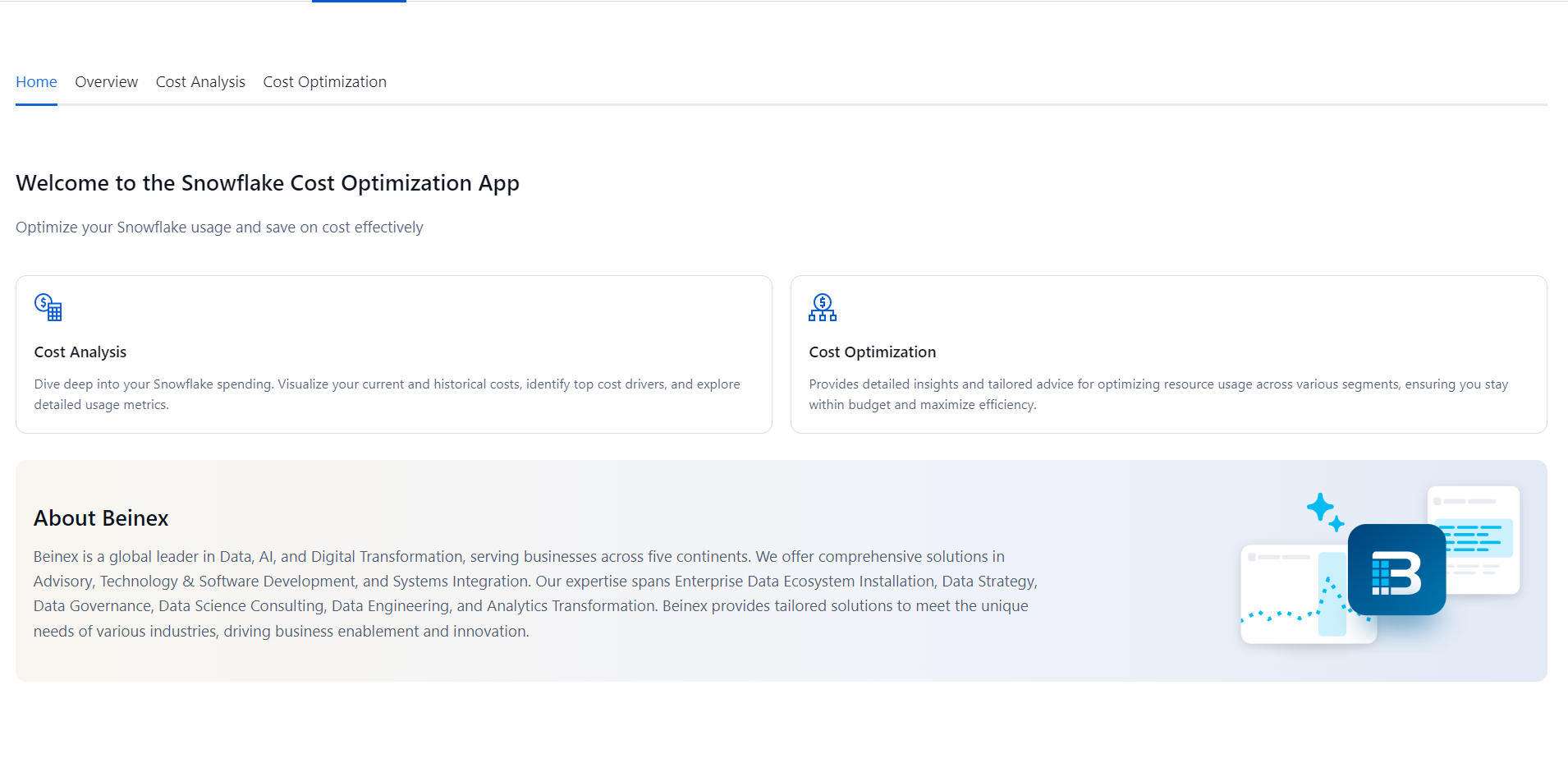
Beinex's strategic partnership with Snowflake empowers organizations to harness the full potential of their data. By leveraging Snowflake's powerful data cloud platform, Beinex offers comprehensive solutions for data management, analytics, and machine learning. This partnership enables organizations to accelerate their data-driven initiatives, reduce costs, and gain a competitive edge. Together, Beinex and Snowflake deliver innovative solutions that drive business growth and innovation.
Beinex provides a powerful platform to streamline your Snowflake operations, helping you unlock the full potential of your data. Our advanced analytics and automation tools enable you to optimize costs, gain deeper insights, and accelerate innovation.
We specialize in Snowflake implementation and offer real-time and historical cost analysis. This helps Snowflake Admins to identify inefficiencies in data transformation, optimize allocated resources, and ultimately, optimize costs and resource overspent. By leveraging our expertise, customers can maximize the value of your Snowflake investment. We have now put in place a Snowflake marketplace application with the help of our implementation expertise in Snowflake to optimize costs.
Related Articles

RUNNING THE MIGHTY SMALL LANGUAGE MODEL PHI-3 ON SNOWFLAKE
What is an SLM?
A Small Language Model (SLM) is tailored to excel in simpler tasks, offering boosted accessibility and user-friendliness for organizations operating with limited resources. Besides, they can be readily fine-tuned to align with specific requirements. Small language models are particularly well-suited for organizations aiming to develop applications capable of operating local devices instead of relying on cloud infrastructure. They are especially beneficial for tasks that do not necessitate extensive reasoning or immediate responses.
Reasons to use SLMs
Given the growing popularity and applicability of SLMs across various domains, particularly in areas like sustainability and the volume of data required for training, there are multiple reasons for employing them.
What is Phi-3?
Microsoft has a suite of small language models (SLMs) known as 'Phi,' demonstrating outstanding performance across various benchmarks. Microsoft's recent release is Phi-3, a series of open AI models. The Phi-3 models represent a prototype of capability and cost-effectiveness among small language models (SLMs), exceeding models of equivalent and larger sizes across the spectrum of coding, language, reasoning, and mathematical standards. This launch broadens the array of high-calibre models accessible to customers, providing them with more practical options as they craft and construct generative AI applications.
Phi-3-mini, a 3.8B language model, is accessible through Microsoft Azure AI Studio, Hugging Face, and Ollama. It is offered in two context-length variations—4K and 128K tokens. Notably, it is the first model within its category to support a context window of up to 128K tokens with minimal impact on quality. Furthermore, it is instruction-tuned, implying that it has been trained to comprehend and adhere to diverse instructions, mirroring natural human communication patterns. This ensures that the model is readily deployable straight out of the box. Phi-3-mini is available on Azure AI to leverage the deploy-eval-finetune toolchain, and it is also accessible on Ollama for developers to execute locally on their laptops.
Features of Phi-3
Phi-3 models exhibit distinctive superiority over language models of comparable and larger dimensions on key benchmarks, showcasing the following features:
Snowflake meets Phi-3: Advantages
The key pain point about LLMs is the computing required to host and run them. Setting up a dozen GPUs to run models can be expensive and complex. There's where Snowflake steps up. Snowflake's compute pool option enables users to easily and quickly set up and manage compute clusters. Phi-3 comes into the picture because of its cost-effective GPU utilization.
Can you imagine a situation where your language model only requires less than 3GB of GPU memory for inference? Well, now it's possible, all thanks to Phi-3. It's a state-of-the-art SLM that produces excellent results over GP3.5 and Mistral 8x7B, which are much bigger models. This opens the door for more cost-effective solutions to be brought up in the AI space. Add Snowflake for hosting; you have an excellent setup to host, test, and build AI applications. Read below how Beinex managed to run Phi-3 on Day 0 in Snowflake.
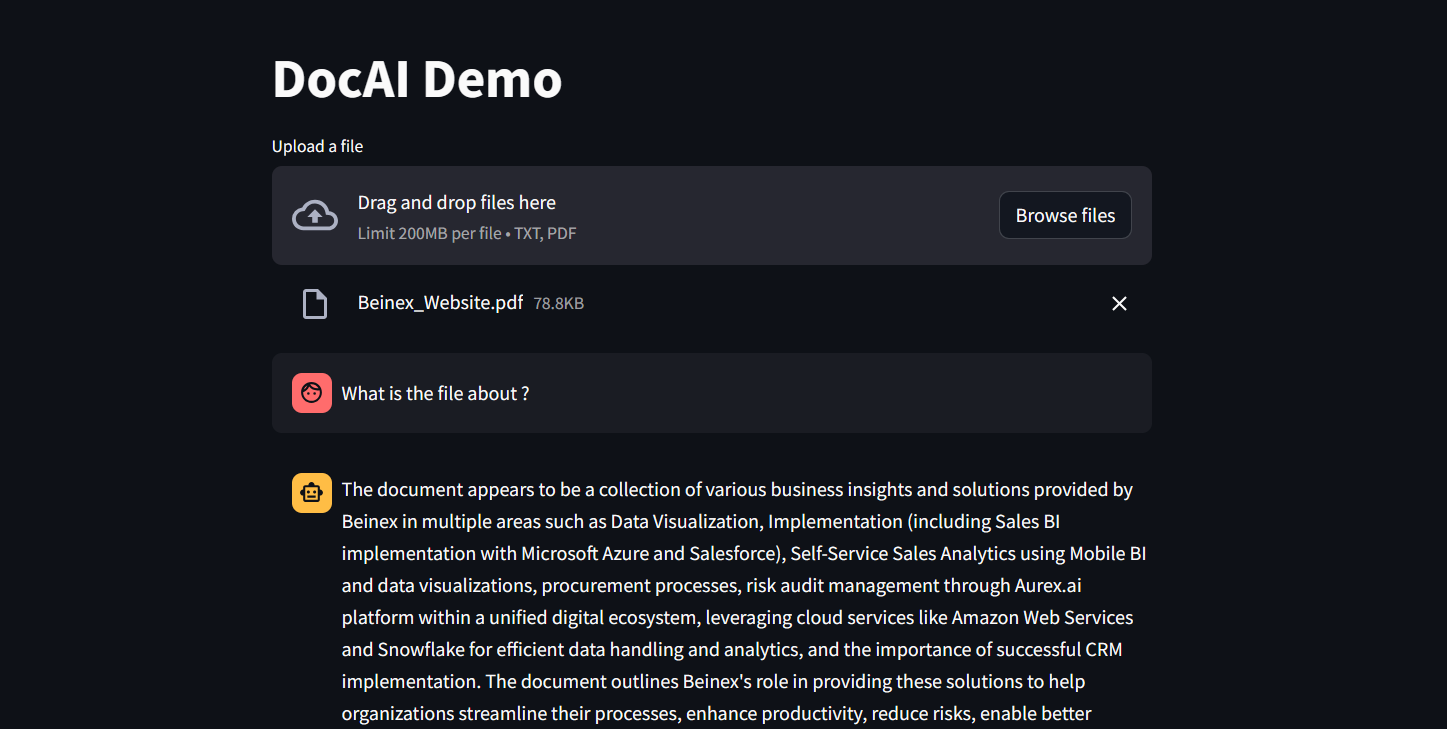 Figure 1: DocAI running on Phi-3
Implementing Phi-3 on Snowflake: What Beinex Did and How Beinex Did it?
Beinex has seamlessly integrated Phi-3 into Snowflake to help enterprises unlock their data's full potential through advanced language processing capabilities and enhance decision-making with deeper insights. The integration facilitates Snowflake users to:
Here's a detailed guide on implementing Phi-3 on Snowflake:
Step 1: Create Necessary Objects
-- Run by ACCOUNTADMIN to allow connecting to Hugging Face to download the model
-- Stage to store LLM models
CREATE STAGE <stagename> IF NOT EXISTS models
DIRECTORY = (ENABLE = TRUE)
ENCRYPTION = (TYPE='SNOWFLAKE_SSE');
-- Stage to store YAML specs
CREATE STAGE <stagename> IF NOT EXISTS specs
DIRECTORY = (ENABLE = TRUE)
ENCRYPTION = (TYPE='SNOWFLAKE_SSE');
-- Image repository
CREATE OR REPLACE IMAGE REPOSITORY images;
-- Compute pool to run containers
CREATE COMPUTE POOL GPU_NV_S
MIN_NODES = 1
MAX_NODES = 1
INSTANCE_FAMILY = GPU_NV_S;
Step 2: Docker Image Code - ollama
FROM ollama/ollama
RUN $(ollama serve > output.log 2>&1 &) && sleep 10 && ollama pull phi3 && pkill ollama && rm output.log
ENTRYPOINT ["ollama"]
CMD ["serve"]
Step 3: Tag and Push the Docker Image
docker tag ollama <SNOW_ORG-SNOW_ACCOUNT>.registry.snowflakecomputing.com/db/schema/image respository /ollama
docker push <SNOW_ORG-SNOW_ACCOUNT>.registry.snowflakecomputing.com db/schema/image repository /ollama
Step 4: Docker Image - UDF
FROM python:3.11
WORKDIR /app
ADD ./requirements.txt /app/
RUN pip install --no-cache-dir -r requirements.txt
ADD ./ /app
EXPOSE 5000
ENV FLASK_APP=app
CMD ["flask", "run", "--host=0.0.0.0"]
App.py content is given below :
from flask import Flask, request, Response, jsonify
import logging
import re
import os
from openai import OpenAI
client = OpenAI(
base_url='http://ollama:11434/v1',
api_key="EMPTY",
)
model = "phi3"
app = Flask(__name__)
app.logger.setLevel(logging.ERROR)
def extract_json_from_string(s):
logging.info(f"Extracting JSON from string: {s}")
# Use a regular expression to find a JSON-like string
matches = re.findall(r"\{[^{}]*\}", s)
if matches:
# Return the first match (assuming there's only one JSON object embedded)
return matches[0]
# Return the original string if no JSON object is found
return s
@app.route("/", methods=["POST"])
def udf():
try:
request_data: dict = request.get_json(force=True) # type: ignore
return_data = []
for index, col1 in request_data["data"]:
completion = client.chat.completions.create(
model=model,
messages=[
{
"role": "system",
"content": "You are a bot to help extract data and should give professional responses",
},
{"role": "user", "content": col1},
],
)
return_data.append(
[index, extract_json_from_string(completion.choices[0].message.content)]
)
return jsonify({"data": return_data})
except Exception as e:
app.logger.exception(e)
return jsonify(str(e)), 500
Step 6: YAML File
spec:
containers:
- name: ollama
image: <SNOW_ORG-SNOW_ACCOUNT>.registry.snowflakecomputing.com/ db/schema/image respository /Phi3
resources:
requests:
nvidia.com/gpu: 1
limits:
nvidia.com/gpu: 1
env:
NUM_GPU: 1
MAX_GPU_MEMORY: 24Gib
volumeMounts:
- name: llm-workspace
mountPath: /<stage name>
- name: udf
image: <SNOW_ORG-SNOW_ACCOUNT>.registry.snowflakecomputing.com/ db/schema/image respository /ollama_udf
endpoints:
- name: chat
port: 5000
public: false
- name: llm
port: 11434
public: false
volumes:
- name: llm-workspace
source: "@<llm stage_name>"
Step 7: Upload YAML File and Create Service
Upload the YAML file to the created stage, where the stage name in the YAML file should match the stage created in Step 2.
-- Create service
create service phi3
IN COMPUTE POOL <name of compute pool created>
FROM @dash_stage
SPECIFICATION_FILE = '<name of yaml file uploaded>';
Step 8: Create Service Function
Create a service function on the service (after it starts).
create or replace function phi3chat(prompt text)
returns text
service= phi3
endpoint=chat;
Check Service Status
Use the following command to check the status of the service:
SELECT
v.value:containerName::varchar container_name,
v.value:status::varchar status,
v.value:message::varchar message
FROM (
SELECT parse_json(system$get_service_status('<service name>'))
) t,
LATERAL FLATTEN(input => t.$1) v;
Benefits of Running Phi-3 on Snowflake
1. Cost-Effectiveness and Efficiency:
2. Compatibility with Smaller GPUs:
3. Exceptional Performance:
4. Faster Response Times:
SLM vs LLM
The choice between small and large language models hinges on organizational needs, task complexity, and resource availability.
LLMs excel in applications requiring the orchestration of intricate tasks, encompassing advanced reasoning, data analysis, and contextual comprehension.
On the other hand, SLMs present viable options for regulated industries and sectors facing scenarios necessitating top-tier results while maintaining data within their premises.
Both large and small language models possess distinct strengths and applications. While large language models thrive in managing complex workflows, small language models deliver impressive performance despite their compact size.
While some customers may exclusively require small models, others may favour larger models, with many seeking to integrate both types in various configurations. Ultimately, the optimal selection depends on the unique context and objectives of the organization. Besides transitioning from large to small models, the trend is evolving towards a diversified portfolio of models. This means that instead of relying on a single model, customers can choose from various models with different sizes, capabilities, and resource requirements. This empowers customers to decide the best model for their scenario, balancing performance and resource constraints.

From Insights to Actions: Leveraging BI Applications for Your Competitive Advantage
Business intelligence (BI) software solutions are designed to analyse data that is input by users or fed from various data sources. The software then organises this data based on patterns or trends it identifies. Finally, the software presents these patterns and trends through visualisations, making the information easy to understand even for users without any statistical analysis experience.
Organisations can develop informed and current strategies by using the insights and trends revealed by these visualisations. With the advancements in technology and innovations, a wide range of BI applications are available for diverse types of data analysis.
Therefore, it is imperative for forward-thinking organisations to recognise the BI tools that market leaders offer and how these tools can impact their own operations positively. Here are four significant business intelligence applications that can enhance your organisation’s operations.
List of Four Business Intelligence Applications
- Sales Intelligence
- Visualisation
- Reporting
- Performance Management
Let’s take a deep dive into the four noteworthy Business Intelligence applications:
1. Sales Intelligence
One crucial application of BI is to improve customer engagement and sales performance. The sales department of any organisation should prioritise building solid relationships with customers. However, converting leads and convincing potential clients to purchase a product or service can be challenging. BI tools can make this process smoother and more predictable.
BI collects data on specific key performance indicators (KPIs) such as customer demographics, conversion rates, and sales metrics. It then presents this data in structured visualisations like graphs, pie charts, and scatterplots. This data lets users identify trends and insights into customer behaviour and business operations. Understanding the customer allows organisations to provide better service and improve sales performance.
Moreover, the reports and dashboards generated by BI are valuable in providing easy-to-interpret data to potential clients and supporting claims with solid evidence. Managers can use the insights from BI analysis to make data-driven decisions based on complex data and forecasting.
BI applications provide an excellent means of optimising an organisation’s sales operations. Sales and marketing teams can leverage BI to identify trends in client preferences, enabling the organisation to maximise sales within their ideal client base. This allows them to concentrate on targeting highly qualified leads, improving conversion rates and overall profit margins.
2. Visualisation
Furthermore, when used alongside customer relationship management (CRM) software, BI offers businesses a sophisticated method for understanding their customers and making informed sales decisions. By integrating CRM data with BI analysis, organisations can better understand their customers' needs and behaviours, enabling them to provide personalized products and services, strengthen relationships, and increase customer loyalty.
Another critical application of BI is data visualisation. Business intelligence software employs various data analytic tools designed to analyse and manage data related to an organisation’s operations. The resulting data is then presented in the form of visualizations, enabling the organization to monitor logistics, sales, productivity, and more. Some BI platforms offer custom reporting capabilities, allowing users to specify their own parameters, while others offer pre-designed reporting templates that include industry-standard metrics.
By presenting data in intuitive and easy-to-understand formats, BI systems enable inexperienced employees to draw insights from data. Rather than relying on trained data scientists to analyze data, employees can analyze and present their own data to shareholders, other departments, or teams.
3. Reporting
Reporting is a way of summarising data to keep track of business performance, while analysis is a way of exploring data to gain insights that can improve business practices. Business intelligence tools play a crucial role in reporting by collecting and analysing data and generating various types of reports related to staffing, expenses, sales, customer service, and other processes. While reporting and data analysis are related, they differ in purpose, delivery, tasks, and value.
Simply put, reporting takes raw data and transforms it into easily understandable information, while analysis takes data and extracts valuable insights to enhance business practices. Although both processes can incorporate visualisations, their approaches are distinct. Reporting reveals what's happening, whereas analysis explains why it's happening. Traditionally, data visualisations were static, requiring the creation of a new one for every variable change. However, contemporary BI software provides interactive dashboards that can update in real-time, resulting in enhanced usability and flexibility in data analysis.
4. Performance Management
BI tools can help with performance management by allowing organisations to set and track performance goals using data-driven insights. This can include goals related to project completion, delivery time, or sales targets, among others. For example, a BI system can analyze past sales data and recommend a realistic sales goal for the future based on previous performance. This helps organisations stay on track with their goals and make data-driven decisions to improve performance.
With BI applications, organisations can closely track their progress towards pre-defined or customisable goals within specific timeframes. The data-driven plans could include meeting project completion deadlines, target delivery times, or sales targets. For instance, if an organisation wants to achieve a specific sales target, the BI system can analyse previous data and suggest a reasonable goal based on past performance.
By monitoring goal progress in real-time, businesses can stay informed of any remaining gaps and take timely action to bridge them. Users can also set alerts to notify them when they are nearing their target or when the time limit is approaching, and they haven't achieved their goal. This helps managers and employees stay on track and focused on achieving their goals.
Moreover, users can also assess the overall productivity of an organisation by monitoring the fulfilment of goals and tracking progress data. Since the information is readily accessible, there is no time wasted in tracking down urgently needed data, thus saving businesses time and money.
Three Steps to Choose Right Business Intelligence Tools
To choose the right Business Intelligence software for your organisation, it's crucial to identify the features and capabilities that your organisation requires. Follow the three steps below to find out which Business Intelligence tool suits you the best:
- Selection
- Compare Applications
- Shortlist and Trials
Now, let's explore in detail the three steps to choose the right Business Intelligence tool:
1. Selection
It's recommended to select only the modules you will use rather than opting for a solution with a long list of features you don't need. Overbuying can increase the cost and lower the chances of a successful implementation, so it's better to start small and upgrade as your company expands.
2. Compare Applications
You should compare various options based on your specific requirements to choose the right BI software for your organisation. Each vendor may have different strengths and specialities within the BI field, so it's essential to prioritise your needs and preferences. Instead of a one-size-fits-all approach, it's better to focus on the most critical features and evaluate solutions based on how well they meet those requirements. It's also important to remember that the most expensive solution is not always the best one, and sometimes paying a higher price can result in better quality and long-term benefits.
3. Shortlist and Trials
Once you have a shortlist of vendors, it's time to narrow it down further by considering factors such as pricing, demos, and trials. Many vendors offer free trials or demos so that potential users can get a feel for the system's user interface. Make sure to choose a system that most users can use and keep your budget flexible. Consider the type of user support each vendor offers, determine whether you need any integrations with other business software, and confidently make your final decision.
Summing Up
Business Intelligence applications can benefit organisations, from improved decision-making to enhanced performance management. By gathering and analysing data, businesses can gain valuable insights into their operations and customers and use this information to drive growth and success. When selecting a BI tool, it's essential to identify your specific requirements and carefully compare different vendors based on their features, pricing, and support.
Business Intelligence services extended by Beinex deliver solutions to all your business questions. At-a-glance analysis facilitated by cutting-edge BI tools does wonders for every industry. With BI tools, analysing enormous and complex data couldn’t be mind-boggling for you anymore. With Beinex, you can interact with an agile and intuitive system to validate your data, navigate your vision, and execute it data-driven to tap into the potent entrepreneurial potential.

What’s New in Tableau 2025.1: AI-Powered Insights, Multilingual Support, Private Connectivity, and More
Tableau 2025.1 at a Glance
- • Converse with Tableau Agent in six new languages using conversational AI.
- • Connect Tableau Cloud to AWS data securely with Private Connect.
- • Track KPIs on the go with a redesigned Pulse mobile homepage.
- • Programmatically access published data sources using VizQL Data Service.
- • Explore new features early with Tableau Cloud preview websites.
Let’s dive into the new updates in Tableau 2025.1:
1. Tableau Agent Multilingual Support
Perform multilingual data analysis. It is now possible for users to converse with Tableau Agent (and Tableau Pulse!) in French, Italian, German, Spanish, Japanese, and Portuguese. More people can now access conversational analytics in their native language.
With conversational AI, the Tableau Agent helps users navigate from data curation to exploration and accelerates all phases of analysis with generative AI. Additionally, because it is based on the Einstein Trust Layer, businesses can be assured that their data will remain safe, secure, and accessible only as intended.
2. Private Connect for Tableau Cloud
Use a dedicated, private connection to safely link Tableau Cloud to AWS data. Private Connect establishes a secure connection between Tableau Cloud and AWS data, ensuring your data remains private and is not made publicly available.
3. Revamped Tableau Pulse Homepage on Mobile
The redesigned Tableau Pulse mobile homepage enhances users' ability to engage with data on the go. With a side-by-side view of at least three key metrics, it allows for instant comparison and faster insight generation.
The clean, intuitive interface enables users to easily spot patterns, track trends over time, and take action quickly, without needing to dig through dashboards. Whether you're monitoring sales, operations, or customer engagement, Pulse ensures your most important KPIs are always within reach.
4. API for VizQL Data Services
VizQL Data Service is an innovative API that allows you to access published data sources in Tableau through programmatic queries rather than visualizations. Designed to maximize the versatility of your Tableau assets beyond traditional visualization, VizQL Data Service helps you tap into the analytic power of your data model anywhere.
It facilitates automating data processes by allowing you to run programmed queries directly on your data sources. By utilizing pre-existing Tableau connectivity and data models, you may more effectively design sophisticated, data-driven apps. You can now utilize your data models in any context, breaking free from the confines of visual tools.
5. Tableau Cloud Preview Websites
Tableau administrators can stay ahead of the curve by gaining early access to upcoming updates through release preview sites. This allows teams to test new features in advance, understand functional changes in a hands-on environment, and evaluate how updates will affect their organization’s unique dashboards and workflows—ensuring a smooth transition when the full release goes live.
In a Nutshell
The Tableau 2025.1 release brings a bunch of exciting updates to make working with data easier, smarter, and more secure. Now you can chat with Tableau Agent in multiple languages, get help with data prep and analysis using natural language, and connect securely to your AWS data using Private Connect. The refreshed Pulse homepage on mobile lets you track and compare key metrics at a glance, helping you make faster decisions wherever you are. Plus, with the new VizQL Data Service, developers can now access and use data directly, without relying on traditional dashboards. And if you're a Tableau admin, you get early access to test new features before they go live, so your team is always ready for what’s next.
Source: https://www.tableau.com/en-gb/2025-1-features

Analytics Automation: How It Can Transform Modern Businesses
What is Automated Analytics?
Think about your day's tedious tasks: organizing, cleaning, and formatting data. These repetitive processes are ripe for automation, and that's where automated analytics shines. Automated analytics combines the power of software and AI, including machine learning (ML) and generative AI, to streamline the analytics lifecycle. Diverse systems like data warehouses, analytics platforms, and reporting tools can be connected with it into an integrated, end-to-end workflow. It also saves time and improves productivity and accuracy, turning raw data into actionable insights more accessible than ever.Key Forms of Automated Analytics:
- Automated Machine Learning (AutoML): With low-code or no-code platforms, model creation is simplified, enabling faster deployment of predictive models. From defining problems to fine-tuning models, AutoML handles every step with ease.
- Generative AI: Adds a creative edge by automating documentation, generating summaries, and crafting stakeholder-ready presentations.
- ETL Automation: Platforms like Alteryx automate data ingestion, transformation, and reporting, allowing you to build workflows once and let them run indefinitely.
- Business Intelligence Automation: Enhances visualization and dashboarding by automatically surfacing insights and generating interactive reports.
Top Benefits of Automated Analytics
Analytics automation is indispensable, enabling organizations to tackle challenges at scale while maintaining agility and precision.
The top benefits of analytics automation are listed below:
Efficiency
Analytics automation significantly reduces the time required for data collection, preparation, and analysis. Automating daily tasks helps data professionals focus on deriving meaningful insights that drive business growth.
Improved Accuracy
Human error is a common pitfall in manual data handling, but automation ensures consistent logic and precision while safeguarding data quality and reliability.
Real-Time Insights
Gone are the waiting weeks for reports. Automated analytics deliver frequent updates, allowing businesses to respond swiftly to trends and opportunities.
Streamlined Scalability
Automation provides the flexibility to scale processes without additional resources as your data grows. Whether adding data sources or increasing analysis frequency, automation adapts seamlessly.
Empowered Decision-Making
Automated analytics empowers decision-makers with timely, accurate insights, ensuring they always have the information to steer their organizations forward.
Foster Collaboration
Cloud-based solutions promote teamwork by making workflows accessible and lowering barriers to advanced analytics like machine learning.
Getting Started with Analytics Automation
Your organization can get started with analytics automation with little hassles. Here's a roadmap to guide your journey:
- Define Your Objectives: First, identify the challenges you aim to solve with automation, whether it's optimizing data prep, deploying machine learning models, or improving reporting efficiency.
- Choose the Right Tools: Secondly, choose a solution that aligns with your goals and integrates with your existing infrastructure. Always go for enterprise-grade platforms that offer robust security and scalability.
- Gather Relevant Data: Always ensure you have access to suitable datasets, e.g., from CRM systems, social media analytics, or financial platforms, and prepare them for automation.
- Implement and Optimize: Finally, start with automating specific workflows, then expand to more complex processes. Continuous improvement will reveal even greater efficiencies over time.
Real-world applications of Analytics Automation
- Demand Forecasting: Retailers leverage automation to predict future demand by connecting historical sales data, blending it for analysis, and creating predictive models and all without manual effort.
- What-If Analysis in Financial Forecasting: Financial professionals can harness greater accuracy and flexibility with automated scenario modeling. It reduces errors and accelerates decision-making.
- Month-End Close: By automating data preparation, validation, and reporting, you can easily simplify the reconciliation process, allowing accountants to focus on strategic financial analysis.
Take the Leap with Analytics Automation
Analytics automation isn't just a tool; it's a transformative approach to data-driven decision-making. Whether you're a data analyst, scientist, or business leader, automation opens new possibilities, allowing you to work smarter, not harder. With platforms like Alteryx, you can automate the entire analytics lifecycle, from data prep to visualization, and transform how your organization handles data. Start automating today and redefine what's possible for your business.
Alteryx+ Beinex Offerings
Our Premier partnership with Alteryx empowers business users to automate manual data cleansing and tasks in minutes through a simple visual workflow while incorporating the latest technological advancements. Connect with us for a free demo: https://beinex.com/alteryx-partner/

Generative AI and AWS: Enhance Customer Engagement and Business Growth with AWS AI Services
AWS AI services
AWS pre-trained artificial intelligence (AI) services easily integrate with your applications to address common use cases such as personalized recommendations, modernizing your contact center, improving safety and security, and increasing customer engagement. Because we use the same deep learning technology that powers Amazon.com and our machine learning services, you get quality and accuracy from continuously learning APIs. Explore purpose-built AWS AI services:
- Amazon Bedrock
- Amazon Q
- Amazon Transcribe
- Amazon Polly
- Amazon Textract
- Amazon Rekognition
- Amazon Lex
- Amazon Translate
- Amazon Personalize
- Amazon Augmented AI
- Amazon Comprehend
- Amazon Fraud Detector
- Amazon Kendra
Amazon Bedrock
Amazon Bedrock simplifies the development of generative AI applications by offering a fully managed environment with robust security and privacy features. It provides access to top-performing models from leading providers like AI21 Labs, Anthropic, Cohere, Meta, Stability AI, and Amazon, ensuring a wide range of AI capabilities. Businesses can customize these models using their proprietary data through fine-tuning and retrieval-augmented generation (RAG), enabling tailored solutions. Seamless integration with familiar AWS services through serverless deployment minimizes operational overhead. Additionally, Amazon Bedrock supports HIPAA compliance and adheres to GDPR regulations, ensuring data privacy and regulatory compliance.
Amazon Q
Amazon Q is a generative AI assistant that enhances work efficiency in organizations. It offers specialized features for software developers, business analysts, contact center staff, and supply chain analysts, helping them gain insights and complete tasks faster. With Amazon Q, companies can streamline processes, make quicker decisions, and improve productivity.
Amazon Transcribe
Amazon Transcribe is a fully managed automatic speech recognition (ASR) service that converts spoken language into written text. Utilizing a state-of-the-art, multi-billion-parameter speech model, it provides highly accurate transcriptions for both streaming and recorded speech. Thousands of customers rely on Amazon Transcribe to automate tasks, gain valuable insights, enhance accessibility, and improve the discoverability of their audio and video content.
Amazon Polly
Amazon Polly is a fully managed service that converts text into lifelike speech. It offers a variety of voices in multiple languages, allowing applications to cater to global linguistic, accessibility, and educational needs. With advanced neural networks and generative voice engines operating in the background, Amazon Polly synthesizes high-quality speech suitable for a wide range of use cases.
Amazon Textract
Amazon Textract is a machine learning service that automatically extracts text, handwriting, layout elements, and data from scanned documents. Unlike traditional OCR (optical character recognition) software, Amazon Textract employs machine learning to process various document types, including PDFs, images, and forms. Its capability to extract data in minutes rather than hours or days allows businesses to automate document workflows and enhance efficiency.
Amazon Rekognition
Amazon Rekognition enables businesses and developers to address computer vision requirements without needing machine learning expertise. Its scalable and cost-effective capabilities include facial analysis, object detection, and text recognition for various applications.
Amazon Lex
Using technology similar to Alexa, Amazon Lex allows developers to create conversational AI interfaces through natural language processing. It facilitates both voice and text interactions, making applications more intuitive and improving customer experiences.
Amazon Translate
Amazon Translate enables the localization of content for a diverse global audience, allowing for the translation and analysis of large volumes of text to facilitate cross-lingual communication among users.
Amazon Personalize
Amazon Personalize enhances customer experience through AI-driven personalization. With the Amazon Personalize recommendation engine, you can provide hyper-personalized user experiences in real-time at scale, thereby boosting user engagement, customer loyalty, and business outcomes.
Amazon Augmented AI
Amazon Augmented AI (Amazon A2I) enables you to conduct human reviews of machine learning (ML) systems to ensure accuracy. You can implement human reviews and audits of ML predictions tailored to your specific requirements, which may include multiple reviewers. Accelerate your time to market with prebuilt workflows, and continuously retrain your models to improve performance. Additionally, you can integrate human judgment and AI into any ML application, whether it operates on AWS or another platform.
Amazon Comprehend
Gain valuable insights from various types of text, including documents, customer support tickets, product reviews, emails, social media feeds, and more. Streamline your document processing workflows by extracting text, key phrases, topics, sentiment, and other relevant information from documents like insurance claims. Differentiate your business by training a model to classify documents and identify specific terms, all without requiring machine learning (ML) experience. Ensure the protection and control of your sensitive data by identifying and redacting Personally Identifiable Information (PII) from your documents.
Amazon Fraud Detector
Build, deploy, and manage fraud detection models without previous machine learning (ML) experience. Gain insights from your historical data, plus 20+ years of Amazon experience, to construct an accurate, customized fraud detection model. Start detecting fraud immediately, easily enhance models with customized business rules, and deploy results to generate critical predictions.
Amazon Kendra
The Amazon Kendra GenAI Index is a new feature in Kendra designed for retrieval-augmented generation (RAG) and intelligent search. It aims to help enterprises build digital assistants and create intelligent search experiences more efficiently and effectively. This index provides high retrieval accuracy by utilizing advanced semantic models and the latest information retrieval technologies. The Kendra GenAI Index can be integrated with Bedrock Knowledge Bases and other Bedrock tools to develop RAG-powered digital assistants. It can also be used with Q Business for a fully managed digital assistant solution. This index addresses common challenges faced when building retrievers for Generative AI assistants, such as data ingestion, model selection, and integration with various Generative AI tools. Key features of the Kendra GenAI Index include a managed retriever with high semantic accuracy, a hybrid index that combines vector and keyword search, pre-optimized parameters, connectors to a variety of enterprise data sources, and user permissions filtering based on metadata.
AWS Beinex Partnership
Generative AI’s potential is vast, from automating content creation to transforming entire industries. AWS’s secure infrastructure and AI services empower businesses to innovate confidently while safeguarding data integrity. Beinex is an AWS consulting partner, and we empower customers with AWS-managed services to host their BI solutions and much more on the cloud. Our cloud migration experts bring in best-in-class stability and reliability by understanding your business strategy and working closely with you to deploy AWS infrastructure as a service. Beinex has also achieved a Gold-level ranking for Cloud Consulting services in the Middle East by Consultancy-me for our excellence in client services and solutions in 2024.