How AI Decision-Making is Improving Enterprise Outcomes
Blog
Share 
The Launch of AWS Middle East (UAE) Region: Marking a Holistic Shift
 7 September 2022
  Rakesh Neelakandan
 For Beinex, being a custodian of data engineering and data analytics technologies, presence of AWS in UAE offers a plethora of opportunities for customers in terms of:
(a) Drawing customer centricity and confidence in data related services increasing productivity
(b) Building highly scalable and efficient data lakes/data warehouses/data marts to create ‘center of excellences in data’
(c) One-stop unified data access, security and governance using AWS data stack, thereby removing multiple overheads and solutions
(d) Building and deploying ML models and integrating with analytics services creating business far-sightedness
(e) Reducing time to market taken by "product based" data analytics solution to blazing fast AWS services boosting innovation
The new AWS Middle East (UAE) Region consists of three Availability Zones (AZs) and becomes AWS’s second region in the Middle East with the existing AWS Region in Bahrain, launched in 2019. The new AWS Region gives organizations even greater choice for running their applications and serving end users from data centers located in the UAE, using advanced AWS technologies to drive innovation.
AWS Regions are composed of Availability Zones that place infrastructure in separate and distinct geographic locations. Availability Zones are located far enough from each other to support customers’ business continuity but near enough to provide low latency for high availability applications that use multiple Availability Zones.
Each Availability Zone has independent power, cooling, and physical security and is connected through redundant, ultra-low latency networks. AWS customers focused on high availability can design their applications to run in multiple Availability Zones to achieve even greater fault tolerance. The launch of the AWS Middle East (UAE) Region will enable local customers with data residency requirements to store data securely in the UAE, while providing customers with even lower latency across the country.
Beinex has prescriptive and predictive data analytics product suites comprising of a mix of services (Redshift, S3, Glue, Athena, Kinesis, EMR etc.) customized along with BI viz platform apps like Tableau & Alteryx, all on the AWS platform. Beinex is also competent in data innovation using AI/ ML stack with Amazon Sagemaker.
The firm is a preferred partner of Aurex, a SaaS based GRC solution. The company has capabilities in data engineering technologies like data ingestion, data lakes, ETL & data transformation, data visualization and AI/ ML models leading to insights generation platforms.
The launch of AWS Middle East (UAE) Region will catalytically encourage the Public Sector to shift to Cloud in a big way. It will drastically alter the way business is conducted in that realm, providing an added boost to the entire region. Besides, the AWS range of services characterized by AI-ML capabilities will facilitate ease of living and convenience in all walks of life across the society.
The launch of AWS Middle East (UAE) Region will support the acceleration of innovation and digital transformation in the United Arab Emirates (UAE). Beinex is excited to build on the great momentum of cloud adoption in the Middle East by providing more choice for customers in the UAE to run applications and store data locally.
Related Articles

Understanding Data Clean Rooms
Uncovering Data Sharing
Traditional data-sharing methods involve copying files via FTP/cloud, employing ETL pipelines, or utilising APIs. While these methods facilitate data exchange, they come with inherent limitations. Security vulnerabilities, data inaccuracies, and high maintenance costs are just a few of the challenges organisations face. Snowflake's Secure Data Sharing offers a standard shift by enabling seamless, governed access to data within the Snowflake platform.
Secure Data Sharing
Secure data sharing is ideal for granting raw data access across business units or to trusted partners for analysis. It fosters informed decision-making and facilitates data monetisation by providing secure, revocable access to valuable datasets.
Snowflake's Role in Secure Data Sharing
Snowflake's Cloud Data Platform empowers organisations to collaborate securely, driving cost savings and uncovering new insights. With Snowflake Secure Data Sharing, businesses can:
Introducing Data Clean Rooms
In the era of heightened data privacy concerns, data clean rooms emerge as a game-changer. Unlike traditional clean rooms, modern data clean rooms go beyond physical boundaries. They operate as a framework, eliminating the need to relocate data. In essence, a data clean room allows providers to dictate query rules without granting access to underlying data.
When to Opt for Data Clean Rooms
While secure data sharing suffices for many collaborations, data clean rooms shine in scenarios involving sensitive or regulated data. Regulations like CCPA and GDPR mandate stringent privacy adherence, making data clean rooms indispensable for privacy-preserving collaboration. For industries like media and advertising, data clean rooms enable personalised insights without compromising consumer privacy.
Snowflake Global Data Clean Room
Snowflake Global Data Clean Room revolutionises multi-party collaboration by safeguarding data privacy. Leveraging Snowflake's robust collaboration and governance features, it facilitates secure analysis across clouds and regions, mitigating the risk of data exposure or re-identification.
Choosing the Right Approach
In navigating data collaboration, enterprises must prioritise security and compliance. While Snowflake Secure Data Sharing suits low-risk collaborations, data clean rooms are indispensable for handling sensitive or regulated data. By embracing these innovative solutions, businesses can foster a culture of secure collaboration, driving insights and innovation while safeguarding data privacy.

Snowflake Summit: Glimpses of Groundbreaking Data Cloud Developments
Snowflake summit 'The World of Data Collaboration' was held in Las Vegas, Nevada, June 13-16, 2022. It featured the first look at innovations coming to the Data Cloud. Over 200 lectures, practical labs, certification possibilities, and more than 200 Basecamp partners were included in the four-day data Snowflake Summit. Thousands of Snowflake's partners, clients, and industry colleagues were there to network, cooperate, and learn crucial information about Snowflake and new Data Cloud trends.
Here are the four most exciting of Snowflake's latest offerings:
1.Innovative data capabilities that save time and resources
The release of Snowpark for Python, which is currently in public preview, was one of the statements that received the most attention at the summit. Both streaming ingestions using the new Snowpipe Streaming and streaming pipelines with the launch of Materialised Tables generated a lot of interest. These new features demonstrate Snowflake's product philosophy, which strongly emphasises simplicity for partners and customers while delivering value. The declarative model is excellent since it only requires describing the change; Snowflake will handle the rest. They anticipate less data lag, more real-time features, and quicker decision-making.
A new workload, Unistore, that enables users to work seamlessly with transactional and analytical data together in a single platform stirred curiosity in the audience. Unistore can save time and effort in moving data from operational systems and help with low-latency machine learning (ML) inference scenarios. It provides snappy user interfaces, allowing teams to create real-time analytical queries on their transactional data and build transactional business applications directly on Snowflake and offers a unified approach to security and governance.
2.Creating, monetising, and using apps on the Data Cloud
The most intriguing news is the potential of the Snowflake Native Application Framework, which is now in private preview. Anyone may now create applications using the well-known Snowflake core functionality, share and earn money from them through Snowflake Marketplace, and deploy them directly inside a customer's Snowflake account. Customers may keep their data centralised and greatly simplify application acquisition and maintenance. In contrast, application suppliers will have quick visibility to thousands of Snowflake customers globally across the three major clouds. It was a piece of ground-breaking information for all parties.
Bidirectional and multi-source native apps developed by Informatica allow users to combine data from various cloud and enterprise platforms, including IBM, Microsoft, Salesforce, and SAP. So, Snowflake partners and customers can concentrate more on what to build and less on how to build it; Snowflake wants to make the building process more straightforward. Snowflake may not be able to foresee the entire extent of value creation and innovation that would result from this.
3.More options and cloud compatibility
As a customer-focused business, Snowflake constantly strive to strike a balance between giving our consumers options, streamlining processes, and lowering complexity. Providing a consistent user experience and simple governance for data housed in any of the three significant clouds is a crucial objective (AWS, Azure, and Google Cloud). With the help of the Snowflake platform, businesses may create their applications once and deploy them across several major cloud vendors' regions. Companies can migrate data—and now applications—easily between regions or clouds thanks to Snowflake's cross-cloud capabilities. You can use transactional consistency for failover and failback. For both customers and partners, Snowflake is offering a way to make the construction of cross-regional and cross-cloud experiences simpler.
Snowflake's ability to develop an app once and have it function flawlessly across various clouds and locations is a game changer. By enabling the Data Cloud to process data from S3-compatible storage systems, such as on-premises storage providers, Snowflake has also improved choice (currently in development). It also supports interoperability and open file formats as agents of choice. To that aim, Snowflake unveiled the presently under story Apache Iceberg Tables, which will let users select Iceberg as the persistence table type and Parquet as the file format, table by table.
4.Rich data experiences without sacrificing readability for data governance or security
Clients of Snowflake value the data governance and security provided by Snowflake as well as the release of numerous new features and enhancements are appreciated. For instance, with the assistance of Snowflake's new workload Cybersecurity, cybersecurity teams can easily break down data silos, resulting in improved visibility into security incidents, risks, and threats. In short, clients want to create reliable data products and openly share data without relinquishing control of or re-siloing their data. Snowflake accelerates the economic value cycle for partners, clients, and, quite honestly, by doing away with the trade-off.
Snowflake has planned to offer more services connected with data sharing, collaboration with clean data rooms, and Native Applications Framework.
Beinex's partnership with Snowflake
Beinex's partnership with Snowflake enables it to offer clients advanced features like automated tuning and elastic compute with unlimited decoupled computing capability, along with the analytics modernisation services, to help organisations realise exponential Return on Investment. We keep innovating for all our clients and to support businesses around the world to create more possibilities and quality services.

IMAGE IN BAR CHART – NEW LEVELS OF TABLEAU VISUALIZATION!
The following blog depicts the technique created by Alex Jones (@jusdespommes) blog about “How to… create a chart from an image in Tableau!”.
Show/Hide Containers
Tableau 2019.2 has introduced an option to show/hide containers (when the container is a floating type). Many experts have come up with different use cases such as hiding and showing the filters, parameters, or even a worksheet with a click which occupies much space in the dashboard using this feature.
This feature is pretty simple to use and comes in handy when we want to save some space in our dashboards.
How to Swap image in Bar Chart?
1.Create a simple bar chart in Tableau 2019.2. We have used “Top 5 Grossing Games Worldwide 2018” to create a bar chart and sorted based on the revenue.
2.Remove the label, header and export the worksheet to image. Worksheet > Export > Image (Choose ‘view’ in Export Image dialog box)
3. Open Photopea, which is an online photo editor and open the saved worksheet image.
File > Open > Image
4. Now, download 2 images from online which we are going to use for bar chart.
5.Copy and paste image 1 on top of the bar image. Now we will be having two layers of images one above another.
(We can even re-position, crop the image if needed)
6.Choose ‘Magic Wand’ from the tool bar at left side. Click on the image, and we can see the selection in dotted lines.
7.Choose the top layer (image 1) and click delete. Now we can able to get the below image.
8.The background of the image needs to transparent. So, delete the below layer (bar chart image) using delete icon at the bottom right corner.
9.Now, choose File > Export as > .PNG to save the image as .png format (this will retain the transparent layer)
10.Repeat the same steps with image 2 to get the same effect.
Note: Keep the same resolution and image size as the previous one.
10.1.Now, open Tableau Desktop and bring in the image as floating type.
11.We have to position the bar chart over the image. To make it easy, decrease the opacity of the bar chart and give border.
12. Add labels and tooltip to the bar chart.
13.Now the dashboard looks like this. We can able to hover on bars to see tooltip.
14.Now, comes the trick of using ‘Show/Hide Containers’ to swap image. Bring a container to floating and add image 2 to the container. (Set the padding to zero)
15.Next, we have to position the both images and the bar chart one above another. To make it easy, use x, y axes and size w, h to position accurately.
Note: Make sure the position of the 3 objects (Use Floating Order) follows the below order as all are in floating.
- Image 1 (Below layer)
- Image 2 inside container (Middle layer – where show/hide option is to be used)
- Bar Chart (Top layer)
16.Choose the container and right click at the top right corner. Enable ‘Add Show/ Hide Button.’ Now we can see a floating button.
17.We can customize the button by adding image and tooltip to buttons.
18.We have used below customized images (created with PowerPoint) for buttons to swap between 2 images.
19.Another simple trick is that we can control the transparency of the image by adjusting the opacity of the bars.
20.Take a look at the final dashboard….
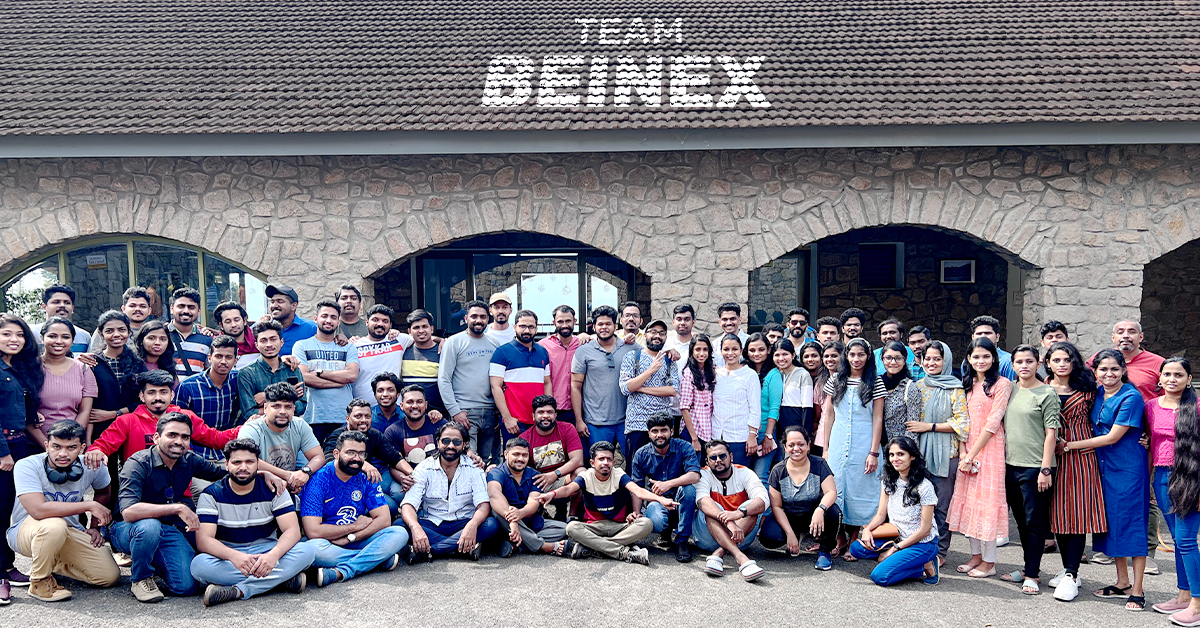
Just Go Wild: Beinex Offsite Visit to Munnar
We all boarded after breakfast from Edapally into the buses waiting as planned. Our journey to Munnar resembled the long-lost college trips, filled with songs, dances and ‘Antaksharis’. Finally, we reached our destination passing vast expanses of tea estates and dewy mountains.
Munnar is an exotic place with a breath-taking landscape and scenic spots. The chilly hill station stole our minds with its exotic flora and fauna. Our team stayed in a luxury resort: Mountain Club. The cottages chosen for us resembled the colonial architecture from the bygone era. The bedrooms were cosy, with a balcony open to the rustic surroundings.
The lunch was a luxurious affair that included starters to desserts. We used the mealtime to get to know more about each other. Then, we all attended the motivation speech by Sibu Varghese which was quite insightful, followed by an interactive session. Then, we interacted with and introduced each other. Personal interaction creates tight bonds and has an integral role in team building. We all broke the ice by sharing our stories and telling jokes. It was fun to get to know each other.
 In the evening, we had a wild-theme based gala party, and all got dressed up in sync with the theme, ‘Just Go Wild’. It was fun to watch everyone from the Manager to the employees dressed up in the same theme. We had an exhilarating DJ party manned by Darryl Gaulbert which made us all shake a leg to the tune. We danced and roared to the music. It was indeed wild!
The following day after breakfast, we met our founder Indumon Das, who had a chat with us regarding the journey of Beinex and his vision. It inspired us all to have a dream and pursue it fearlessly. Some of us accessed the infinity pool late afternoon and had great fun swimming and playing pool ball.
It was a blissful evening based on an ethnic wear theme. We competed for the best ethnic outfit of the evening. The different hues and styles made the evening stunning. Everyone flaunted the traditional wear in style. We had a musical evening with a live barbeque and a sumptuous dinner.
Finally, the day of leaving Munnar dawned; March 19. We all had breakfast in the morning and packed our backpacks. Most of us were pretty reluctant to leave Munnar as we were not ready to lose the bond we created together. Nonetheless, we vowed to stay connected. We boarded the buses around 10 AM and waved goodbye to Munnar.
When we reached Edapally in the evening, a surprise goody bag was waiting. It was an impressive and admirable gesture from our firm. Beinex has a culture of nurturing growth and spreading positivity, and employees’ comfort is the priority here.
In the evening, we had a wild-theme based gala party, and all got dressed up in sync with the theme, ‘Just Go Wild’. It was fun to watch everyone from the Manager to the employees dressed up in the same theme. We had an exhilarating DJ party manned by Darryl Gaulbert which made us all shake a leg to the tune. We danced and roared to the music. It was indeed wild!
The following day after breakfast, we met our founder Indumon Das, who had a chat with us regarding the journey of Beinex and his vision. It inspired us all to have a dream and pursue it fearlessly. Some of us accessed the infinity pool late afternoon and had great fun swimming and playing pool ball.
It was a blissful evening based on an ethnic wear theme. We competed for the best ethnic outfit of the evening. The different hues and styles made the evening stunning. Everyone flaunted the traditional wear in style. We had a musical evening with a live barbeque and a sumptuous dinner.
Finally, the day of leaving Munnar dawned; March 19. We all had breakfast in the morning and packed our backpacks. Most of us were pretty reluctant to leave Munnar as we were not ready to lose the bond we created together. Nonetheless, we vowed to stay connected. We boarded the buses around 10 AM and waved goodbye to Munnar.
When we reached Edapally in the evening, a surprise goody bag was waiting. It was an impressive and admirable gesture from our firm. Beinex has a culture of nurturing growth and spreading positivity, and employees’ comfort is the priority here.
 Yes, we had a fantastic time together. After this retreat, our rejuvenated and motivated minds are ready to bounce back to work with enhanced spirit. We are looking forward to more team building sessions in the future to meet each other more often.
In the evening, we had a wild-theme based gala party, and all got dressed up in sync with the theme, ‘Just Go Wild’. It was fun to watch everyone from the Manager to the employees dressed up in the same theme. We had an exhilarating DJ party manned by Darryl Gaulbert which made us all shake a leg to the tune. We danced and roared to the music. It was indeed wild!
The following day after breakfast, we met our founder Indumon Das, who had a chat with us regarding the journey of Beinex and his vision. It inspired us all to have a dream and pursue it fearlessly. Some of us accessed the infinity pool late afternoon and had great fun swimming and playing pool ball.
It was a blissful evening based on an ethnic wear theme. We competed for the best ethnic outfit of the evening. The different hues and styles made the evening stunning. Everyone flaunted the traditional wear in style. We had a musical evening with a live barbeque and a sumptuous dinner.
Finally, the day of leaving Munnar dawned; March 19. We all had breakfast in the morning and packed our backpacks. Most of us were pretty reluctant to leave Munnar as we were not ready to lose the bond we created together. Nonetheless, we vowed to stay connected. We boarded the buses around 10 AM and waved goodbye to Munnar.
When we reached Edapally in the evening, a surprise goody bag was waiting. It was an impressive and admirable gesture from our firm. Beinex has a culture of nurturing growth and spreading positivity, and employees’ comfort is the priority here.
Yes, we had a fantastic time together. After this retreat, our rejuvenated and motivated minds are ready to bounce back to work with enhanced spirit. We are looking forward to more team building sessions in the future to meet each other more often.
AI Adoption in HR: Top Five Benefits Powering the Future Workforce
