How AI Decision-Making is Improving Enterprise Outcomes
Blog
Share 
Strategic Insights with Tableau Pulse: Real-Time Insights for Every Team
 11 October 2024
  Sumi S
 Setting Up Metrics Is a Breeze
Configuring metrics in Tableau Pulse takes just minutes. Whether it’s setting up your own custom metrics or utilizing pre-defined ones, the process is straightforward and user-friendly. And once set up, the visuals, descriptions, and insights are generated automatically, enabling team members to stay updated on performance with ease.
Pro Tip: You can also customize existing metrics to meet specific goals. For example, a custom metric was developed to track interactions generated by teams in the field, with a target of reaching a high engagement level within a set timeframe. This tailored approach has streamlined the process of monitoring performance and recognizing accomplishments.
Integrating Data into the Flow of Work
Tableau Pulse effortlessly integrates data into the tools you use daily, like Slack or email, allowing you to stay informed without disrupting your workflow. Each morning, you can start your day by reviewing the Pulse Digest in Slack, which provides a snapshot of key metrics, trends, and insights.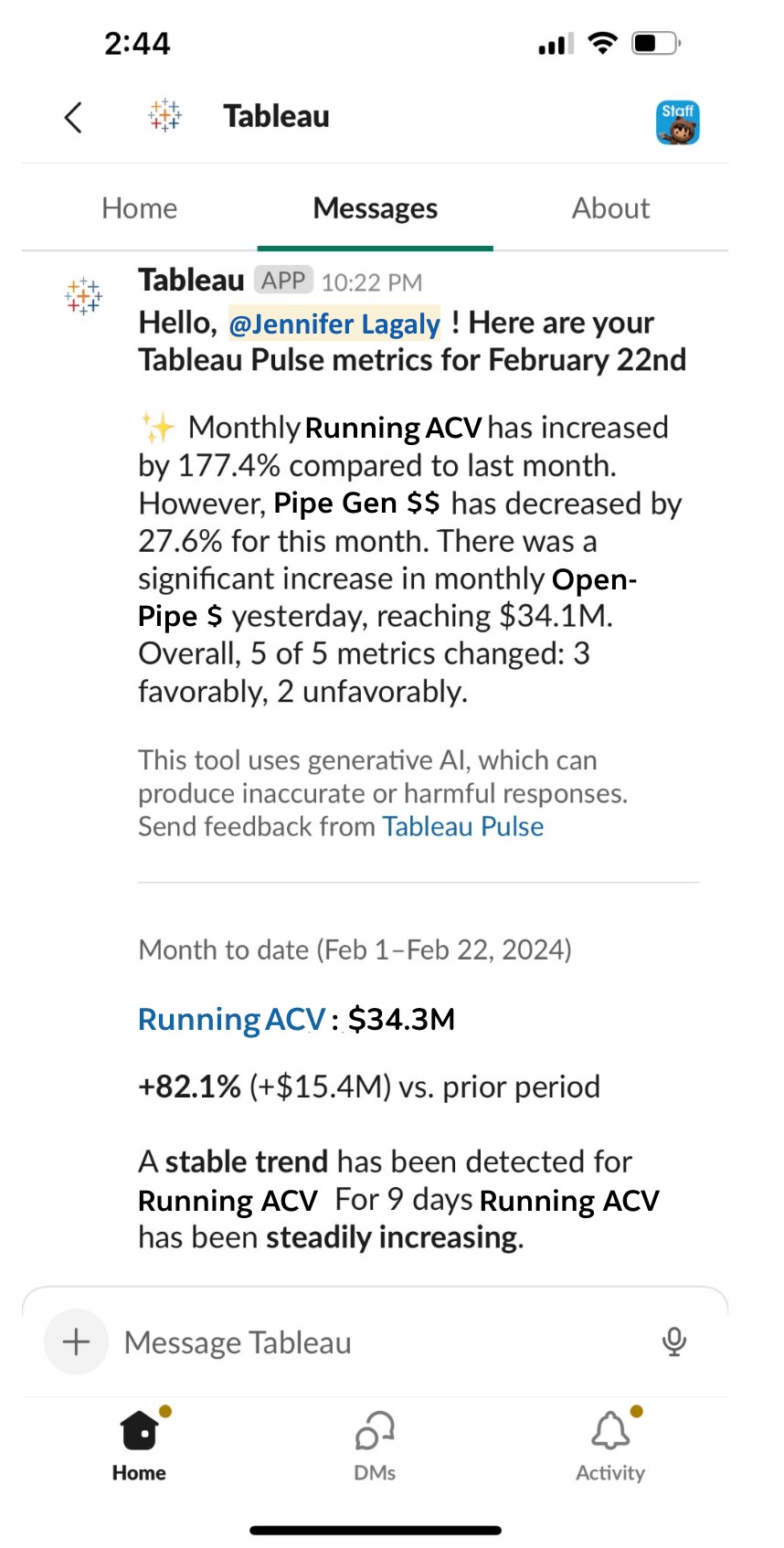 Source:https://www.tableau.com/blog/how-tableau-chief-revenue-officer-uses-tableau-pulse
Decipher Trends with Intelligent Metrics
Monitoring metrics is not solely focused on tracking numbers; it also involves identifying opportunities and addressing challenges. With AI-generated summaries of key metrics like Annual Contract Value (ACV) and Pipeline Generation, Tableau Pulse helps you understand the context behind the data. The live updates ensure that any changes are reflected immediately, providing real-time insights that are always up-to-date.
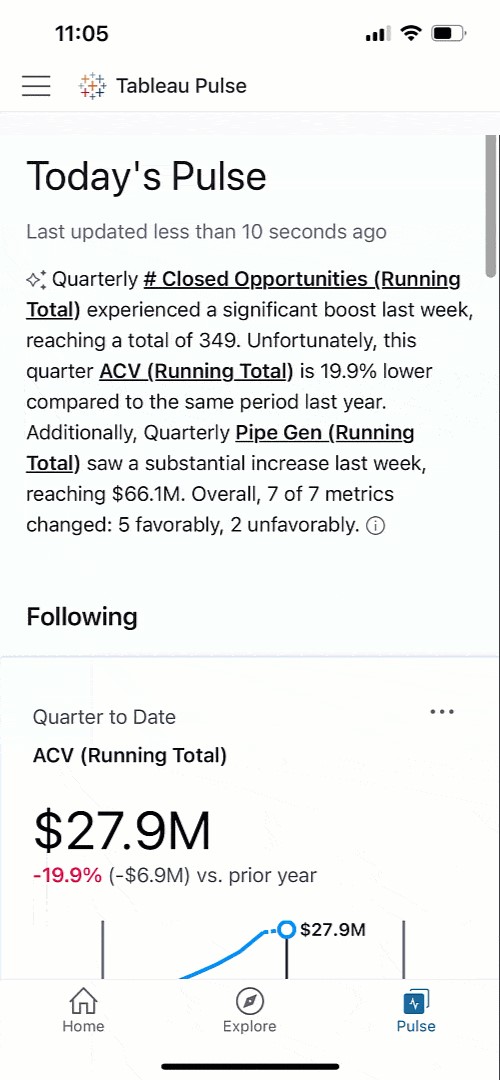
Get a Clear View of Business Performance
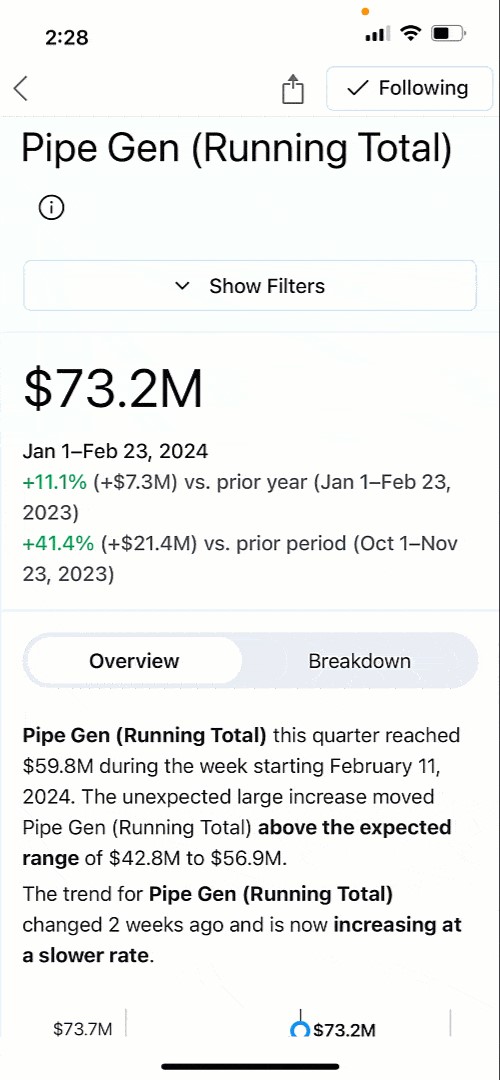
Tableau Pulse’s intuitive visualizations and natural language summaries make it easy to compare current and past performance, helping you identify areas that may need closer attention. For instance, if Pipeline Generation is up 10.9% year over year but showing signs of slowing, Pulse allows you to dig deeper, understand the cause, and take timely action to keep growth on track.
Tableau Pulse is available on mobile, and these insights are accessible wherever you are, making it easy to stay connected to your data on the go.
Analyze Business Segments with Precision
Tableau Pulse enables detailed analysis of various business segments, offering a clear view of how different teams and departments contribute to overall success. With just a click, you can explore revenue trends, track team performance, and understand the impact of different strategies across the organization.This level of analysis, which once required hours of manual work, is now at your fingertips. You can easily filter by segment, product, or deal size to gain nuanced insights that drive better decision-making.
Ask Smart, Data-Driven Questions
Powered by AI, Tableau Pulse does more than just report numbers. It actively helps you explore trends by suggesting relevant questions and providing insights in clear, understandable language. Whether it’s identifying which sales regions are thriving or where potential issues may arise, Pulse empowers you to make data-driven decisions with confidence.
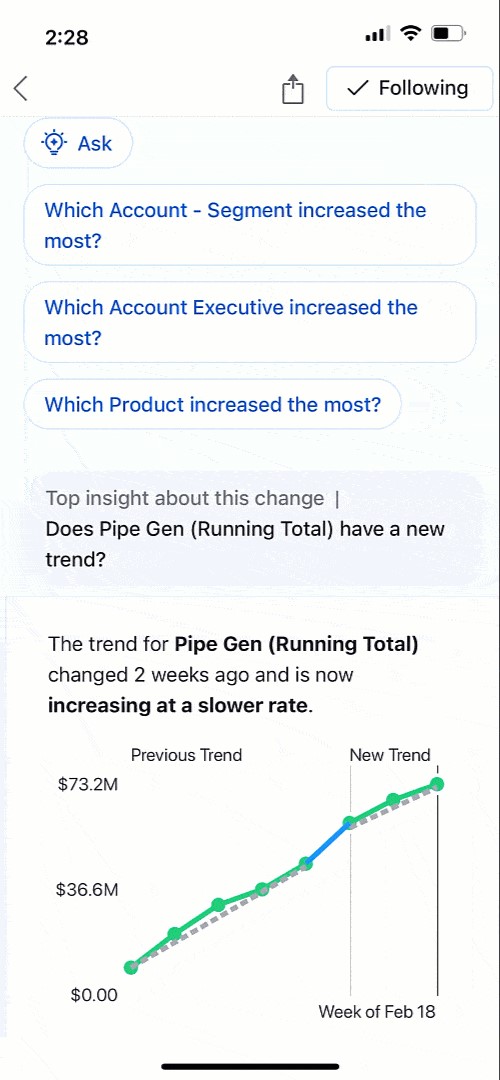
Foster a Data-Driven Culture
Tableau Pulse is designed to be accessible to everyone, regardless of their level of data expertise. By integrating insights into tools like Slack, Pulse ensures that critical information is always at hand, promoting a culture of informed decision-making across the organization. This democratization of data means that every team member can contribute meaningfully to achieving our shared goals.
Tableau Pulse has truly transformed how we approach strategic decisions, placing personalized, contextually relevant insights directly in our workflow. It empowers everyone to be data-driven, aligning efforts towards achieving your company objectives and navigating the dynamic challenges of business with agility and insight.
Want to Transform Your Business?
Watch our demo to see how Tableau Pulse, powered by Tableau AI, can elevate your business strategy, and start your free Tableau Pulse trial today: https://www.beinex.com/free-tableau-software/Organizations are tasked with the management of diverse teams, each dedicated to distinct objectives that collectively contribute to our overarching goals. Whether it’s Sales, Solution Engineering, or Partner Management, each team operates with distinct KPIs aligned with our organization’s strategic targets. To stay ahead, we need a solution that allows us to effortlessly monitor and align these metrics in real time, and that’s where Tableau Pulse comes in.
By simply subscribing to key metrics in Tableau Pulse, anyone, be it team leads, analysts, or executives, can gain a comprehensive view of performance against targets. Setting up these metrics is quick and intuitive, empowering everyone to stay informed and engaged without technical expertise. For leaders tracking the big picture or team members focusing on specific goals, Pulse ensures that everyone has the data they need right at their fingertips.
Related Articles

Beinex Gets an Upgrade to Snowflake Services Partner Premier Tier
This significant milestone reflects our unwavering commitment to delivering the best solutions to our customers' data challenges. With this enhanced partnership, we are poised to offer our customers unparalleled opportunities to leverage Snowflake's unique architecture and revolutionise their data-driven strategies.
Beinex: The First Snowflake Premier Partner in the Middle East
Beinex is the first Data & Analytics firm in UAE to enter Snowflake Services Partner Premier Tier. Beinex's exceptional service quality and the expertise of its consultants, scientists, and engineers have been demonstrated through years of unparalleled dedication to clients. The partnership between Beinex and Snowflake is set to revolutionise how businesses unlock the true power of their data.
The New Status Helps Us Serve You Even Better!
Snowflake's cutting-edge cloud data platform has garnered widespread recognition for its ability to deliver unmatched performance, scalability, and ease of use.
By attaining the Premier Tier Partner status:
- Beinex can further leverage Snowflake's advanced capabilities and integrate them seamlessly into your solutions.
- Enable and empower Digital Transformation at an accelerated pace for our clients with experience and competency of the right kind in accompaniment.
- Aid our customers with the tools they need to extract maximum value from their data, propelling them towards success in an increasingly data-centric world.
Snowflake's architecture utilises a cloud-native approach, separating storage and compute, which results in unparalleled flexibility and scalability. This means that businesses can dynamically scale their computing resources as needed without the limitations of traditional on-premises solutions.
By embracing this architecture, our customers can say goodbye to lengthy and resource-intensive data processing times, paving the way for faster time-to-insights and improved operational efficiency.
Beinex+ Snowflake
The collaboration between Beinex and Snowflake has opened a new realm of possibilities for our mutual customers. The clients are further assured of the superior knowledge and competence possessed by Beinex’s league of Data Engineers, Data Scientists and Consultants in all matters Snowflake.
Now, organisations can experience a quantum leap in their data processing capabilities by harnessing the power of Snowflake's unique architecture. The ability to process vast amounts of data with lightning speed enables businesses to derive real-time insights and confidently make critical decisions.
Our partnership with Snowflake enables us to offer you advanced features like automated tuning and elastic compute, along with analytics modernisation services, to help your organisation realise exponential Return on Investment.
A Major Milestone for Beinex
The attainment of Snowflake Services Partner Premium Tier marks an exciting milestone for Beinex. This partnership underscores our dedication to delivering exceptional data solutions and reinforces our commitment to staying at the forefront of industry advancements. Together, Beinex and Snowflake are primed to transform how businesses harness their data's true potential, driving innovation and success in the digital era.

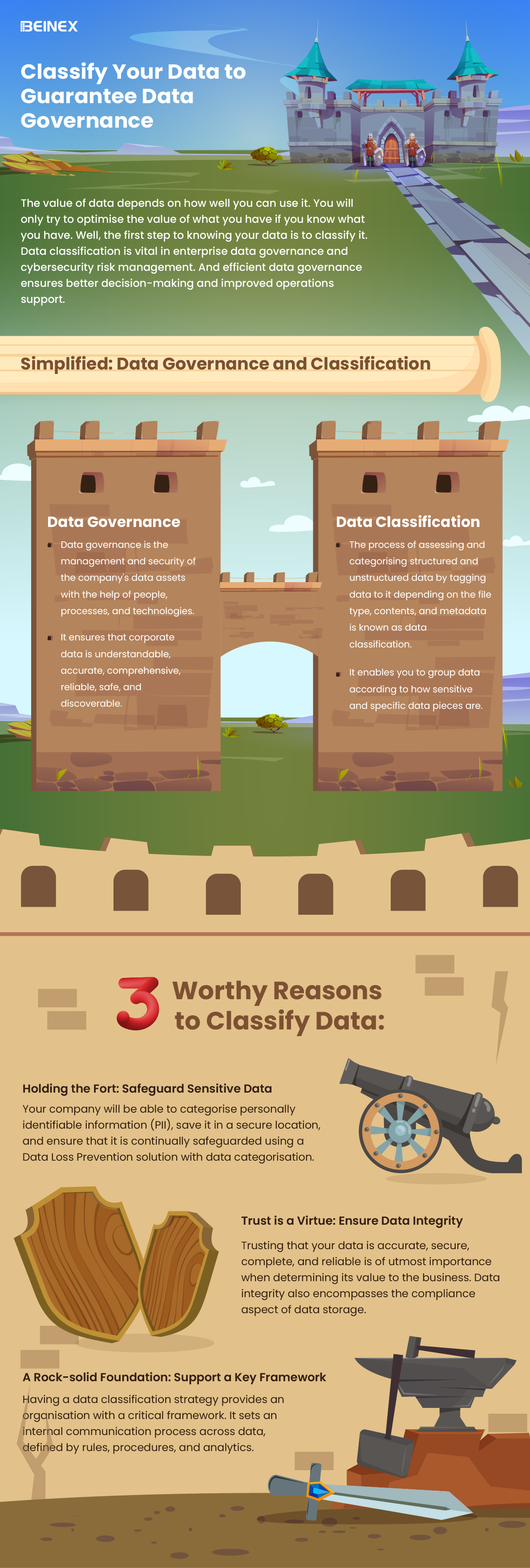
Classify your Data to Guarantee Data Governance(Infographics)

Data Ethics: Principles, Characteristics and Regulatory Aspects
The Principles of Data Ethics
And there are five of these principles:
- Ownership: The individual, himself/ herself/ themself, possesses the ownership of the data related to the person. A firm cannot take that data without the consent of the person lest it be deemed stealing.
- Transparency: The individual, aka data subject, has the right to know how a particular enterprise intends to collect, store and utilise the data concerned with the person.
- Privacy: Any bit of Personally Identifiable Information (PII) should not be made publicly available unless otherwise consented to. This includes the name, address, phone number etc.
- Intention: If the firm is collecting data on the individuals to fulfill unstated malicious intentions, it goes against the spirit of ethics.
- Outcome: If the collected data, despite the right intentions, come to have an unwanted outcome vis-a-vis the owner of the data, thanks to an algorithmic bias or any other reason, then the data ethics stand violated.
Characteristics of Data Ethics
Largely there are four characteristics that portray data ethics.
- Vouching for and ensuring data security and protecting customer info: When you handle customer data, as an enterprise, you are bound to protect it, prevent breaches, and ensure data never gets compromised. This is easier said than done. IBM India, in a report, outlines that “data breach average cost increased 2.6% from USD 4.24 million in 2021 to USD 4.35 million in 2022.”
- Offering clear benefits: It is a kind of social contract clause. You give your consumers greater speed, convenience, value and savings, and they (users, patients, clients, employees, customers and partners) will not be hesitant to part with their data as long as they are guaranteed and followed on the guarantee of data in safe hands not prone to misuse.
- Provision for consumer agency: Look at this scenario from a McKinsey report: “If a customer receives an offer and says, ‘I think I got this because of how you’re using my data, and that makes me uncomfortable. I don’t think I ever agreed to this,’ another company might say, ‘On page 41, down in the footnote in the four-point font, you did actually agree to this.’ Here, the customer has no agency. Worse than that, he feels he has been duped by the company. Game over! Remember, your reputation as an enterprise and the trust that you painstakingly cultivated over the years with customers can vanish in as much time as it takes for the customer to hit the post button on social media.
- Doing what you promise: The company should do what it has promised it will do or risk credibility and reputation.
In short, companies that adhere to the principles of fairness, privacy, transparency, and accountability in data matters can earn and retain the trust of their customers or clients. Trust is one power of attorney. It empowers a firm to not only ensure better customer service and experience by exercising the power of data it has been granted but also preserve and enhance its reputation.
Regulations and Data Ethics
Regulatory requirements and ethical obligations are mutually related and complementing. The European Union’s General Data Protection Regulation (GDPR) went into effect (only) in May 2018. But the Internet and data collection using the Internet predate it. Does it mean that companies could have done whatever they wanted to do with data prior to GDPR? Negative.
Ethics is your enterprise’s shadow. It is born with it as its twin. Regulation or law is the caretaker that comes afterwards.
“The bar here is not regulation. The bar here is setting an expectation with consumers and then meeting that expectation—and doing it in a way that’s additive to your brand,” an expert noted.
No wonder you are obliged to build company-specific data usage rules rather than await the regulators and legislators to chip in with guidelines and laws which could be too late or sometimes too little. Ascertain what are the no-go areas; areas where you cannot take the data to.
Once it is done, it is important that you communicate the data values internally and externally so that everyone is on the same page. You also need to set up an agency (e.g. Data Ethics Board) and institutionalise and propagate the values that you designed. C-suite should also be made a part of this ethics board or should be kept posted on the developments in the board.

The Strategic AI Deployment: Integrating Llama 3 in the Snowflake Ecosystem
Businesses are indulging in the continuous endeavour to leverage the full potential of their data, and they are constantly seeking innovative solutions for the same. A solution capable of gaining traction is the integration of Meta Llama 3 into the Snowflake ecosystem. Beinex has brought this to fruition by establishing an innovative work model that guarantees an application that functions within Snowpark Container Services and harnesses the capabilities of Llama 3.
 Figure 1: Screenshot from DocAI. Zaki Document Chatbot (DocAI) tapping into Llama 3 by Meta and running in the Snowflake ecosystem.
Beinex tested Llama 3 on its in-house DocAI, a solution that runs on Snowflake using Snowpark Container services. The DocAI chatbot solution offers the flexibility to chat with documents such as PPT, PDF, word files, and text files. It currently uses llama3. Llama 3 is a major leap forward, establishing new standards for large language models. Its extensive training data, improved quality, and increased context length make it a powerful choice for document-related tasks, including our DocAI chatbot solution. The article will explain how Beinex deployed Llama 3 in the Snowflake ecosystem in the upcoming sections.
Recently, notable advances have been made in large language models — sophisticated natural language processing (NLP) systems equipped with billions of parameters. These models have demonstrated remarkable abilities, including generating creative text, solving complex mathematical theorems, predicting protein structures, and more. They illustrate the immense potential benefits that AI can offer to billions of people on a global scale.
Meta’s Llama (Large Language Model Meta AI), a state-of-the-art foundational large language model, is designed to support researchers in advancing their work within AI. By providing access to smaller yet highly efficient models like Llama, Meta aimed to empower researchers who may not have access to extensive infrastructure to delve into the study of these models. This democratization of access is pivotal in fostering innovation and progress in this dynamic and crucial field.
Figure 1: Screenshot from DocAI. Zaki Document Chatbot (DocAI) tapping into Llama 3 by Meta and running in the Snowflake ecosystem.
Beinex tested Llama 3 on its in-house DocAI, a solution that runs on Snowflake using Snowpark Container services. The DocAI chatbot solution offers the flexibility to chat with documents such as PPT, PDF, word files, and text files. It currently uses llama3. Llama 3 is a major leap forward, establishing new standards for large language models. Its extensive training data, improved quality, and increased context length make it a powerful choice for document-related tasks, including our DocAI chatbot solution. The article will explain how Beinex deployed Llama 3 in the Snowflake ecosystem in the upcoming sections.
Recently, notable advances have been made in large language models — sophisticated natural language processing (NLP) systems equipped with billions of parameters. These models have demonstrated remarkable abilities, including generating creative text, solving complex mathematical theorems, predicting protein structures, and more. They illustrate the immense potential benefits that AI can offer to billions of people on a global scale.
Meta’s Llama (Large Language Model Meta AI), a state-of-the-art foundational large language model, is designed to support researchers in advancing their work within AI. By providing access to smaller yet highly efficient models like Llama, Meta aimed to empower researchers who may not have access to extensive infrastructure to delve into the study of these models. This democratization of access is pivotal in fostering innovation and progress in this dynamic and crucial field.
Users can benefit from enhanced text understanding and generation
Enables more efficient and accurate data processing, analysis, and decision-making
Empowers users to interact with their data more intuitively and naturally
Drives greater productivity and insights within the Snowflake environment
Traditionally, utilizing modern LLMs at scale has necessitated reliance on proprietary services, often requiring organizations to abandon control over their data to service providers. This compromise between data residency and accessing advanced AI capabilities has been a conflict for many.
However, a solution has emerged with Beinex's innovative approach and successful Proof of Concept (PoC). Beinex has devised a model ensuring that applications function seamlessly within Snowpark Container Services while harnessing the power of Llama 3. This integration means organizations can now deploy Llama 3 directly within the Snowflake ecosystem, eliminating the need for reliance on external proprietary services.
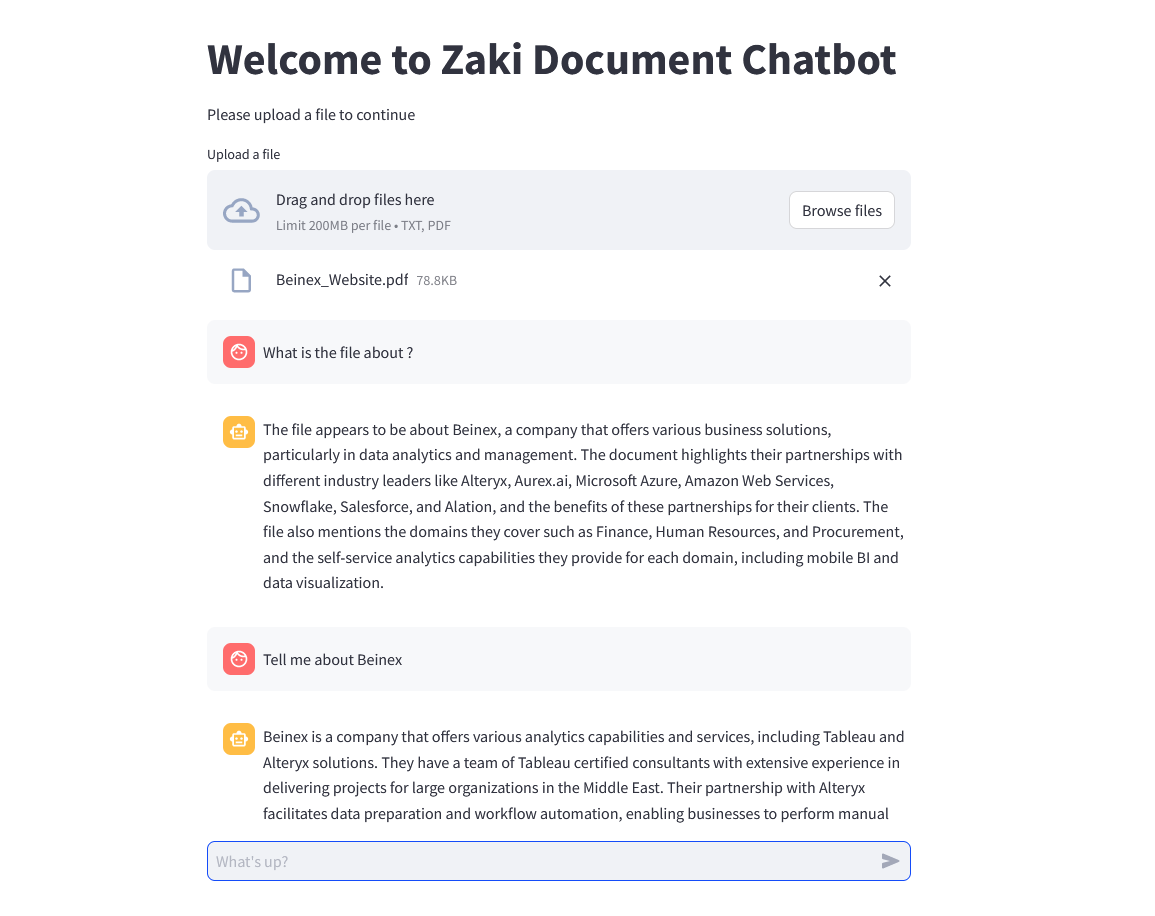 Figure 2: Zaki Document Chatbot (DocAI) in action!
Superior AI apps courtesy of Llama 3: Allows organizations to harness the full potential of this advanced LLM. Llama 3 offers avant-garde capabilities in natural language processing and generation, enabling the development of superior AI applications with enhanced performance, accuracy, and efficiency.
Data residency: Ensures that organizations maintain control over their data residency.
With Snowflake's robust data governance and compliance features and Llama 3's deployment within the same ecosystem, organizations can confidently adhere to data residency requirements and regulations, ensuring that sensitive data remains within specified jurisdictions or regions.
Scalability: Provides organizations with remarkable scalability for their AI applications.
This seamless scalability empowers organizations to handle large volumes of data and accommodate growing user demands without compromising performance.
Easy monitoring: Simplifies the monitoring and management of AI applications.
Snowflake's intuitive interface and comprehensive monitoring tools enable organizations to easily track the performance, usage, and health of their deployed Llama 3 models. It facilitates proactive identification of issues, optimization of resources, and overall better management of AI workloads, ensuring smooth and efficient operations.
By leveraging Llama 3 within Snowflake, organizations can alleviate data sovereignty and control concerns. They can rest assured that their precious and sensitive data remains within their realm of control while still being able to build and scale superior applications. This development marks a significant milestone in bridging the gap between data residency requirements and accessing the most effective LLM technology.
-Mebin Joy
Figure 1: Screenshot from DocAI. Zaki Document Chatbot (DocAI) tapping into Llama 3 by Meta and running in the Snowflake ecosystem.
Beinex tested Llama 3 on its in-house DocAI, a solution that runs on Snowflake using Snowpark Container services. The DocAI chatbot solution offers the flexibility to chat with documents such as PPT, PDF, word files, and text files. It currently uses llama3. Llama 3 is a major leap forward, establishing new standards for large language models. Its extensive training data, improved quality, and increased context length make it a powerful choice for document-related tasks, including our DocAI chatbot solution. The article will explain how Beinex deployed Llama 3 in the Snowflake ecosystem in the upcoming sections.
Recently, notable advances have been made in large language models — sophisticated natural language processing (NLP) systems equipped with billions of parameters. These models have demonstrated remarkable abilities, including generating creative text, solving complex mathematical theorems, predicting protein structures, and more. They illustrate the immense potential benefits that AI can offer to billions of people on a global scale.
Meta’s Llama (Large Language Model Meta AI), a state-of-the-art foundational large language model, is designed to support researchers in advancing their work within AI. By providing access to smaller yet highly efficient models like Llama, Meta aimed to empower researchers who may not have access to extensive infrastructure to delve into the study of these models. This democratization of access is pivotal in fostering innovation and progress in this dynamic and crucial field.
What is Llama 3?
Meta's latest advancement in the LLM (Large Language Model) series is Llama 3, the most sophisticated model with considerable advancements in performance and AI capabilities. Llama 3, built upon the architecture of Llama 2, is offered in 8B and 70B parameters, each featuring a base model and an instruction-tuned version tailored to enhance performance in specific tasks, particularly AI chatbot conversations. According to Meta, Llama 3 sets a new standard for open-source models, rivalling the performance of proprietary models available today. Llama 3 models will soon be accessible across various platforms, including AWS, Google Cloud, Hugging Face, Databricks, Kaggle, IBM Watson, Microsoft Azure, NVIDIA NIM, and Snowflake. Capabilities such as reasoning, code generation, and instruction following have seen substantial enhancements, rendering Llama 3 more adaptable and controllable. Meta plans to introduce additional capabilities, longer context windows, expanded model sizes, and enhanced performance. Utilizing Llama 3 technology, Meta AI emerges as one of the premier AI assistants globally, offering intelligence augmentation and support across various tasks, including learning, productivity, content creation, and connection facilitation.Llama 2 vs Llama 3
According to Meta, the newly introduced models, Llama 3 8B with 8 billion parameters and Llama 3 70B with 70 billion parameters, represent a significant advancement in performance compared to their predecessors, Llama 2 8B and Llama 2 70B. Meta describes these models as a ‘major leap’ in performance. Llama 2 serves research and commercial purposes, excluding the top consumer companies globally. Llama 2 boasts enhancements such as training on 40% more data, doubling the context length, and leveraging a vast dataset of human preferences to ensure safety and helpfulness, backed by over 1 million annotations. On the other hand, Llama 3 represents the next step in Meta AI's LLM evolution, catering to research and commercial applications, provided monthly active users are under 700 million. Positioned as the successor to Llama 2, Llama 3 showcases state-of-the-art performance on benchmarks and is lauded by Meta as the 'best open-source model of their class.'Ollama
There were times when accessing Large Language Models (LLMs) was restricted to cloud APIs offered by major providers like OpenAI and Anthropic. While these cloud API providers continue to dominate the market with user-friendly interfaces facilitating easy access for many users, it's important to recognize the trade-offs users make beyond the costs associated with pro plans or API usage. This trade-off involves granting providers full access to chat data. For those seeking to securely run LLMs on their hardware, the alternative has typically involved training their LLMs. Ollama, an open-source application, is designed to enable users to run, create, and share large language models locally through a command-line interface on MacOS and Linux. With Ollama, running LLMs on personal hardware requires minimal setup time. It caters to individuals seeking to run LLMs on their laptops, maintain control over their chat data without involving third-party services, and interact with models through a straightforward command-line interface. Additionally, Ollama offers various community integrations, including user interfaces and plugins for chat platforms.Deploying Llama 3 in the Snowflake Ecosystem: What Beinex Did?
Deploying Llama 3 in the Snowflake Ecosystem means integrating the advanced language capabilities of Llama 3, the latest version of Meta’s language model, into the Snowflake data platform. It represents a significant breakthrough for organizations seeking to maintain control over their data. It allows users to directly leverage Llama 3's powerful natural language processing capabilities within Snowflake for various tasks such as data analysis, querying, and generating insights.
Figure 2: Zaki Document Chatbot (DocAI) in action!
Deploying Llama 3 in the Snowflake Ecosystem: How Beinex Did it?
Here’s a detailed guide on deploying Llama 3 on Snowflake Container Services: Step 1: Create Necessary Objects -- Run by ACCOUNTADMIN to allow connecting to Hugging Face to download the model -- Stage to store LLM models CREATE STAGE <stagename> IF NOT EXISTS models DIRECTORY = (ENABLE = TRUE) ENCRYPTION = (TYPE='SNOWFLAKE_SSE'); -- Stage to store YAML specs CREATE STAGE <stagename> IF NOT EXISTS specs DIRECTORY = (ENABLE = TRUE) ENCRYPTION = (TYPE='SNOWFLAKE_SSE'); <br. -- Image repository CREATE OR REPLACE IMAGE REPOSITORY images; -- Compute pool to run containers CREATE COMPUTE POOL GPU_NV_S MIN_NODES = 1 MAX_NODES = 1 INSTANCE_FAMILY = GPU_NV_S; Step 2: Docker Image Code - ollama FROM ollama/ollama RUN $(ollama serve > output.log 2>&1 &) && sleep 10 && ollama pull llama3 && pkill ollama && rm output.log ENTRYPOINT ["ollama"] CMD ["serve"] Step 3: Tag and Push the Docker Image docker tag ollama .registry.snowflakecomputing.com/db/schema/image respository /ollama docker push .registry.snowflakecomputing.com db/schema/image repository /ollama Step 4: Docker Image - UDF FROM python:3.11 WORKDIR /app ADD ./requirements.txt /app/ RUN pip install --no-cache-dir -r requirements.txt ADD ./ /app EXPOSE 5000 ENV FLASK_APP=app CMD ["flask", "run", "--host=0.0.0.0"] App.py content is given below : from flask import Flask, request, Response, jsonify import logging import re import os from openai import OpenAI client = OpenAI( base_url='http://ollama:11434/v1', api_key="EMPTY", ) model = "llama3" app = Flask(__name__) app.logger.setLevel(logging.ERROR) def extract_json_from_string(s): logging.info(f"Extracting JSON from string: {s}") # Use a regular expression to find a JSON-like string matches = re.findall(r"\{[^{}]*\}", s) if matches: # Return the first match (assuming there's only one JSON object embedded) return matches[0] # Return the original string if no JSON object is found return s @app.route("/", methods=["POST"]) def udf(): try: request_data: dict = request.get_json(force=True) # type: ignore return_data = [] for index, col1 in request_data["data"]: completion = client.chat.completions.create( model=model, messages=[ { "role": "system", "content": "You are a bot to help extract data and should give professional responses", }, {"role": "user", "content": col1}, ], ) return_data.append( [index, extract_json_from_string(completion.choices[0].message.content)] ) return jsonify({"data": return_data}) except Exception as e: app.logger.exception(e) return jsonify(str(e)), 500 Step 6: YAML File spec: containers: - name: ollama image: <SNOW_ORG-SNOW_ACCOUNT>.registry.snowflakecomputing.com/ db/schema/image respository /llama3 resources: requests: nvidia.com/gpu: 1 limits: nvidia.com/gpu: 1 env: NUM_GPU: 1 MAX_GPU_MEMORY: 24Gib volumeMounts: - name: llm-workspace mountPath: /<stage name> - name: udf image: .registry.snowflakecomputing.com/ db/schema/image respository /ollama_udf endpoints: - name: chat port: 5000 public: false - name: llm port: 11434 public: false volumes: - name: llm-workspace source: "@<llm stage_name>" Step 7: Upload YAML File and Create Service Upload the YAML file to the created stage, where the stage name in the YAML file should match the stage created in Step 2. -- Create service create service llama3 IN COMPUTE POOL<name of compute pool created> FROM @dash_stage SPECIFICATION_FILE = '<name of yaml file uploaded>'; Step 8: Create Service Function Create a service function on the service (after it starts). create or replace function llama3(prompt text) returns text service=llama3 endpoint=chat; Check Service Status Use the following command to check the status of the service: SELECT v.value:containerName::varchar container_name, v.value:status::varchar status, v.value:message::varchar message FROM ( SELECT parse_json(system$get_service_status('<service name>')) ) t, LATERAL FLATTEN(input => t.$1) v;Benefits of Deploying Llama 3 in the Snowflake Ecosystem

What’s New in Tableau's 2024.1 Release: Tableau Pulse, Metrics Layer, Viz Navigation, and More
Tableau's 2024.1 Release: What’s in it for you
Do your employees struggle to understand complex data visualizations? Does your organization lack a consistent approach to defining metrics? Are you looking for ways to make data more accessible for everyone? If you answered yes to any of these questions, then the new features in Tableau 2024.1 are for you! This release addresses these common challenges head-on, offering solutions like Viz Navigation for Text Tables, the Metrics Layer in Tableau Pulse, and more. Keep reading to learn more about these innovations and how they can revolutionize your data analysis workflows:
1. Tableau Pulse: Personalized Insights Delivered
Tableau Pulse is a real lifesaver, transforming how your organization interacts with data. Here's how it empowers your workforce:
To learn more about Tableau Pulse, click here: https://beinex.com/topics/tableau-ai-and-tableau-pulse-tableaus-dynamic-duo/
2. The Metrics Layer: Building a Unified Language for Data
Achieving consistency and clarity in data analysis is key to making informed decisions. The Metrics Layer within Tableau Pulse tackles this challenge by providing a central hub for defining and managing metrics.
Here's how it works:
By creating a unified language for data, the Metrics Layer empowers collaboration and drives data-driven decision making throughout your organization.
3. Tableau Pulse on Mobile: Stay on Top of Your Data Anywhere
Monitor key metrics and gain actionable insights, even when you're on the go. Tableau Pulse seamlessly integrates with Tableau Mobile, allowing you to access your personalized AI-powered insights directly from your smartphone or tablet.
Get a quick snapshot of your metrics:
Dive deeper for a comprehensive analysis:
This one-click access empowers everyone in your organization to make data-driven decisions, regardless of location. Tableau Pulse is available on both iOS and Android versions of Tableau Mobile.
4. Tableau Available Through AWS Marketplace: Streamlined Procurement and Deployment
For organizations leveraging the power of AWS cloud infrastructure, Tableau Cloud is now available on the AWS Marketplace. This integration offers several benefits:
5. Viz Navigation for Text Tables: Enhanced Accessibility
Tableau 2024.1 introduces a groundbreaking feature for exploring data visualizations: Viz Navigation for Text Tables. This innovative capability empowers users to navigate and interact with text tables using their keyboard or assistive technologies, removing the need for a mouse.
Benefits for all users:
This new feature signifies Tableau's commitment to making data accessible to everyone, regardless of their ability or preferred method of interaction.
6. Tableau Prep: Identify Duplicate Rows
Tableau Prep enables you to take control of your data quality. By removing or correcting duplicates, you can build trust in your data and generate reliable insights that drive better business decisions.
Effortlessly Spot Duplicates:- Remove identified duplicates to ensure a clean and accurate dataset.
- Fix the underlying issues causing the duplication, preserving valuable data points.
A New Era of Data-Driven Decision Making
With Tableau 2024.1 and Tableau Pulse, you have everything you need to democratize data across your organization. Empower your employees to leverage insights and make data-driven decisions that drive real business impact.
How Beinex Can Assist You
Beinex, a premier Tableau partner, provides sustainable analytics solutions to organizations and help to build superior data visual analytics capabilities internally through our bespoke training programs. Our team of Tableau-certified consultants are real-life Tableau business users who are passionate about Tableau and delivering a world-class experience. Connect with us for a Tableau free trial.