How AI Decision-Making is Improving Enterprise Outcomes
Blog
Share 
Snowflake's Evolution: A Look at the New Features in 2024
 19 April 2024
  Sumi S
 1. Snowpark Container Services:
This innovative feature allows you to deploy and manage containers directly within Snowflake. Imagine leveraging secure and scalable infrastructure, similar to Kubernetes, without leaving the Snowflake environment. Use containers to build and run data products like large language models and full-stack applications. You can even utilize containers from the Snowflake marketplace or create custom ones for sharing.
Getting started is simple. Create a Docker image with your code and dependencies, push it to a Snowflake registry, and then create a service, job, or function using the Snowpark API. Snowflake handles the rest, including provisioning, scaling, and monitoring your containers.
2. Snowpark Model Registry:
Data scientists and ML engineers require a secure and efficient way to manage and deploy machine learning models. Snowpark Model Registry, currently in public preview, addresses this need by providing a native solution within Snowflake. This integrated registry allows you to register, manage, and use models and their metadata directly in the platform.
The benefits of the Snowpark Model Registry are numerous:
3. Streamlit in Snowflake for Azure:
Snowflake's commitment to platform flexibility is evident in its expansion to Azure. The general availability of Streamlit in Snowflake for Azure empowers Python developers to create data applications directly within the Snowflake environment. Streamlit simplifies the creation of interactive dashboards and data visualizations, bridging the gap between data and actionable insights for business teams.Here's how Streamlit in Snowflake for Azure benefits users:
4. Security Enhancements in Snowflake Horizon:
Security is paramount for any data platform. Snowflake Horizon takes data security to the next level with a range of enhancements:
These security enhancements within Snowflake Horizon empower organizations to meet stringent compliance requirements and safeguard their valuable data assets.
5. Snowflake Unistore:
Snowflake Unistore is a game-changer for working with both transactional and analytical data within a single platform, often referred to as Hybrid Transactional/Analytical Processing (HTAP). This feature introduces the 'hybrid' table type, supporting fast single-row operations.
Hybrid tables utilize a new row-oriented store within Snowflake, enabling functionalities typically associated with transactional data stores:
Snowflake's global services layer and query engine seamlessly manage the underlying row and column stores, allowing you to join hybrid and standard tables natively.
6. Snowflake Iceberg:
The Apache Iceberg format acts as a metadata layer for data files stored in open formats like Parquet and ORC. It enables querying this data using SQL, regardless of the specific query engine (Spark, Hive, Impala).
'Snowflake Iceberg' leverages this open format, allowing you to directly query data files stored in cloud storage services like S3 buckets. This eliminates the need to move or copy data into Snowflake while maintaining interoperability for users already working with that data location.
Snowflake Iceberg offers significant advantages over the existing external table type:
7. Document AI:
Typically, data systems struggle with unstructured data formats like PDFs. Snowflake's answer to this challenge is Document AI, a tool currently in private preview. It allows you to process any document and answer questions using natural language without requiring machine learning expertise.
Document AI draws power from Snowflake's first-party large language model (LLM) built on Applica's generative AI technology. This, combined with Snowflake's support for unstructured data (announced in June 2023), empowers you to store, query, and analyze all data types within the platform.
Document AI represents just one facet of Snowflake's vision for generative AI and LLMs, a dominant trend in 2023 that is poised to continue its dominance in 2024.
Looking Ahead
Snowflake started strongly in 2024 with exciting releases like Snowpark Model Registry, Streamlit in Snowflake for Azure, and security enhancements in Snowflake Horizon. These anticipated features position Snowflake as a frontrunner in the data cloud landscape, offering a comprehensive data management, analytics, and application development platform.
Beinex + Snowflake Partnership
Beinex is a Snowflake Services Partner Premier Tier, and the partnership reaffirms Beinex’s commitment to delivering exceptional data solutions and positions the company at the forefront of industry advancements. Harnessing the true potential of the data, partnership drives innovation and success in the digital era. Belonging to Snowflake Services Partner Premier Tier, Beinex leverages Snowflake’s advanced capabilities and seamlessly integrates them into its comprehensive data solutions.
Snowflake's journey since its 2014 release as a "cloud data warehouse" has been nothing short of remarkable. It has continuously evolved, integrating functionalities from various systems into a unified platform. This transformation is evident in its current branding as a "cloud data platform" or the "data cloud."
A significant transformation kickstarted in Snowflake after the onset of 2024, with the introduction of features like full support for transactional workloads, advanced capabilities for Generative AI/LLMs (Large Language Models), and a fully containerized solution for app hosting. Let's delve into the most interesting and innovative features:
Related Articles

AWS Systems Manager: Proven Best Use Cases and a Real-World Success Story
AWS Systems Manager seamlessly operates with both Windows and Linux OS and integrates with CloudWatch metrics, CloudWatch Dashboard, and AWS Config. Moreover, it enables the creation of resource groups spanning various AWS services, allowing for aggregated operational data viewing and facilitating monitoring, troubleshooting, and resource group-specific actions.
Common use cases and best practices for AWS Systems Manager capabilities are listed below:
Automation
Inventory
Maintenance Windows
Parameter Store
Patch Manager
Run Command
Session Manager
State Manager
Managed Nodes
Case Study: A Global Cloud Solutions and Services Company Enhances Scalability and Efficiency with AWS Systems Manager
Client: A Global Cloud Solutions and Services Company
A technology services company that specialises in helping organisations across 120 countries adopt modern technologies and manage them efficiently. They focus on creating solutions for hybrid and multi-cloud environments.
Requirement: Finding Scalability on AWS Systems Manager
The client faced a significant challenge in managing multi-cloud environments at scale reliably and cost-effectively. Manually handling activities across hundreds of thousands of different compute instances was resource-intensive and delayed issue resolution. They needed a solution that could run both on-premises and on the cloud and wanted a single tool for managing their suite of solutions.>
Challenges
Process: Supporting Automation, Staff Productivity, and Transparency on AWS
The client began using AWS Systems Manager in 2015 for various products and extended its use to other cloud environments in 2019. Since 2019, the client has utilised AWS Systems Manager to power patching activities across all major cloud providers they support. They perform mass patching at scale, covering over 62,000 VMs across all their managed services. VM Management automates traditionally manual tasks like patching, agent distribution, server diagnostics, and issue remediation. It significantly reduces labour, costs, and errors associated with manual tasks, enhancing security and efficiency.
SmartTickets, a component in VM Management, handled thousands of incidents and automated responses using AWS Systems Manager, saving time and reducing costs for the company. They also used Amazon CloudWatch for monitoring and observability and automated runbooks for real-time monitoring and alerts.
AWS Systems Manager provides a single-pane view of environments, improving customer visibility and decision-making.
Result: Taking Automation to the Next Level on AWS
The client plans to develop custom runbooks with customers and further automate responses and resolutions using AWS Systems Manager. They have successfully solved industry challenges by saving time, cutting costs, and reducing complexity for both their customers and themselves.
Key Takeaway
The client leveraged AWS Systems Manager to streamline and automate their operations, resulting in improved efficiency, cost reduction, and enhanced customer satisfaction. With automation, they can swiftly respond to and resolve issues, meeting customer expectations effectively.
How Beinex Can Help You
Beinex is an AWS consulting partner, and we empower customers to host their BI solutions and much more on the cloud. Our cloud migration experts bring in best-in-class stability and reliability by understanding your business strategy and working closely with you to deploy AWS infrastructure as a service.
Top Picks: Tableau 2020.4
As a frequent user of Tableau Desktop and Server, check out my top picks from the list.
• Improved dynamic parameter
• Multiple marks layer support for maps
• Block comments in calculations
• Web authoring enhancements
• Offline map support for Tableau Server
• Tableau Server Management (TSM) improvements
• Multiple key activation on Tableau Server prior to TSM initialization
• Analytics Extension for Tableau Online
• Merge duplicate external assets
• Tableau Prep Builder in the browser
Tableau Desktop
Improved Dynamic Parameter
The dynamic parameter was one of the features which I used extensively starting from 2020.1. The feature allows us to populate parameter values based on a specified field whenever the workbook is opened. We will be able to select only the field with matching data types.
The feature update announced in Tableau 2020.4 gives me more privilege to customize the Dynamic Parameter. I can now set a parameter’s range to a field’s min and max value upon opening the workbook, or when the field’s data source is refreshed.
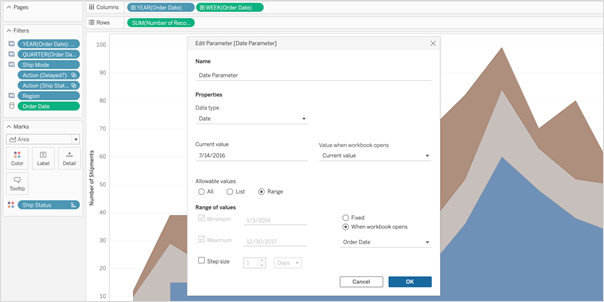 So, whenever I open the workbook or the extract is refreshed, Tableau displays the unique values within the range specified, giving more control over the parameter values displayed.
Multiple Marks Layer Support for Maps
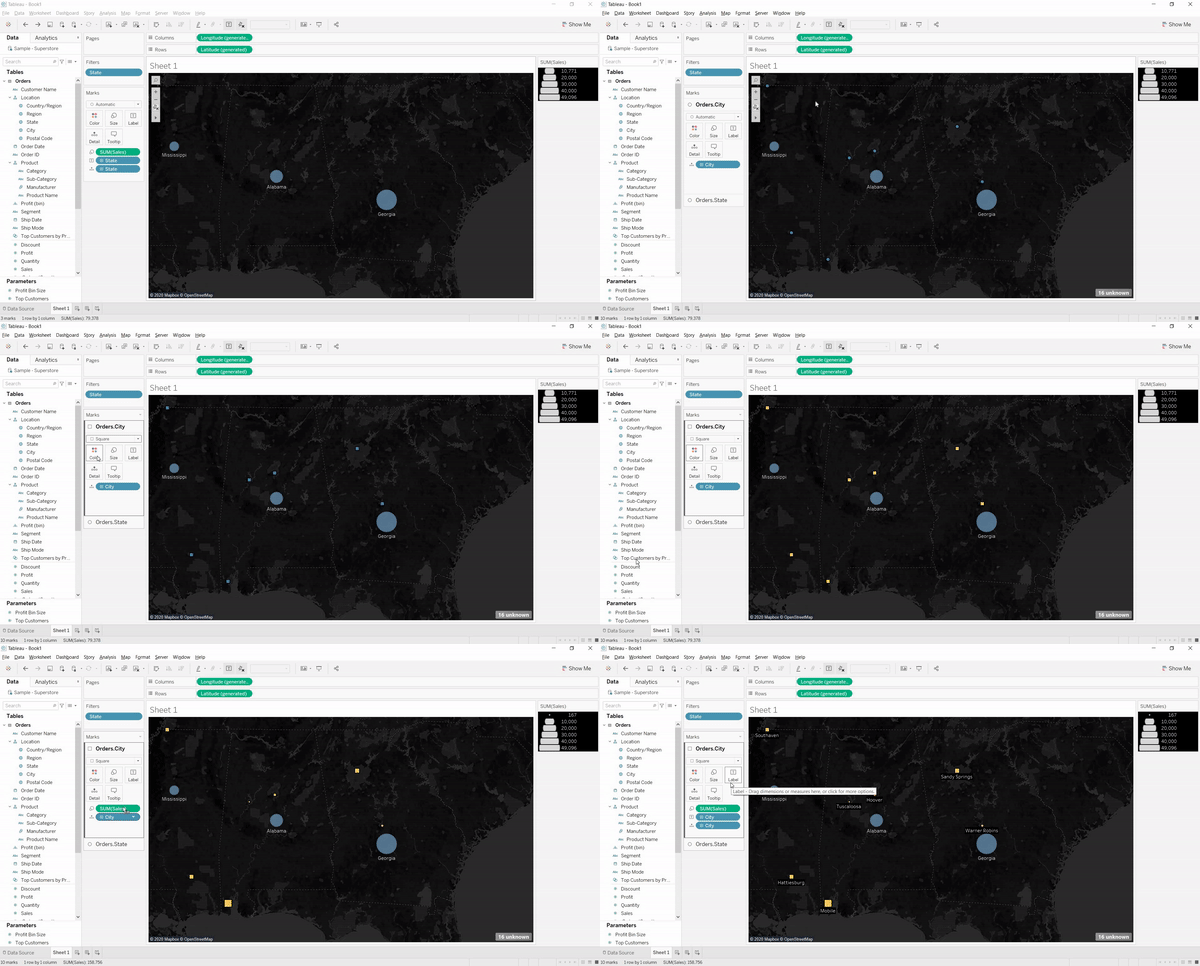
This is an exceptional feature to bring multiple spatial layers and context together to better understand and analyze geospatial data and map views. I will be able to include multiple marks layers from a data source to map visualizations and enhance the geospatial analysis. I can present more context in a single map view and perform further analysis with this feature.
So, whenever I open the workbook or the extract is refreshed, Tableau displays the unique values within the range specified, giving more control over the parameter values displayed.
Multiple Marks Layer Support for Maps
This is an exceptional feature to bring multiple spatial layers and context together to better understand and analyze geospatial data and map views. I will be able to include multiple marks layers from a data source to map visualizations and enhance the geospatial analysis. I can present more context in a single map view and perform further analysis with this feature.
 Block Comments in Calculations
Block comments is a simple yet one of the most useful features for me, which Tableau has announced in 2020.4. I often used to add comments in complex calculations for easy understanding in future references. Earlier, only single-line comments were possible, limiting the description I could add. But from now on, I can add comments of any length to calculation windows with block comments by simply starting the comment with /* and ending with */.
What makes it unique is that the new multi-line block comment feature is consistent with other popular programming languages. This feature is an example of Tableau’s on-going effort to provide its customers with an intuitive user experience.
Block Comments in Calculations
Block comments is a simple yet one of the most useful features for me, which Tableau has announced in 2020.4. I often used to add comments in complex calculations for easy understanding in future references. Earlier, only single-line comments were possible, limiting the description I could add. But from now on, I can add comments of any length to calculation windows with block comments by simply starting the comment with /* and ending with */.
What makes it unique is that the new multi-line block comment feature is consistent with other popular programming languages. This feature is an example of Tableau’s on-going effort to provide its customers with an intuitive user experience.
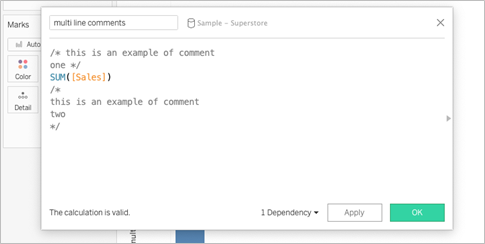 Tableau Server
Web Authoring Enhancements
Starting from Tableau 2020.4, it is possible to author dashboards from the browser just like how we design it in Tableau Desktop. With this web authoring enhancements, I can include Highlight actions, Format Mark Labels, apply filters to worksheets, create fixed sets, and even create extract in my workbooks from the browser itself. I no longer have to make changes from Tableau Desktop and publish it to the server. I can directly do it from the browser itself.
Tableau Server
Web Authoring Enhancements
Starting from Tableau 2020.4, it is possible to author dashboards from the browser just like how we design it in Tableau Desktop. With this web authoring enhancements, I can include Highlight actions, Format Mark Labels, apply filters to worksheets, create fixed sets, and even create extract in my workbooks from the browser itself. I no longer have to make changes from Tableau Desktop and publish it to the server. I can directly do it from the browser itself.
 Offline Map Support for Tableau Server
Rendering dashboards with maps is now faster compared to previous versions. Now, I can create maps using the offline map style in web authoring, ensuring the performance of map views in Tableau Server. Offline map support is a great deal for organizations with strict internet access restrictions, assuring that map view access to all its users.
Tableau Server Management (TSM) Improvements
Tableau Server Administration activities like installation, upgrade and backup are now easy like never before. I can retry installation or upgrade from the last checkpoint in case of an unexpected issue or error during installation or upgrade, saving my efforts to obliterate tableau server.
Backups can be performed twice as fast as previous versions, and I can monitor the progress with the new progress bar giving visibility into what step the backup is on and how much time is remaining.
Backups can also be scheduled using TSM command starting from 2020.4 and that is awesome. I no longer need to prepare batch script and depend on the windows task scheduler to schedule the backups on regular intervals; instead, I can schedule it with just a single command.
Multiple Key Activation on Tableau Server Prior to TSM Initialization
During Tableau Server installation, it is now possible to activate multiple license keys prior to TSM initialization. I will be able to save a lot of time by eliminating the need to restart after the installation is completed to activate multiple licenses and experience a smoother installation.
Analytics Extension for Tableau Online
The power of the Analytics extension is now unlocked in Tableau Online too. The feature was already available in Tableau Server, and it helped us dynamically perform advanced analysis with models and functions in R, Python and other platforms.
Analytics extension in Tableau Online significantly enhances the scope of using Advanced Analytics by the common users.
Merge Duplicate External Assets
Earlier, the Database or Table with similar names used to appear as multiple assets within Tableau Catalog. But, the new feature helps me to merge those multiple assets into a single one. I can manage assets easily and keep an organized view of External assets by merging the common ones.
Offline Map Support for Tableau Server
Rendering dashboards with maps is now faster compared to previous versions. Now, I can create maps using the offline map style in web authoring, ensuring the performance of map views in Tableau Server. Offline map support is a great deal for organizations with strict internet access restrictions, assuring that map view access to all its users.
Tableau Server Management (TSM) Improvements
Tableau Server Administration activities like installation, upgrade and backup are now easy like never before. I can retry installation or upgrade from the last checkpoint in case of an unexpected issue or error during installation or upgrade, saving my efforts to obliterate tableau server.
Backups can be performed twice as fast as previous versions, and I can monitor the progress with the new progress bar giving visibility into what step the backup is on and how much time is remaining.
Backups can also be scheduled using TSM command starting from 2020.4 and that is awesome. I no longer need to prepare batch script and depend on the windows task scheduler to schedule the backups on regular intervals; instead, I can schedule it with just a single command.
Multiple Key Activation on Tableau Server Prior to TSM Initialization
During Tableau Server installation, it is now possible to activate multiple license keys prior to TSM initialization. I will be able to save a lot of time by eliminating the need to restart after the installation is completed to activate multiple licenses and experience a smoother installation.
Analytics Extension for Tableau Online
The power of the Analytics extension is now unlocked in Tableau Online too. The feature was already available in Tableau Server, and it helped us dynamically perform advanced analysis with models and functions in R, Python and other platforms.
Analytics extension in Tableau Online significantly enhances the scope of using Advanced Analytics by the common users.
Merge Duplicate External Assets
Earlier, the Database or Table with similar names used to appear as multiple assets within Tableau Catalog. But, the new feature helps me to merge those multiple assets into a single one. I can manage assets easily and keep an organized view of External assets by merging the common ones.
 Tableau Prep
 Builder in the Browser
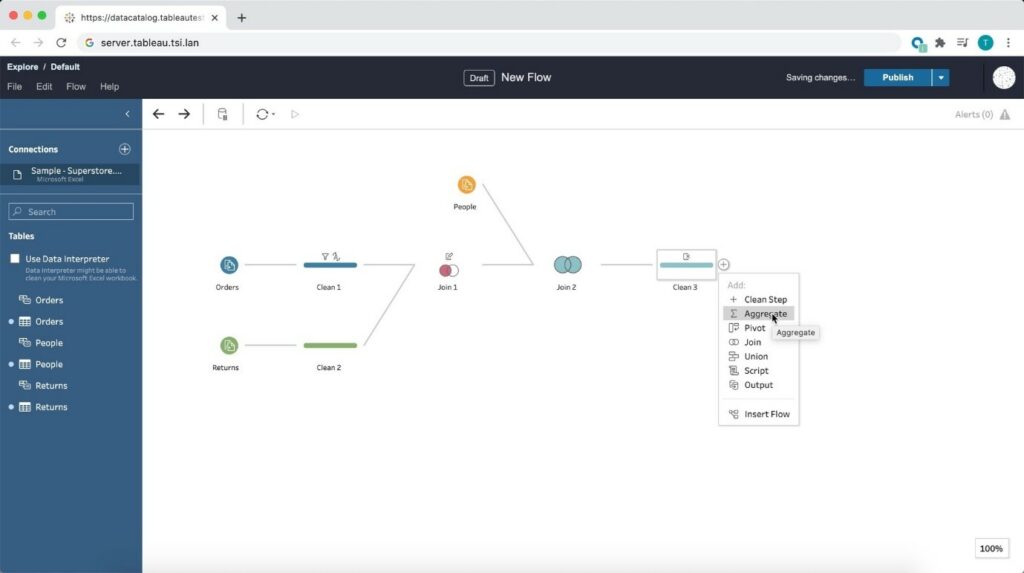
Prepare the data for visualizations from anywhere using a browser! Starting from 2020.4, Tableau is bringing the data prep process into one integrated platform on the web. Now I can easily prepare and manage prep flows from anywhere using a browser.
Tableau Prep
Tableau Prep Builder in the Browser
Prepare the data for visualizations from anywhere using a browser! Starting from 2020.4, Tableau is bringing the data prep process into one integrated platform on the web. Now I can easily prepare and manage prep flows from anywhere using a browser.
 Conclusion
Tableau is progressively evolving as a single platform for data preparations, visualization, and collaboration with every update and version release.
Author : Firdous Maqbool
Images Courtesy : Tableau
Conclusion
Tableau is progressively evolving as a single platform for data preparations, visualization, and collaboration with every update and version release.
Author : Firdous Maqbool
Images Courtesy : Tableau
So, whenever I open the workbook or the extract is refreshed, Tableau displays the unique values within the range specified, giving more control over the parameter values displayed.
Multiple Marks Layer Support for Maps
This is an exceptional feature to bring multiple spatial layers and context together to better understand and analyze geospatial data and map views. I will be able to include multiple marks layers from a data source to map visualizations and enhance the geospatial analysis. I can present more context in a single map view and perform further analysis with this feature.
Block Comments in Calculations
Block comments is a simple yet one of the most useful features for me, which Tableau has announced in 2020.4. I often used to add comments in complex calculations for easy understanding in future references. Earlier, only single-line comments were possible, limiting the description I could add. But from now on, I can add comments of any length to calculation windows with block comments by simply starting the comment with /* and ending with */.
What makes it unique is that the new multi-line block comment feature is consistent with other popular programming languages. This feature is an example of Tableau’s on-going effort to provide its customers with an intuitive user experience.
Tableau Server
Web Authoring Enhancements
Starting from Tableau 2020.4, it is possible to author dashboards from the browser just like how we design it in Tableau Desktop. With this web authoring enhancements, I can include Highlight actions, Format Mark Labels, apply filters to worksheets, create fixed sets, and even create extract in my workbooks from the browser itself. I no longer have to make changes from Tableau Desktop and publish it to the server. I can directly do it from the browser itself.
Offline Map Support for Tableau Server
Rendering dashboards with maps is now faster compared to previous versions. Now, I can create maps using the offline map style in web authoring, ensuring the performance of map views in Tableau Server. Offline map support is a great deal for organizations with strict internet access restrictions, assuring that map view access to all its users.
Tableau Server Management (TSM) Improvements
Tableau Server Administration activities like installation, upgrade and backup are now easy like never before. I can retry installation or upgrade from the last checkpoint in case of an unexpected issue or error during installation or upgrade, saving my efforts to obliterate tableau server.
Backups can be performed twice as fast as previous versions, and I can monitor the progress with the new progress bar giving visibility into what step the backup is on and how much time is remaining.
Backups can also be scheduled using TSM command starting from 2020.4 and that is awesome. I no longer need to prepare batch script and depend on the windows task scheduler to schedule the backups on regular intervals; instead, I can schedule it with just a single command.
Multiple Key Activation on Tableau Server Prior to TSM Initialization
During Tableau Server installation, it is now possible to activate multiple license keys prior to TSM initialization. I will be able to save a lot of time by eliminating the need to restart after the installation is completed to activate multiple licenses and experience a smoother installation.
Analytics Extension for Tableau Online
The power of the Analytics extension is now unlocked in Tableau Online too. The feature was already available in Tableau Server, and it helped us dynamically perform advanced analysis with models and functions in R, Python and other platforms.
Analytics extension in Tableau Online significantly enhances the scope of using Advanced Analytics by the common users.
Merge Duplicate External Assets
Earlier, the Database or Table with similar names used to appear as multiple assets within Tableau Catalog. But, the new feature helps me to merge those multiple assets into a single one. I can manage assets easily and keep an organized view of External assets by merging the common ones.
Tableau Prep
Tableau Prep Builder in the Browser
Prepare the data for visualizations from anywhere using a browser! Starting from 2020.4, Tableau is bringing the data prep process into one integrated platform on the web. Now I can easily prepare and manage prep flows from anywhere using a browser.
Conclusion
Tableau is progressively evolving as a single platform for data preparations, visualization, and collaboration with every update and version release.
Author : Firdous Maqbool
Images Courtesy : Tableau
Explore the Latest Advancements in AWS Storage Solutions
AWS Storage Solutions
AWS offers a comprehensive array of storage solutions tailored to specific use cases and demands. These include Amazon S3, Amazon EBS, Amazon EFS, Amazon Glacier, AWS Storage Gateway, Amazon FSx, and the AWS Snow Family. Each service is designed to address storage needs, from simple data storage to high-performance file systems and large-scale data transfer.
Here are some of the key storage solutions provided by AWS: Amazon S3 (Simple Storage Service):Latest Developments in AWS Storage Services
Over the past two quarters, AWS has introduced several exciting enhancements to its storage services, offering users greater flexibility and efficiency in managing their data. Let's delve into these notable updates:
AWS Backup's Local Time Zone Support
AWS Backup is a fully managed service that simplifies data protection across AWS services and hybrid workloads. The latest enhancement allows users to select their local time zone when creating or modifying backup plans. This eliminates the need for manual time zone conversions from UTC, making backup scheduling more user-friendly and convenient.
Amazon S3's Multivalue Answer for DNS Queries
Amazon S3 now offers Multivalue Answer (MVA) support for responding to DNS queries for S3 endpoints. With MVA, users can obtain up to eight S3 IP addresses per DNS query. This feature enables the automatic establishment of multiple concurrent connections to S3, potentially boosting throughput significantly. Moreover, MVA enhances retry operation efficiency by allowing applications to automatically attempt an alternative IP address without waiting for another DNS query. These improvements give users more robust and efficient access to Amazon S3 services.
General Availability of Mountpoint for Amazon S3
AWS has announced the general availability of Mountpoint for Amazon S3, an open-source file client that offers high-throughput access to Amazon Simple Storage Service (Amazon S3). This innovation reduces processing times and compute costs for data lake applications. Mountpoint for Amazon S3 acts as a file client that translates local file system API calls into S3 object API calls, including GET and PUT operations.
This feature is particularly valuable for workloads involving reading large datasets, ranging from terabytes to petabytes in size, and requiring the scalability and high throughput offered by Amazon S3. Use cases include machine learning training, reprocessing, autonomous vehicle data processing validation, and more. It supports sequential and random read operations on existing files and sequential write operations for creating new files. These capabilities enhance the efficiency of processing large-scale data stored in Amazon S3, making it a valuable tool for data-intensive applications.
Amazon S3 Glacier Flexible Retrieval Enhancements
Amazon S3 Glacier Flexible Retrieval has significantly improved data restore times, reducing them by up to 85%, and this improvement comes at no additional cost. These faster data restores are automatically applied to the Standard retrieval tier when Amazon S3 Batch Operations are used. Objects begin to be returned within minutes of initiating the restore process, facilitating quicker processing of restored data.
This enhancement benefits various tasks, such as transcoding media, restoring operational backups, training machine learning models, and analysing historical data. Leveraging S3 Batch Operations, archived data can be efficiently restored on a large scale by showing the objects to be retrieved and specifying the retrieval tier. The Standard retrieval tier now initiates restoring things within minutes, a substantial improvement compared to the previous 3–5 hour wait time. Overall restore throughput is also enhanced, thanks to new performance optimisations, enabling faster data workflows and quicker responses to business requirements.
AWS Backup Audit Manager's Delegated Backup Administrator Support
With AWS Organizations, the delegation of backup management has been expanded beyond the management account to dedicated administration accounts. This means that delegated administrators can now assume backup management responsibilities. As part of this launch, delegated backup administrators can centralise report generation and management on a large scale through AWS Backup Audit Manager. This feature is designed for auditing and reporting on data protection posture compliance.
Project Quotas Support in Amazon FSx for Lustre
Amazon FSx for Lustre, a fully managed service for high-performance file systems, now supports project quotas. This update allows users to easily group multiple files or directories within the file system into distinct projects and monitor storage usage per-project basis. Project quotas are particularly valuable for storage administrators responsible for managing file systems serving multiple projects or teams. This feature ensures no project exceeds its designated storage capacity, helping maintain effective resource allocation and control within the file system.
Beinex+ AWS Offerings
Beinex is an AWS consulting partner, and we empower customers to host their BI solutions and much more on the cloud. Our cloud migration experts bring in best-in-class stability and reliability by understanding your business strategy and working closely with you to deploy AWS infrastructure as a service.
AWS's commitment to innovation ensures that its storage solutions will remain at the forefront of the industry, providing users with the cutting-edge tools and capabilities required to thrive in the digital age. Embrace AWS storage solutions' possibilities and stay ahead in your data management endeavours.

BEINEX CONSULTING WINS ALTERYX 2020 PARTNER OF YEAR AWARDS, MIDDLE EAST
Beinex Consulting has been awarded as the Alteryx 2020 Partner of the Year, Middle East at the Alteryx Partner Summit and Awards virtual event along with 15 other winners from North America, LATAM, and EMEA.
 During the Alteryx Summit, ‘Your Road to Revenue’, Alteryx celebrated the achievements and commitment of their partners to the Alteryx business and its customers. Beinex Consulting was awarded on the level of engagement in the Alteryx partner program and its efforts around driving innovation, growing revenue, and empowering Alteryx customers to solve our world’s most pressing business and societal issues in the Middle East Region.
Selected among top Middle East Alteryx partners, Beinex demonstrated excellence in delivering end-to-end analytics transformation services that revolutionised multiple industries in the Middle East.
Beinex Consulting Founder and Managing Director, Indumon Das indicates further growth for the digital transformation organisation soon: “Beinex continues to make strategic investments to enhance our association with Alteryx and clients in major Middle East markets. This award is a recognition to our continuous growth strategy and focus to be the best Middle East partner”
“Through their ongoing pledge to the Alteryx Partner Program, our partners have demonstrated their commitment to helping Alteryx customers break down barriers and deliver game-changing insights.” – Josh Lewis, VP, Global Channels, Alteryx
About Beinex Consulting
Beinex is a digital transformation organization with a broad range of analytics modernization and training services. As a pioneer in analytics and cloud transformation, Beinex’s mission is to transform the way individuals and the organizations work with the data through innovation and experience. Beinex offers a broad range of robust and scalable business intelligence and analytics services to drive effective decision-making and create business value.
During the Alteryx Summit, ‘Your Road to Revenue’, Alteryx celebrated the achievements and commitment of their partners to the Alteryx business and its customers. Beinex Consulting was awarded on the level of engagement in the Alteryx partner program and its efforts around driving innovation, growing revenue, and empowering Alteryx customers to solve our world’s most pressing business and societal issues in the Middle East Region.
Selected among top Middle East Alteryx partners, Beinex demonstrated excellence in delivering end-to-end analytics transformation services that revolutionised multiple industries in the Middle East.
Beinex Consulting Founder and Managing Director, Indumon Das indicates further growth for the digital transformation organisation soon: “Beinex continues to make strategic investments to enhance our association with Alteryx and clients in major Middle East markets. This award is a recognition to our continuous growth strategy and focus to be the best Middle East partner”
“Through their ongoing pledge to the Alteryx Partner Program, our partners have demonstrated their commitment to helping Alteryx customers break down barriers and deliver game-changing insights.” – Josh Lewis, VP, Global Channels, Alteryx
About Beinex Consulting
Beinex is a digital transformation organization with a broad range of analytics modernization and training services. As a pioneer in analytics and cloud transformation, Beinex’s mission is to transform the way individuals and the organizations work with the data through innovation and experience. Beinex offers a broad range of robust and scalable business intelligence and analytics services to drive effective decision-making and create business value.

During the Alteryx Summit, ‘Your Road to Revenue’, Alteryx celebrated the achievements and commitment of their partners to the Alteryx business and its customers. Beinex Consulting was awarded on the level of engagement in the Alteryx partner program and its efforts around driving innovation, growing revenue, and empowering Alteryx customers to solve our world’s most pressing business and societal issues in the Middle East Region.
Selected among top Middle East Alteryx partners, Beinex demonstrated excellence in delivering end-to-end analytics transformation services that revolutionised multiple industries in the Middle East.
Beinex Consulting Founder and Managing Director, Indumon Das indicates further growth for the digital transformation organisation soon: “Beinex continues to make strategic investments to enhance our association with Alteryx and clients in major Middle East markets. This award is a recognition to our continuous growth strategy and focus to be the best Middle East partner”
“Through their ongoing pledge to the Alteryx Partner Program, our partners have demonstrated their commitment to helping Alteryx customers break down barriers and deliver game-changing insights.” – Josh Lewis, VP, Global Channels, Alteryx
About Beinex Consulting
Beinex is a digital transformation organization with a broad range of analytics modernization and training services. As a pioneer in analytics and cloud transformation, Beinex’s mission is to transform the way individuals and the organizations work with the data through innovation and experience. Beinex offers a broad range of robust and scalable business intelligence and analytics services to drive effective decision-making and create business value.
We are thrilled to recognize Beinex Consulting for being named Alteryx Middle East Partner of the Year!https://t.co/xwmp7HbsMp#TogetherWeSolve pic.twitter.com/4zic9mdlgD
— Alteryx (@alteryx) October 1, 2020

Digital Transformation in Banking: The Golden Touch of RPA
The brick-and-mortar banking model faced an existential threat with the emergence of Fintech (financial technology), or new technology that aims to enhance and automate the delivery and use of financial services. And later, new-gen technology companies started to deliver these services on secure digital platforms at a lower cost, resulting in traditional banks adopting advanced technology too.
Most banks were apprehensive about adopting automation to the finance function. This concern is frequently centered on whether it is possible to replace existing systems entirely with automation. The core banking system is perhaps the best example. Automating ‘untouchable’ core functions is not necessary. Instead, it can deal with the issues that surround them. But rooting your digital transformation in all other banking processes in intelligent, digital workflows is feasible.
What is digital banking?
Digital banking involves digitising all traditional banking products, procedures, and activities to serve customers through online channels. Examples include obtaining bank statements, cash withdrawals, funds’ transfers, accounts management and checking opening deposit accounts, loan management, bill payment, cheque management, and transaction records monitoring.
With digital banking, all banking services are accessible round-the-clock on mobile phones, PCs, and other intelligent devices. Thanks to digital banking software, all traditional services are now easier to obtain, comprehend, and manage.
Leading banks in the UAE make significant financial investments in the digital transformation of their banking operations and launch digital-only banks in the country.
Pros of digital banking
Here are some of the most known benefits of digital banking:1. Scalability
Numerous functions provided by digital banks are just absent from traditional banks. This includes investing directly in stock markets and acquiring cryptocurrency and gold using the banking app. The user of digital banking can modify their security preferences, transaction caps, and even whether they wish to enable NFC or magnetic stripe transactions.
2. Personalisation
In digital banking, sophisticated personalisation tactics are powered by artificial intelligence (AI) and machine learning (ML). Customers can get timely financial solutions, interactive tools, and instructional resources from banks. Automatic budgeting, expenditure analytics, and savings reminders are a few technologies that can inform and engage customers.
3. Cost savings
Traditional banks spend a lot of time and expense on the checking and accounting processes. The elimination of unnecessary operations is what makes digital banking software's operational costs less expensive. With digital banking systems, banks may take on less labour by automating the procedures related to routine transactions. Because fewer persons and stages are required for transactions when technology is used, there is a lower chance of financial mistakes, and money transfers are more straightforward.
The touch of automation
Let’s also look at the most automated processes in the banking industry that have undergone complete digitization with the touch of automation.
1. Loan processing
RPA or Robotic Process Automation can reduce lengthy procedures that typically take months to as little as 10–15 minutes. Automation enables essential data extracted from customer-submitted documents to validate all details. Systems employ Machine Learning to make better-informed judgments based on data analytics supported by more straightforward statistical methods. Intermediary bots infer business logic and ask the user to correct any inaccurate entries to ensure safer loan judgments and automatic confirmation letter creation
2. Know Your Customer (KYC)
Not only is Know Your Customer (KYC) a necessary compliance procedure for any bank, but it is also the trickiest. To execute the customer checks, this process requires at least 150 and maybe thousands of FTEs.
According to Thomson Reuters, a small number of banks annually invest at least $500 million in KYC compliance. Banks have recently begun utilising RPA to gather and flawlessly check consumer information to cut costs and resources. Because of this, banks can now complete the KYC procedure with fewer resources and mistakes.
3. Anti-Money Laundering (AML)
One of the most data-intensive processes, AML, can be made simpler with some help from Robotic Process Automation (RPA). Implementing RPA has proven more efficient than labour-intensive traditional banking solutions in identifying suspicious banking transactions or automating repetitive operations.
4. Fraud Detection
Banks are concerned about enhancing their fraud detection system due to the rising banking fraud scenario. Banking fraud has increased since the introduction of cutting-edge technologies. Considering this, it is virtually hard for banks to manually review each transaction to spot fraud trends in real-time. RPA cleverly uses the "if-then" principle to spot any potential fraud and report it for prompt resolution with the relevant department.
5. Mortgage processing
Both banks and their clients find mortgage processing extremely labour-intensive and cumbersome. Before processing each loan request, banks manage their mortgage procedure for more than a month, going through several unnerving stages like job verification, credit checks, and inspection. The processing of mortgage loans could be severely delayed by even the slightest mistake made by either the customer or the bank.
But RPA has accelerated this process for banks. Robotics goes through a defined set of rules to eliminate potential bottlenecks and speed up mortgage processing.
Customer acceptance of digital banking services has rapidly increased throughout the UAE. According to bankers, the older generation, initially apprehensive, is now quickly adjusting, whereas younger clients are quick to accept digital offerings and digital-only platforms. Digital banks are drawing a lot of new consumers due to lower account maintenance expenses and improved deposit returns.
How Beinex can help you
Beinex is a Dubai-based digital transformation organisation anchored in innovation, creativity, and unrivalled customer service. Our extensive analytics modernisation and training services will empower you to construct an intelligent and dynamic banking enterprise. Our extensively experienced consultants enable a seamless digital experience for the banking industry.