How AI Decision-Making is Improving Enterprise Outcomes
Blog
Share 
الخدمة الذاتية
 23 September 2019
  Team Beinex
 الخدمة الذاتية لتحليلات التدقيق: قم بتغيير طريقتك في التعامل
على الرغم من أن تحليلات البيانات وتقنيات التدقيق المحوسبة (CAAT) كانت ولا زالت جزءًا من التدقيق لما يقرب من 30 عامًا، لا تزال العديد من المؤسسات تواجه الكثير من الصعاب في عملية تنفيذ تحليلات البيانات الفعالة لتعزيز جودة التدقيق الداخلي وفاعليته. ولذلك يقدم الخبراء في بينيكس للاستشارات المشورة والمساعدة.
تتطلب التعقيدات المتزايدة للمخاطر والظهور المستمر للتقنيات التخريبية تغييرًا جوهريًا في عمليات التدقيق الداخلي. في الوقت الحاضر الذي يشهد اضطرابًا مستمرًا، يجب أن يتطور التدقيق الداخلي إلى وظيفة ديناميكية وموائمة لتطلعات المستقبل. فما الذي يعيق الطريق؟
انقر هنا لقراءة المميزات الكاملة التي تقدمها بينيكس للاستشارات.
-
Related Articles
TABLEAU 2020.3 NEW FEATURES – TOP PICKS
I’ve always been a huge Tableau fan as they never fail to impress me by bringing out new exciting features in every release. Tableau has yet again released a new version after a thorough research based on people’s experience, thoughts, and comments.
As a result, Tableau 2020.3 has an exciting feature with respect to Predictive modelling functions, especially useful to advanced analytics geeks. There are so many other new features which everyone will appreciate – such as IN operator for calculations, Search improvements in data pane, Data quality warnings on Tableau Server and many more!
Here are my top picks from the list.
The IN Operator
The much-awaited feature for the SQL lovers. The IN operator is a shorthand replacement for multiple OR functions. By using IN operator, we will be able to create concise calculation fields instead of never-ending lines of ‘OR’.
Let’s look into a simple use case by assuming that I am interested to know the sales value of ‘Apple Products’ compared to all other products, then I can use IN operator to with IF statement to group the products to “Apple Product” and “Other Products”
IF [Product Name] IN (‘Apple iPhone 5′,’Apple iPhone 5C’,’Apple iPhone 5S’) THEN “Apple Products” ELSE “Other Products” END
Predictive Modelling Function
Now the predictive genes would be happy to see more features on the prediction module of Tableau. With the added advantages of the functions MODEL_QUANTILE and MODEL_PERCENTILE, now the prediction function goes beyond the existing trendline analysis. Both the functions will help to build a model that understands how your data is distributed around a best-fit line.
MODEL_QUANTILE is a table calculation that returns a target value at a specified percentile, based on other predictors MODEL_PERCENTILE is a table calculation that returns the probability of the expected value being less than or equal to the observed mark, based on other predictors
 Search improvements in Data pane
While developing business specific dashboards, we need to create several calculations and its needs to be adjusted or new calculations needs to be created from existing calculations as per the business unit’s requirements.
With the newly added Search improvement feature, our lives are made easy by searching or filtering specific filed based on field name, type, or comments.
Search improvements in Data pane
Write to external databases in Tableau Prep
Write to external databases in Tableau Prep
The wow moment for prep is here with the introduction of the ability to output to a database. In all previous versions of Prep, we have been able to write to an extract file or csv, and now from the latest 2020.3 introduces the ability to output to a database. Currently supported databases are SQL Server, MySQL, PostgreSQL, Amazon Redshift, Snowflake, Oracle, and Teradata.
As shown in the below example, result from the flow can be saved to a data base table from the output step by choosing “Database table” option, specify your server connection (with login credentials) , choose the data base and then the table.
And now, Write to database will power the analytics journey by helping to solve the issues related to, data sources, data security and data governance
Open or Upload Workbooks On The Web within Tableau Server
Sharing your work and exploring insights from others just got easier. You can now open a Tableau workbook or upload it straight to the web without having to use Tableau Desktop. Simply select the workbook (.twb or .twbx) you want to upload and publish directly to your site on Tableau Server or Online. Only users with the appropriate publishing permissions will have the ability to upload content.
Open or Upload Workbooks On The Web within Tableau Server
Three refresh options are available, they are
Earlier prep was used mainly for
Set Data Quality Warnings on Tableau Server
Data quality warnings make it possible to let users know when a data asset is flagged, whether because the data is under maintenance, it’s stale, or some other reason. With high visibility data quality warnings, not only let users know about the issue but make sure they do not miss it.
Are you interested in learning more about Tableau’s new features or the features? Are you a Tableau user and would like to become a Tableau Champion?
If the answer to the above questions is a big “YES”, Please contact us at training@beinex.com/ info@beinex.com and we would be happy to schedule a Tableau demo or training for you and your company.
Search improvements in Data pane
While developing business specific dashboards, we need to create several calculations and its needs to be adjusted or new calculations needs to be created from existing calculations as per the business unit’s requirements.
With the newly added Search improvement feature, our lives are made easy by searching or filtering specific filed based on field name, type, or comments.
Search improvements in Data pane
Write to external databases in Tableau Prep
Write to external databases in Tableau Prep
The wow moment for prep is here with the introduction of the ability to output to a database. In all previous versions of Prep, we have been able to write to an extract file or csv, and now from the latest 2020.3 introduces the ability to output to a database. Currently supported databases are SQL Server, MySQL, PostgreSQL, Amazon Redshift, Snowflake, Oracle, and Teradata.
As shown in the below example, result from the flow can be saved to a data base table from the output step by choosing “Database table” option, specify your server connection (with login credentials) , choose the data base and then the table.
And now, Write to database will power the analytics journey by helping to solve the issues related to, data sources, data security and data governance
Open or Upload Workbooks On The Web within Tableau Server
Sharing your work and exploring insights from others just got easier. You can now open a Tableau workbook or upload it straight to the web without having to use Tableau Desktop. Simply select the workbook (.twb or .twbx) you want to upload and publish directly to your site on Tableau Server or Online. Only users with the appropriate publishing permissions will have the ability to upload content.
Open or Upload Workbooks On The Web within Tableau Server
Three refresh options are available, they are
Earlier prep was used mainly for
Set Data Quality Warnings on Tableau Server
Data quality warnings make it possible to let users know when a data asset is flagged, whether because the data is under maintenance, it’s stale, or some other reason. With high visibility data quality warnings, not only let users know about the issue but make sure they do not miss it.
Are you interested in learning more about Tableau’s new features or the features? Are you a Tableau user and would like to become a Tableau Champion?
If the answer to the above questions is a big “YES”, Please contact us at training@beinex.com/ info@beinex.com and we would be happy to schedule a Tableau demo or training for you and your company.
Search improvements in Data pane
While developing business specific dashboards, we need to create several calculations and its needs to be adjusted or new calculations needs to be created from existing calculations as per the business unit’s requirements.
With the newly added Search improvement feature, our lives are made easy by searching or filtering specific filed based on field name, type, or comments.
Search improvements in Data pane
Write to external databases in Tableau Prep
Write to external databases in Tableau Prep
The wow moment for prep is here with the introduction of the ability to output to a database. In all previous versions of Prep, we have been able to write to an extract file or csv, and now from the latest 2020.3 introduces the ability to output to a database. Currently supported databases are SQL Server, MySQL, PostgreSQL, Amazon Redshift, Snowflake, Oracle, and Teradata.
As shown in the below example, result from the flow can be saved to a data base table from the output step by choosing “Database table” option, specify your server connection (with login credentials) , choose the data base and then the table.
And now, Write to database will power the analytics journey by helping to solve the issues related to, data sources, data security and data governance
Open or Upload Workbooks On The Web within Tableau Server
Sharing your work and exploring insights from others just got easier. You can now open a Tableau workbook or upload it straight to the web without having to use Tableau Desktop. Simply select the workbook (.twb or .twbx) you want to upload and publish directly to your site on Tableau Server or Online. Only users with the appropriate publishing permissions will have the ability to upload content.
Open or Upload Workbooks On The Web within Tableau Server
Three refresh options are available, they are
Create table- if the table is an already existing one, it will be deleted
Append to Table –Without impacting the existing records, data will be added as new records
Replace Data – This selection will Replaces data in the existing table.
Preparing data so that it can be used in extract refresh of exiting tableau dashboards
Generic data preparations and export to csv
TABLEAU IS UPGRADED TO 2021.3: LET CELEBRATIONS CONTINUE FROM THE LAST QUARTER
When the sliver of thought -- that we have seen all that Tableau can do -- crosses our mind, just pay witness to a meteor shower of new features lighting the horizon up! Tableau is officially upgraded to 2021.3.
Tableau 2021.2 was a remarkable update in itself: it included ‘ask and explain data’ for viewers, allowing connected desktops, Collections, and many more valuable options and features.
So, what does the latest upgrade feature? In one go, the following list encapsulates the whole gamut of supplements:


- Improvements to Data Prep Experience
- Linked tasks
- Generate rows
- Improvements to Tableau Catalog
- Data quality warnings in subscription emails
- Inherited descriptions in web authoring
- Slack Integration
- Additional Features
- Customise the set of workbooks on the homepage
- Rename published data sources directly in Tableau Online or Server
- Authors of a flow can get alerted automatically provided any of the jobs fail and can set up an appropriate warning on the data for consumers well in advance.
- Any flow can be scheduled by customers, or they can extract refresh to run when new data arrives, saving them time and resources.
(Image 1: Linked Tasks on Tableau Prep)
Besides, Tableau Prep Conductor can generate a set of rows that are otherwise missing based on dates, date times, or integers. This is of huge importance as it allows users to fill gaps in data quite easily to ultimately ensure that processes downstream have all the requisite datasets to work on and create highly accurate and precise visualisations. Please see Image 2 for a quick understanding of the feature:
(Image 2: Generate rows on Tableau Prep)
Improvements to Tableau Catalog Next in the line comes improvements to Tableau Catalog. Two features need special mentioning:- Data quality warnings in subscription emails, and
- Inherited descriptions in web authoring
- Shared content
- Data-driven alerts
- @mention
(Image no.3)
Add to this the ability to rename published data sources directly in Tableau Online or Server on the data source page; the upgrade is a real treat to data rockstars. (See image no. 4) Practitioners point out that The REST API can also be used when changing a large number of workbooks to minimise efforts.
(Image no.4)
No need to generate a newly published data source to change the name. No need to manually change all workbooks on the Desktop to use that newly published data source, which was highly frustrating! So, welcome to Tableau 2021.3. Let us uncomplicate and perpetually so! Co-Author : Rakesh Neelakandan
One Suite and Project and Performance Management in One Go
Introducing Enterprise Project Management and Enterprise Performance Management (STRACT) solutions:
Enterprise Project Management
Project management is akin to running a small city. An innumerable number of projects, resources, and deadlines are to be taken care of, along with budget management, proper risk prediction and communication. It is stressful to handle so many things, and finally, it results in never-ending email chains, missed deadlines and dissatisfied clients. Despite this, managers fail to find solutions for all these nerve-wracking issues.
Projects are completed frequently under enormous time constraints that result in poor quality output. Every client has strategic goals, and poor project management ruins their objectives. Project management is critical in this case because projects that veer off course or fail to adapt to business needs may be costly and inappropriate.
Well, what is the proper solution?
Enterprise Project Management solution from Beinex Digital assists businesses in accurately measuring & controlling scope and consistently delivering projects aligned with business goals to ensure project success. A standalone tool for niche buyers with project portfolio management, resource management, risk management, demand management, and project analytics, this application can work wonders.
Beinex’s enterprise app is an ideal tool that act as a force multiplier in enhancing project management efficiency; the goal of the solution is to connect the company's goals with recurring projects to ensure that resources are directed to the right spot at the right time. It also entails managing the interdependent elements between projects and ensuring they are completed on time and within budget.
Use Cases
- Risk Analysis: Identification and mitigation of project risks
- Structured Estimating: Calculate the project's costs, resources, and duration
- Project Evaluations: Keep track of the current project portfolio's progress.
- Project Management Coaching: Entails providing project managers with training.
- Escalated Issue Management: Draw attention to critical issues.
- Time Management: Create a time management system
- Information System Management: Create a centralised management platform for information systems
Enterprise Performance Management (STRACT)
In today's workforce, inefficient performance and management are roadblocks leading to heavy financial losses. Traditional data collection, validation, budgeting, forecasting, and reporting approaches are time-consuming and inaccurate. The regularity of mundane tasks drains employees' energy and keeps them away from value-added assignments.
So, what is the remedy?
Enterprise Performance Management (EPM) is essentially a set of management processes, often aided by technology, which supports the improvement of strategic decisions made by people in organisations daily. The quality of those decisions distinguishes successful businesses from the rest. As a result, performance management is a broad term for a set of management approaches that enable organisations to define and execute their strategy and measure and monitor performance to inform strategic decision-making and learning.
STRACT by Beinex is an indisputably efficient tool that helps deliver optimised business performance. It allows businesses to forecast, track, assess, and identify areas for improvement across all operations. Companies can thoroughly and comprehensively analyse all relevant financial and operational metrics across various levels of the business by consolidating data and performance metrics into one centralised database and then measuring this against their strategic goals.
STRACT is a comprehensive solution with features that allow you to create more accurate and flexible budgets, which will enhance your current business and resource planning and forecasting. It has a Performance Cockpit that has a comprehensive performance management interface with modules covering the creation, editing and maintenance of performance.
Use cases
Consolidation of Financial Statements: Equity roll-ups, minority interest calculations, intercompany transactions, and currency translation adjustments are consolidated.
Financial Close: Improving business processes and efficiency within the Finance Department to streamline the monthly, quarterly, and year-end close.
Financial Reporting: It is essential whether you are a public company reporting to the SEC or a private company reporting to your stakeholders.
Financial Planning and Analysis: It includes trend analysis, variance analysis, line-item detail, and commentary.
Operational Planning: Capacity and Demand Planning, Sales and Marketing Planning, and Capital Expenditures (CAPEX) Planning are examples of operational planning.
Strategic Planning: It can model long-term capital, working ratios, and acquisitions and divestitures.
Real-Time Decision Making: With better data, subject matter experts can make better decisions faster.
These are the features that facilitate both EPM and STRACT:
Three-way Multi-factor Authentification: Fully secure platform with User Authentication, SMS OTP and Captcha Confirmation and dedicated user access management and control page.
Activity Tracking and Notification: Keeps track of progress status through designated stages of the project lifecycle and maintains transaction logs for Audit purposes and automated alerts and progress notification.
Interactive Dashboards and Reports: Simplified and interactive dashboard and reporting module to display project status dynamically with drill-down options. Automated reports allow real-time progress tracking.
Collaboration-based User Experience: Ability to collaborate and communicate on a Project line level with features to Add/ Edit tasks, upload attachments and communicate with other users through comments.
End-to-end Project Management: Comprehensive project management interface with modules covering the creation, editing and maintenance of Projects.

Transform Your Snowflake Operations with Beinex: Achieve Cost Efficiency, Real-Time Insights, and Accelerated Innovation
Cost Optimization
- • Real-time and Historical Cost Analysis: Leverage granular cost insights to identify and mitigate resource inefficiencies.
- • Precision Cost Attribution: Accurately pinpoint the root causes of cost deviations within your Snowflake environment.
- • Optimized Resource Utilization: Receive data-driven recommendations to optimize resource allocation and minimize unnecessary expenditures.
- • Proactive Cost Management: Implement preventative measures to avoid unexpected cost spikes and ensure adherence to budget constraints.
Learn more: https://app.snowflake.com/marketplace/listing/GZT8Z14W95T/beinex-consulting-llc-cost-optimizer
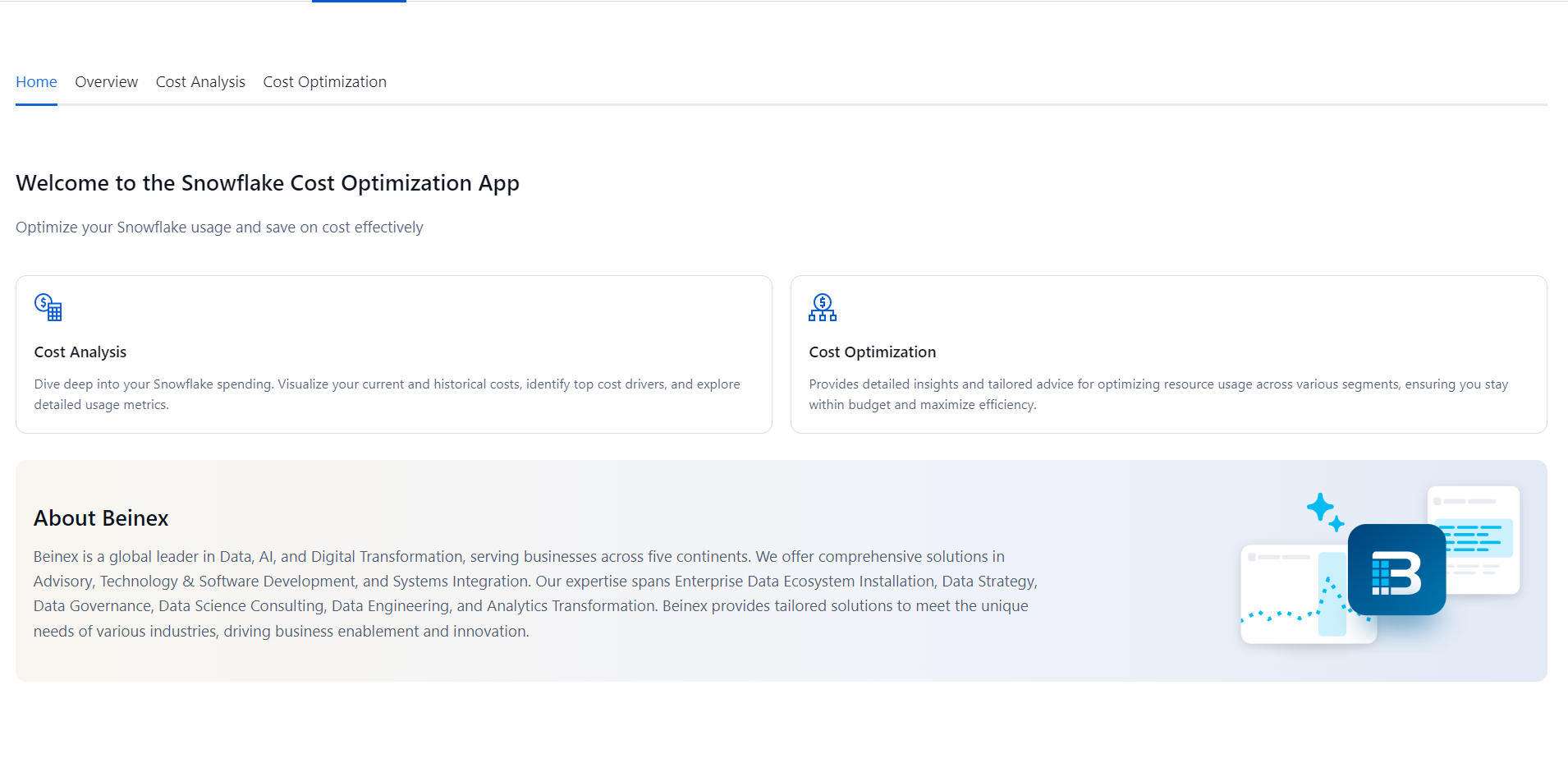
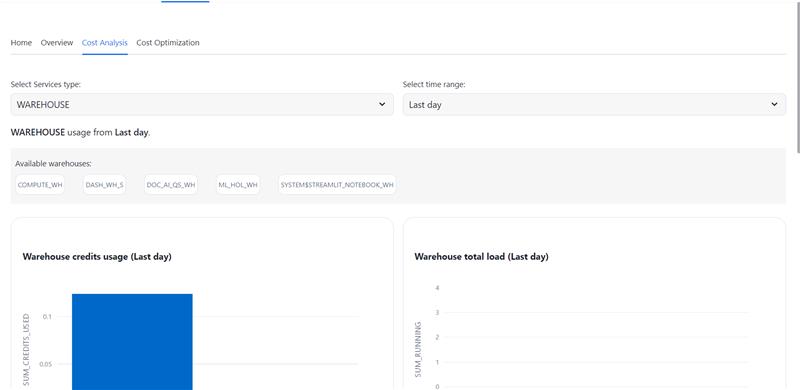
Beinex's strategic partnership with Snowflake empowers organizations to harness the full potential of their data. By leveraging Snowflake's powerful data cloud platform, Beinex offers comprehensive solutions for data management, analytics, and machine learning. This partnership enables organizations to accelerate their data-driven initiatives, reduce costs, and gain a competitive edge. Together, Beinex and Snowflake deliver innovative solutions that drive business growth and innovation.

An Ultimate Guide on Amazon Bedrock: How Businesses Can Turn Generative AI into Real Business Value
What is Amazon Bedrock?
Amazon Bedrock is a fully managed AWS service designed to help businesses quickly build and deploy generative AI applications. It offers access to a variety of high-performing foundation models from leading AI companies, including AI21 Labs, Anthropic, Cohere, and Stability AI, through a single, unified API.
What makes Bedrock especially appealing to enterprises and fast-growing businesses is that it takes the heavy lifting off their shoulders. There’s no need to manage model training infrastructure, scale servers, or worry about data exposure. You can just focus on building applications; AWS handles the rest.
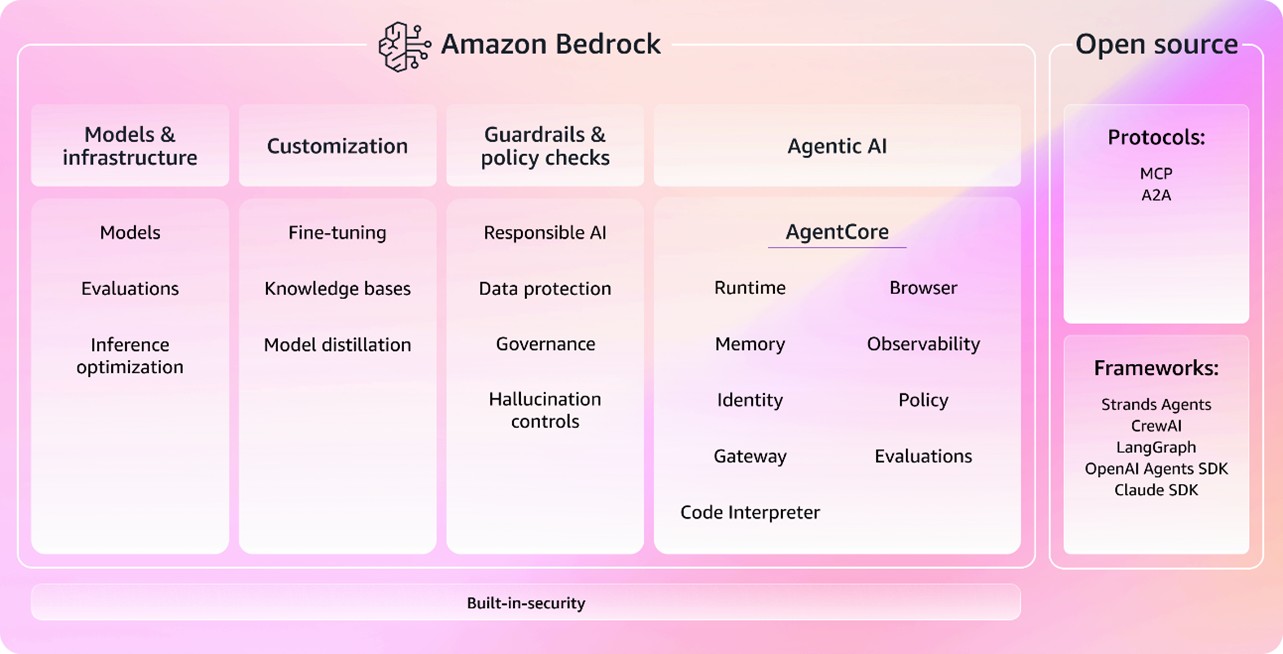 Source: AWS
Key Features of Amazon Bedrock
Let’s break down the key features powering AWS Bedrock:1. Access to Foundation Models
Amazon Bedrock offers ready-to-use models that are pre-trained, reliable, and production-ready, and are capable of tasks like:
- • Conversational AI and chatbots
- • Image generation
- • Text generation and summarization
- • Content classification and analysis
2. Secure Model Customization
Businesses can customize foundation models using their own proprietary data—without that data ever leaving their AWS environment. This is especially critical for industries, such as finance, healthcare, and government, where data governance and compliance matter.
3. Serverless Infrastructure
As Bedrock is completely serverless, there is no need to provision, manage, or scale infrastructure. Applications can also start small and scale instantly with demand, thereby making them ideal for both startups and large enterprises.
4. Single API Integration
Bedrock integrates seamlessly with existing AWS services and enterprise systems via a single API. This feature simplifies development and speeds up time-to-market.
5. Model Playground
AWS provides a Bedrock Playground, a visual interface where users can experiment with text, image, and chat models before deploying them into applications, making it helpful for teams evaluating use cases or testing outputs.
Top Benefits of Choosing Amazon Bedrock for Your Business
Amazon Bedrock stands out because it makes generative AI practical, not just impressive. Here are the top benefits organizations gain by adopting Amazon Bedrock:
Access AI Faster
Teams can start building generative AI applications without deep machine learning expertise, as it removes technical barriers.
Increased Efficiency
Businesses can prototype and deploy solutions faster, thereby accelerating innovation cycles instead of spending months building models from scratch.
Affordable AI Implementation
The cost of building AI capabilities can be significantly reduced by using pre-trained models, especially when compared to developing custom models.
Built for Scale
Bedrock supports enterprise-scale workloads while maintaining performance and reliability powered by AWS infrastructure.
Flexible Across Use Cases
From customer engagement to analytics and creative design, Bedrock supports a wide range of business needs on a single platform.
Real-World Use Cases for Amazon Bedrock
As you are now familiar with Amazon Bedrock, let’s understand how your business is going to benefit through some real-life use cases of Bedrock:
1. Customer Service Automation
Businesses can build AI-powered chatbots to handle order tracking, FAQs, and troubleshooting. It reduces response time, improves customer experience, and allows support teams to focus on complex issues.
2. Marketing and Content Creation
Marketing teams can generate blog drafts, social media copy, email campaigns, and product descriptions more quickly, freeing up time for strategy and creativity.
3. Product and Experience Personalization
Bedrock-powered applications can deliver personalized product recommendations and content, increasing engagement and conversion rates by analyzing customer behavior.
4. Analytics and Business Insights
Amazon Bedrock can summarize complex datasets, generate executive summaries, and highlight trends, making data easier to interpret for leadership teams.
5. Design and Creative Workflows
Design teams can use generative AI for image creation, branding concepts, and campaign visuals, speeding up ideation and iteration without replacing creative control.
Summing Up
If you are looking to move beyond experimentation and into real-world AI impact, Amazon Bedrock offers a practical, future-ready foundation. It can support you by providing:
- • Enterprise-grade security and compliance
- • Rapid deployment for competitive markets
- • Scalable solutions without operational complexity
For a free demo, connect with us: https://beinex.com/beinex-amazon-web-services/