Reactive vs Proactive AI Governance: Why Enterprises Must Go Beyond Compliance
Enterprise AI adoption is accelerating, but governance maturity is not keeping pace. According to a 2025 research report by Infosys on Responsible Enterprise AI in the Agentic Era, 95% of enterprises reported AI-related incidents in the last two years, while only 2% met the " responsible AI “gold standard readiness levels. Another 2025 study on the state of AI security found that 70% of organizations still lack optimized AI governance frameworks.
This gap explains why enterprises can no longer treat AI governance as a compliance checkbox. Beyond avoiding regulatory penalties, governance today is about ensuring reliability, accountability, security, transparency, and business resilience as AI becomes embedded into core operations.
Difference Between Reactive and Proactive AI Governance
Many organizations still follow a reactive governance model. Policies are introduced only after a regulatory requirement, audit issue, or AI-related incident emerges. This approach focuses heavily on documentation, approvals, and post-incident corrections.
Proactive AI governance takes a different path. Proactive governance is structural, not procedural; it embeds controls, accountability, and risk assessment into the design of AI systems, rather than adding them as a layer after deployment. Instead of responding after risks materialize, enterprises continuously monitor AI systems, establish accountability frameworks, assess model behavior, and integrate governance into the AI lifecycle from development to deployment.
The difference between reactive and proactive AI governance is ultimately about control. Reactive governance manages consequences. Proactive governance manages risks before they become business problems.
Why AI Compliance Is Not Enough for Governance
Compliance is necessary, but it is not sufficient. Most regulations define minimum standards. They do not fully address operational risks such as hallucinations, biased outputs, shadow AI usage, poor model explainability, or unauthorized data exposure.
For example, IBM’s 2025 report on AI governance gaps found that nearly 74% of enterprises have only moderate or limited AI risk governance coverage. At the same time, enterprises are deploying increasingly autonomous AI systems that directly influence customer interactions, business decisions, and operational workflows.
This creates a critical challenge: a company may technically comply with regulations while still exposing itself to reputational damage, financial loss, and customer trust issues.
That is why managing AI risks beyond compliance has become a strategic priority for enterprise leaders.
Proactive AI Governance Benefits for Enterprises
Organizations that adopt proactive governance frameworks are better positioned to scale AI responsibly and confidently.
Key proactive AI governance benefits include:
- Improved visibility into AI system behavior and performance
- Faster identification of security, bias, or compliance risks, especially critical in regulated industries where detection lag creates direct legal exposure.
- Stronger customer and stakeholder trust
- Better alignment between AI initiatives and business objectives
- Reduced operational disruptions and reputational exposure
- Greater readiness for evolving global AI regulations, including the EU AI Act, SEC disclosure rules, and emerging Gulf region AI frameworks.
Research also shows that governed AI environments deliver stronger long-term business outcomes. Enterprises with mature AI governance frameworks consistently report stronger long-term ROI, lower remediation costs, and greater stakeholder confidence in AI-driven decisions.
Managing AI Risks Beyond Compliance Requires a Strategic Shift
AI governance is evolving from a regulatory function into a business capability. Enterprises that treat governance as an ongoing operational discipline, not a periodic compliance exercise, will be better equipped to scale AI responsibly.
The real question is no longer whether organizations should govern AI. It is whether their governance strategy is mature enough to support the speed, complexity, and autonomy of modern AI systems.
At Beinex, we help enterprises move from reactive compliance to proactive AI governance by building frameworks embedded in AI operations, not bolted on after deployment. If your governance strategy isn't keeping pace with your AI ambitions, that's the conversation to start.
Related Articles

These services link together all the Snowflake components to handle user requests, from login to query dispatch. The compute commands that Snowflake procured from the cloud provider is also used by the cloud services layer. Every day, Snowflake processes petabytes of data and thousands of customer accounts.
The cloud service layer enables the management of a customer’s account, and it includes:
Authentication
Snowflake allows flexible authentication methodologies like Local, Active Directory, Multifactor and SAML Authentications. It permits the use and maintenance of Snowflake user credentials like login name and password. In short, account and security managers can create users with passwords stored in Snowflake or other authenticators and users can access Snowflake using their login credentials.
Infrastructure Management
With the capacity to immediately spin up and down an almost infinite number of concurrent workloads against the same, single copy of data, the users need not be concerned about the size of the data or the details about how a cluster is powered up instantly, with a few clicks on the corresponding interface. Behind the scenes, the infrastructure manager communicates and provides instructions to the corresponding cloud provider to immediately spin up the resources required by the users.
Metadata Management
Snowflake metadata management is a part of the data governance discipline which involves processes, policies, workflows, and technology to identify, and organise Snowflake metadata for data consumers. Metadata management is the key to adding actionable context to the assets in the Snowflake data warehouse.
Metadata management in Snowflake makes it easy to search, filter, and find data assets by various criteria. Metadata gives you complete visibility into the lifecycle of a data asset. Snowflake stores all the metadata in a centralized component called Cloud Services.
Snowflake automatically creates metadata for data residing both externally (S3, Azure, GCP) and internally (within Snowflake), stores it as a key-value pair (dictionary), and makes it available via the Information Schema.
Query Parsing and Optimisation
Users need not be much concerned regarding query performance. It is handled automatically via a dynamic query optimization engine in the cloud services layer. It can model, load, and query the data.
The cloud services layer does all the query planning and query optimization based on data profiles that are collected automatically as the data is loaded. It automatically collects and maintains the required statistics to determine how to distribute the data and queries most effectively across the available compute nodes.
Snowflake's query caching retains the outcomes of all queries run during the previous 24 hours. The query results returned to one user are accessible to any other user on the system who conducts the same query. It helps to save time by drastically reducing retrieval time when data is pulled from cache memory. The cost is also saved by not spinning up the compute clusters.
Access Control
Access to Snowflake depends on Access Control privileges which determine who can access and operate on Snowflake. According to the Snowflake model, users or other roles with rights allocated to them can gain access to secure items. Every secure object also has an owner who can provide access to other roles. Unlike user-based access control models, which provide rights and privileges to individual users or groups of users, this model does not do it. The Snowflake approach is intended to offer a sizable level of flexibility and control. It enables Snowflake to provide row-level security and protect PII through dynamic data masking.
The Need for Automating Compliance
As business environments today are rapidly changing and highly regulated, it is important to automate compliance to boost accuracy, efficiency, and scalability. The following aspects emphasize why automating compliance is highly significant. • Amplifies security by complying with data privacy and safety regulations. • Saving time and effort by automating recurring tasks like monitoring, reporting, and audits. • Deploying the required infrastructure faster and in a standardized format. • Boosting accuracy by reducing the risks of human error and consistently adhering to industry standards.
What is an AWS Systems Manager?
A unified management system, an AWS Systems Manager, streamlines infrastructure management by improving visibility and giving you control over your AWS infrastructure. It delivers a suite of tools for managing configurations, automating repetitive tasks, patching systems, maintaining consistent configurations, and securely managing secrets and configurations. The primary features of AWS Systems Manager associated with compliance are: • Compliance Dashboards: They offer a centralized visualization of your compliance status, emphasizing resources that are non-compliant to facilitate faster remediation. • Patch Manager: It automates the deployment and monitoring of patches across your instances. • State Manager: It ensures that your systems are configured to a specific desired state.
Compliance Made Effortless: Automation with AWS Systems Manager
A comprehensive management service, AWS Systems Manager, allows you to automatically accumulate and aggregate data from your AWS resources. It provides a unified view of your AWS environment, making managing and monitoring your resources easier. Compliance, an AWS Systems Manager capability, enables the scanning for inconsistencies in compliance and configuration and offers real-time compliance insights. This capability facilitates drilling down into certain non-compliant resources from the data aggregated from multiple AWS accounts. The additional features and benefits Compliance provides are as follows: • Utilizing AWS Config to see compliance history and monitor changes. • Exporting data to Amazon Athena and Amazon QuickSight to generate organization-wise reports. • Using Amazon EventBridge, State Manager or Run Command to fix issues. • Customizing compliance to develop compliance types to fit your business needs. • Employing AWS Systems Manager for seamless integration of third-party compliance tools and automation of configuration management and vulnerability scanning. AWS Systems Manager facilitates the automation of intricate and recurring tasks associated with configuration, patching, and software installation. It allows businesses to run these tasks across systems simultaneously while minimizing the time needed to effect the changes and ensuring consistency in the process. This execution enables software compliance, including maintaining antivirus definitions up to date, implementing firewall policies, and setting patch baselines. The automation capability of AWS Systems Manager entails streamlining the deployment, maintenance, and remediations of AWS services like Amazon EC2, Amazon S3, and more.
Let’s explore how AWS Systems Manager automates compliance checks:
• Centralizing compliance management: AWS Systems Manager offers a unified compliance dashboard that lets users see the compliance status across different AWS accounts and regions in real-time. The dashboard consolidates data from the state manager and patch manager to centralize compliance management, enabling easy detection and addressing of specific non-compliant resources. • Enforcing configuration: Users can define and implement preferred states for the resources with the State Manager. It ensures consistency in configurations and compliance in setting permissions, configuring firewall rules, or installing software. • Patch Management: It automates the processes of patching applications and operating systems on your instances, allowing users to select authorized patches and schedules for automatic deployment. It makes sure that your systems are up-to-date and stay compliant with the safety standards. • Automating Remediation: AWS Systems Manager allows the automated remediation of non-compliant resources. For example, if a system falls out of compliance due to a missing patch, Patch Manager can trigger an automatic patch deployment to resolve the issue. • Facilitating integration with AWS Config: AWS Systems Manager integrates seamlessly with AWS Config, which helps assess and monitor configuration modifications against compliance rules. This integration facilitates continuous monitoring and automated reporting, ensuring a robust compliance posture.Some of the benefits of using AWS Systems Manager for compliance include:
• Saving time and expediting remediation as automation of compliance processes checks reduces manual effort. • Streamlines the audit processes and ensures audit readiness through meticulous logging and documentation of compliance actions. • Fortifies security by detecting and addressing vulnerabilities on time and ensures your enterprise aligns with the standard security practices. • Leverages existing AWS infrastructure to reduce the requirement for reliable compliance tools, saving costs. • Offers real-time insights into the compliance status across your AWS environment, facilitating proactive management. AWS Systems Manager can be a game changer for businesses looking forward to ensuring compliance with complex regulations and industry standards across a dynamic IT environment. Automating compliance checks boosts accuracy, efficiency, and security, transforming compliance management into a streamlined workflow. Beinex is an AWS consulting partner that lets you navigate the AWS landscape and leverage it for unprecedented business benefits. Connect with us for a free demo: Beinex - Beinex - Your Reliable AWS Partner for Cloud Computing Services
Snowflake summit 'The World of Data Collaboration' was held in Las Vegas, Nevada, June 13-16, 2022. It featured the first look at innovations coming to the Data Cloud. Over 200 lectures, practical labs, certification possibilities, and more than 200 Basecamp partners were included in the four-day data Snowflake Summit. Thousands of Snowflake's partners, clients, and industry colleagues were there to network, cooperate, and learn crucial information about Snowflake and new Data Cloud trends.
Here are the four most exciting of Snowflake's latest offerings:
1.Innovative data capabilities that save time and resources
The release of Snowpark for Python, which is currently in public preview, was one of the statements that received the most attention at the summit. Both streaming ingestions using the new Snowpipe Streaming and streaming pipelines with the launch of Materialised Tables generated a lot of interest. These new features demonstrate Snowflake's product philosophy, which strongly emphasises simplicity for partners and customers while delivering value. The declarative model is excellent since it only requires describing the change; Snowflake will handle the rest. They anticipate less data lag, more real-time features, and quicker decision-making.
A new workload, Unistore, that enables users to work seamlessly with transactional and analytical data together in a single platform stirred curiosity in the audience. Unistore can save time and effort in moving data from operational systems and help with low-latency machine learning (ML) inference scenarios. It provides snappy user interfaces, allowing teams to create real-time analytical queries on their transactional data and build transactional business applications directly on Snowflake and offers a unified approach to security and governance.
2.Creating, monetising, and using apps on the Data Cloud
The most intriguing news is the potential of the Snowflake Native Application Framework, which is now in private preview. Anyone may now create applications using the well-known Snowflake core functionality, share and earn money from them through Snowflake Marketplace, and deploy them directly inside a customer's Snowflake account. Customers may keep their data centralised and greatly simplify application acquisition and maintenance. In contrast, application suppliers will have quick visibility to thousands of Snowflake customers globally across the three major clouds. It was a piece of ground-breaking information for all parties.
Bidirectional and multi-source native apps developed by Informatica allow users to combine data from various cloud and enterprise platforms, including IBM, Microsoft, Salesforce, and SAP. So, Snowflake partners and customers can concentrate more on what to build and less on how to build it; Snowflake wants to make the building process more straightforward. Snowflake may not be able to foresee the entire extent of value creation and innovation that would result from this.
3.More options and cloud compatibility
As a customer-focused business, Snowflake constantly strive to strike a balance between giving our consumers options, streamlining processes, and lowering complexity. Providing a consistent user experience and simple governance for data housed in any of the three significant clouds is a crucial objective (AWS, Azure, and Google Cloud). With the help of the Snowflake platform, businesses may create their applications once and deploy them across several major cloud vendors' regions. Companies can migrate data—and now applications—easily between regions or clouds thanks to Snowflake's cross-cloud capabilities. You can use transactional consistency for failover and failback. For both customers and partners, Snowflake is offering a way to make the construction of cross-regional and cross-cloud experiences simpler.
Snowflake's ability to develop an app once and have it function flawlessly across various clouds and locations is a game changer. By enabling the Data Cloud to process data from S3-compatible storage systems, such as on-premises storage providers, Snowflake has also improved choice (currently in development). It also supports interoperability and open file formats as agents of choice. To that aim, Snowflake unveiled the presently under story Apache Iceberg Tables, which will let users select Iceberg as the persistence table type and Parquet as the file format, table by table.
4.Rich data experiences without sacrificing readability for data governance or security
Clients of Snowflake value the data governance and security provided by Snowflake as well as the release of numerous new features and enhancements are appreciated. For instance, with the assistance of Snowflake's new workload Cybersecurity, cybersecurity teams can easily break down data silos, resulting in improved visibility into security incidents, risks, and threats. In short, clients want to create reliable data products and openly share data without relinquishing control of or re-siloing their data. Snowflake accelerates the economic value cycle for partners, clients, and, quite honestly, by doing away with the trade-off.
Snowflake has planned to offer more services connected with data sharing, collaboration with clean data rooms, and Native Applications Framework.
Beinex's partnership with Snowflake
Beinex's partnership with Snowflake enables it to offer clients advanced features like automated tuning and elastic compute with unlimited decoupled computing capability, along with the analytics modernisation services, to help organisations realise exponential Return on Investment. We keep innovating for all our clients and to support businesses around the world to create more possibilities and quality services.

5 Steps in Alteryx Predictive Analytics Process
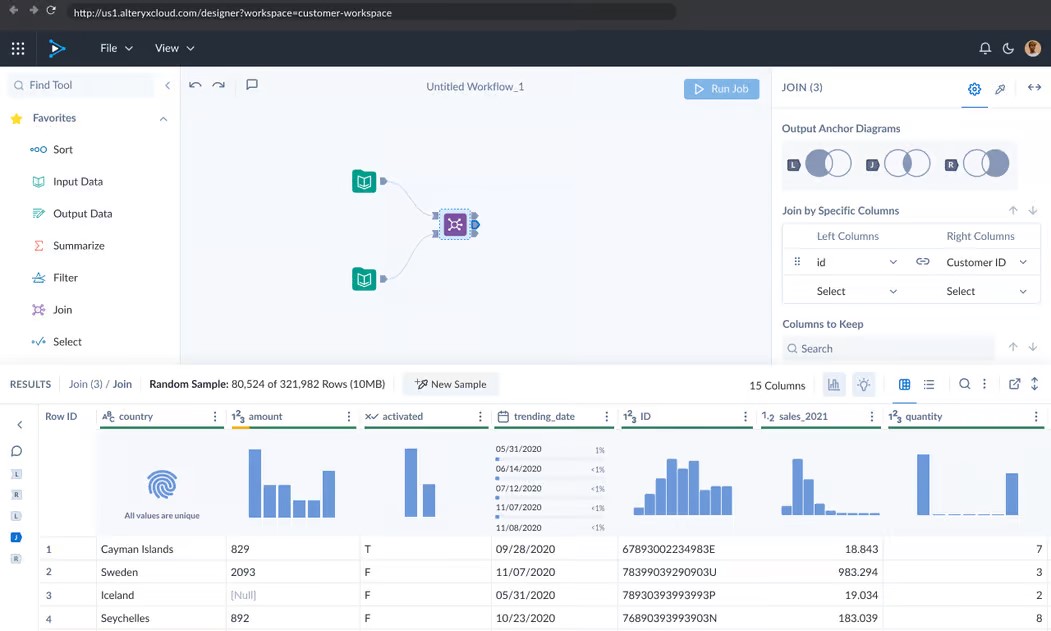
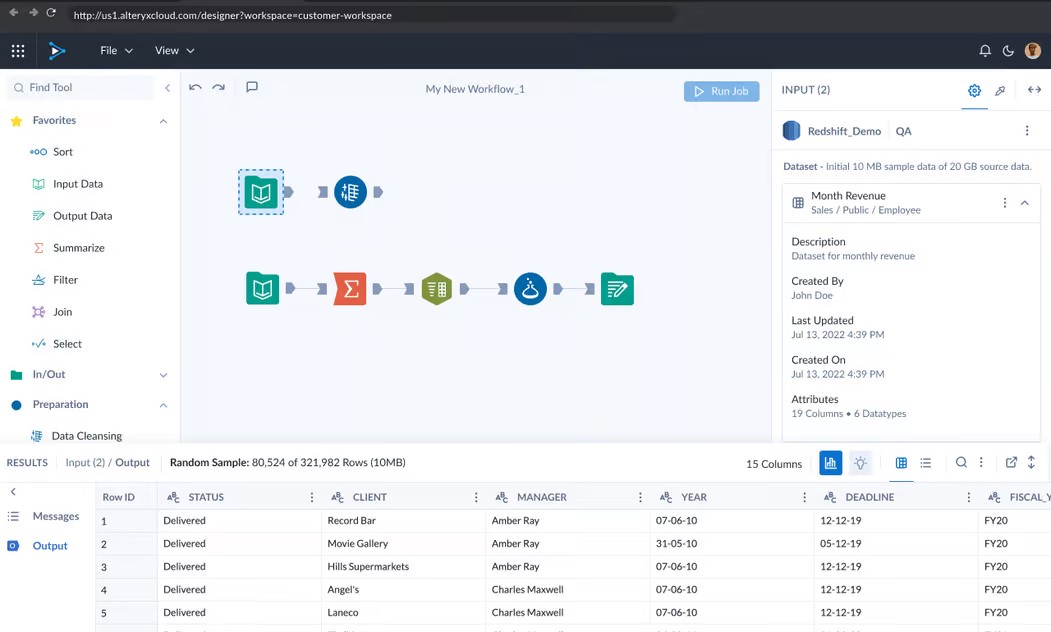
The five major stages of the predictive analytics process cycle include selecting a target variable, examining the data, collecting the data, creating the model, and scoring the model.A detailed description of the steps involved in the predictive analytics process in Alteryx:
- Step 1: Select a Target Variable
- Step 2: Analyse Your Data
- Step 3: Run Calculations/ Collect New Data
- Step 4: Model Building
- Step 5: Score the Model
Step 1: Select a Target Variable
Select the target variable which is the column that should be predicted. It could be a binary or non-binary categorisation or a numerical value and it can be continuous or time-based. Each of these target variables helps in finding business solutions. But just because time is a variable in the problem does not mean that a time-based model will be the best way to solve it. Simultaneously if a field has a numeric value, it does not mean that a binary model cannot be utilised in finding insights.
Step 2: Analyse Your Data
The largest contributor to excellent predictive models is the sample size. Anything less than 5000 records is counted as under-sampled and using it is not considered the best practice.
Alteryx and Tableau Prep are both excellent tools for understanding data by creating histograms, scatterplots, and correlation matrices. Before step 3, in the data transformation procedure, it is better to know what types of variables are in the data. There are various sorts of predictor variables and several types of target variables, and each must be structured differently.
- Categorical Data: String fields with no order are categorical data. It contains data in the form of text.
- Ordinal Data: String fields with an order are ordinal data. It can be substituted into numeric order in a predictive workflow.
- Numeric Data: It represents information with a measurable value.
- Cyclical Information: Data which gets repeated as such in a cyclic process is cyclic information.
Step 3: Run Calculations/ Collect New Data
Obtaining the greatest data or inferring fields from present data, such as adding seasonality, can be a powerful predictor variable. Always be inventive in the choice of variables. It is crucial to note that if there is to infer a piece of data, it is sometimes unwise to include both that data and the original data column in the same model because the predictive model would automatically give higher weight to this column. It is also critical to recognise that while it is beneficial to include factors with correlation, variables that drown out all other variables must occasionally be removed.
Step 4: Model Building
a. Make Use of the Decision Tree
Using a Decision Tree, it is possible to rapidly discover which of the factors are the most crucial for predicting the target variable. This model will not be utilised in the final forecast since it will over-fit, but it will show whether some of the variables are overly connected to the target variable.
b. Experiment with Different Models
Data Science is complicated, and it is difficult to know which model will yield the best results, therefore a variety of models, such as Random Forest, Boosted Models, and Neural Networks can be employed for better results.
Step 5: Score the Model
Alteryx offers a scoring tool that may be used to score models. During this step, data should be withheld for the model to test and score. Even though different models can provide different scores, through testing and reconfiguring, accurate predictions can be made.
What makes Alteryx an exceptional tool for predictive analytics?
These remarkable capabilities make Alteryx an excellent tool to carry out predictive analytics tasks easily:
- • No or Low coding required
- • Predictive analytics by drag and drop
- • Predictive tool kit for specifically performing predictive analytics
- • Integration to R and Python
- • Variety of built-in and custom ML models are available
- • Model customizations are possible
- • Automation and/or scheduling of predictive analytics workflows
Predictive Analytics Tools
Predictive analytics solutions use the power of data to help businesses in identifying trends in customer behaviour, making predictions, and developing optimised marketing plans.
The tools that aid in predictive analytics are enlisted below:
- Data Investigation Tools
- Predictive Tools
- Tools for the Modern Statistical Learning Method
- Tools for Predictive Model Comparison and Hypothesis Testing
- Tool for Predicting Values for All General Predictive Modeling Tools
1. Data Investigation Tools
Data investigation tools contain tools that help to get a better understanding of data. To better understand the data used in a predictive analytics project including both visualization tools and tools that provide tables of descriptive statistics.
The list of data investigation tools is given below:
- Field Summary Tool
- Heat Plot Tool
- Histogram Tool
- Plot of Means Tool
- Scatterplot Tool
- Violin Plot Tool
2. Predictive Tools
This category contains general predictive modelling tools for classification and regression models, and also tools for predictive modelling related to model comparison and hypothesis testing.
Predictive tools are enlisted below:
- Count Regression Tool
- Gamma Regression Tool
- Linear Regression Tool
- Logistic Regression Tool
- Naïve Bayes Classifier Tool
- Neutral Network Tool
- Stepwise Tool
- Support Vector Machine Tool
3. Tools for the Modern Statistical Learning Method
- Boosted Model Tool
- Decision Tree Tool
- Forest Model Tool
- Spline Tool
4. Tools for Predictive Model Comparison and Hypothesis Testing
- Cross-Validation Tool
- Lift Chart Tool
- Model Coefficients Tool
- Model Comparison Tool
- Nested Test Tool
- Test of Means Tool
- Variance Inflation Factors Tool
5. Tool for Predicting Values for All General Predictive Modeling Tools
- Score Tool
6. Time Series Tools
- ARIMA tool
- ETS tool
- TS Compare Tool
- TS Covariate Forecast Tool
- TS Filler Tool
- TS Forecast Tool
- TS Forecast Factory Tool
- TS Model Factory Tool
- TS Plot Tool

What is Generative AI
Generative AI is a subfield of Artificial Intelligence that utilizes patterns found in vast databases to produce original content, including text, images, music, and videos. GenAI aims to provide creative and human-like outputs, in contrast to classical AI, which primarily makes predictions or classifies data. Generative AI models, such as OpenAI's ChatGPT and DALL-E, utilize sophisticated neural networks, specifically transformer architecture, to produce content that is logical and sensitive.
Industries are transforming with the help of generative AI, and its benefits are innumerable. Marketers are using it to automate campaigns and generate personalized content at scale, while writers and creators rely on it to spark ideas and accelerate production. In healthcare, it's being explored for diagnostics, treatment planning, and medical research. At its core, Generative AI isn't just a tool; it's a transformative force reshaping how we create, innovate, and solve complex problems across sectors.
GenAI Solutions in the UAE
The Generative AI market in the UAE is on an impressive growth trajectory. Currently, the market is estimated to have reached USD 220 million and is expected to surpass USD 1.3 billion by 2030, growing at a CAGR of over 35%. With the UAE's commitment to becoming an AI-driven economy, including initiatives such as the UAE National AI Strategy 2031, the region is emerging as a hub for AI adoption and innovation.
Top 10 Benefits of Generative AI
Generative AI is reshaping how businesses create, operate, and innovate. Here are the top ten key benefits of GenAI that you can leverage for your business:
1. Automates Content Creation
Generative AI tools streamline content development, including blog posts, ad copy, social media content, and other types of content. Marketing teams use AI to generate drafts, brainstorm ideas, and iterate quickly. It speeds up production, improves quality through iterative feedback, and reduces the need for hiring additional staff. GenAI tools can craft landing page content or email campaigns that effectively highlight your brand's voice.
2. Delivers Hyper-Personalized Experiences
AI leverages customer and product data to generate personalized recommendations and messaging. In e-commerce, this can mean showing the right product to the right user at the right time. Personalized AI outputs enhance engagement and conversion rates.
To ensure ethical outcomes, businesses are auditing training datasets to prevent bias, which is particularly crucial in sensitive sectors such as healthcare, finance, and hiring.
3. Enhances Product Design and Innovation
AI models analyze market trends and customer behavior to guide product development. By processing vast datasets, they uncover unmet needs and help generate concepts that align with evolving consumer preferences. Many GenAI tools aid in rapid prototyping and idea testing.
4. Strengthens Cybersecurity
Generative AI boosts threat detection by identifying anomalies in network traffic and alerting teams in real time. It excels at identifying phishing patterns, malware signatures, and unusual behaviors more quickly than manual reviews. As attackers also begin using AI, this defense becomes increasingly critical.
5. Accelerates Healthcare Research
Generative AI is expediting drug discovery and diagnostics. AI also allows the generation of synthetic patient data, facilitating preclinical testing without privacy risks. It shortens development timelines and supports personalized medicine by analyzing genetic and clinical datasets. It can also predict diseases before they strike us.
Read Our AI in Healthcare Case Study on Cardiovascular Disease Prevention!
6. Streamlines Business Processes
AI automates repetitive tasks such as summarizing reports, drafting emails, or analyzing PDFs. GenAI Tools allow teams to focus on strategic work rather than data wrangling. For example, HR teams can auto-generate job descriptions, and sales teams can craft personalized follow-up emails using AI.
Book a Free Demo of Our Document Chatbot
7. Improves Customer Support
Generative AI chatbots offer 24/7 support, providing context-aware responses to resolve queries. Unlike traditional bots, these systems adapt in real time, understand tone, and escalate issues when necessary. Businesses utilize various tools to achieve faster resolution times and higher satisfaction scores.
8. Accelerates Market Innovation
By analyzing market signals, customer behavior, and industry shifts, AI uncovers opportunities for product, service, or business model innovation. It reduces risk and helps companies make data-backed decisions about where to invest. AI can forecast trends and simulate outcomes before committing resources, allowing for informed decision-making.
9. Drives Digital Transformation
AI encourages traditional industries, like oil & gas, construction, logistics, and agriculture, to adopt technology by demonstrating clear ROI. Predictive maintenance, supply chain optimization, and workflow automation are just a few areas where AI proves valuable. It helps leaders make faster, more informed decisions, accelerating digital adoption.
10. Accelerates Creative Innovation
Generative AI serves as a brainstorming partner. Designers utilize tools like Midjourney for rapid visual prototyping, while writers and product teams employ chatbots to refine their ideas. These tools provide novel starting points, enabling creators to break through mental blocks and explore new directions more quickly.
Summing Up
Beinex GenAI Solutions is at the forefront of transformation, helping organizations in the UAE explore the full potential of generative AI. As one of the recipients of the Dubai AI seal, Beinex is enabling businesses to innovate faster and operate smarter, from automating content generation to creating intelligent decision-making systems. Businesses that adopt it strategically are gaining a competitive edge, not just by saving time, but by reimagining what's possible.