Just Go Wild: Beinex Offsite Visit to Munnar
In the evening, we had a wild-theme based gala party, and all got dressed up in sync with the theme, ‘Just Go Wild’. It was fun to watch everyone from the Manager to the employees dressed up in the same theme. We had an exhilarating DJ party manned by Darryl Gaulbert which made us all shake a leg to the tune. We danced and roared to the music. It was indeed wild!
The following day after breakfast, we met our founder Indumon Das, who had a chat with us regarding the journey of Beinex and his vision. It inspired us all to have a dream and pursue it fearlessly. Some of us accessed the infinity pool late afternoon and had great fun swimming and playing pool ball.
It was a blissful evening based on an ethnic wear theme. We competed for the best ethnic outfit of the evening. The different hues and styles made the evening stunning. Everyone flaunted the traditional wear in style. We had a musical evening with a live barbeque and a sumptuous dinner.
Finally, the day of leaving Munnar dawned; March 19. We all had breakfast in the morning and packed our backpacks. Most of us were pretty reluctant to leave Munnar as we were not ready to lose the bond we created together. Nonetheless, we vowed to stay connected. We boarded the buses around 10 AM and waved goodbye to Munnar.
When we reached Edapally in the evening, a surprise goody bag was waiting. It was an impressive and admirable gesture from our firm. Beinex has a culture of nurturing growth and spreading positivity, and employees’ comfort is the priority here.
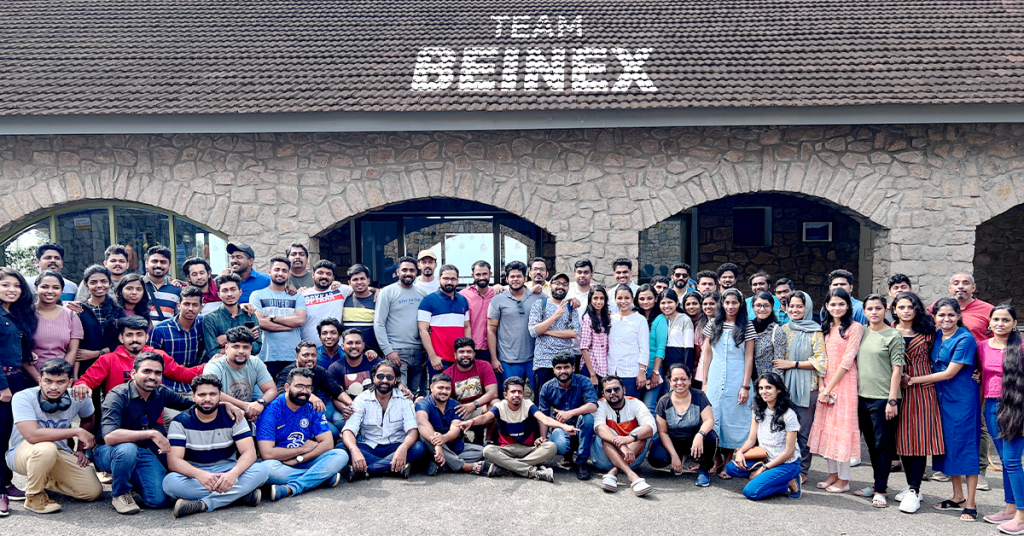
Yes, we had a fantastic time together. After this retreat, our rejuvenated and motivated minds are ready to bounce back to work with enhanced spirit. We are looking forward to more team building sessions in the future to meet each other more often.We were just voices or images on ‘Teams’ until we finally met on 17 March 2022. After many days of contemplation and planning to turn our offsite visit into a memorable one, the day arrived. We were all super excited to meet each other. Even though we are spread across different geographies, it could not prevent us from having the much-awaited meeting.

Related Articles

These days we are into the 2-D screen of our mobile phones and watch videos and shows and engage in many more activities. But we are not carried away to that place or get immersed in it. Through the metaverse, that is possible. Here you can have an avatar which can act as a replica of your physical self. You can indulge in anything from hanging out with pals, participating in sports or workout sessions, learning new courses or activities, attending events, or shopping.
What are the possibilities Metaverse offers?
Using the limitless opportunities, you can virtually own digital clothing, buy land, construct buildings, start businesses, visit nightclubs and shopping centres, and even buy digital artworks. Non-fungible Tokens (NFTs) are used in the metaverse to digitally represent physical assets like art, music, in-game goods, and videos. They can be purchased and sold online. An evolving business strategy called "Direct-to-avatar" (D2A) makes it possible to sell and buy goods directly to avatars or other digital identities in virtual environments. Here, the possibilities are just boundless. Considering the future prospects, many brands like Adidas, Nike and Gucci, to name a few, have invested in the metaverse. As Gen Z and millennials are already spending a considerable amount of time in the virtual world, it is anticipated that by the end of 2022, the global VR sector will generate over $6.71 billion in revenue, and by 2024, it will be around $12.19 billion.
Metaverse generates value in customer experience by providing real-life interactions and can revolutionise user experience. Let’s see how it can be done:
1. Providing Unique Customised Experiences
Customisation plays a crucial part in today’s business world, as does in the metaverse. Businesses struggle to tailor the experience for each consumer, whether they prefer to purchase online or go to a physical store. Thankfully, the metaverse can guarantee that each customer's experience in an online store is distinctive. Customers can browse products geared toward their unique needs rather than browsing products that are of no interest to them. Additionally, the metaverse encourages connectedness, so consumers may share their experiences with other metaverse users and read reviews of goods and services before making a purchase.
Sports gear giant Adidas is one step ahead of the game by providing virtual gear for the virtual world and metaverse. Major apparel retailers like Macy's, Adidas, and Modcloth have already adopted virtual dressing rooms to enable customers to visualise a garment on their body without actually trying it on. The Swedish furniture retailer IKEA has already released an augmented reality catalogue app that lets you view how various pieces of furniture would look in your home. Nike owns Nikeland, a virtual world which is a free immersive sports space where you participate in sporting events from your computer or phone through your unique avatar.
2. Trials Using Virtual and Augmented Reality
Earlier trials were provided only for digital products, but with the help of the metaverse, we can experience every product virtually. For instance, we can choose a hotel to stay in after virtually experiencing the facilities provided by it. That’s cool, isn’t it? The metaverse uses augmented and virtual reality to give users a fully immersive experience. Customers who engage in immersive experiences may be able to do things that they otherwise might not have been able to do or uniquely do things. From buying lipstick after a virtual trial to buying a car after a virtual drive allows customers to explore and experience more realistically. Customers can currently utilise augmented reality through apps in a limited way, but the metaverse will allow them to experience the product from a close-up and personal perspective. For instance, Hyundai’s mobility adventure enables a vivid virtual experience.
BMW's augmented reality experiences enable automobile buyers to modify their desired vehicles in showrooms with the help of their tablets or smartphones. Alternatively, consumers can don virtual reality goggles to experience what it's like to drive cars, which will help them comprehend their options and select the best option available for their new car.
3. Accessible from Anywhere
The metaverse offers businesses plenty of advertising opportunities, but it also enables customers to interact with the people, places, and brands that interest them. Businesses can provide customers with experiences that let them explore their interests in greater detail without leaving the comfort of their homes and provide free samples of real-world events.
For people for whom it is not always feasible or economical to attend events in real life, the metaverse is the ideal replacement. Through 3D virtual worlds and avatars, users can enjoy affordable front-row access to various events with a level of immersion that must be experienced. Thanks to simple navigation, which places them in a metaverse tailored to their interests.
If you want to go shopping and there is no time for that, you can access it virtually from anywhere. To cite an example, for interior designing of your house, you can try different pieces or types of furniture from a virtual shop by arranging those in a digital representation of your house. Customers could quickly see whether the sofa would go with the colour scheme of their floor or wall or whether a wardrobe would fit in the available area. Ikea, the furniture brand, has already provided virtual experiences for customers. Buying land without the help of an agent is possible through Upland, a virtual real estate software that lets users browse and buy virtual property connected to actual towns and cities.
4. Strengthen Customer Experience
Companies now offer advice and assistance in addition to goods and services. Metaverse enables businesses to develop natural relationships with clients that weren't feasible with earlier forms of technology. Through virtual reality, customers experience ‘story-living’ rather than just ‘story-telling’. Shoppers can have a distinctive customer experience as they can purchase through experiencing it, have opinions about it, interact with other users and ask questions in the metaverse itself.
The businesses are testing out virtual and augmented retail on various platforms. Within the Roblox online multiplayer game, Gucci and Nike have unveiled fashion shows. In Fortnite, Balenciaga has begun offering high-end clothing. Additionally, the South Korean social avatar app Zepeto, Ralph Lauren, and Adidas have introduced interactive experiences. In the meantime, Charlotte Tilbury has established a virtual cosmetic store.
The journey doesn't end with how companies interact with customers in the metaverse. Businesses that use the metaverse's advantages ensure their clients have a customised experience that develops at the same rate as the metaverse. It's time for businesses to be prepared to adopt the impending metaverse and become early adopters before it is too late. Even though the metaverse is the next frontier of internet technology and consumer experience enhancement, massive adoption and accessibility are crucial. It's vital for business owners to begin learning about how these virtual worlds function, what opportunities and problems there are, and how to take advantage as soon as possible.
What is AGI (Artificial General Intelligence)?
Artificial General Intelligence (AGI) refers to an AI that, in theory, can think, learn, and understand more like a human. It is designed to perform any intellectual task a human can do. However, AGI remains a theoretical concept, and current AI systems have not yet achieved true cognitive abilities, reasoning skills, or emotional intelligence comparable to humans. Rapid advancements suggest that reaching a form of AGI is not beyond possibility. Given the unprecedented growth of AI in recent years, it's wise to stay informed and prepared.Generative AI vs. AGI vs. ASI: Understanding the Difference
Generative AI is a subset of deep learning that predicts responses based on extensive training data. These models, including ChatGPT and Midjourney, are powerful but still fundamentally narrow AI systems. They lack true understanding, common-sense reasoning, and emotional intelligence. Conversely, Artificial General Intelligence (AGI) is regarded as a strong form of AI. Like human intelligence, it would be self-aware, flexible, and capable of solving problems in various fields. AGI might learn, reason, and apply knowledge across domains without explicit training, in contrast to GenAI, which works within predetermined tasks. Even if AGI is yet theoretical, it has enormous potential to change society and industry. Beyond human intelligence, Artificial Super Intelligence (ASI) can tackle issues beyond human comprehension. For example, an ASI system might be able to create novel medicinal treatments or extremely efficient energy systems. Nonetheless, ASI is still primarily theoretical and a subject of discussion and assumption.GenAI vs. AGI vs. ASI: Key Differences
Here are the main differences between GenAI, AGI, and ASI:| Generative AI (GenAI) | Artificial General Intelligence (AGI) | Artificial Super Intelligence (ASI) |
|---|---|---|
| AI that generates text, images, audio, and code based on training data | AI with human-like reasoning, learning, and problem-solving across all domains. | AI that surpasses human intelligence and capabilities |
| Generates content, predicts patterns, and automates tasks | Understands, learns, and adapts like a human across multiple fields. | Thinks, learns, and innovates beyond human intelligence |
| Examples: ChatGPT, Midjourney, DALL-E, Bard | A self-learning AI that can pass human-level exams and perform diverse tasks. | An AI that can autonomously innovate, research, and make better decisions than humans. |
| Mimics creativity but lacks true understanding | Matches human cognitive abilities. | Beyond human intellectual capacity |
| Fully functional and widely adopted | Estimated timeframe is 2030–2050 (speculative). | Not yet possible with current technology |
AGI and Businesses: How Executives Can Prepare for AGI
The best way to keep up with new technology isn’t to wait until it arrives; it’s to prepare before it changes everything. Here are a few simple ways to get ready for Artificial General Intelligence (AGI):1. Stay Informed and Monitor AI Advancements
The first step in getting ready is to comprehend how quickly AI is advancing. Executives should keep an eye on new advancements in AGI, legal reforms, and AI research. Keeping tabs on start-ups, business leaders, and research organizations can yield insightful information.2. Invest in AI Skills
But there's no point in waiting for AGI to happen; smart leaders should be ready now. Leading businesses should invest in automation and artificial intelligence to gain a competitive edge. Developing AI expertise within your organization, whether through employing AI experts, educating employees, or implementing AI-powered technologies, will lay a strong foundation for future AGI integration.3. Develop a Robust Data Infrastructure
High-quality data is essential for AI to flourish. Businesses should ensure their data ecosystems are safe, organized, and ready for AI-driven insights. Adopting the retrieval-augmented generation (RAG) models and cloud-based AI solutions improves AI applications and prepares for more complex systems like artificial general intelligence.4. Adopt a Human-centric AI Approach
Even with AI's expanding capabilities, human monitoring is still crucial. "Human-in-the-loop" models, in which AI complements human decision-making rather than replaces it, should be given top priority by executives. Employee resistance to automation can be decreased, and productivity can be increased by teaching them how to work with AI tools.5. Address Ethical and Security Considerations
Ethical issues like bias, security, and data privacy are becoming increasingly urgent as AI develops. Executives must implement governance structures to ensure accountability and transparency in AI deployments. AGI readiness will also depend on how well cybersecurity threats and compliance laws are handled.6. Organize Teams for AI-driven Workflows
An AI-driven world may require adaptability that traditional organizational structures may not be able to provide. Employers should consider flexible workforce models in which staff members switch between projects regularly. AI literacy upskilling programs can facilitate employees' hassle-free transition into AI-augmented roles.7. Experiment with AI Investments
While AGI is still a way off, companies should start making calculated investments in AI research, automation driven by AI, and cognitive computing. When artificial intelligence (AGI) becomes economically viable, companies that invest in AI-driven innovation can become early adopters.The Business Impact of GenAI: Current Trends and ROI
While Generative AI (GenAI) is already revolutionizing industries with quantifiable return on investment, Artificial General Intelligence (AGI) is still a vision for the future. A 2024 Deloitte survey identified key sectors where organizations are experiencing notable advances: • Text Generation (83%) – Automating reports, document summarization, and marketing content. • Code Assistance (62%) – Helping developers write code efficiently with fewer errors. • AI-Powered Call Centers (56%) – Reducing customer service costs by up to 90%. • Image & Video Generation (55%) – Creating product simulations and marketing materials. Additionally, enterprises are increasingly adopting multi-model AI approaches, using a mix of open-source and proprietary models to tailor-made solutions and avoid vendor lock-in.The Future of Leadership in an AGI-Driven World
AGI might still be years away, possibly emerging between 2030 and 2050, but its impact will be massive. Proactive leaders can get ahead by using today’s AI, building flexible systems, and creating a culture of continuous learning. Companies that embrace AI now won’t just keep up; they’ll lead the way when machines start thinking more like humans. So, leaders, now’s the time to act.For instance, the dashboard given below mirrors a project undertaken for a client seeking insights into the pandemic's impact on their business across specific areas. They wanted to determine the number of stores stocking their product within a defined radius, highlighting the local business impact amid the pandemic.
To craft the map showcased in this dashboard, we leverage Tableau's map layers feature introduced in version 2020.4. For further insights into this functionality, additional details can be found here.
Prior to initiating the map creation process, frequently refer to the Profit Margin field. Here's the calculation for this field: it computes the percentage of Sales that translates into Profit. This calculation enables us to gauge the profitability derived from our sales figures.
For the States map layer, the State field is utilized and placed on the 'Detail' shelf. Each state is color-coded based on its Profit Margin.
Moving to the Cities layer, the City field is added onto the top left area labeled "Add a Marks Layer." To ensure the visibility of every city, the State level of detail is included as well. This accounts for cities existing in multiple states, displaying every city/state combination. Cities are color-coded using the Profit Margin field, with additional color based on the absolute value of the Profit Margin. This helps visualize the range and direction of profitability for each city.

Buffer Calculation
The Buffer calculation generates a radius, known as a "buffer," around a specific map point, defined within the syntax parameters. Here's the syntax breakdown for the Buffer: The initial part determines the center location, followed by the distance around the point, and finally, the chosen unit of measurement.
To establish the desired centroid point, we employ the Makepoint function. This function simply utilizes latitude and longitude coordinates to generate a point on the map. Below is the calculation illustrating its usage.
To achieve the interactivity you desire, you'll begin by creating three parameters: [Location Lat], [Location Long], and [Radius]. These parameters offer flexibility, allowing you to adjust them within the dashboard interface.
As you click on different cities, the [Location Lat] and [Location Long] fields dynamically change, altering the central point. Meanwhile, the [Radius] field, functioning as an input parameter, enables you to modify the radius distance according to your preferences. This setup grants you personalized control over these parameters directly within the dashboard.
With the creation of the final map layer field, you can now drag this field to the top left of the map and add it to the existing layers. Once done, you'll have all the map layers integrated into the map, allowing you to recreate the dashboard as depicted below. This comprehensive setup will mirror the dashboard layout and functionality.
Parameter Actions
Parameter Actions are essential at this stage to ensure dynamic interaction within the map layers. By implementing parameter actions, we enable the Location Lat and Location Long fields to adjust dynamically when clicking on a city. This action directly affects the MAKEPOINT() field within the Buffer calculation, effectively altering the radius location. Below, you can observe the setup of the parameter action and how it facilitates this dynamic transformation.
Finally, we aim for these parameters to influence the available metrics showcased at the top of the dashboard. These metrics offer insights into the concentration of profit and profit margin within the selected radius. Below, you'll find the supporting calculations and the formulae for the metrics displayed on the dashboard. These metrics serve as indicators of profitability and profit margin concentration within the chosen radius.
Wrapping up, creating interactive data visualizations opens doors to explore and comprehend information, fostering informed decision-making and exploration of new analytical paths.
What is Agentic AI?
Unlike traditional AI models that rely on static predictions, Agentic AI operates dynamically, making independent decisions, adapting to new situations, and optimizing processes autonomously.
Key Capabilities of Agentic AI
Agentic AI is more versatile than GenAI, and it can:
• Sense & Interpret – Understand real-time data, identify anomalies, and detect trends.
• Act & Decide – Take actions based on goals, risk factors, and evolving scenarios.
• Learn & Adapt – Improve continuously through feedback loops and reinforcement learning.
Agentic AI vs. Generative AI: The Key Differences
While traditional AI analyzes data and identifies patterns, GenAI creates content and generates images and code through prompts or instructions. Agentic AI is autonomous and doesn’t rely entirely on prompts. It makes independent decisions, acts, and adapts to changing situations with minimal human input. The main differences between Agentic AI and GenAI are as follows:
| GenAI | Agentic AI |
|---|---|
| Creates new content like text, images, videos, audio, code, etc. | Makes autonomous decisions and performs tasks |
| Reactive response to user input, i.e., the output generated will be based on the prompt received. | Proactive approach: It acts independently with minimal or no human oversight. |
| Generates creative and original content | Does not create content but makes decisions. |
| Limited to generating responses based on trained data | Analyzes situations, reasons, and takes actions autonomously |
| Engages with users by generating text, images, or media based on input | Interacts with its environment, making real-time decisions |
| Use cases: SEO content, marketing copy, chatbot responses, code generation | Use cases: Self-driving cars, autonomous virtual assistants, workflow automation, financial risk analysis |
| Examples: ChatGPT, DALL·E, MidJourney, Copilot | Examples: Tesla Autopilot, virtual assistants (e.g., Google Assistant with enhanced autonomy), AI-driven workflow management systems |
Top Benefits of Agentic AI: Why Businesses Need It
In a world of complex risks, volatile markets, and increasing regulatory pressure, static AI models fall short. Organizations need AI that proactively thinks ahead, mitigates risks, and unlocks new efficiencies across industries.
The key benefits of Agentic AI are listed below:
• Execute autonomous, goal-directed actions and decision-making.
• Engage in proactive problem-solving instead of reactive responses.
• Carry out complex reasoning and long-term planning.
• Learn and adapt autonomously with minimal human oversight.
How Agentic AI Gives Businesses a Competitive Edge
The rise of AI-first companies means businesses that embrace Agentic AI will gain a competitive edge, leveraging:
• Self-learning AI agents that evolve with business needs.
• Automated decision systems that operate with minimal human intervention.
• AI-native enterprise ecosystems that seamlessly integrate with digital workflows.
Comprehensive List of Agentic AI Tools & Use Cases
Agentic AI refers to AI systems that act autonomously, making decisions and performing multi-step tasks with minimal human intervention. Below are some real-world tools and use cases of Agentic AI across various industries:
| Industry | Agentic AI Use Cases | Agentic AI Tools / Examples | Business Impact |
|---|---|---|---|
| Virtual Assistants | Autonomous AI task execution | AutoGPT, BabyAGI | Automates workflows, reduces manual effort |
| Self-Driving Vehicles | Autonomous navigation & decision-making | Tesla Autopilot, Waymo | Enhances safety, reduces human intervention |
| Robotics | AI-powered automation in warehouses | Boston Dynamics’ Spot, Amazon Robots | Reduces human risk, improves efficiency |
| Finance & Trading | AI-driven autonomous trading | Numerai AI Hedge Fund, Kavout Kai AI | Optimizes investments, minimizes risk |
| Healthcare | AI-powered diagnosis & treatment planning | IBM Watson Health, Qventus AI | Improves accuracy, streamlines patient care |
| Cybersecurity | Threat detection & autonomous response | Darktrace, CrowdStrike Falcon AI | Prevents cyberattacks, enhances security |
| Smart Cities | AI-driven traffic & energy optimization | Google DeepMind AI, AI Traffic Systems | Reduces congestion, lowers energy costs |
| Enterprise AI | AI-driven workflow automation | UiPath AI RPA, Adept ACT-1 | Increases productivity, minimizes errors |
| Retail & E-commerce | Autonomous inventory & order management | Amazon Warehouse AI, AI Chatbots | Optimizes supply chains, improves CX |
| Personal AI Assistants | AI-driven memory & task management | Rewind AI, Inflection AI Pi | Enhances productivity, personalized insights |
List of Key Applications of Agentic AI
The major applications of Agentic AI are diverse and can be employed across various domains such as:
• Banking & Financial Services – AI-driven fraud prevention, adaptive risk management, and autonomous trading.
• Healthcare & Life Sciences – Personalized AI-powered treatments, real-time diagnostics, and proactive patient monitoring.
• Risk & Compliance – AI-driven audits, self-regulating compliance frameworks, and dynamic risk assessment.
• Supply Chain & Logistics – Autonomous demand forecasting, intelligent inventory management, and AI-driven logistics.
• Cloud & Digital Transformation – Self-optimizing cloud infrastructures, real-time automation, and AI-powered cybersecurity.
How Beinex is Leading the Agentic AI Revolution
At Beinex, we are pioneering Agentic AI solutions that enable businesses to shift from reactive decision-making to intelligent automation. Our expertise spans:
• AI-powered GRC (Governance, Risk & Compliance) – Ensuring real-time regulatory adherence.
• AI-driven financial transformation – Fraud detection, customer intelligence, and risk modeling.
• Cloud-first AI ecosystems – Enabling adaptive, self-learning enterprise solutions
The Future of Agentic AI: Are You Ready?
As AI governance, ethical AI, and real-time automation evolve, businesses embracing Agentic AI will define the next digital transformation era. The question is no longer if AI can optimize business operations; it’s how fast your business can adapt to AI that thinks, learns, and acts. Interested? Let’s connect for a free assessment: https://beinex.com/contact-us/
Tableau Cloud is a web-based data visualization tool. It is a part of the futuristic notion that enabled the evolution of a completely hosted, cloud-based solution, enabling wiser decisions through quick, flexible, and simple analytics. Tableau Cloud helps more people and teams obtain insights and become more innovative and competent decision-makers by distributing reliable data across enterprises, eventually leading to better, data-driven outcomes.
Tableau Cloud takes pride in the fact that the system is built to fit any enterprise architecture, with industry-leading security features, the highest certification requirements such as SOCII and ISO, and best-in-class governance capabilities to guarantee your data is always in the right hands.
The expected features are all here, with solid and intelligent additions such as Advanced Management, Data Stories, new embedded functionality, etc. These vital advancements add to the advantages of moving Tableau to the cloud, such as time savings, flexibility, and decreased costs. Still, they also give insights that evolve scale without having to install or maintain any software or hardware.
The most wanted features are here:
Advanced Management - Advanced Management contains several operational insight elements to gain information into visualisation load times, user interactions, number of views, and more. Admin Insights delivers easy-to-understand visualisations derived from the environment's usage statistics, and the Activities Log gives granular event data to create a record of activity. The newly added feature helps to handle critical analytics with ease. Features like flexible control, better security and manageability, and limitless scalability are designed to help the business thrive.
Data Stories – Data stories help to get clear, automated explanations for dashboards in no time. Make dashboard analytics simple with clear, automatic explanations. Big data is divided into critical aspects, and insights are provided in simple terminology
Embedded Analytics – Embedded Analytics integrates analytics seamlessly into the products and applications, surfacing insights to the users wherever they are, including public domains. It's straightforward to configure, integrate, and deploy Embedded Analytics right into your applications, products, and online portals. Tableau Cloud will allow administrators to share their workbooks and visualisations with the public, enabling users to view their information without logging in.
Tableau Cloud is an easy-to-use self-service platform, and all you must do is prepare your data, author, analyze, collaborate, publish, and share on Tableau Cloud
Source: https://www.tableau.com/products/cloud-bi
Tableau Cloud is user-friendly, and its activation can be done with a finger snap. The first step is to configure the authentication mechanism and securely publish interactive dashboards and data because it is managed and hosted by Tableau.
The material will then be accessible from any browser or mobile device, allowing the team to collaborate and share analytics with everyone, anywhere. Simple, right!
Feel free to request a free trial using this link.