How AI Decision-Making is Improving Enterprise Outcomes
Blog
Share 
How EHSS reported a 40% increase in productivity after implementation of AWS
 26 April 2021
 Team Beinex
About Employee Health & Safety System (EHSS)
The Employee Health & Safety System (EHSS) is a comprehensive covid test and vaccination tracking platform developed by Beinex, designed to empower organizations to track and monitor covid related details of their own employees, external entities, vendors etc. vising their premises and derive meaningful insights from the data using a powerful analytics engine. This platform was developed to assist our client Department of Health, Abu Dhabi (DoH) to provide them a complete overview of covid 19 related status within the UAE. EHSS leverages cutting edge technology and the power of AI to remove some of the ardent pain points such as risk scoring of employees based on physiology, at the same time providing an intuitive user access control to manually add and edit employee records. EHSS helped DoH to visualize covid relation information by combining four independent processes in silo, onto one single integrated platform – employee health tracking, input and data capture, reporting & analytics and collaboration & control.Challenge

The IT infrastructure of DoH where EHSS platform was hosted was in an on-premise datacenter which was designed to be scalable and robust with multi node physical clusters including the server, storage and network components. However, most of the physical hardware was quite old and not equipped with the latest generation of physical servers.
Frequent hardware crashes and portal downtime kept troubling the availability of the EHSS application. Assigning a touch hand support person to power on the hardware that was down seemed quite impossible due the restrictions during covid period. Hence, DoH wanted to look for another viable solution.
Though the hardware setup at DoH was well equipped to meet the occasional spikes in the traffic, it was observed that over a course of 6-month time, most of the IT infra was underutilized than predicted. It was realized that spending huge amount of money on an old hardware plus software maintenance, license costs, internet bandwidth, datacenter cooling and maintenance, touch support personnel and electricity costs – were keeping the business operations challenging.
There was an attempt by DoH to select a cost-effective solution that can host EHSS application servers, web servers and archival data. This way IT infra can be re-provisioned to host sensitive data on-premise and the rest on the cloud, thereby reducing the overall physical hardware costs spent on a yearly basis.
Why AWS

Auraa’s backend application servers, web servers, database servers and archival data were decided to be migrated to AWS.
DoH decided to migrate EHSS’s backend application servers, web servers, database servers and archival data to AWS.
The EHSS application’s AWS architecture includes Amazon Elastic Compute Cloud (Amazon EC2), that provides complete control of its computing resources, updates to tables in Amazon Relational Database Service (Amazon RDS) and AWS Elastic Load Balancer was used to distribute the traffic to the underlying EC2 instances based on the load.
Exploration of Amazon ElastiCache to retrieve data from fast, managed in-memory caches is in progress by DoH. This technology will be used to build distributed data collection systems and handle real-time statistics and metadata associated with EHSS application.
Benefits

DoH uses AWS services now to provision infrastructure and deploy the EHSS platform to other departments within it. In addition, the EHSS resources that are no longer required to be run all the time are made to auto shutdown thus saving cost. DoH reports an increase of 40% productivity after implementation of AWS for the EHSS platform.
The implementation of EHSS on AWS made DoH confident in the security of its data, and its accreditation team is enthusiastic about the monitoring and auditing capabilities provided by AWS tools. With the implementation of IAM roles, DoH IT team was able to isolate systems and tightly control user accesses. These capabilities were harder to achieve within the existing infra but were available out of the box with AWS
By adopting AWS to host the EHSS platform, DoH has been able to innovate and experiment to a degree previously impossible. For example, DoH compared the performance and cost-effectiveness of three different cloud solutions. Without moving to the AWS, the costs associated with running an outdated on-premise hardware would have creeped up and the alternative way of upgrading the existing on-prem infrastructure to the latest hardware models and then hosting the EHSS application on top of it would have taken months.
How the Department of Health (Abu Dhabi) streamlined covid related information by implementing the “EHSS” platform on AWS that gained a 40% productivity in operations control
Related Articles

Accelerating Digital Transformation with Data and Design: HR Transformation
Digital transformation connects disparate data points and platforms across an organisation's larger ecosystem – both online and offline. It provides a clear picture of how to improve, expand, and add value to the organisation.
Most businesses conduct their operations on the cloud. As businesses migrate data to the cloud, much of what is done is digitally replicating existing services. True digital transformation, on the other hand, implies much more. A digital transformation can be transformative across an organisation by establishing a technology framework to channel all the services and data into actionable insights that can improve almost every aspect of the organisation.
Digital transformation can be used to re-evaluate and optimise your systems and processes, ensuring they are interrelated and flexible enough to provide robust business intelligence and position your company for future success.
How can digital transformation change different aspects of an organisation?
Digital transformation can be intimidating in the first stage despite all the aura associated with it. But there is no need for a second thought once the initiative is taken. A well beginning is half done, right? Well, let's discuss how digital technology transforms the crucial areas of an organisation.
HR and Digital Transformation
Automating HR processes and making them data-driven is termed HR digital transformation. An automated performance management system is implemented, and the managers and employees access the platform to view and update it and gather data for salary appraisals, screening processes and many other activities.
Well, what does HR digital transformation look like? It is not about HR but the whole metamorphosis an organisation undergoes after implementing digital transformation. Let's delve deep into HR Digital transformation and understand how digital technology can invariably bring changes to the HR department.
Digital Onboarding
The prevalence of hybrid work mode and hybrid work atmosphere has made digital onboarding the need of the hour. The employee onboarding process is done in person and is time-consuming, labour-intensive, and sometimes inconsistent. So many checklists must be ticked to complete the process like:
- Is all required reading and learning completed?
- Have they checked in with the HR assistant?
- Have they completed all the required onboarding formalities?
- An excellent digital onboarding process is structured and strategic, ensuring new employees feel welcomed, assisted, and trained to do their best work.
Employee Self-Service Portals
Employees have many queries regarding company policies, benefits, and basic HR information.
Every question can instead be answered by an easily accessible employee self-service information portal as part of your HR digital transformation.
Aside from routine information requests, self-service portals (also known as HCM Systems) can provide employees and managers with access to critical information, such as:
- NPS ratings
- Company news and workplace policies
- Performance management information such as self-evaluations, objectives, training, and ongoing trends
- Job opportunities
- Wellness polls
- Minutes of meetings and updates to the knowledge base
- Employees can take advantage of available training opportunities to improve their skills.
People Analytics
The application of data-driven decision-making to HR processes to enhance employee performance, commitment, and achievement is known as people analytics. Organisations use people analytics to improve talent management, employee retention, succession planning, and recruiting.
The information gathered helps employees to succeed and feel more fulfilled at work. The data collected from team-building exercises and other data collection and analysis methods can be used to develop an effective L&D strategy, allowing for upskilling and reskilling while also increasing productivity and employee satisfaction.
AI-Powered Applicant Tracking Systems
It's no surprise that many more giant corporations have adopted AI-powered applicant tracking systems (ATS). No one can afford to miss out on a compatible candidate in this competitive period because they're manually sorting through so many unqualified candidates.
Artificial Intelligence-powered applicant tracking systems use pre-programmed filters based on keywords, capabilities, years of work experience, education, and so on to eliminate unsuitable applicants before they are approached in person or interviewed.
ATS also shares job listings to multiple platforms, conduct pre-interview screening, schedule interviews, facilitate candidate evaluations from numerous interviewers, and provide the data required to assess the success of your hiring processes. It also makes sure to make unbiased decisions regarding the employee selection process.
HR Chatbots
HR chatbot is a convenient substitute for visiting the HR department to seek answers to simple questions or doubts. The most carefully planned digital employee onboarding process and employee self-service portal fail to resolve every question or concern your workforce may have. On the other hand, HR chatbots allow HR to create auto-response messages that instantly address some of the most frequently asked issues and concerns. Chatbots collect employee data sequentially as needed.
In a nutshell, digital technology has the grit to fully transform every aspect of an organisation. Initially, it can be intimidating as any new step, but it is worthy enough for the massive changes it can bring forth. It is for sure that the digital transformation movement will gain momentum.
The workforce will be affected by the next wave of digital transformation in a way that traditional automation cannot, and the nature of labour in many roles will shift completely. This will be the outcome of a trifecta of factors, including the arrival of a generation who grew up with technology, the widespread use of traditional technologies that eliminate the majority of repetitive activities, and the quick development of cognitive technologies. Even though HR departments are increasingly taking charge of their digital transformation, it is still required to collaborate closely with the technology department to make sure that the systems and tools you choose are in line with the enterprise's broader strategy.
According to IDC, by 2023, digital transformation will account for 53% of all information and communication technology investments. Let us not dare to miss this bus!
 Model Accuracy Explained Why It Doesn’t Guarantee Business Success.png)
Artificial Intelligence (AI) Model Accuracy Explained: Why It Doesn’t Guarantee Business Success
Artificial intelligence has moved from experimentation to enterprise-wide adoption. Today, organizations across industries are investing heavily in AI. Yet many still misunderstand one critical reality: high AI model accuracy does not automatically translate into measurable results.
AI models can achieve impressive technical scores during model accuracy testing and still fail to generate measurable outcomes after deployment. This paradox is becoming increasingly common. Enterprises should evaluate AI success beyond traditional model accuracy metrics. Understanding why this happens and how to address it is now a foundational competency for any entrepreneur serious about AI adoption.
Explore further: https://www.beinex.ai/generative-ai

Data Blending for Spatial Analytics in Just 6 Steps Using Alteryx
What is Spatial Analysis?
Spatial analysis is the art and science of extracting insights from data that has a geographic component. Think of it as giving your data a physical address! Traditionally, this involved complex Geographic Information Systems (GIS) software. But today, spatial analysis is more accessible than ever, thanks to data science and machine learning.
Pinpointing locations on a map is just the first step. Spatial analytics goes far beyond that, offering a powerful lens to understand how relative location impacts your business. It allows you to see the bigger picture: how customers, stores, services, and other factors interact with each other geographically.
This magic happens by blending spatial data (think zip codes, store addresses) with your existing data sets (sales figures, customer demographics). By analyzing these combined datasets, you gain a wealth of insights that can transform your decision-making process.
What Spatial Analytics Can Do for You
Here's how spatial analytics can help you understand and optimize key areas:
- • Customer Behavior and Inventory: Analyze nearby consumer buying habits for specific products and services. This allows you to customize inventory and service experiences at each location based on local demand.
- • Strategic Location Planning: Optimize your location strategyby determining how the proximity of competitors or existing locations impacts new site expansion. You can also understand how far customers are typically willing to travel for your product or service.
- • Improved Customer Experiences: Ensure service availabilityand minimize service gaps by strategically locating key hubs within an appropriate distance from each other. This translates to a smoother and more efficient experience for your customers.
- • Targeted Marketing: Drive efficiencies in your marketing programs by customizing your offerings to match demographic purchasing preferences in specific locations. This targeted approach allows you to reach the right audience with the right message.
- • Import and Unify: Easily bring in various datasets, regardless of format.
- • Effortless Geocoding: Transform addresses and other location data into usable geographic coordinates with a few clicks.
- • Spatial Blending: Combine your location data seamlessly with traditional datasets for a holistic view.
- • Advanced Analytics Made Simple: Perform complex spatial analyses without needing specialized coding skills.
- • Data Enrichment: Boost your insights by adding demographic, firmographic, or industry-specific data to your spatial datasets.
- • Visualize and Explore: Discover hidden patterns and relationships through interactive maps and visualizations.
- • Gather Data: Gather all the data sets you need for your analysis, from customer information to market demographics.
- • Translate Your Addresses: Use Alteryx's geocoding tools to transform addresses and other location data into usable geographic coordinates.
- • Define Your Trade Zone: Create a virtual boundary to analyze specific locations based on radius
- • Blend Datasets Together: Seamlessly combine your spatial data with traditional datasets to create a comprehensive picture of customer-location relationships.
- • Use Advanced Spatial Analytics for Additional Insights: Perform complex spatial analyses within Alteryx's user-friendly interface, unlocking hidden insights without needing specialized coding skills.
- • Visualize and Share Your Findings: Prepare your data for reports and interactive visualizations that effectively communicate your insights. Alternatively, export the data for further analysis or integration with downstream processes.
How Alteryx Enables Data Blending for Spatial Analytics
Forget complex GIS! Alteryx's no-code tools make spatial analysis a breeze, unlocking location intelligence for all data users. Optimize resources, plan assets, manage logistics, and more - all in a user-friendly platform.
Alteryx offers an intuitive workflow that streamlines the entire process:
A 6-Step Recipe for Blending Spatial Data in Alteryx
Alteryx makes blending spatial data with your existing information a breeze. Here's a step-by-step guide to get you started:
Find a detailed 6-step guide for blending spatial data using Alteryx:
1. Gather Data
Alteryx's Input tool lets you grab data from anywhere – spreadsheets, databases, even social media! Just connect to your desired sources, and Alteryx will get your data ready for spatial exploration.

2. Turn Addresses into Locations:
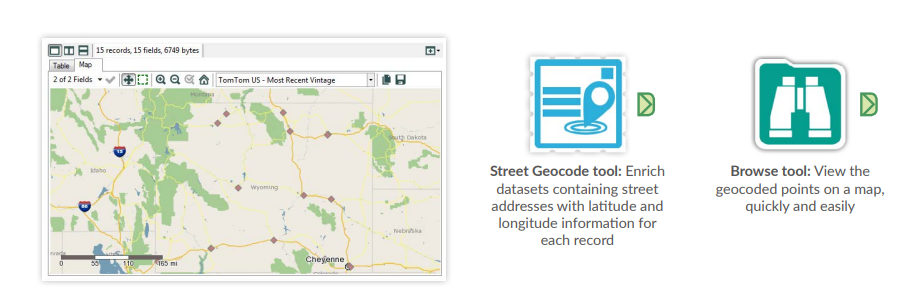
The Street Geocode tool in Alteryx quickly transforms your standard addresses (like customer locations or branch sites) into geographic coordinates (latitude and longitude). This "spatializes" your data, adding a new data point for each location.
In this example, we'll use it to geocode both customer and site data.
3. Define Your Trade Zone:
The Trade Area tool lets you see what's happening within a specific area around each location. For example, you can create a 10-minute drive time polygon. This "draws" a zone around each location, encompassing all areas reachable within a 10-minute drive using the road network.

4. Blend Datasets Together:
The Spatial Match tool lets you see how different sets of locations relate to each other. For instance, you can use it to find out how many customers live within (or outside) the 10-minute drive time zone you created for each location. It essentially compares your customer data points (spatial points) with the trade area polygons (spatial objects) to identify matches based on spatial relationships (like "contains" or "intersects").

5. Use Advanced Spatial Analytics for Additional Insights
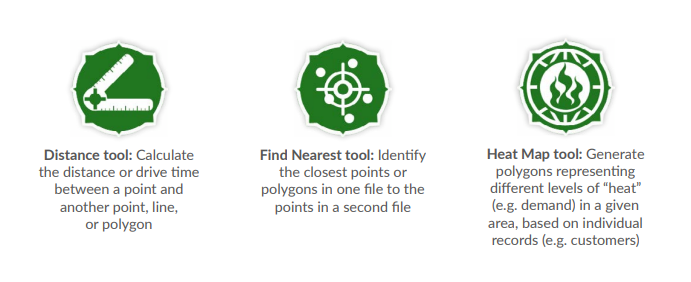
Alteryx offers a range of additional tools for advanced spatial analysis, making it accessible to users beyond data specialists. Additional tools include:
6. Visualise and Share Your Findings:
Alteryx doesn't just help you crunch data - it enables you to share your insights clearly.
Visualize Your Success: Overlay data on detailed maps or satellite imagery using advanced mapping tools.
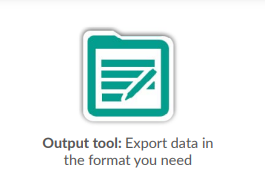
Spread the Knowledge: Export your analysis in various formats like Excel, ESRI, or even Tableau and Qlik for seamless integration with other data workflows and presentations.
Beinex + Alteryx Offerings
As a Premier Alteryx partner, we have extensive experience and a proven track record of success. Our team is highly skilled in Alteryx solutions and can help you unlock the full potential of this powerful platform.
Contact us today to learn more about how Alteryx and our partnership can take your business to the next level.
Image Source: https://community.alteryx.com/pvsmt99345/attachments/pvsmt99345/general-discussions/2303/2/Spatial_Cookbook_Victa.pdf

Grow Your Business with Competitive Intelligence (CI)
What is Competitive Intelligence (CI)?
Competitive Intelligence (CI) is a systematic process for gathering, analyzing, and applying information about the competitive landscape in which a business operates. It equips organizations with valuable insights, helping them make strategic decisions, mitigate risks, and gain a competitive edge.
Competitive Intelligence services play a vital role in helping businesses gain a strategic advantage through the smart utilization of data and information. By gathering, analyzing, and applying information about the competitive landscape, CI equips organizations with valuable insights, enabling them to make data-driven decisions, mitigate risks, and ultimately outperform their competitors.
To learn more about the benefits of Competitive Intelligence, click here
Why Competitive Intelligence (CI) Matters in Business
In today's fast-paced business world, staying ahead is crucial, and Competitive Intelligence services can be the game-changer your business needs. Here's why Competitive Intelligence matters:
Informed Decision-Making
In the modern business landscape, decisions need to be grounded in data, not guesswork. CI services equip decision-makers with valuable insights that help them make well-informed choices. By analyzing competitor behavior, market trends, and consumer preferences, businesses can develop strategies that are not based on hunches but on hard evidence.
For example, consider a scenario where a tech startup is contemplating the launch of a new product. CI can provide insights into the competitive landscape, revealing what similar products are in development, their features, and their projected market reception. Armed with this data, the startup can make crucial decisions about product design, pricing, and marketing with a higher degree of certainty.
Anticipating Market Changes
The business world is in a constant state of flux. Markets evolve, consumer preferences shift, and disruptive technologies emerge. In this environment, businesses that can anticipate and adapt to change gain a significant advantage. CI allows organizations to do just that.
By monitoring industry trends, tracking competitor movements, and analyzing consumer behavior, businesses can identify early indicators of change. This insight provides a head start in adjusting strategies, launching new products, and capitalizing on emerging opportunities. It's the difference between reacting to change and proactively shaping the market.
For instance, an established retail chain with a robust CI process may spot the growing consumer interest in sustainable and eco-friendly products. Armed with this knowledge, the chain can pivot its product selection and marketing to cater to this demand, staying ahead of competitors who are slower to adapt.
Outsmarting the Rivals
Competition in business is not just a matter of survival; it's a race to outperform rivals. In this race, CI is the secret weapon that enables organizations to outmaneuver their competitors.
By gaining insights into competitors' strategies, strengths, and weaknesses, businesses can develop tactics to gain an edge. For example, a restaurant chain can analyze a competitor's menu changes, pricing strategies, and customer reviews to refine its own offerings and marketing approach. This allows for not only maintaining market share but also expanding it.
Moreover, CI is not just about reacting to competitors; it's also about predicting their moves. By understanding the future direction of the market and the strategies competitors are likely to employ, businesses can position themselves strategically. This foresight is a cornerstone of successful long-term planning.
Examples of Competitive Intelligence (CI) in Action
Competitive Intelligence services are used in various business aspects:
Market Research: Imagine a tech company that monitors competitors' product launches, pricing strategies, and customer reviews to refine its own offerings.
Competitor Analysis:A restaurant chain may analyze its competitors' menu changes, customer reviews, and marketing strategies to refine its own offerings.
Supplier and Vendor Insights:By employing CI, companies can assess their suppliers' performance, ensuring a streamlined supply chain.
Types of Competitive Intelligence
CI comes in various flavors, each with its own focus and strategic horizon:
Tactical CI:This short-term focus involves addressing immediate competitive threats and challenges. For example, a retailer may use tactical CI to respond to a competitor's sudden price drop.
Strategic CI:With a long-term view, strategic CI aims to identify trends, market shifts, and opportunities. An example is a global tech corporation analyzing market trends to position itself as a leader in a specific technology sector.
Product CI: This type focuses on tracking competitors' product development and launches, ensuring companies are aware of what's in the pipeline and can adjust their product roadmaps accordingly.
Pricing CI:It involves tracking competitors' pricing strategies and understanding how they position themselves in the market. Companies can then make informed pricing decisions.
The Role of Competitive Intelligence (CI) in Marketing
Incorporating CI into your marketing strategy is a game-changer. It allows you to align your marketing efforts with the competitive landscape and customer preferences, optimizing your strategies for success. Here's how to do it:
CI is more than a buzzword; it's a strategic imperative for businesses. By incorporating CI into your strategies, you can gain a competitive edge, make data-driven decisions, and secure your position in the market. Whether through market research, competitor analysis, or innovative marketing strategies, CI can be the key to success in today's fast-paced business world.
How Beinex Can Help You
Robust Competitive Intelligence is essential in strategising for your next move, enabling you to anticipate your competitors’ direction and future performance. Our data harvesting team validates the entire data manually before the CI application consumes it. Our clients can easily integrate our CI database with their actual transactional data.
Efficient, Competitive Intelligence analysis can give a significant boost to your strategy. Beinex provides comprehensive competitive intelligence solutions that help businesses gain a competitive edge in their industry. Supercharge your competitive strategy with Beinex!

Digital Twins: A Thin Line Between Reality and Virtuality
An actual representative and one fascinating example of digital transformation is the use of "digital twins," which are virtual reproductions of real-world things that have been given artificial intelligence and real-time data. The ‘thing’ can be anything under the moon, from a jet engine to a car. The physical asset's connected sensors gather data that can be transferred onto the virtual model. Now, anyone seeing the digital twin can see essential details regarding how the physical object is faring in the real world. They can, however, be interpreted in various ways, which tends to conceal their accurate, practical application.
A digital equivalent for a physical entity serves as the foundation for digital twins. Every business connection with its clients involves physical elements, from the automotive to the agricultural industries. With the help of digital twins, businesses will be able to extend the advantages of the software world to their physical assets, better meeting the needs of their digital customers.
How do digital twins get to know everything?
The digital data, twins gather from specialists with in-depth topic expertise from other similar assets, helps them learn on their own. After being created, the twins have sensors that enable it to take in any input from its physical twin. This can be used to identify potential problems, gain knowledge, gather feedback on a product, and more. Additionally, they include and use past data to polish their simulations.
The digital twin's architecture
Customarily, digital twins have three layers:
- A connectivity layer that uses SCADA, the Internet of Things, or historians
- A modelling and simulation layer may include a wide range of tools, including artificial intelligence (AI), industry simulators (thermodynamic, fluid-dynamic, chemical, and more), and AI.
- A layer for insight and visualisation that can be created online, with analytics software, or even with mixed reality
The final layer of these three is called "learning feedback," which enables the use of expert feedback and historical data to alter the behaviour of digital twins and the dependability of the physical twin.
Who stands to gain?
Digital twins can contribute to increased productivity in massive engines and intricate machinery. Like industrial settings with cooperative machine systems, digital twins are excellent in enhancing process efficiency. Those sectors that work on large-scale items or projects have the most success with digital twins. Digital twin technology has been used in Formula 1 racing to streamline the competition. Any racing or sports team could employ the digital twin to use a virtual twin in determining areas for strategy and progress.
Consider real estate as another example; a digital twin would link all systems and provide accurate insights and the capacity to evaluate the process. Managers would then be able to refine their plans, improving the structure's viability and effectiveness. Additionally, it would result in lower expenses.
Last but not least, the digital twin notion in healthcare refers to the development of computer models of diseases or even a virtual human body. Customised medications or therapies might be created using a medical twin for each patient. The following industries are going to reap the maximum benefits of digital twins:
- Engineering (systems)
- Automobile manufacturing
- Aircraft production
- Railcar design
- Building construction
- Manufacturing
- Power utilities
- Real estate
- Sports and Racing
- Healthcare
1.Enhance the user experience
Data is essential to comprehend the past, know the present, and anticipate the future. The foundation of any effective user experience programme is effective data management. Digital twins use IoT to collect real-time data from the physical environment. The information gathered is continually analysed, examined, and learned to provide valuable insights. With real-time analytics, businesses may successfully implement user-centric programs.
2.High-quality, innovative products
A competitive advantage that separates the leader from the followers is innovation. Physical asset innovation necessitates significant R&D expenditures. Design, testing, and operation require specialised knowledge due to the high cost of failures. These creative roadblocks can be solved with the help of digital twins. Enterprises can work with the user community to create high-quality offerings in a simulated environment that combines real-time information.
3.Enhance business processes
In terms of consumer annoyance, broken processes and bureaucracy would be at the top. The orchestration, knowledge management, and technological architecture are fragmented and siloed due to the complexity of modern business operations. The numerous systems and processes are brought together under one roof using digital twins, which act as a meta-layer. Digital twins are essential for knowledge management, training, and process optimisation in the complicated future. Additionally, simulations and visualisations support better process management and human learning.
4.Operative flexibility
Operational agility will affect an organisation’s top and bottom lines in a highly competitive marketplace. Black-box algorithms, the enormous amounts of information gathered, and the need for quicker judgments all work against human operators. Digital twins allow a range of diagnostic and prognostic capabilities by utilising enormous amounts of data, technology, and scenario. The human operators can re-enter the process and find strategies for being competitive and flexible.
5.Information security
Information security is a challenge that comes with all the data. Open source, collaborative learning, and knowledge sharing have never had a more compelling argument. We can't advance if data breaches are happening more frequently. Trusted stakeholders could collaborate on a platform provided by digital twins to share information and gain from it. Digital twins can also act as a layer of concealment to protect the confidentiality of the data.
6.Upgraded R&D
Utilising digital twins produces a wealth of data regarding expected performance results, facilitating more efficient product research and creation. Before beginning production, businesses can use this data to gain insights that will help them make the necessary product improvements.
7.Greater effectiveness
Digital twins can aid in monitoring and mirroring production systems even after a new product has entered production to reach and maintain peak efficiency throughout the manufacturing process.
8.Product life cycle
Digital twins can also assist producers in determining how to handle products that have reached the end of their useful lives and require final processing, such as recycling or other actions. They can decide which product materials can be gathered by utilising digital twins.
9.The Future Course
The market for digital twins is increasing, which suggests that even if they are already used in many different industries, demand will persist for a while. The need for digital twins was worth USD 3.1 billion in 2020. It may continue to snowball until at least 2026, rising to a projected USD 48.2 billion, according to specific industry observers.
According to IDC, global spending on products and services that facilitate digital transformation will amount to US$1.97 trillion in 2022, growing at a CAGR of 16.7%. Businesses are transforming the structure of their work to put the client first. Enterprises are taking more significant risks than ever in every aspect of business, from product design to marketing, sales, and even post-sales. Enterprises can use digital twins as a strategy to accomplish the goals of their initiatives for digital transformation.