How AI Decision-Making is Improving Enterprise Outcomes
Blog
Share 
How AI Decision-Making is Improving Enterprise Outcomes
 6 April 2026
  Sumi S
 Enterprises today don’t suffer from a lack of data; instead, they’re overwhelmed by it. The real challenge before organizations is turning that data into well-timed decisions. This is where AI decision-making comes in. Enterprises are increasingly relying on AI-driven decision intelligence to guide strategy, enhance operations, and achieve better business outcomes. Let’s see how it drastically changes how modern businesses operate.
According to McKinsey & Company, 88% of organizations now use AI in at least one business function, up from 78% a year ago. This shift shows that AI is moving from experimentation to a central role in decision-making. Gartner predicts that by 2028, at least 15% of daily business decisions will be made autonomously, and 33% of enterprise applications will include agentic AI.
What is AI Decision-Making?
AI decision-making refers to the use of artificial intelligence to analyse data, generate insights, and recommend or execute business decisions with limited human involvement.
Unlike traditional analytics tools that only report past performance, AI systems predict future trends, simulate scenarios, and recommend optimal actions. This shift helps leaders to adopt proactive, data-driven strategies and is evident in current enterprise applications. For example, AI models can analyse customer behaviour, supply chain patterns, and market signals simultaneously to recommend pricing adjustments, inventory changes, or risk reduction strategies. They can also bring major changes in the following sectors:
- Financial services: AI agents are increasingly being deployed to automate fraud alerts, accelerate loan processing, and trigger compliance escalations based on predefined risk thresholds. Banks are also using agentic AI across KYC, AML, and customer onboarding workflows to reduce manual review.
- Aviation and customer service: Airlines use AI agents to handle routine customer requests, such as rebooking flights or rerouting baggage. This allows human agents to focus on complex or sensitive issues, improving efficiency and customer satisfaction.
- Manufacturing: AI agents support product development by balancing competing priorities like cost, quality, and time-to-market. It helps teams make the right design decisions.
How AI Improves Business Outcomes Across Industries
Organizations adopting AI-powered decision systems are seeing measurable improvements across several areas. Across fields like finance, retail, healthcare, and manufacturing, these capabilities are boosting productivity, reducing costs, and resulting in better strategic planning.
Insights from Deloitte show that:
- 66% of enterprises report productivity gains from AI
- 53% say AI improves decision-making and analysis
- 40% report cost reductions
- 38% see better customer relationships
These benefits are not theoretical; they are already playing out across sectors.
1: Faster decision cycles :
AI processes large volumes of data in real time, allowing businesses to respond quickly to market changes or business interruptions.
Example: Leading banks are already using AI to analyze transactions and customer behavior in real time. It supports faster credit decisions and early fraud detection.
2: More accurate forecasting:
Predictive analytics helps companies predict demand alterations, financial risks, and customer trends before they occur. Research from McKinsey & Company highlights how AI-driven forecasting improves accuracy in demand planning and financial modeling.
Example: In the energy sector, many prominent organizations use AI to predict equipment failures and optimize production, thereby reducing downtime and improving reliability.
3: Operational proficiency:
Automated routine decision tasks, such as fraud detection, logistics optimization, or service routing, reduce human workload and improve consistency.
Example: Major retail leaders use AI to automatically adjust inventory, predict demand increases, and personalize promotions across locations.
4: Better customer experiences:
AI-based insights support businesses to personalize recommendations, improve service delivery, and respond to customer needs faster.
Example: Prominent healthcare Institutions use AI to support diagnostics, accelerate patient flow, and assist clinical decision-making, thereby improving both the speed and quality of care.
How Self-governing AI Systems Support Enterprises
Enterprise AI is changing at a quicker pace. Earlier systems mainly supported individual decision-making by supplying data and analytics. Today, more complex systems can act on those insights autonomously.
These AI agents can monitor data streams, trigger workflows, and coordinate with other systems to complete tasks. In financial services, for instance, AI models can flag suspicious transactions instantly. In supply chains, AI can adjust inventory levels automatically based on demand signals.
Rather than replacing humans, these systems create a collective decision-making model in which AI handles high-volume operational decisions while leaders focus on strategy and innovation.
How to Build Responsible AI Decision Frameworks
As AI assumes greater decision-making tasks, governance becomes essential. Organizations are required to preserve data validity, transparency, and human monitoring to prevent biased or incorrect outcomes.
Formulating clear policies for AI accountability, explainability, and monitoring helps businesses preserve trust while scaling intelligent decision systems.
Next Phase of Enterprise Decision Intelligence
The next phase of digital transformation will be defined not just by automation but by intelligent decision-making at scale. Enterprises that successfully integrate AI into their decision-making processes will operate faster, more precisely, and with greater resilience.
In the years ahead, the organizations that thrive will not simply be those with the most data, but those that use AI to make the smartest decisions from it.
Related Articles

Top Benefits of Adopting Digital Twin Services in Your Organization
Digital Twin Services in the UAE
The UAE digital twin market generated USD 558.3 million in revenue in 2024 and is projected to grow to USD 3.48 billion by 2030, at a CAGR of 34%. Within the broader GCC region, the digital twin market achieved USD 1.52 billion in 2024, with the UAE positioned as the lead market.
Digital twin services have widely brought transformative changes in both government and private structures. Imagine testing modifications to a production line, monitoring energy usage across an entire facility, or simulating traffic patterns in a smart environment, all without impacting real-world operations. That’s the transformative power of digital twins, and Beinex is helping organizations harness it to drive smarter, data-backed decisions.
In the UAE, where innovation meets ambition, the digital twin services are rapidly gaining traction across key sectors:
- • Healthcare providers are using digital twins for patient-specific simulations, improving diagnostics and treatment planning.
- • Manufacturing & industrial operations, including oil & gas, petrochemicals, are employing digital twins for asset performance monitoring, failure prediction, and process optimization.
- • Automotive and transport industries are the largest and fastest-growing adopters of digital twin solutions, leveraging them for innovation, sustainability, and operational excellence.
Whether it's a high-tech manufacturing facility in Abu Dhabi or a cutting-edge urban development in Dubai, Beinex Digital Twin Solutions is empowering organizations to make smarter, faster, and more informed decisions, with fewer surprises along the way.
What is a Digital Twin?
A digital twin is a virtual replica of a physical asset, system, or process powered by real-time data and enhanced with artificial intelligence. It mirrors real-world behavior, performance, and status, enabling businesses to monitor, simulate, and optimize their operations. Whether it’s a jet engine, a wind turbine, or an entire smart city infrastructure, digital twins provide an insightful, data-driven window into how physical objects function in the real world.
Studies by Deloitte indicate that the global digital twin market size is projected to increase from nearly US$13 billion in 2023 to US$259 billion by 2032. Undoubtedly, in the coming years, we can anticipate a surge in the number of businesses adopting digital twin technology as part of their business strategy.
How Digital Twin Solutions are Transforming Businesses in the UAE
Digital Twin technology and its solutions allow businesses to track the performance of assets, detect potential faults, and make smarter decisions about maintenance and lifecycle management. Digital Twin Solutions in the UAE are rapidly growing, especially in sectors like construction, urban planning, and public services. Here's how Digital Twin Solutions are reshaping various industries in the UAE.
Energy Sector (Oil & Gas)
The energy industry is using digital twin technology in optimizing resource distribution, enhancing demand forecasting, and improving asset monitoring. This technology ensures a more resilient and efficient infrastructure as the UAE continues its transition to sustainable energy.
Healthcare Sector
Digital twins are used in the medical industry to simulate organs, personalize patient care, and streamline clinical procedures. It opens the door for precision medicine and more sophisticated patient care in the rapidly expanding healthcare industry in the United Arab Emirates.
Engineering Sector
In the engineering field, digital twins are used to simulate and analyze intricate machinery and infrastructure. It supports engineers to test scenarios, identify errors, and refine system designs before construction. In industries like infrastructure, aviation, and defence, it guarantees safer and more efficient development.
Automobile Manufacturing Industry
The UAE automotive industry is using digital twins to improve vehicle design, testing, and maintenance. Virtual prototypes save production costs, increase safety, and accelerate innovation. As a result, the UAE has begun making significant investments in electric vehicles and innovative mobility technologies.
Aviation Industry
Digital twins can be beneficial for modelling aircraft parts, tracking performance, and forecasting maintenance requirements in the UAE's booming aviation industry. It prolongs the aircraft's lifespan, improves performance, and safety.
Construction and Infrastructure Industry
Real-time models of buildings, bridges, and other infrastructure are produced using digital twin technology. In the thriving UAE construction industry, it enables contractors and developers to monitor developments, reduce errors, and create more intelligent, sustainable urban designs.
Manufacturing Sector
In the UAE, manufacturers are using digital twins to simulate production processes, monitor machinery, and manage supply networks. As the competitive global market demands more flexible operations, improved quality control, and reduced downtime, digital twins can provide significant support.
Real Estate and Property Development
UAE real estate developers are using digital twins to view buildings before construction, remotely manage homes, and simulate energy consumption. For today's tech-savvy purchasers and investors, these solutions facilitate more informed decision-making in design, leasing, and facility management.
Top 8 Benefits of the Digital Twin
Let’s discuss the top eight benefits of digital twins, but these are only the tip of the iceberg; the others are up and coming:
1. Enhance User Experience
Data is essential to comprehend the past, know the present, and anticipate the future. The foundation of any effective user experience program is effective data management. Digital twins use IoT to collect real-time data from the physical environment. The information gathered is continually analyzed, examined, and learned to provide valuable insights. With real-time analytics, businesses may successfully implement user-centric programs.
2. High-quality and Innovative Products
A competitive advantage that separates the leader from the followers is innovation. Physical asset innovation necessitates significant R&D expenditures. Design, testing, and operation require specialized knowledge due to the high cost of failures. These creative roadblocks can be solved with the help of digital twins. Enterprises can work with the user community to create high-quality offerings in a simulated environment that combines real-time information.
3. Enhance Business Processes
For consumers, broken processes and bureaucracy would be at the top of their list of annoyances. The orchestration, knowledge management, and technological architecture are fragmented and siloed due to the complexity of modern business operations. The numerous systems and processes are brought together under one roof using digital twins, which act as a meta-layer. Digital twins are essential for knowledge management, training, and process optimization in the complicated future. Additionally, simulations and visualizations support better process management and human learning.
4. Operative Flexibility
Operational agility will affect an organization's top and bottom lines in a highly competitive marketplace. Black-box algorithms, the enormous amounts of information gathered, and the need for quicker judgments all work against human operators. Digital twins allow a range of diagnostic and prognostic capabilities by utilizing enormous amounts of data, technology, and scenarios. The human operators can re-enter the process and find strategies for being competitive and flexible.
5. Information Security
Information security is a challenge that comes with all the data. Open source, collaborative learning, and knowledge sharing have never had a more compelling argument. We can't advance if data breaches are happening more frequently. Trusted stakeholders could collaborate on a platform provided by digital twins to share information and gain from it. Digital twins can also act as a layer of concealment to protect the confidentiality of the data.
6. Upgraded Research & Development
Utilising digital twins produces a wealth of data regarding expected performance results, facilitating more efficient product research and creation. The best thing is that before beginning production, businesses can use this data to gain insights that will help them make the necessary product improvements.
7. Greater Effectiveness
Digital twins can aid in monitoring and mirroring production systems even after a new product has entered production to reach and maintain peak efficiency throughout the manufacturing process.
8. Product Life Cycle
Digital twins can also assist producers in determining how to handle products that have reached the end of their useful lives and require final processing, such as recycling or other actions. They can decide which product materials can be gathered by utilising digital twins.
Beinex Digital Twin Solutions & Consulting Services
The steadily growing digital twins’ market is evidence that, although being widely used in many different industries, this technology is still far from attaining its full potential. The entire business lifecycle is undergoing a transformation due to digital twin solutions, encompassing product creation and design, marketing, sales, and post-purchase support.
For businesses seeking to advance their digital transformation agendas, digital twins are now more than just a tool; they are a strategic enabler. In the UAE, Beinex's digital twin consulting services are having a significant impact. Beinex is here to help you achieve the full potential of your digital twin journey. Connect with us to know more: https://beinex.com/digital-twin/
Beinex is Now Great Place to Work-Certified™!
This is a remarkable achievement. Yes, something which we have been living is now officially recognised, and it adds to our commitment to keeping Beinex a Great Place to Work, always!
Snapshots from the Survey
- Our Trust Index is 84! The Trust Index© score is the percentage of employees that shared a positive response (rated 4 or 5 on a 5-point scale) to the 59 statements of the survey.
- Trust Index© Feedback Credibility of Management stands at 87.
- Respect for people – 80
- Fairness at the Workplace - 84
- Pride – 86
- Camaraderie between People - 86
What our accomplishment means
The Great Place to Work® Certification Program is the initial step for an organisation on its journey of building a High-Trust, High-Performance Culture™ and our organisation has successfully reached this milestone.
Yes, the word that should be borne in mind is ‘milestone’. We still have a long way to go! And we will, with confidence, sustain our victories on all fronts.
We will not rest on our laurels
As the next step to our Certification, we have various opportunities to learn, develop & grow our talent with the help of Great Place to Work® Events. They are characterised by an exciting range of engagement measures and large-scale events from where we would be able to learn and contribute to the richness of our culture.
About Great Place to Work Institute
Great Place to Work® Institute is a global management research and consulting firm dedicated towards enabling organizations to achieve business objectives by building better workplaces. They work with over 10,000 organizations globally every year to help them create and sustain High-Trust, High-PerformanceTM cultures.
As part of the assessment, they measured the perceptions of Beinex’s employees using Great Place to Work® Trust Index© Employee Survey and understood our organization’s differentiating culture through the Culture Brief© and Culture Audit©.

Agentic AI and Enterprise Intelligence: Leading Trends, Challenges, and Opportunities in 2026 and Beyond
For a long time, enterprise intelligence relied on dashboards, reports, and predictive systems. These tools helped leaders see what happened and predict what could happen next. However, the users still had to interpret the results and act on them themselves.
Now, that approach is changing with the adoption of Agentic AI. According to Gartner research, 40% of enterprise applications are expected to include task-specific AI agents by 2026, up from less than 5% in 2025.
Let the force be with you: Data residency and Hyperforce
After two very long masked years, the world has slowly started to breathe, again!
With lockdowns on and work taking place from the very room you had slept a couple of hours back -- the human universe has been phenomenally re-engineered by a microscopic organism.
Your geographical location has been made immaterial in the digital world. But the same cannot be said about data, and this may sound paradoxical and ironic. For instance, an MNC’s location of the data now matters more than ever before. With a major chunk of data of many entities, especially government ones, on the public cloud, the airing of concerns related to data security, data sovereignty, data localisation/ data residency is growing louder in decibel terms.
This is where Hyperforce comes in.
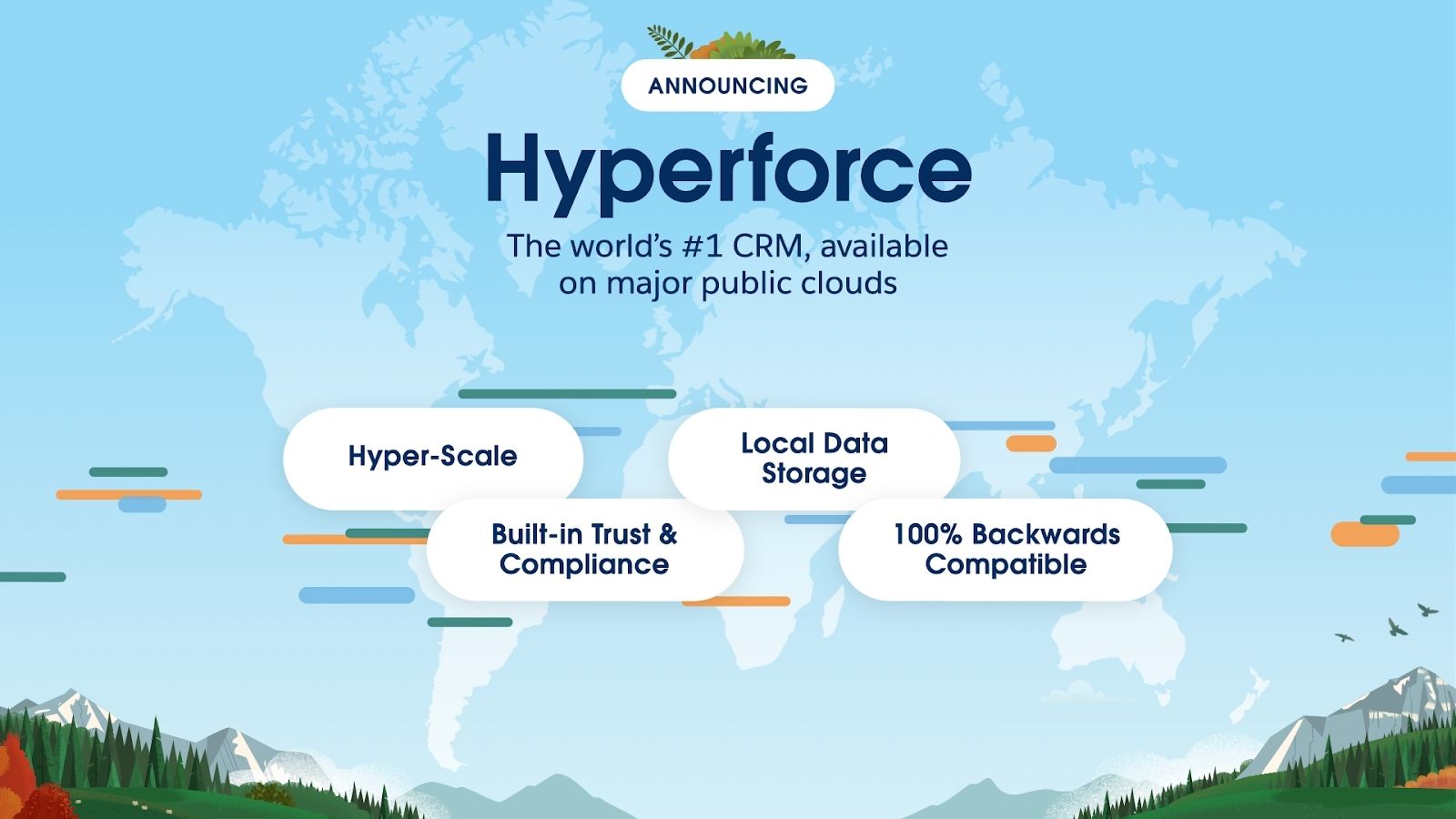
Hyperforce is how Salesforce has reimagined its platform. It is now horizontally scalable, and through tie-ups with major cloud providers, the scalability has grown by leaps and bounds. Imagine you are a B2B company with 10,000 customers or a B2C company with tens of millions of customers: Hyperforce lets you scale up your capabilities and provides you with a single source of truth. But what if you are a multi-geographic business conglomerate in a heavily regulated industry like finance or health? How will you comply with data sovereignty, data localisation/ data residency requirements? Hyperforce’s collaboration with public cloud companies ensures that the data can be located at any specified place in the world, adhering to the local rules of data governance and storage locations. “Choose the location where your data will be stored to comply with regulations specific to your company, region, or industry — even in highly regulated industries like the public sector,” the store-data-locally-keep-it-compliant-globally mantra tells. Other features Hyperscalable: Hyperforce also enables you to scale the infrastructure as per the needs of the business by letting you access extra computing capacity as and when required. You can employ resources in the public cloud rather quickly. Yes, it is your decision whether to scale up or not, and the elasticity can be dictated by the nature of your requirements. Hypersecure: Also, trust is built-in, which puts security at the forefront of the architecture. Data privacy and security are sacrosanct. This leaves you with enough room to focus on innovation. Hypercompatible: And most important of all, backward compatibility ensures that all the extant Salesforce apps, customisations and integrations will continue to work on Hyperforce regardless of cloud. In the physical world, your geographical location assumes importance. But in the digital world, it is the location of the data that matters. Hyperforce, by virtue of its collaboration with major players in the cloud domain, ensures data residency requirements are adhered to when and where needed. The architecture is hyper-scalable, secure, and comes with backward compatibility. Hyperforce is soon to be launched in the UAE, and Beinex, a Salesforce partner, is all set to carry out implementation and consulting of and for Hyperforce.
Google Cloud Platform: The Future of Business Transformation
Google Cloud Platform is a Google-delivered complete set of cloud computing services. The services extend to networking, storage, application development, computing, Big Data and even more, which operate on the same cloud infrastructure used internally by Google for Gmail, YouTube, and others. What makes GCP a reliable and secure cloud infrastructure to build, test and run applications is the fact that its server has not gone down in years. IT professionals, software developers and cloud administrators can access GCP services online.
Why choose the Google Cloud Platform?
In 2022, Gartner Magic Quadrant Cloud Infrastructure and Platform services named Google as a leader for the fifth time in a row. Google Cloud Platform's global network of data centres spans multiple continents, ensuring low-latency access and redundancy for your applications and data. Therefore, GCP can be the perfect choice for organisations looking for a globally renowned cloud platform known for its wide array of services and offerings. GCP's extensive catalogue of services with unique features can be attributed to the global expansion and recognition of the platform. Some of GCP's significant services include Computing, Storage, Networking, Big Data, Cloud AI, Security and Identity Management, Management Tools, and IoT.
Besides, the following aspects also add to the reasons why GCP is a viable cloud provider for businesses:
- Provides multi-level security to safeguard resources like assets and operating systems
- Has a network infrastructure comprising physical, logistical, and human-resource-related elements, like wiring, routers, switches, and firewalls
- Has proficient experts who provide support on installation and maintenance
Key Benefits of Google Cloud Platform
GCP enables customers to access computer resources located in Google's global data centres at no cost or on a pay-per-use for the services and resources used. GCP hosting plans are cost-effective compared to other platforms and offer superior features.
With features like data encryption, multi-factor authentication, and identity and access management, GCP prioritises the security of client data and applications.
Google's web-based applications provide users with complete accessibility to GCP from virtually anywhere.
GCP delivers enterprise-grade solution architectures and tech strategies to provide scalability and expedite digital transformation.
Google boasts its proprietary network infrastructure, granting users greater control over the functions of GCP. As a result, users experience seamless performance and heightened efficiency across the network.
GCP offers tools for automation, compliance and governance and a secure cloud environment to navigate challenges in cloud operations.
GCP enables organisations to harness the power of AI to automate processes, gain data-driven insights and employ machine learning for innovation.
With services like Bigtable and Cloud Storage, GCP benefits organisations in managing extensive data and facilitating real-time data processing and analysis.
Real-World Business Challenges & GCP Solutions
GCP’s suite of solutions assists organisations in tackling challenges in the dynamic business landscape effectively. Some common challenges in business and their respective GCP solutions are briefed below.
GCP equips your business with analytics tools and robust data storage to manage extensive data effectively and derive valuable insights.
With development and deployment tools like Cloud Functions and Google App Engine, GCP enables organisations to expedite development and gain a competitive edge.
GCP’s extensive global network infrastructure aids businesses by ensuring the applications reach across the world seamlessly.
With its suite of security tools for threat detection, data encryption and access and identity management, GCP safeguards data and applications with multi-level security.
In the event of unanticipated disruptions that halt business operations, GCP ensures business continuity with its backup options and disaster recovery solutions, making critical applications and data accessible.
X (formerly Twitter), eBay, PayPal, and 20th Century Fox are some of the top users who have leveraged the transformative potential of Google Cloud Platform. Being a globally recognised brand for its speed, performance, security, reliability and innovation, the Google Cloud Platform is a beacon of digital transformation for businesses navigating the challenges of the data-driven digital era. As companies venture on their journey with GCP, the prospects are endless. This partnership empowers businesses with the tools, resources, and support needed to thrive in a dynamic landscape. Whether achieving operational efficiency, reducing costs, or delivering superior customer experiences, GCP catalyses change.
What can Beinex do for you?
Beinex is now a service partner of GCP and is helping businesses advance their digital transformation endeavours by leveraging GCP’s AI capabilities, cloud infrastructure, and data analytics. Beinex offers clients expert guidance in deploying proactive solutions and using Google Cloud to make more informed data-driven decisions. This approach enables them to overcome business challenges and fosters competitiveness, efficiency, and growth. At Beinex, we deploy Google Cloud Platform as a service and the infrastructure as a service, enabling organisations to streamline access to a broader array of services and resources, resulting in cost efficiency and improved quality.