How AI Decision-Making is Improving Enterprise Outcomes
Blog
Share 
Four Ways SMBs can Leverage Digital Transformation
 14 April 2023
  Sumi S
 The digital transformation uses digital technologies to transform businesses’ operations, deliver customer value, and compete in the market. For SMBs, digital transformation can provide a pathway to growth, unlocking new potential for efficiency, productivity, and innovation.
The Context and the Harvest Potential
Reports suggest that SMBs that are digitally engaged can increase their profits up to twice as fast as their offline counterparts. Digital transformation opens up new market opportunities for SMBs, driving overall growth.
Some noteworthy figures include the expected economic value of digital transformation to reach $100 trillion by 2025. While 21% of organisations believe their digital transformation efforts are complete, 87% of senior business leaders consider digitalisation a company priority, with 79% of corporate strategists indicating that it is reinventing their business and creating new revenue streams.
Moreover, 71% of leaders believe that the role of the workforce is crucial in implementing digital transformation, as employees play an essential part in driving and adopting new technologies.
How to Get Started?
To commence the digital transformation process for your SMB, you should initiate a discussion with your team regarding the concept of digital transformation and how it will impact your business. Additionally, it is crucial to consider a few points, such as:
• Identify the areas where your business is falling behind compared to your competitors.
• Determine which components of your current business plan require replacement or technological advancement.
• Evaluate the operations that are time-consuming and can be automated
Here are some key pathways in which SMBs can unlock their potential through digital transformation:
1. Embracing Cloud Computing
One fundamental way SMBs can unlock their potential through digital transformation is by embracing cloud computing. Cloud computing has become a game-changer for SMBs, providing access to powerful tools and technologies without significant upfront investment. With cloud-based solutions, SMBs can scale their operations, reduce IT costs, and gain the agility needed to compete in a fast-paced market.
Cloud computing provides SMBs access to various services, including storage, computing power, and software applications, all delivered over the Internet. Using cloud-based services, SMBs can eliminate the need for on-premise IT infrastructure, reduce maintenance costs, and free up resources to focus on core business activities.
Cloud-based solutions also offer SMBs the flexibility to scale their operations quickly and efficiently. With cloud computing, SMBs can easily adjust their IT infrastructure to meet changing business needs, whether adding new users, increasing storage capacity, or rolling out new applications.
2. Leveraging Data Analytics
Data is the lifeblood of modern businesses, and SMBs can harness the power of data analytics to gain insights into customer behaviour, market trends, and operational performance. By leveraging data analytics tools, SMBs can make more informed decisions, improve processes, and identify new growth opportunities.
Data analytics tools can help SMBs to:
• Monitor customer behaviour and preferences
• Identify trends and patterns in sales data
• Optimise pricing and inventory management
• Improve marketing effectiveness
• Enhance operational efficiency
To leverage data analytics effectively, SMBs must have the proper data management and analysis tools. This includes collecting, storing, and analysing data from various sources, such as customer relationship management (CRM) systems, sales data, and social media metrics.
3. Automating Business Processes
Automation has revolutionised how businesses operate, and SMBs can benefit from automating routine tasks and processes. Automation can help SMBs to reduce costs, increase efficiency, and improve customer satisfaction by freeing up resources to focus on higher-value activities.
Automated processes can include:
• Invoicing and billing
• Inventory management
• Payroll processing
• Customer service
• Marketing and sales
By automating these processes, SMBs can reduce errors, improve productivity, and deliver a more consistent customer experience. Automation can also free up resources to focus on more strategic initiatives, such as product development and business expansion.
4. Embracing E-commerce
E-commerce has become a vital channel for SMBs to reach customers and generate revenue. By embracing e-commerce platforms, SMBs can expand their reach, reduce overhead costs, and offer customers a convenient, digital-first experience.
E-commerce platforms provide SMBs with a range of benefits, including:
• Access to a global customer base
• Reduced overhead costs
• Increased sales and revenue
• Improved customer experience
• Flexibility and scalability
To remain competitive in the digital marketplace, SMBs must adopt online marketing strategies and cloud-based solutions for operational efficiency. Moreover, customer-centricity is the primary focus in the digital market, unlike the traditional profit-oriented approach.
Summing Up
The scope of digital transformation is vast, and there is much more to it than meets the eye. Studies show that 85% of decision-makers feel digital integration is necessary within two years or less.
As such, the future of digital transformation will feature technology at the heart of all business processes and prioritise customer satisfaction. However, there will be significant challenges regarding needing more resources and skills, which business leaders must address and mitigate.
Beinex Digital, a part of Beinex Holdings, is a digital transformation entity with a comprehensive suite of independent products that address specific business gaps, use cases, and needs. The growth strategy of Beinex Digital revolves around inducing digital transformation as a way of life for businesses worldwide.
Rather than waiting for change to happen, businesses should start acting. The question is, are you prepared to embrace digital transformation?
Small and Medium-sized Businesses (SMBs) are the backbone of the global economy, contributing significantly to job creation, innovation, and economic growth. However, in today's rapidly evolving digital landscape, SMBs face many challenges in staying competitive and relevant. The emergence of new technologies, changing consumer behaviours, and a shift towards digital-first experiences have all contributed to the need for SMBs to adapt and embrace digital transformation.
Related Articles

Tableau + AWS: Dashboards Development Using AWS Glue DataBrew
With AWS Glue DataBrew, we can transform and prepare datasets from Amazon Aurora and other Amazon Relational Database Service (Amazon RDS) databases and upload them into Amazon S3 to visualise the transformed data on a dashboard using Tableau.
Here is how to do it:
With AWS Glue DataBrew, we can:
1. Transform and prepare datasets from:
a. Amazon Simple Storage Service (Amazon S3)
b. Amazon Aurora
c. Amazon Relational Database Service (Amazon RDS) databases
2. Upload them into Amazon S3
3. Visualize the transformed data on a dashboard using Tableau
Method:
1. You can create a JDBC connection for Amazon Redshift and a DataBrew project on the DataBrew console.
2. DataBrew queries data from Amazon Redshift by creating a recipe and performing transformations.
3. The DataBrew job writes the final output to an S3 bucket in Tableau Hyper format.
4. You can now upload the file into Tableau for further visualisation and analysis.
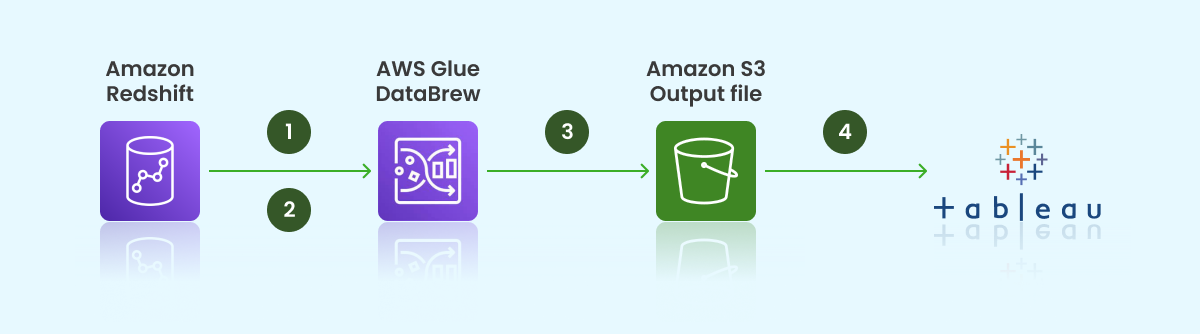
Result: Creation of predictive dashboards on top of the S3 bucket
AWS Glue DataBrew is a tool for data analysts and scientists that simplifies cleaning and standardising data to prepare it for machine learning and analytics.

RecapAI: An AI-Powered Assistant for Priority Tracking and Follow-Through
What is RecapAI Agent
RecapAI is an AI-powered assistant that helps professionals quickly regain context after time away from work. It analyzes meetings, deadlines, communications, and updates to identify what has changed, what requires action, and what should be prioritized next. Instead of reviewing multiple tools and threads, users receive a clear, structured overview of critical follow-ups, key discussions, and upcoming priorities.
Connect With Us for a Free Demo!
How RecapAI Supports You
While you are away, RecapAI quietly keeps your workspace running. It monitors your inbox, tracks meeting updates, notes shifting deadlines, and identifies what needs your attention. It works like a calm, thoughtful assistant who knows exactly what matters and what can wait.
Our RecapAI agent welcomes you with a brief, clear summary – no scrolling, no searching, no overwhelm. You open your workspace, and everything makes sense instantly.
Your:
- • Shifted deadlines
- • Key meeting
- • Follow-ups you need to send
- • People to catch up
- • Upcoming priorities – all sorted for you.
It feels like someone has already organised your day and highlighted only what matters. RecapAI Agent isn't just a summarizer – It understands your priorities. You return after a break and instantly know what needs your attention.
Summing Up
RecapAI goes beyond simple summarization by aligning information with the user’s responsibilities and priorities. It supports focused decision-making and quicker re-engagement. The best part is that RecapAI makes sure users return to work informed, organized, and ready to act.
Connect with us if you want to know more about RecapAI: https://beinex.com/contact-us/

Top 5 Benefits of Google Cloud Platform: Be Ready to be Blown Away by Google Cloud Offerings
What is Google Cloud Platform (GCP)?
GCP is not just a cloud solution; it's a comprehensive package that integrates Infrastructure as a Service (IaaS), Platform as a Service (PaaS), and Software as a Service (SaaS). It's your all-in-one place for managing projects, handling resources, storing data securely, running applications effortlessly, processing vast datasets efficiently, and streamlining development workflows.
What sets GCP apart is its versatility. Whether you're a startup with a dream or an enterprise with complex demands, GCP is designed to make your cloud experience smoother and more efficient. It's not just about computing in the cloud; it's about transforming how you work, collaborate, and innovate.
Why is GCP gaining immense popularity? The answer lies in its ability to adapt and serve many functions. It's the go-to platform for managing projects seamlessly, storing and retrieving data efficiently, running applications flawlessly, and tackling large-scale data processing tasks with finesse.
Google Cloud Platform (GCP): Top Five Benefits
GCP simplifies the complexities of cloud computing, offering an extensive array of solutions catering to the unique needs of businesses and individuals. Whether you're a tech-savvy developer or a business owner seeking streamlined operations, GCP covers you. Let’s take a look at the top five benefits of GCP:
- Comprehensive Suite of Services: Shaping Tools to Your Needs
- Cost Efficiency: Hardware and Software Overheads
- Robust Security: Trust Google's Expertise in Cloud Computing
- Scalability: Unlimited Business Growth
- Customization: GCP Meets Your Unique Requirements
Google Cloud Platform provides an extensive array of services, ensuring that businesses can find the perfect tools for their unique requirements. From software development to app development, GCP's "cloud native" approach guarantees applications that seamlessly leverage the cloud's scalability and flexibility. The platform is backed by Google's world-class infrastructure, ensuring optimal availability and performance.
GCP empowers businesses to slash hardware and software costs significantly. Organizations can sidestep hefty investments in infrastructure and maintenance through managed environments for development and cloud-native applications. The pay-as-you-go pricing model further allows businesses to manage costs effectively, with additional training and support resources ensuring maximum returns on investment.
Leverage Google Cloud Platform's robust security features to safeguard your data effectively. With tools like Identity and Access Management, Data Loss Prevention, and Security Health Analytics, businesses can confidently ensure the safety and integrity of their data within the GCP ecosystem.
Google Cloud Platform offers unparalleled scalability, allowing businesses to develop and deploy applications without concerns about underlying infrastructure. Ideal for those embracing a cloud-native approach, GCP harnesses Google's top-tier data centers and global network, enabling businesses to scale usage up or down as needed without incurring additional costs.
The high level of customization afforded by Google Cloud Platform makes it a powerful tool for businesses of all sizes. Whether for software development, app creation, or transitioning to the cloud, GCP's flexibility ensures it can be configured to meet the specific needs of any business, offering versatility and adaptability.
If your business is poised for growth, the Google Cloud Platform is invaluable. With diverse features and benefits, GCP enhances efficiency, communication, collaboration, and security making your business a worthwhile investment.
Bonus Section: Exploring Google Cloud Platform Services for Business Enhancement
Google Cloud Platform goes beyond conventional cloud services, offering a comprehensive suite of features that can revolutionize how businesses operate and innovate. Whether you're a startup or an established enterprise, GCP has the tools to propel your business forward.
Improved Features: Google Cloud offers collaborative project features, unlimited data, and better security, providing an upgraded experience compared to Google Drive.
Unlimited Data: GCP's unlimited data storage is particularly beneficial for businesses involved in large projects, such as video games or movies.
Gather Data Effectively: BigQuery provides real-time analytics, allowing businesses to make informed decisions based on up-to-the-minute data.
Take Advantage of Tutorials: Google Cloud offers many resources, including tutorials and support forums, ensuring businesses can effectively utilize the platform's capabilities.
Advanced Services: GCP caters to specific industries, offering tailored services for live streamers, healthcare professionals, telecommunications, and retailers.
Make Websites and Apps: GCP's app creator and website hosting simplify digital endeavors for businesses, providing special deals for popular site builders like WordPress.
Train AI: Google Cloud stands out with its AI/ML features, enabling businesses to develop chatbots, crunch data, and enhance overall data gathering and generation.
Beinex Offerings
Beinex, a Google Cloud Platform service partner, assists organisations in advancing their digital transformation initiatives by leveraging the cloud infrastructure, data analytics and AI capabilities of Google Cloud Platform. We offer our clients expert guidance in implementing future-ready solutions and utilising Google Cloud for better data-driven decisions, tackling business challenges and fostering competitiveness, efficiency, and growth.

The Strategic AI Deployment: Integrating Llama 3 in the Snowflake Ecosystem
Businesses are indulging in the continuous endeavour to leverage the full potential of their data, and they are constantly seeking innovative solutions for the same. A solution capable of gaining traction is the integration of Meta Llama 3 into the Snowflake ecosystem. Beinex has brought this to fruition by establishing an innovative work model that guarantees an application that functions within Snowpark Container Services and harnesses the capabilities of Llama 3.
 Figure 1: Screenshot from DocAI. Zaki Document Chatbot (DocAI) tapping into Llama 3 by Meta and running in the Snowflake ecosystem.
Beinex tested Llama 3 on its in-house DocAI, a solution that runs on Snowflake using Snowpark Container services. The DocAI chatbot solution offers the flexibility to chat with documents such as PPT, PDF, word files, and text files. It currently uses llama3. Llama 3 is a major leap forward, establishing new standards for large language models. Its extensive training data, improved quality, and increased context length make it a powerful choice for document-related tasks, including our DocAI chatbot solution. The article will explain how Beinex deployed Llama 3 in the Snowflake ecosystem in the upcoming sections.
Recently, notable advances have been made in large language models — sophisticated natural language processing (NLP) systems equipped with billions of parameters. These models have demonstrated remarkable abilities, including generating creative text, solving complex mathematical theorems, predicting protein structures, and more. They illustrate the immense potential benefits that AI can offer to billions of people on a global scale.
Meta’s Llama (Large Language Model Meta AI), a state-of-the-art foundational large language model, is designed to support researchers in advancing their work within AI. By providing access to smaller yet highly efficient models like Llama, Meta aimed to empower researchers who may not have access to extensive infrastructure to delve into the study of these models. This democratization of access is pivotal in fostering innovation and progress in this dynamic and crucial field.
Figure 1: Screenshot from DocAI. Zaki Document Chatbot (DocAI) tapping into Llama 3 by Meta and running in the Snowflake ecosystem.
Beinex tested Llama 3 on its in-house DocAI, a solution that runs on Snowflake using Snowpark Container services. The DocAI chatbot solution offers the flexibility to chat with documents such as PPT, PDF, word files, and text files. It currently uses llama3. Llama 3 is a major leap forward, establishing new standards for large language models. Its extensive training data, improved quality, and increased context length make it a powerful choice for document-related tasks, including our DocAI chatbot solution. The article will explain how Beinex deployed Llama 3 in the Snowflake ecosystem in the upcoming sections.
Recently, notable advances have been made in large language models — sophisticated natural language processing (NLP) systems equipped with billions of parameters. These models have demonstrated remarkable abilities, including generating creative text, solving complex mathematical theorems, predicting protein structures, and more. They illustrate the immense potential benefits that AI can offer to billions of people on a global scale.
Meta’s Llama (Large Language Model Meta AI), a state-of-the-art foundational large language model, is designed to support researchers in advancing their work within AI. By providing access to smaller yet highly efficient models like Llama, Meta aimed to empower researchers who may not have access to extensive infrastructure to delve into the study of these models. This democratization of access is pivotal in fostering innovation and progress in this dynamic and crucial field.
Users can benefit from enhanced text understanding and generation
Enables more efficient and accurate data processing, analysis, and decision-making
Empowers users to interact with their data more intuitively and naturally
Drives greater productivity and insights within the Snowflake environment
Traditionally, utilizing modern LLMs at scale has necessitated reliance on proprietary services, often requiring organizations to abandon control over their data to service providers. This compromise between data residency and accessing advanced AI capabilities has been a conflict for many.
However, a solution has emerged with Beinex's innovative approach and successful Proof of Concept (PoC). Beinex has devised a model ensuring that applications function seamlessly within Snowpark Container Services while harnessing the power of Llama 3. This integration means organizations can now deploy Llama 3 directly within the Snowflake ecosystem, eliminating the need for reliance on external proprietary services.
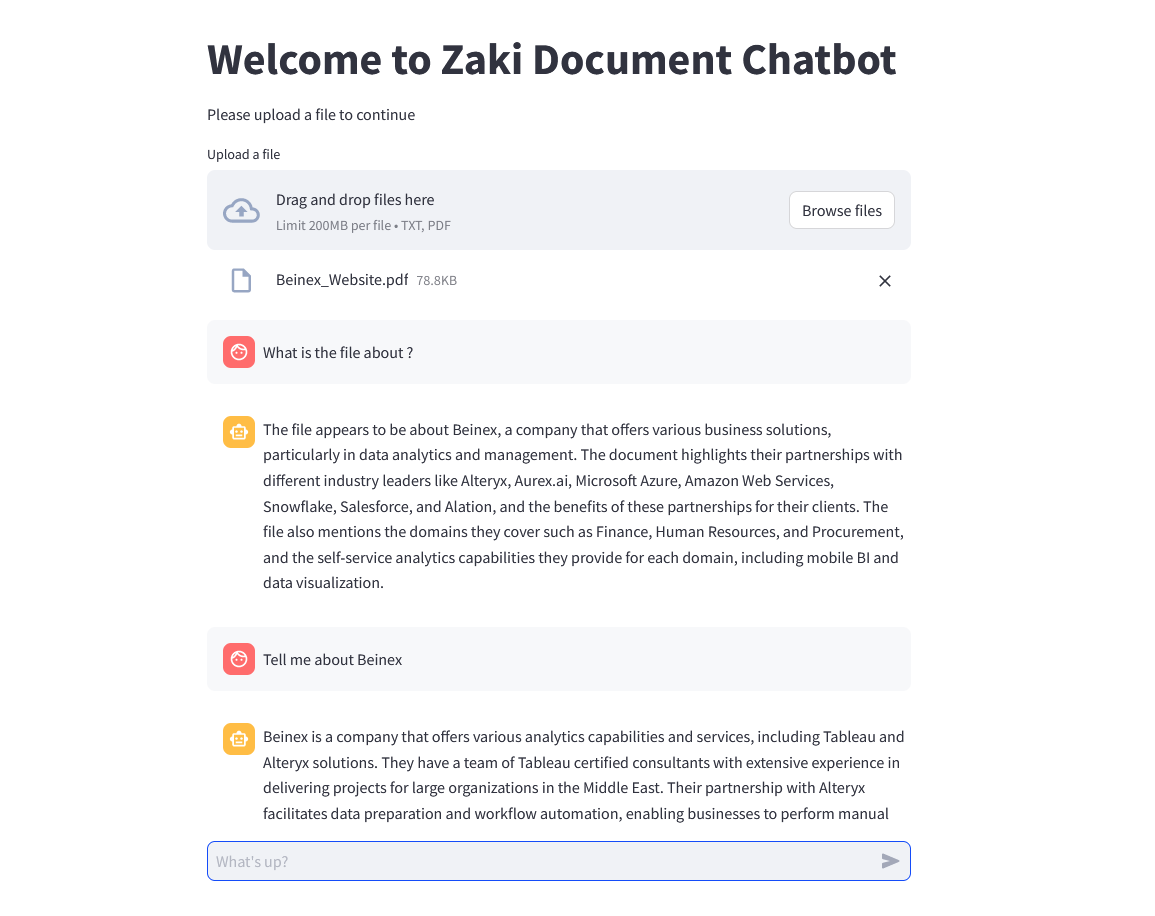 Figure 2: Zaki Document Chatbot (DocAI) in action!
Superior AI apps courtesy of Llama 3: Allows organizations to harness the full potential of this advanced LLM. Llama 3 offers avant-garde capabilities in natural language processing and generation, enabling the development of superior AI applications with enhanced performance, accuracy, and efficiency.
Data residency: Ensures that organizations maintain control over their data residency.
With Snowflake's robust data governance and compliance features and Llama 3's deployment within the same ecosystem, organizations can confidently adhere to data residency requirements and regulations, ensuring that sensitive data remains within specified jurisdictions or regions.
Scalability: Provides organizations with remarkable scalability for their AI applications.
This seamless scalability empowers organizations to handle large volumes of data and accommodate growing user demands without compromising performance.
Easy monitoring: Simplifies the monitoring and management of AI applications.
Snowflake's intuitive interface and comprehensive monitoring tools enable organizations to easily track the performance, usage, and health of their deployed Llama 3 models. It facilitates proactive identification of issues, optimization of resources, and overall better management of AI workloads, ensuring smooth and efficient operations.
By leveraging Llama 3 within Snowflake, organizations can alleviate data sovereignty and control concerns. They can rest assured that their precious and sensitive data remains within their realm of control while still being able to build and scale superior applications. This development marks a significant milestone in bridging the gap between data residency requirements and accessing the most effective LLM technology.
-Mebin Joy
Figure 1: Screenshot from DocAI. Zaki Document Chatbot (DocAI) tapping into Llama 3 by Meta and running in the Snowflake ecosystem.
Beinex tested Llama 3 on its in-house DocAI, a solution that runs on Snowflake using Snowpark Container services. The DocAI chatbot solution offers the flexibility to chat with documents such as PPT, PDF, word files, and text files. It currently uses llama3. Llama 3 is a major leap forward, establishing new standards for large language models. Its extensive training data, improved quality, and increased context length make it a powerful choice for document-related tasks, including our DocAI chatbot solution. The article will explain how Beinex deployed Llama 3 in the Snowflake ecosystem in the upcoming sections.
Recently, notable advances have been made in large language models — sophisticated natural language processing (NLP) systems equipped with billions of parameters. These models have demonstrated remarkable abilities, including generating creative text, solving complex mathematical theorems, predicting protein structures, and more. They illustrate the immense potential benefits that AI can offer to billions of people on a global scale.
Meta’s Llama (Large Language Model Meta AI), a state-of-the-art foundational large language model, is designed to support researchers in advancing their work within AI. By providing access to smaller yet highly efficient models like Llama, Meta aimed to empower researchers who may not have access to extensive infrastructure to delve into the study of these models. This democratization of access is pivotal in fostering innovation and progress in this dynamic and crucial field.
What is Llama 3?
Meta's latest advancement in the LLM (Large Language Model) series is Llama 3, the most sophisticated model with considerable advancements in performance and AI capabilities. Llama 3, built upon the architecture of Llama 2, is offered in 8B and 70B parameters, each featuring a base model and an instruction-tuned version tailored to enhance performance in specific tasks, particularly AI chatbot conversations. According to Meta, Llama 3 sets a new standard for open-source models, rivalling the performance of proprietary models available today. Llama 3 models will soon be accessible across various platforms, including AWS, Google Cloud, Hugging Face, Databricks, Kaggle, IBM Watson, Microsoft Azure, NVIDIA NIM, and Snowflake. Capabilities such as reasoning, code generation, and instruction following have seen substantial enhancements, rendering Llama 3 more adaptable and controllable. Meta plans to introduce additional capabilities, longer context windows, expanded model sizes, and enhanced performance. Utilizing Llama 3 technology, Meta AI emerges as one of the premier AI assistants globally, offering intelligence augmentation and support across various tasks, including learning, productivity, content creation, and connection facilitation.Llama 2 vs Llama 3
According to Meta, the newly introduced models, Llama 3 8B with 8 billion parameters and Llama 3 70B with 70 billion parameters, represent a significant advancement in performance compared to their predecessors, Llama 2 8B and Llama 2 70B. Meta describes these models as a ‘major leap’ in performance. Llama 2 serves research and commercial purposes, excluding the top consumer companies globally. Llama 2 boasts enhancements such as training on 40% more data, doubling the context length, and leveraging a vast dataset of human preferences to ensure safety and helpfulness, backed by over 1 million annotations. On the other hand, Llama 3 represents the next step in Meta AI's LLM evolution, catering to research and commercial applications, provided monthly active users are under 700 million. Positioned as the successor to Llama 2, Llama 3 showcases state-of-the-art performance on benchmarks and is lauded by Meta as the 'best open-source model of their class.'Ollama
There were times when accessing Large Language Models (LLMs) was restricted to cloud APIs offered by major providers like OpenAI and Anthropic. While these cloud API providers continue to dominate the market with user-friendly interfaces facilitating easy access for many users, it's important to recognize the trade-offs users make beyond the costs associated with pro plans or API usage. This trade-off involves granting providers full access to chat data. For those seeking to securely run LLMs on their hardware, the alternative has typically involved training their LLMs. Ollama, an open-source application, is designed to enable users to run, create, and share large language models locally through a command-line interface on MacOS and Linux. With Ollama, running LLMs on personal hardware requires minimal setup time. It caters to individuals seeking to run LLMs on their laptops, maintain control over their chat data without involving third-party services, and interact with models through a straightforward command-line interface. Additionally, Ollama offers various community integrations, including user interfaces and plugins for chat platforms.Deploying Llama 3 in the Snowflake Ecosystem: What Beinex Did?
Deploying Llama 3 in the Snowflake Ecosystem means integrating the advanced language capabilities of Llama 3, the latest version of Meta’s language model, into the Snowflake data platform. It represents a significant breakthrough for organizations seeking to maintain control over their data. It allows users to directly leverage Llama 3's powerful natural language processing capabilities within Snowflake for various tasks such as data analysis, querying, and generating insights.
Figure 2: Zaki Document Chatbot (DocAI) in action!
Deploying Llama 3 in the Snowflake Ecosystem: How Beinex Did it?
Here’s a detailed guide on deploying Llama 3 on Snowflake Container Services: Step 1: Create Necessary Objects -- Run by ACCOUNTADMIN to allow connecting to Hugging Face to download the model -- Stage to store LLM models CREATE STAGE <stagename> IF NOT EXISTS models DIRECTORY = (ENABLE = TRUE) ENCRYPTION = (TYPE='SNOWFLAKE_SSE'); -- Stage to store YAML specs CREATE STAGE <stagename> IF NOT EXISTS specs DIRECTORY = (ENABLE = TRUE) ENCRYPTION = (TYPE='SNOWFLAKE_SSE'); <br. -- Image repository CREATE OR REPLACE IMAGE REPOSITORY images; -- Compute pool to run containers CREATE COMPUTE POOL GPU_NV_S MIN_NODES = 1 MAX_NODES = 1 INSTANCE_FAMILY = GPU_NV_S; Step 2: Docker Image Code - ollama FROM ollama/ollama RUN $(ollama serve > output.log 2>&1 &) && sleep 10 && ollama pull llama3 && pkill ollama && rm output.log ENTRYPOINT ["ollama"] CMD ["serve"] Step 3: Tag and Push the Docker Image docker tag ollama .registry.snowflakecomputing.com/db/schema/image respository /ollama docker push .registry.snowflakecomputing.com db/schema/image repository /ollama Step 4: Docker Image - UDF FROM python:3.11 WORKDIR /app ADD ./requirements.txt /app/ RUN pip install --no-cache-dir -r requirements.txt ADD ./ /app EXPOSE 5000 ENV FLASK_APP=app CMD ["flask", "run", "--host=0.0.0.0"] App.py content is given below : from flask import Flask, request, Response, jsonify import logging import re import os from openai import OpenAI client = OpenAI( base_url='http://ollama:11434/v1', api_key="EMPTY", ) model = "llama3" app = Flask(__name__) app.logger.setLevel(logging.ERROR) def extract_json_from_string(s): logging.info(f"Extracting JSON from string: {s}") # Use a regular expression to find a JSON-like string matches = re.findall(r"\{[^{}]*\}", s) if matches: # Return the first match (assuming there's only one JSON object embedded) return matches[0] # Return the original string if no JSON object is found return s @app.route("/", methods=["POST"]) def udf(): try: request_data: dict = request.get_json(force=True) # type: ignore return_data = [] for index, col1 in request_data["data"]: completion = client.chat.completions.create( model=model, messages=[ { "role": "system", "content": "You are a bot to help extract data and should give professional responses", }, {"role": "user", "content": col1}, ], ) return_data.append( [index, extract_json_from_string(completion.choices[0].message.content)] ) return jsonify({"data": return_data}) except Exception as e: app.logger.exception(e) return jsonify(str(e)), 500 Step 6: YAML File spec: containers: - name: ollama image: <SNOW_ORG-SNOW_ACCOUNT>.registry.snowflakecomputing.com/ db/schema/image respository /llama3 resources: requests: nvidia.com/gpu: 1 limits: nvidia.com/gpu: 1 env: NUM_GPU: 1 MAX_GPU_MEMORY: 24Gib volumeMounts: - name: llm-workspace mountPath: /<stage name> - name: udf image: .registry.snowflakecomputing.com/ db/schema/image respository /ollama_udf endpoints: - name: chat port: 5000 public: false - name: llm port: 11434 public: false volumes: - name: llm-workspace source: "@<llm stage_name>" Step 7: Upload YAML File and Create Service Upload the YAML file to the created stage, where the stage name in the YAML file should match the stage created in Step 2. -- Create service create service llama3 IN COMPUTE POOL<name of compute pool created> FROM @dash_stage SPECIFICATION_FILE = '<name of yaml file uploaded>'; Step 8: Create Service Function Create a service function on the service (after it starts). create or replace function llama3(prompt text) returns text service=llama3 endpoint=chat; Check Service Status Use the following command to check the status of the service: SELECT v.value:containerName::varchar container_name, v.value:status::varchar status, v.value:message::varchar message FROM ( SELECT parse_json(system$get_service_status('<service name>')) ) t, LATERAL FLATTEN(input => t.$1) v;Benefits of Deploying Llama 3 in the Snowflake Ecosystem

SELF-SERVICE AUDIT ANALYTICS - Beinex
SELF-SERVICE AUDIT ANALYTICS: TRANSFORM YOUR APPROACH
Despite the fact that data analytics and Computer Assisted Audit Techniques (CAAT) have been part of auditing for nearly 30 years, many organisations are still struggling with the implementation of effective data analytics to enhance internal audit quality and effectiveness. Experts at Beinex Consulting offer advice and help.
Increasing complexities of risk and incessant emergence of disruptive technologies are demanding substantial change in internal audit processes. In today’s world of constant disruption, internal audit should evolve into a dynamic and future-orientated function. So what’s getting in the way?
Click here to read the full sponsored feature by Beinex Consulting