How AI Decision-Making is Improving Enterprise Outcomes
Blog
Share 
أبلغ EHSS عن زيادة بنسبة 40٪ في الإنتاجية بعد تطبيق AWS
 26 April 2021
  Team Beinex
 حول نظام صحة الموظفين وسلامتهم (EHSS)
نظام صحة الموظفين وسلامتهم (EHSS) هو عبارة عن منصة شاملة لاختبار كورونا وتتبع التطعيم طورتها شركة بينيكس، وهي مصممة لتمكين المؤسسات من تتبع ومراقبة التفاصيل ذات الصلة بموظفيها والكيانات الخارجية والموردين وما إلى ذلك عند زيارة مبانيهم واستخلاص المعنى. رؤى من البيانات باستخدام محرك تحليلات قوي. تم تطوير هذه المنصة لمساعدة عملائنا دائرة الصحة ، أبو ظبي (DoH) لتزويدهم بنظرة عامة كاملة عن حالة فيروس كورونا Covid 19 ذات الصلة داخل دولة الإمارات العربية المتحدة. يستفيد نظام EHSS من أحدث التقنيات وقوة الذكاء الاصطناعي لإزالة بعض نقاط الإزعاج الشديد مثل تسجيل المخاطر للموظفين بناءً على علم وظائف الأعضاء، وفي نفس الوقت يوفر تحكمًا بديهيًا في وصول المستخدم لإضافة سجلات الموظفين وتعديلها يدويًا.
ساعدت البيئة والصحة والسلامة والأمن (EHSS) وزارة الصحة على تصور معلومات علاقة كورونا من خلال الجمع بين أربع عمليات مستقلة في صومعة، في منصة واحدة متكاملة - تتبع صحة الموظف، والإدخال والتقاط البيانات، وإعداد التقارير والتحليلات، والتعاون والتحكم.
تحد

كانت البنية التحتية لتكنولوجيا المعلومات في دائرة الصحة حيث تمت استضافة منصة EHSS في مركز بيانات محلي تم تصميمه ليكون قابلاً للتطوير وقويًا مع مجموعات مادية متعددة العقد بما في ذلك الخادم والتخزين ومكونات الشبكة. ومع ذلك، فإن معظم الأجهزة المادية كانت قديمة جدًا وغير مجهزة بأحدث جيل من الخوادم المادية.
استمرت الأعطال المتكررة للأجهزة ووقت تعطل البوابة في القلق بشأن توفر تطبيق EHSS. يبدو أن تعيين شخص يدعم اليد التي تعمل باللمس لتشغيل الأجهزة التي كانت معطلة أمرًا مستحيلًا تمامًا بسبب القيود خلال فترة كورونا. ومن ثم، أرادت دائرة الصحة البحث عن حل آخر قابل للتطبيق.
على الرغم من أن إعداد الأجهزة في وزارة الصحة كان مجهزًا جيدًا لمواجهة الطفرات العرضية في حركة المرور، فقد لوحظ أنه على مدار 6 أشهر، كانت معظم البنية التحتية لتكنولوجيا المعلومات غير مستغلة بشكل كافٍ مما كان متوقعًا. لقد تم إدراك أن إنفاق مبلغ ضخم من المال على الأجهزة القديمة بالإضافة إلى صيانة البرامج، وتكاليف الترخيص، وعرض النطاق الترددي للإنترنت، وتبريد مركز البيانات وصيانته، وموظفي الدعم باللمس، وتكاليف الكهرباء - كانت تجعل العمليات المحاسبية صعبة.
بالإضافة إلى ذلك، كانت هناك محاولة من قبل وزارة الصحة لاختيار حل فعال من حيث التكلفة يمكنه استضافة خوادم تطبيق EHSS وخوادم الويب وبيانات الأرشفة. وبهذه الطريقة يمكن إعادة توفير البنية التحتية لتكنولوجيا المعلومات لاستضافة البيانات الحساسة في أماكن العمل والباقي على السحابة، وبالتالي تقليل التكاليف المادية الإجمالية للأجهزة التي يتم إنفاقها على أساس سنوي.
لماذا أمازون ويب سيرفيسز

تقرر ترحيل خوادم التطبيقات الخلفية وخوادم الويب وخوادم قواعد البيانات وبيانات الأرشفة من أورا إلى أمازون ويب سيرفيسز، ثم قررت وزارة الصحة ترحيل خوادم تطبيقات EHSS الخلفية وخوادم الويب وخوادم قواعد البيانات وبيانات الأرشفة إلى أمازون ويب سيرفيسز.
تشتمل بنية أمازون ويب سيرفيسز لتطبيق EHSS على Amazon Elastic Compute Cloud (Amazon EC2)، التي توفر تحكمًا كاملاً في مواردها الحاسوبية، وتحديثات للجداول في Amazon Relational Database Service (Amazon RDS) وتم استخدام AWS Elastic Load Balancer لتوزيع حركة المرور على الأساس مثيلات EC2 على أساس الحمل.
في الآونة الأخيرة، يجري استكشاف أمازون ElastiCache لاسترداد البيانات من ذاكرات التخزين المؤقت في الذاكرة التي تتم إدارتها بسرعة بواسطة DoH. سيتم استخدام هذه التقنية لبناء أنظمة جمع البيانات الموزعة والتعامل مع إحصاءات الوقت الفعلي والبيانات الوصفية المرتبطة بتطبيقفو EHSS
ائد

تستخدم DoH خدمات أمازون ويب سيرفيسز الآن لتوفير البنية التحتية ونشر النظام الأساسي EHSS إلى الأقسام الأخرى داخلها. بالإضافة إلى ذلك، فإن موارد EHSS التي لم تعد مطلوبة للتشغيل طوال الوقت يتم تخصيصها للإغلاق التلقائي وبالتالي توفير التكلفة. أبلغت وزارة الصحة عن زيادة في الإنتاجية بنسبة 40٪ بعد تنفيذ أمازون ويب سيرفيسز لمنصة EHSS.
أدى تطبيق EHSS على أمازون ويب سيرفيسز إلى جعل وزارة الصحة واثقة من أمان بياناتها، وفريق الاعتماد لديها متحمس لإمكانيات المراقبة والتدقيق التي توفرها أدوات أمازون ويب سيرفيسز. من خلال تنفيذ أدوار IAM، تمكن فريق تكنولوجيا المعلومات في DoH من عزل الأنظمة والتحكم بإحكام في وصول المستخدم. كان من الصعب تحقيق هذه القدرات ضمن البنية التحتية الحالية، ولكنها كانت متاحة خارج الصندوق مع أمازون ويب سيرفيسز
من خلال اعتماد أمازون ويب سيرفيسز لاستضافة منصة EHSS، تمكنت DoH من الابتكار والتجربة إلى درجة كانت مستحيلة في السابق. على سبيل المثال، قارنت DoH الأداء والفعالية من حيث التكلفة لثلاثة حلول سحابية مختلفة. بدون الانتقال إلى أمازون ويب سيرفيسز، فإن التكاليف المرتبطة بتشغيل الأجهزة المحلية القديمة كانت ستزداد وستكون الطريقة البديلة لترقية البنية التحتية المحلية الحالية لأحدث نماذج الأجهزة ثم استضافة تطبيق EHSS فوقها. استغرق شهور.
-
Related Articles

Agentic AI and Enterprise Intelligence: Leading Trends, Challenges, and Opportunities in 2026 and Beyond
For a long time, enterprise intelligence relied on dashboards, reports, and predictive systems. These tools helped leaders see what happened and predict what could happen next. However, the users still had to interpret the results and act on them themselves.
Now, that approach is changing with the adoption of Agentic AI. According to Gartner research, 40% of enterprise applications are expected to include task-specific AI agents by 2026, up from less than 5% in 2025.

The Business Value of Migration to Amazon Web Services
AWS: Four Types of Cloud Business Value
In the era of digital transformation and infrastructure modernization, the journey to the cloud has been both exhilarating and challenging. Many businesses have successfully migrated their "easy" applications to the cloud. However, a prevailing concern lingers among business leaders—an uncertainty about the returns on investment in terms of time and effort. Questions arise about productivity gains, data security, and the impact on critical agility metrics, such as time to market. Here, we delve into the distinct results observed by AWS users across four pivotal domains of cloud business worth: cost efficiency, workforce efficiency, resilience, and adaptability.
1. Cost Savings: More Than Meets the Eye
Migrating infrastructure to Amazon Web Services (AWS) yields significant cost savings, averaging around 20% in total infrastructure expenses. Top performers witness a staggering 47% reduction, highlighting the potential for substantial savings. Yet, the nuances lie in application-specific cost reductions that vary based on factors like application complexity and cloud tenure.
Studies reveal a significant financial shift for organizations venturing into AWS migration. On average, businesses witness a remarkable 20% reduction in total infrastructure costs—a noteworthy achievement translating to a staggering $69 million slashed from an average pre-migration annual IT spend of $345 million. However, the journey to AWS doesn’t merely stop at these impressive numbers. For top performers, the stakes are higher, yielding an exceptional 47% savings in total infrastructure costs. This equates to a colossal $164 million reduction from an average annual IT spend of $349 million. (Refer to Fig. 1 for a graphical representation.)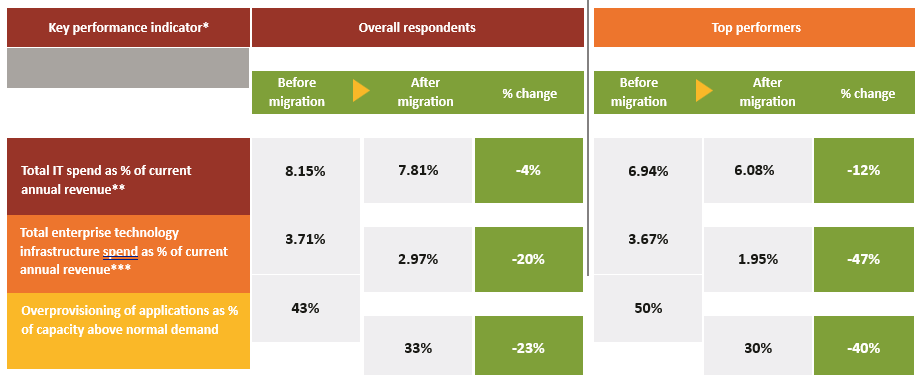

2. Workforce Efficiency
Following the migration of applications to AWS, there's a noticeable enhancement in IT infrastructure staff productivity among respondents. They report a remarkable 66% rise in the number of retained VMs managed per administrator. Such post-migration efficiencies enable a strategic shift, allowing 17% of staff positions to transition from routine infrastructure maintenance to pivotal roles focusing on infrastructure planning, architecture, orchestration, and innovation (Refer to Fig. 3 for visual representation)

A commercial finance organization exemplifies the tangible impact of AWS migration on innovation. Their technology division experienced a significant leap in developer focus post-migration. Initially allocating 20% of developer time to crafting new features, their shift to AWS elevated these efforts drastically. For customer relationship management and business intelligence, the focus surged to an impressive 60%, witnessing a threefold increase. However, the transformation was even more substantial for their migrated financial planning and analysis system, skyrocketing from a mere 20% pre-migration to a staggering 80% post-migration—showcasing an unparalleled fourfold increase.
3. Resilience
Cloud technology has redefined resilience by elevating system availability, reducing latency, and fortifying security measures. The disruptive impact of the pandemic accentuated the criticality of resilience, surpassing the effectiveness of traditional disaster recovery approaches and redundant data centers. Cloud-based infrastructure emerged as a crucial linchpin, ensuring uninterrupted operations during tumultuous times.
The scalability inherent in cloud services played a pivotal role during the pandemic, exceeding initial capacity plans by an astounding 90%. This scalability was instrumental in swiftly connecting and supporting remote workers, effectively mitigating disruptions. Chief Information Officers (CIOs) emphasized that their previous migration to AWS significantly facilitated the accommodation of sudden surges in demand, underscoring the importance of cloud infrastructure in maintaining seamless operations during critical periods.
A U.S.-based healthcare nonprofit's strategic migration of its last on-premises ERP system to the cloud in 2019 fortuitously positioned it for the subsequent shutdowns and challenges brought on by the pandemic. The seamless integration of cloud technology enabled the organization to navigate and maintain operational continuity amidst adversity, highlighting the indispensable role of cloud solutions in supporting mission-critical functions and adapting to hybrid office-remote work models.
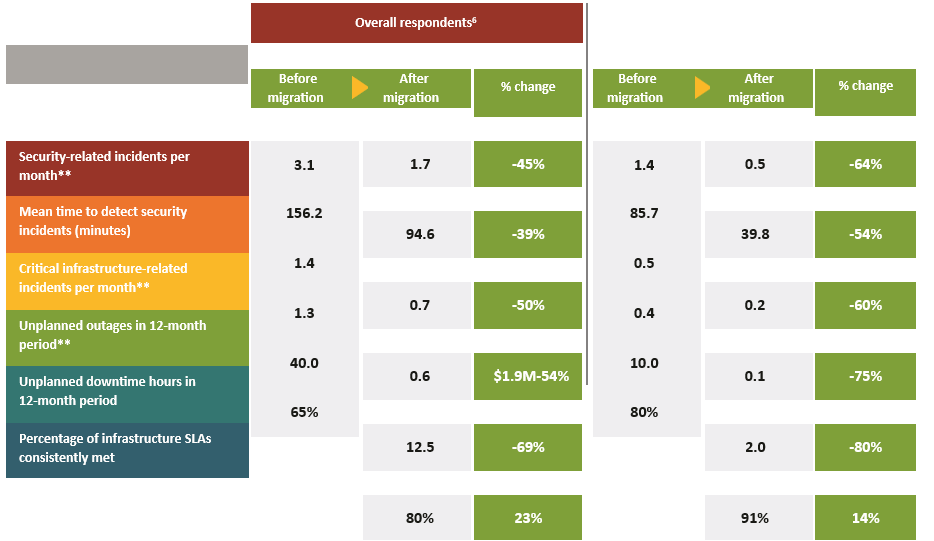
In today's digital commerce landscape, system downtime carries profound consequences far beyond inconvenience. It significantly impacts businesses, directing customers towards competitors' platforms. The financial implications of downtime are staggering, averaging 79 minutes and costing approximately $84,650 per hour in 2020. Furthermore, the aftermath of data breaches and ransomware attacks extends beyond financial costs, causing public embarrassment and substantial recovery expenses, averaging $4.6 million for cyberattacks and $4.2 million for data breaches.
The migration to AWS represents a transformative milestone, significantly bolstering both availability and security. Many key resilience Key Performance Indicators (KPIs) exceeded the 50% mark, as illustrated in Fig. 4. This substantial enhancement underscores the transformative impact of AWS migration in fortifying operational resilience and proactively mitigating potential threats.
4. Adaptability
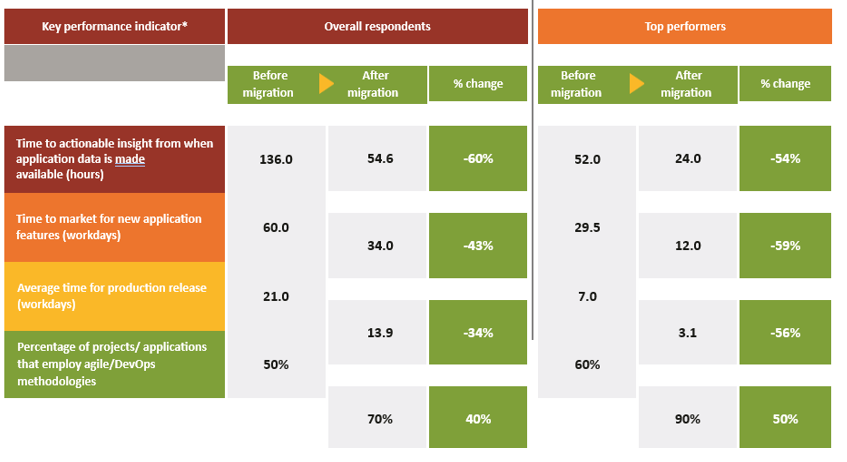
The most strategic of all cloud migration benefits, agility equips organizations for success in a digital business environment. Agility refers to the ability to respond quickly and effectively to changes in business conditions or disruptive business events. Broadly speaking, the more technology infrastructure an organization has in the cloud, the more agile it can be. A study by The Hackett Group on agility in business services functions (i.e., finance, HR, IT, and procurement), found that the most agile organizations have 41% of their infrastructure in the cloud, compared to just 29% for the average respondent.
Winning in a digitally competitive industry or market depends heavily on agility in product development. A major aspect is the speed at which new technology-enabled products and features are brought to market. For applications in the cloud, technology organizations are better able to use agile/DevOps methodologies thanks to services that simplify and accelerate provisioning infrastructure, deploying application code, automating software release processes, and monitoring application and infrastructure performance. These changes, combined with the development-team productivity gains discussed earlier, contribute to a 43% decrease in time to market and a faster pace for production releases (Fig. 5).
Recommendations
The Cloud Services Study underscores how migrating to AWS drives substantial business value across cost savings, staff productivity, resiliency, and agility. It dispels the notion that the cloud is solely a cost-saving venture, highlighting its strategic superiority over traditional on-premises infrastructure. The agility alone—enabling quicker time to market, enhanced insights, and frequent production releases—positions organizations competitively in the digital sphere. This transformative shift from infrastructure management to innovative development is a pivotal game-changer.
In forthcoming reports, we'll delve deeper into specific migration strategies and cloud financial management practices that contribute to superior outcomes. Meanwhile, here are key insights from this study:

Snowflake and GenAI: Revolutionizing Data Analytics
Snowflake Cortex: AI-Powered Data at Your Fingertips
Snowflake Cortex provides access to industry-leading AI models, including large language models (LLMs) and vector search functionality. These serverless tools simplify everyday analytics and AI development, all within a single line of SQL or Python.
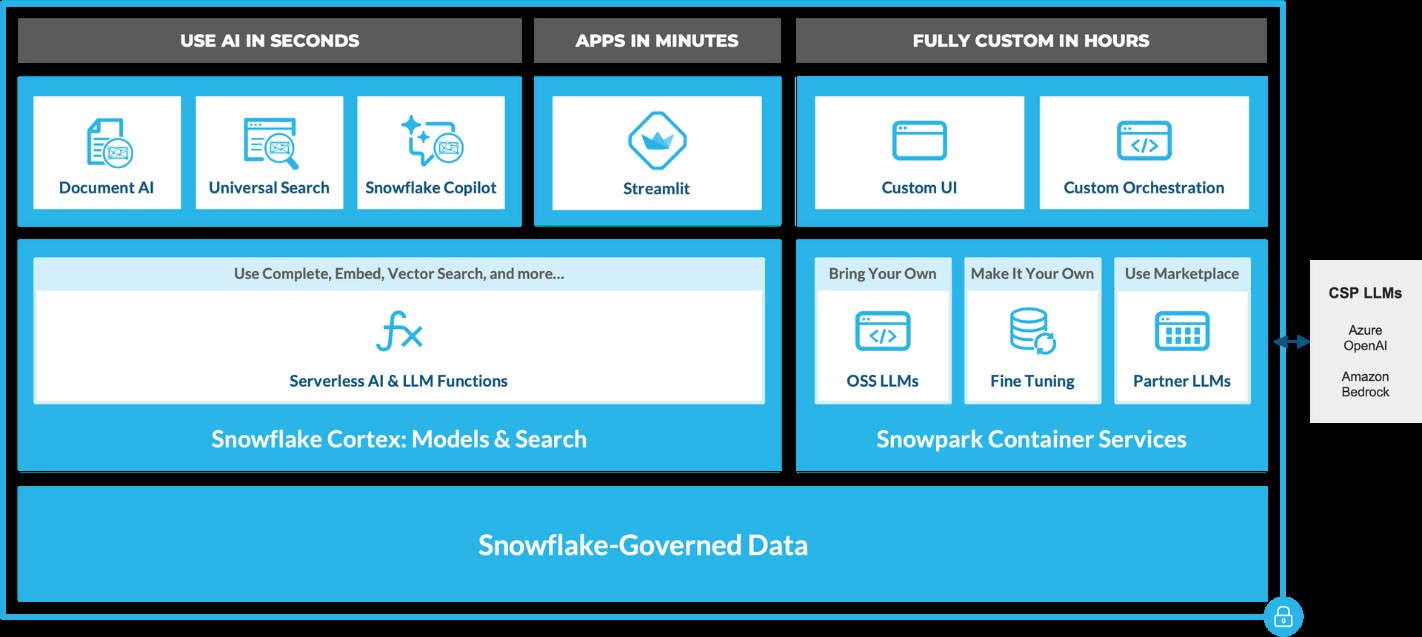 Source: https://www.snowflake.com/en/blog/use-ai-snowflake-cortex/
Key benefits include:
• Instant Access to AI Models: Snowflake users can leverage specialized machine learning and LLM models without managing expensive infrastructure. • Enhanced Data Insights: With Cortex, users can analyze vast datasets using Snowflake’s powerful AI capabilities, unlocking strategic insights to improve decision-making. • Simplified AI App Development: By removing technical barriers, Cortex democratizes AI access, enabling users of all skill levels to build AI applications.
LLM-Based Models for Unstructured Data (in private preview):
• Answer Extraction: Extract key information from unstructured datasets. • Sentiment Detection: Identify the sentiment in textual data. • Text Summarization: Create concise summaries of lengthy documents for quicker insights. • Translation: Perform large-scale text translation efficiently.ML-Based Models (available soon):
• Forecasting: Automatically forecast time series based on historical data, adjusting for seasonality and scaling. • Anomaly Detection: Detect outliers in time series data, useful for monitoring data pipelines. • Contribution Explorer: Identify key factors contributing to changes in metrics between two time intervals. • Classification: Categorize data into predefined classes to offer recommendations based on trends.
General Purpose Models for Broader Use Cases:
• Complete: Generate text completions using state-of-the-art open-source LLMs like Llama 2. • Text2SQL: Convert natural language queries into SQL, powered by Snowflake’s LLM, similar to the Snowflake Copilot feature. These serverless functions offer out-of-the-box capabilities that can be integrated into analytics workflows and app development in Snowflake. For example, with just a few lines of code, developers can embed these functions into chatbots using Streamlit. This allows Python-savvy users to build secure and powerful LLM applications quickly, often within hours.
Document AI
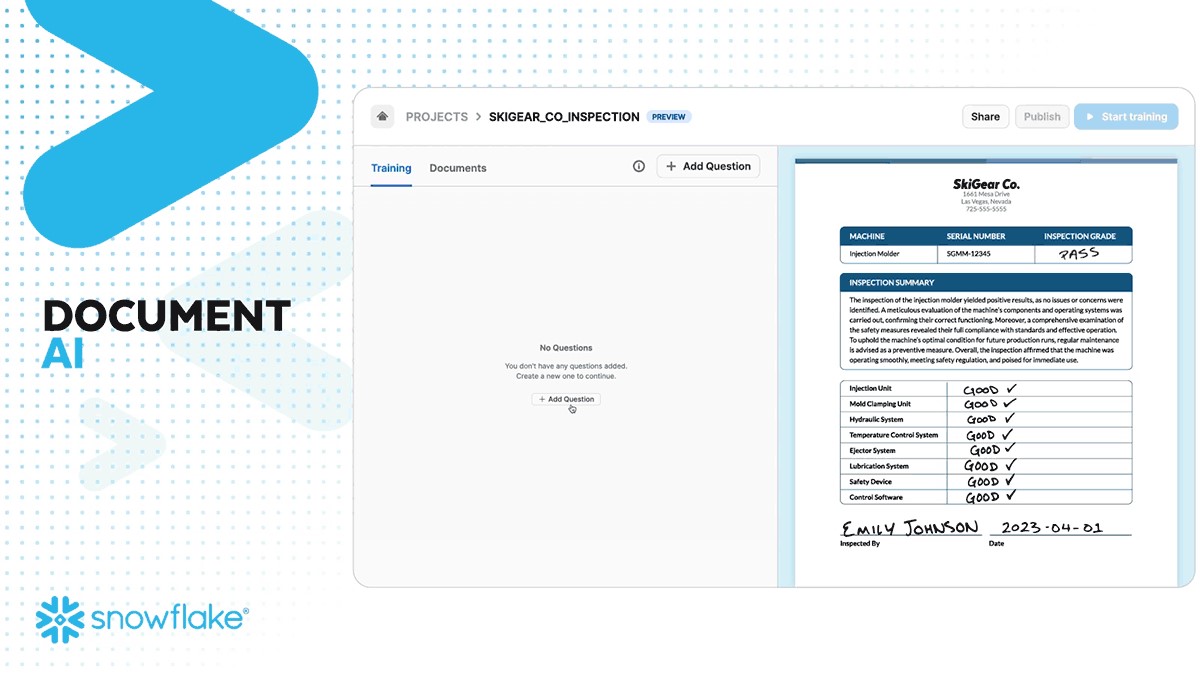
Document AI (currently in private preview) leverages large language models (LLMs) for seamless data extraction. By utilizing a pre-trained model and a user-friendly interface, customers can process various document types—such as PDFs, Word files, text files, and even screenshots—to quickly obtain answers to their queries. This capability can be scaled to build pipelines that automate data extraction, significantly reducing manual effort and saving time.
 Source: https://www.snowflake.com/en/blog/use-ai-snowflake-cortex/
Snowflake Copilot: Your AI-Powered SQL Assistant
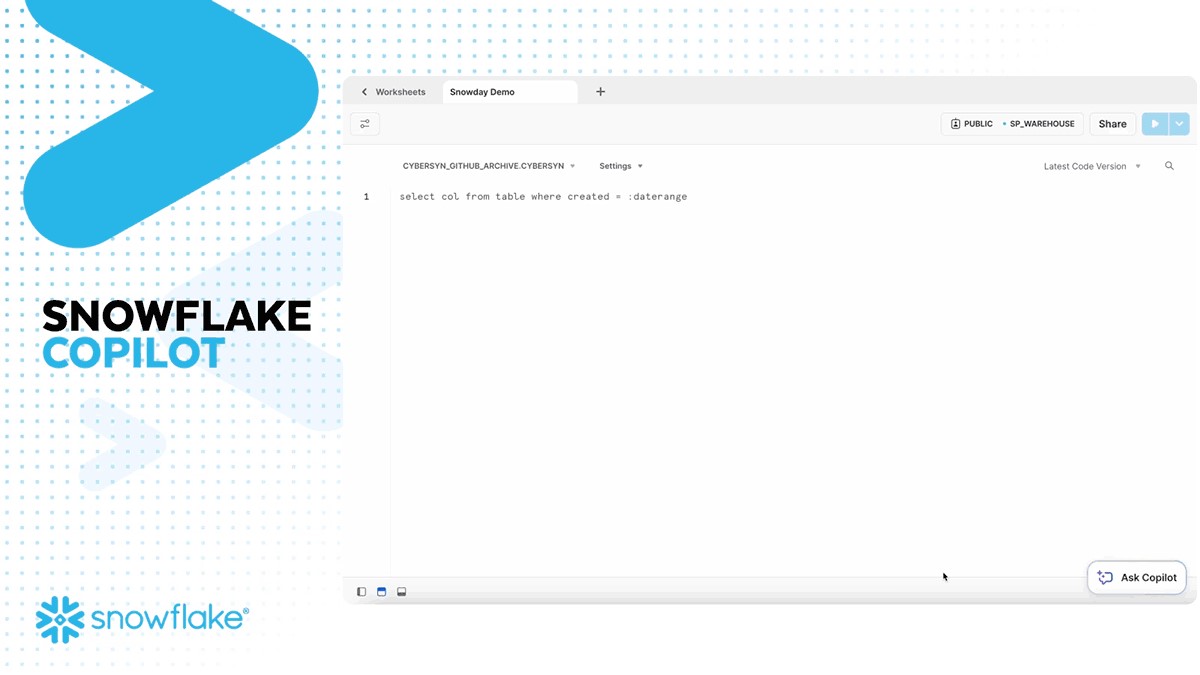
Snowflake recently introduced Snowflake Copilot, an AI-driven solution that makes SQL query generation faster and more efficient. With Snowflake Copilot, users can ask data-related questions in plain English, and the AI will generate SQL queries to deliver the desired insights.
Key Features of Snowflake Copilot:
• Text-to-SQL: Users can interact with their data using natural language, eliminating the need for complex SQL coding. • Enhanced Accuracy: The AI continuously refines its understanding of user queries, providing more accurate SQL code suggestions. • Data Exploration: Ask open-ended questions about your data and receive detailed insights without writing complex queries.
The Future of Generative AI with Snowflake
Snowflake is pushing the boundaries of Generative AI with its continuous development of AI tools like Snowflake Cortex AI and Snowflake Copilot. These innovations pave the way for a future where natural language becomes the primary interface for data analysis, enabling businesses to extract more value from their data while maintaining robust governance.
By integrating AI capabilities directly into the data platform, Snowflake empowers users to streamline workflows, reduce processing times, and unlock new levels of productivity—all without needing deep AI expertise.
A Transformative Partnership for the Future
Generative AI, coupled with Snowflake’s powerful data platform, is a game-changer for businesses looking to innovate and scale. Whether it’s enhancing productivity, improving decision-making, or driving customer engagement, Snowflake’s AI solutions are built to transform how enterprises interact with their data.
As AI continues to evolve, so will Snowflake's offerings, bringing more capabilities, deeper insights, and greater efficiencies to businesses worldwide. Ready to experience the future of data analysis with Snowflake and AI? The journey has just begun!
Snowflake + Beinex Partnership
Beinex is a Snowflake Services Partner Premier Tier, and the partnership reaffirms Beinex’s commitment to delivering exceptional data solutions and positions the company at the forefront of industry advancements. Harnessing the true potential of the data, partnership drives innovation and success in the digital era.
Belonging to Snowflake Services Partner Premier Tier, Beinex leverages Snowflake’s advanced capabilities and seamlessly integrates them into its comprehensive data solutions. This enables Beinex to accelerate the pace of Digital Transformation for its clients, providing them with the tools necessary to extract maximum value from their data and thrive in an increasingly data-centric world.
Connect with us for a free demo: https://beinex.com/contact-us/

AWS Security Hub: Master Cloud Security with a Unified Approach
What is AWS Security Hub?
AWS Security Hub offers a unified, organized, and prioritized view of the compliance status and security posture of your AWS accounts in a standardized format. It automates the security best practice checks of single and multiple AWS accounts. It centralizes the security alerts into one format and place, helping you comprehend the security framework of your AWS environment. It offers a pre-built dashboard that helps manage and prioritize any alerts or issues in your AWS environment found from security checks. Security Hub assesses security controls, performs compliance checks, and generates control findings to gauge your organization's adherence to security best practices. By automating security best practice checks, Security Hub streamlines the understanding and enhancing of the security posture of your AWS accounts. It offers multiple security standards to handle your organization's security position, including Foundational Security Best Practices developed by AWS and external compliance frameworks like Center for Internet Security (CIS) and Payment Card Industry Data Security Standard (PCI DSS). These standards have various security controls, each defining a security best practice. Besides generating control findings, Security Hub acquires findings from AWS services like Amazon Inspector and Amazon GuardDuty and also supports third-party products, offering a centralized view of several security-related issues. Also, the automation capabilities of the Security Hub simplified the triage and remediation of security issues. For example, by setting automation rules, critical discoveries get updated automatically in case of a security check failure.Features of AWS Security Hub
Centralized Cloud Security Management: It offers a unified dashboard that tracks security findings from AWS services like AWS Config and third-party tools, enhancing and prioritizing them in a single place. Third-Party Integration: AWS Security Hub seamlessly integrates with third-party tools like Splunk, consolidating data from multiple sources into a unified view. Tailored Security Insights: It enables the customization of security insights and alerts, allowing organizations to adapt their security posture to specific needs. Automated Compliance and Security Checks: By automating compliance and security checks on AWS accounts, resources, and services, AWS Security Hub enables the detection of security issues, continuous monitoring, and evaluation while ensuring they adhere to industry best practices and standards.Top Benefits of AWS Security Hub
• Streamlines managing cloud security by centralizing all security data in a single place, offering a consolidated view that helps detect possible threats. • Enhances real-time threat detection by facilitating integration with AWS services like Amazon GuardDuty. • Ensures regulatory compliance by fulfilling the industry security criteria and standards • Conducts constant security checks by following industry standards and practices to identify and monitor AWS accounts and resources that need attention, flagging any misconfigurations in security. • Enables automated remediation for specific findings and customized actions triggered upon detection. In short, AWS Security Hub enhances cloud security by centralizing monitoring of accounts, services, and resources, performing automated security assessments, enabling businesses to comply with security standards, and integrating with AWS services for real-time threat detection. It can be quite difficult to manage security in complex cloud environments, but AWS Security Hub streamlines the process by delivering real-time security insights into your AWS environment, consolidating security alerts from different tools into a unified view, and automating security checks to enhance protection and efficiency. As an AWS consulting partner, Beinex offers AWS-managed services to our customers to host their BI solutions and more on the cloud. Our cloud migration experts ensure top-tier stability and reliability by aligning with your business strategy and collaborating closely with you to deploy AWS infrastructure as a service seamlessly. Connect with us for a free demo: https://beinex.com/beinex-amazon-web-services/
Stay Many Steps Ahead: Reap the Top Five Benefits of Competitive Intelligence
Understanding the initiatives of your competitors offers you the edge to keep advancing and differentiating your business. Your company can gather information and keep track of competitors with the help of competitive intelligence. This knowledge can be a helpful planning tool for making future company decisions on your own.
Competitive Intelligence (CI) is a vital component of every corporate strategy. It entails gathering and analysing data regarding a company's market, including that information's competitive environment, competitors' offerings, target markets, and business strategies.
Making sound decisions with the information you have acquired is the key to effective competitive Intelligence research; gathering the information is just one small aspect of the process.
A thorough examination of the competitive environment in your industry is the foundation of effective CI. You can acquire a comprehensive overview of competitor data by using your internal team of CI and industry experts or your sales team to assist you with conducting essential market research.
Who Uses Competitive Intelligence and in What Sectors?
Many industries use competitive intelligence to inform advancements in operations, technology, customer satisfaction scores, market entry or market defence strategies, and more. The following list of sectors contains six.
1.Technology
The technological sector appears to advance at megabit rates. Consumer expectations modifications frequently coincide with changes in broader technical access and affordances, and many companies are competing to offer the most cutting-edge consumer and business technology products. CI improves new or relaunched times-to-market, warranty and customer service operations, user experience (UX), employee recruitment and retention and sustainable organisational structures in the technology sector.
2.Medical care
Significant government rules are navigated by those working in the healthcare sector as the insurance market, market participants, and patients as consumers. Competitive intelligence can help the healthcare sector in pricing analysis, supply chain management and vendor or third-party administrator relations.
3.Biotechnology and prescription drugs
Pharmaceutical and biotechnology businesses operate in a high-cost, multifaceted market with a complex regulatory environment, like the healthcare sector. For individuals working in the life sciences, medical device, pharma, and medical specialisation industries, competitive monitoring and integrative analytics reduce operational risks by improving salesforce operations and structures, drug approvals and drug launch planning, market entry and gains strategies, consumer awareness campaigns surrounding treatments, therapies, and prescriptions
4.Industrial and Manufacturing Sectors
The 21st century has seen a significant revolution in commercial and industrial manufacturing. The manufacturing industry's environment has been permanently changed by scaled-up international rivalry, new automated technology, and evolving supply and demand patterns. Manufacturers regain control thanks to competitive intelligence, which enables them to maximise their advantages today while reducing market risks tomorrow. Competitive Intelligence assists in Supply chain management, Distribution strategies, Supplier and vendor relations, and go-to-market models
5.Consumer Goods
The consumer goods and retail sector include enterprises of every size and speciality, offering anything from domestic furnishings to personal hygiene items, online clothes stores to sparkling flavoured water. CI consulting explores prospects for retailers to improve brand reputation, consumer activity assessments and profiles, emerging and disruptive technology preparedness and local and global market entry.
6.Financial Services
Consumer opinions in the financial sector depend heavily on external factors like trust and openness. Internally, operations compromise the requirement for compliance and how disruptive technology alters traditional banking, lending, investing, and financial advice. Key capabilities enhanced by financial service CI include profitability and cost analysis, brand reputation, brand and service evolution, customer support channels, market risk modules and new entry market profiles.
Top Five Benefits of Competitive Intelligence
1. Recognise the next steps of the opposition
By participating in CI and performing competitive analysis, you may monitor potential future opportunities and threats for your industry. You will have an advantage if you can predict what your competitors will do next. This will allow you to adopt tactics before they do or turn things around to make yourself stand out from the crowd.
Perhaps the lack of data privacy in your industry is drawing criticism. Using CI, you can predict what your competitors would do in response and decide whether to join them or take a different stance to make a point.
2. Maintain a competitive edge
Researching competitive intelligence may take some time, but you'll gain by always being one step ahead of the competition. In an ever-evolving industry, you must appeal to customers and their desires if you want to flourish. Use CI to identify which rivals in your sector aren't taking needs or trends into account and take the initiative to do so in your own business.
3. Key to strategic judgement
Data is the foundation of a successful competitive intelligence strategy; thus, it makes sense that this would result in more strategic decision-making. You'll discover that to be successful in your CI journey; you must back up your decisions with data.
Competitive intelligence explains the value of objective data and will assist you in making better judgments grounded rather than mere speculation. It is your responsibility to fix any gaps in your market identified by the data you gathered during CI and to put new business practices into place.
4. Internal Information Gathering
While obtaining information on competitors emphasises competitive intelligence, the organisation may also collect your company's data. This internal evaluation gives you a sense of how your business is doing, where you are excelling, and where you need to put more effort into it. You can make decisions using the regular information a competitive intelligence organisation might supply about your business. This is especially helpful if the company is vast and has numerous departments that must be controlled. It helps your business boost products and service speed to market.
5. Boost Product and Service Speeds-to-Market
The term "speed-to-market" describes how quickly a good or service is developed and made available for purchase by the public.
Average speed-to-market timeframes will differ depending on the industry, as will the elements involved in developing, testing, and releasing a new commercial product. It is increasingly crucial for a company in that sector to increase its speed-to-market deliverables without compromising quality as the ecosystem for a product or service becomes more competitive. CI research with a market focus improves time-to-market, market-entry, and market defence skills.
The business world today is among the most competitive it has ever been. To survive in the information age, you need to have competitive intelligence. Although businesses have long informally gathered intelligence on their rivals to get an advantage, the combination of technology with the field of competitive intelligence has made it 10x more successful than ever.
Beinex
By providing insights gleaned from relevant web sources, AI-powered markets and competitive intelligence tools can give you a comprehensive view of your market and competitive landscape. The insights from each source provide a perspective you may use to gain a competitive advantage.
Role of Beinex
We are pioneers in providing 100% population-based strategic decision-making solutions with unique capabilities in extensive data harvesting. Beinex offers highly interactive competitive intelligence solutions for agile and data-driven enterprises of all sizes and categories. From Big data harvesting to enterprise reporting and mobile competitive intelligence solutions, we offer a suite of end-to-end big data CI solutions. These enable intelligent business moves and improved operational efficiency resulting in increased profit and happier customers.