How AI Decision-Making is Improving Enterprise Outcomes
Blog
Share 
Data Governance Policies in the UAE: Key Components, Benefits & Best Practices
 2 September 2026
  Subbayya
 Poor data quality costs organizations an average of approximately $12.9 million a year, according to Gartner. Gartner projects that by 2027, 60% of data governance teams will prioritize governing unstructured data to support generative AI use. For businesses across the Middle East scaling cloud adoption, analytics, and AI, data governance has moved from a back-office IT concern to a board-level priority, and the organizations that treat it that way are the ones capturing measurable value from their data.
What Is a Data Governance Policy and Why Does It Matter in the UAE?
A data governance policy is a documented framework that defines who owns organizational data, how it is classified, who can access it, and how it must be handled across its lifecycle. It sits alongside, but is distinct from data security, which protects data, and data management, which handles its day-to-day storage and processing.
The UAE regulatory landscape is multi-layered. At the federal level, the UAE Personal Data Protection Law establishes baseline requirements for the processing of personal data. Organisations operating in or from the Dubai International Financial Centre (DIFC) and the Abu Dhabi Global Market (ADGM) are subject to their own distinct data protection regimes, which may apply in addition to or instead of federal law depending on the organisation's location and activities. Sector-specific requirements in areas such as financial services, healthcare, and telecommunications may also apply.
In a region with strict data protection legislation, sector-specific regulators, and active cross-border data flow requirements, a well-defined UAE data governance framework for businesses does more than reduce regulatory exposure. It creates the ownership, definitions and controls needed to improve trust and consistency in enterprise data, strengthening the quality of reporting, analytics and AI built on top of it.
What Should a Data Governance Policy Include?
The key components of data governance policies in UAE companies typically fall into six categories:
- Data ownership and stewardship: naming accountable owners for each data domain
- Classification standards: tiering data by sensitivity (public, internal, confidential, restricted)
- Access controls: role-based permissions tied to job function, not individual discretion
- Quality standards: defined metrics for accuracy, completeness, consistency, timeliness, validity, and uniqueness.
- Retention and disposal rules: how long data is kept and how it's securely destroyed
- Audit and monitoring trails: logs that make policy adherence provable, not assumed
Together, these components form the operational backbone of consistent data management across departments, rather than governance existing as a document nobody follows.
How Data Governance Policies Improve Data Security
Governance and security reinforce each other directly. Strong governance improves data security by defining classification, access and protection requirements, while security controls such as encryption, masking and access management enforce those requirements in practice.
This is the practical core of data governance and compliance in the UAE: applicable regulators and privacy frameworks may require organizations to demonstrate that controls are implemented in practice through documented access, classification, security and incident-management processes.
Data Governance vs Data Privacy Compliance
These two disciplines are often conflated, but they address different scopes. Privacy law governs the lawful processing, storage and transfer of personal data, and compliance with applicable privacy frameworks is a key output of good governance. Enterprise data governance, however, is broader: it covers data ownership and stewardship, quality, definitions, metadata, lineage, authoritative sources and decision rights across all critical data assets; not only personal data. Privacy compliance is one component of the wider governance model, not a synonym for it.
How to Establish an Effective Data Retention Policy
An effective retention policy maps each data category to an approved retention period based on applicable legal and regulatory requirements, contractual obligations and legitimate business needs, followed by a defined archival or secure deletion process. In practice, this is one of the clearest examples of how to implement data governance in an organization:
- Inventory all data sources and classify them by type and sensitivity
- Assign retention periods based on regulatory and operational requirements
- Automate enforcement: expiry flags, archival triggers, and deletion workflows rather than relying on manual review
- Document exceptions (litigation holds, audits) so deviations are traceable
Retention that depends on individual employees remembering to act is not a policy; it's a liability waiting to surface in an audit.
Best Practices for Implementing Data Governance in UAE Organizations
The data governance best practices for UAE businesses that consistently show up in mature programs include:
- Establishing a cross-functional data governance council, not an IT-only committee
- Running regular internal audits against defined data quality metrics
- Aligning governance policies with sector-specific regulators as they evolve
- Linking governance directly to enterprise risk management rather than treating it as a standalone initiative
- Review the framework at a defined cadence and whenever material regulatory, organizational, technology, or data changes occur.
The common failure mode isn't a missing policy document; it's a policy that was never revisited after it was written.
How AI and Automation Are Changing Data Governance
AI is shifting governance from a periodic compliance checklist into a continuous operational discipline. Automated classification, access monitoring, and metadata tagging can reduce manual effort and make governance more continuous, while human owners remain responsible for policy decisions, exceptions, and accountability. This matters because the relationship runs both ways: organizations with mature data quality and governance frameworks are more likely to move AI use cases successfully from pilot to production, while ungoverned data tends to degrade AI accuracy at scale. Governance maturity is increasingly a key enabler of reliable, scalable AI adoption rather than an activity to address after deployment.
Data governance policies are what separate organizations that can trust their data from those constantly reacting to it. As regulatory scrutiny tightens and AI adoption accelerates in parallel, a structured, auditable governance framework is an immediate risk-management and business-enablement priority.
At Beinex, we work with organizations across the region to design, audit, and modernize data governance frameworks, from defining ownership and classification models to designing retention, access, and accountability controls aligned to applicable regulatory, sector, and business requirements, with a focus on controls that are operationalised rather than only documented. Whether you're starting from scratch or need to bring an existing policy up to current compliance standards, our team can assess your current maturity level and build a roadmap suited to your regulatory environment. Get in touch with us today to start the conversation.
Related Articles

Snowflake and GenAI: Revolutionizing Data Analytics
Snowflake Cortex: AI-Powered Data at Your Fingertips
Snowflake Cortex provides access to industry-leading AI models, including large language models (LLMs) and vector search functionality. These serverless tools simplify everyday analytics and AI development, all within a single line of SQL or Python.
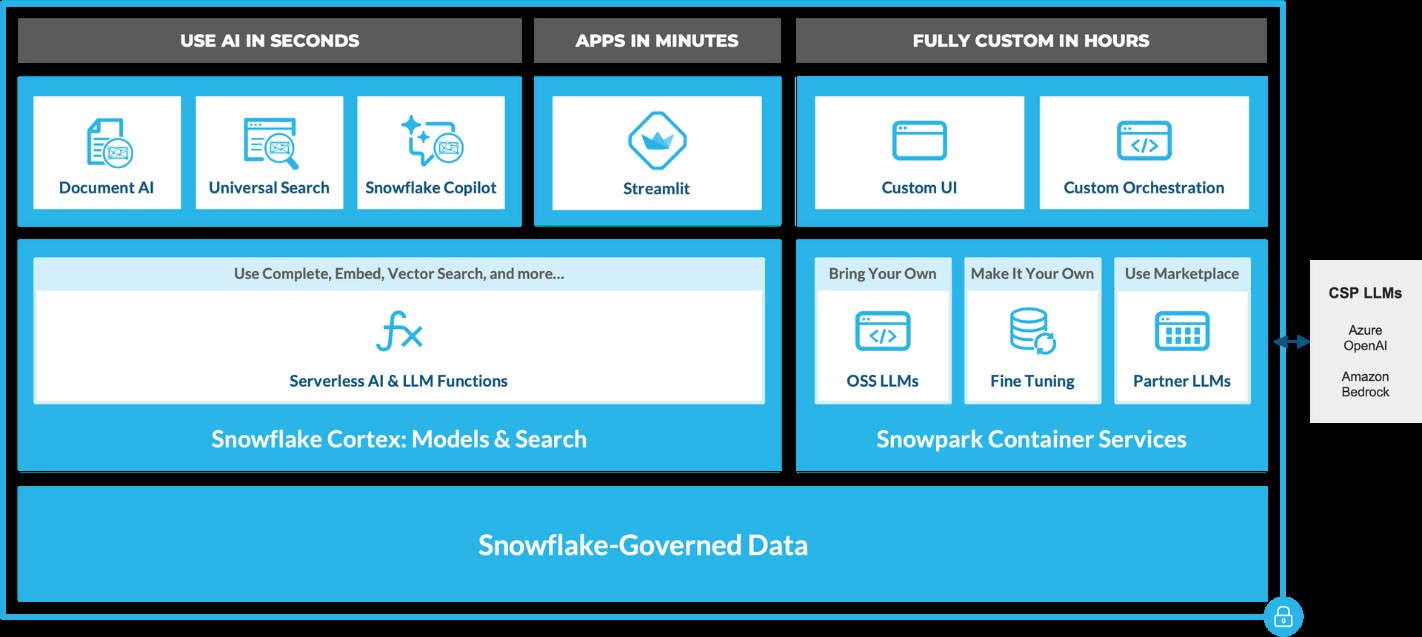 Source: https://www.snowflake.com/en/blog/use-ai-snowflake-cortex/
Key benefits include:
• Instant Access to AI Models: Snowflake users can leverage specialized machine learning and LLM models without managing expensive infrastructure. • Enhanced Data Insights: With Cortex, users can analyze vast datasets using Snowflake’s powerful AI capabilities, unlocking strategic insights to improve decision-making. • Simplified AI App Development: By removing technical barriers, Cortex democratizes AI access, enabling users of all skill levels to build AI applications.
LLM-Based Models for Unstructured Data (in private preview):
• Answer Extraction: Extract key information from unstructured datasets. • Sentiment Detection: Identify the sentiment in textual data. • Text Summarization: Create concise summaries of lengthy documents for quicker insights. • Translation: Perform large-scale text translation efficiently.ML-Based Models (available soon):
• Forecasting: Automatically forecast time series based on historical data, adjusting for seasonality and scaling. • Anomaly Detection: Detect outliers in time series data, useful for monitoring data pipelines. • Contribution Explorer: Identify key factors contributing to changes in metrics between two time intervals. • Classification: Categorize data into predefined classes to offer recommendations based on trends.
General Purpose Models for Broader Use Cases:
• Complete: Generate text completions using state-of-the-art open-source LLMs like Llama 2. • Text2SQL: Convert natural language queries into SQL, powered by Snowflake’s LLM, similar to the Snowflake Copilot feature. These serverless functions offer out-of-the-box capabilities that can be integrated into analytics workflows and app development in Snowflake. For example, with just a few lines of code, developers can embed these functions into chatbots using Streamlit. This allows Python-savvy users to build secure and powerful LLM applications quickly, often within hours.
Document AI
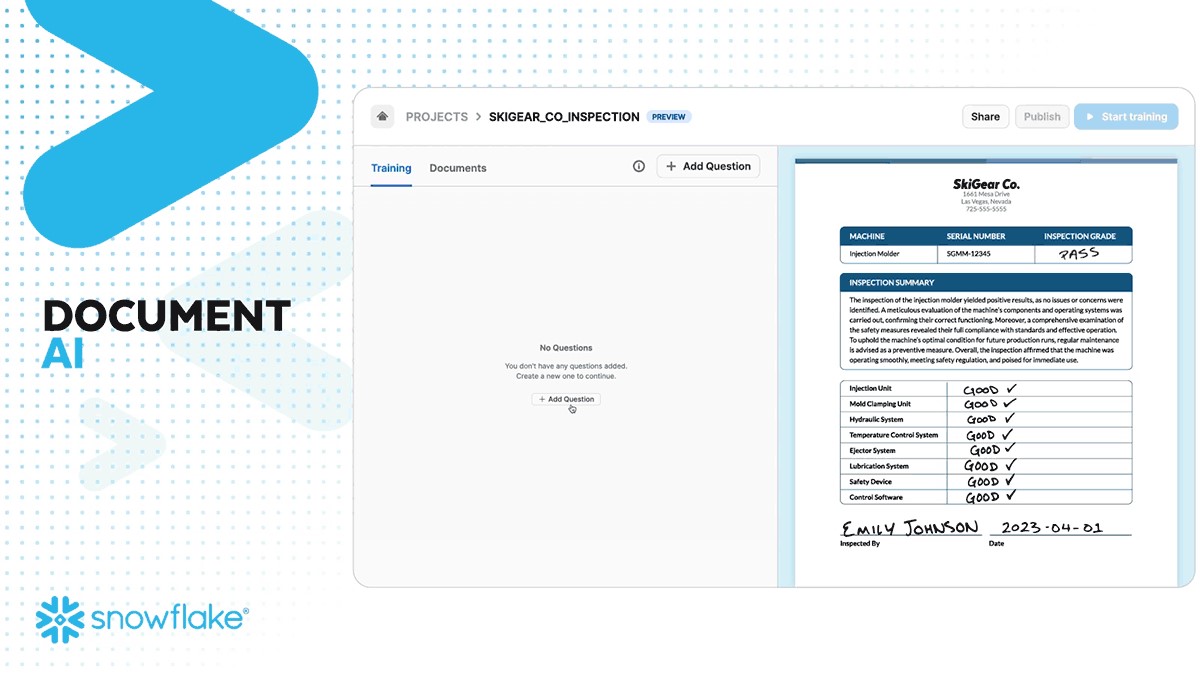
Document AI (currently in private preview) leverages large language models (LLMs) for seamless data extraction. By utilizing a pre-trained model and a user-friendly interface, customers can process various document types—such as PDFs, Word files, text files, and even screenshots—to quickly obtain answers to their queries. This capability can be scaled to build pipelines that automate data extraction, significantly reducing manual effort and saving time.
 Source: https://www.snowflake.com/en/blog/use-ai-snowflake-cortex/
Snowflake Copilot: Your AI-Powered SQL Assistant
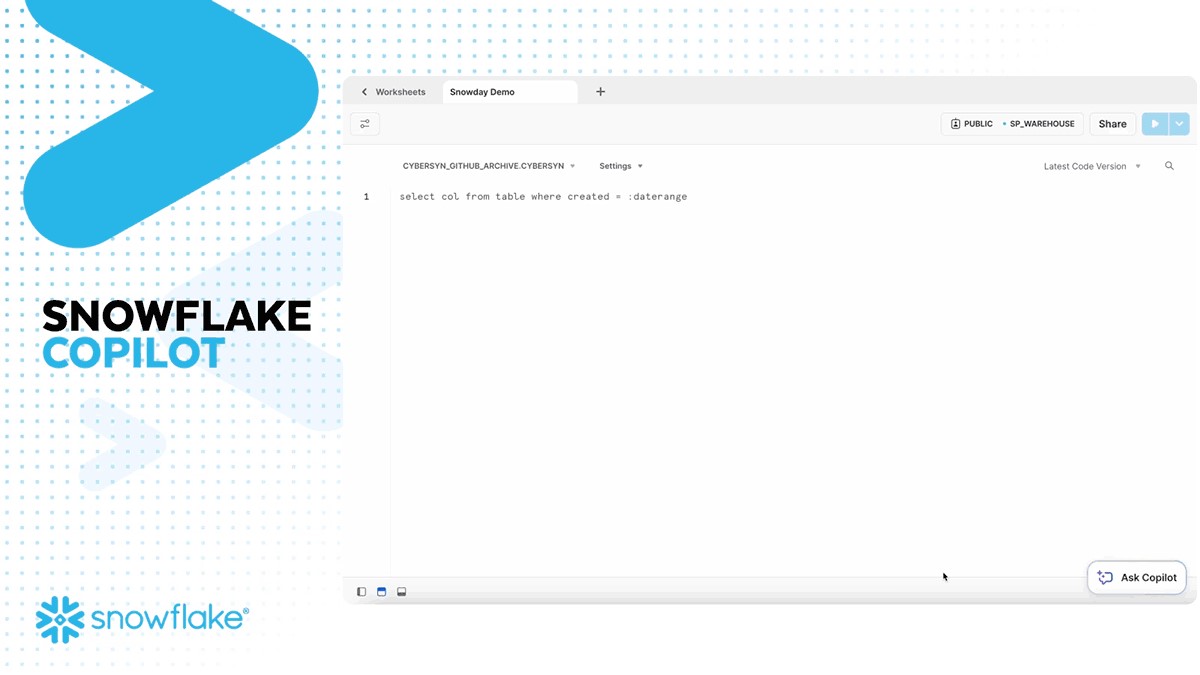
Snowflake recently introduced Snowflake Copilot, an AI-driven solution that makes SQL query generation faster and more efficient. With Snowflake Copilot, users can ask data-related questions in plain English, and the AI will generate SQL queries to deliver the desired insights.
Key Features of Snowflake Copilot:
• Text-to-SQL: Users can interact with their data using natural language, eliminating the need for complex SQL coding. • Enhanced Accuracy: The AI continuously refines its understanding of user queries, providing more accurate SQL code suggestions. • Data Exploration: Ask open-ended questions about your data and receive detailed insights without writing complex queries.
The Future of Generative AI with Snowflake
Snowflake is pushing the boundaries of Generative AI with its continuous development of AI tools like Snowflake Cortex AI and Snowflake Copilot. These innovations pave the way for a future where natural language becomes the primary interface for data analysis, enabling businesses to extract more value from their data while maintaining robust governance.
By integrating AI capabilities directly into the data platform, Snowflake empowers users to streamline workflows, reduce processing times, and unlock new levels of productivity—all without needing deep AI expertise.
A Transformative Partnership for the Future
Generative AI, coupled with Snowflake’s powerful data platform, is a game-changer for businesses looking to innovate and scale. Whether it’s enhancing productivity, improving decision-making, or driving customer engagement, Snowflake’s AI solutions are built to transform how enterprises interact with their data.
As AI continues to evolve, so will Snowflake's offerings, bringing more capabilities, deeper insights, and greater efficiencies to businesses worldwide. Ready to experience the future of data analysis with Snowflake and AI? The journey has just begun!
Snowflake + Beinex Partnership
Beinex is a Snowflake Services Partner Premier Tier, and the partnership reaffirms Beinex’s commitment to delivering exceptional data solutions and positions the company at the forefront of industry advancements. Harnessing the true potential of the data, partnership drives innovation and success in the digital era.
Belonging to Snowflake Services Partner Premier Tier, Beinex leverages Snowflake’s advanced capabilities and seamlessly integrates them into its comprehensive data solutions. This enables Beinex to accelerate the pace of Digital Transformation for its clients, providing them with the tools necessary to extract maximum value from their data and thrive in an increasingly data-centric world.
Connect with us for a free demo: https://beinex.com/contact-us/
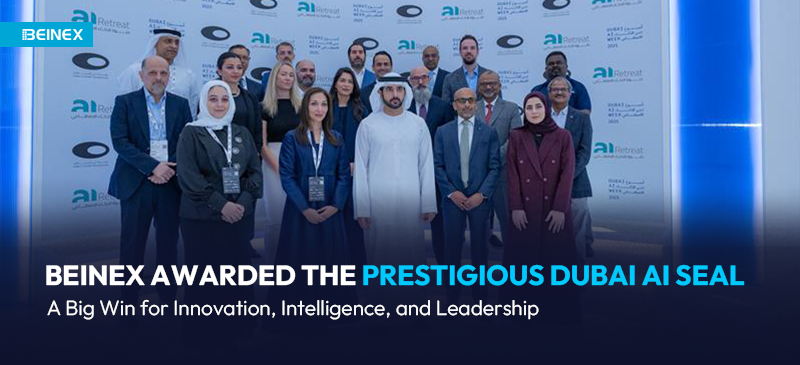
Beinex Among First to Earn Dubai AI Seal at Dubai AI Week, Cementing Its Status as a Trusted AI Leader

Dubai AI Seal, the first-of-its-kind initiative, was launched under the directives of His Highness Sheikh Hamdan bin Mohammed bin Rashid Al Maktoum. Awarded by the Dubai Centre for Artificial Intelligence (DCAI), this AI Seal cements Beinex’s status as a trusted partner in AI solutions. It underscores our commitment to driving transformative impact across government and private industry throughout Dubai and beyond.
Beinex: Your Trusted AI Partner
Beinex stands out as a trusted partner for government and private-sector organizations, driving future-ready AI solutions that align with Dubai’s strategic vision for AI leadership.
• Validation of Excellence: This Seal affirms Beinex’s AI governance, data security practices, and solution quality robustness.
• Expanded Collaboration: Government and private-sector entities can confidently engage with Beinex, knowing we meet Dubai’s exacting standards.
• Visibility & Credibility: The seal's display highlights Beinex’s alignment with Dubai’s strategic vision for AI and further distinguishes us in a competitive market.
Connect With Us to Kickstart Your AI Journey
Dubai AI Seal: A Vision Driving Responsible AI Innovation in the Emirates
Launched in January 2025 as part of the Dubai Universal Blueprint for AI, the Dubai AI Seal is a pioneering accreditation designed to:
• Promote trust in AI service providers through a rigorous evaluation framework
• Strengthen partnerships between government bodies and certified technology companies
• Reinforce Dubai’s leadership in ethical, secure, and high-impact AI deployment
Companies licensed in Dubai offering AI-related products or services undergo a detailed assessment covering their AI activities, team expertise, ongoing and upcoming projects, and collaboration track record. Successful applicants receive a unique serial number and tier classification, granting them the right to display the Seal across digital platforms and promotional materials.
Beinex: Heralding AI Excellence and Innovation across the Middle East
At Beinex, we help businesses achieve full potential through our bespoke solutions in Advanced Analytics, AI/ML/RPA, Risk and Audit Analytics, Digital Twin, Generative AI, Competitive Intelligence, Data Governance, Business Intelligence, Cloud Engineering, Modern Cloud Analytics, Alteryx APA, and Tableau. As a trusted AI partner, we spearhead transformation across healthcare, finance, IT, HR, education, oil & gas, and more. Our clientele includes government bodies and private enterprises, and we drive real impact efficiently, effectively, and at scale. Beinex has also been recognized by Consultancy-ME as one of the Top Consulting Firms in the Middle East for 2024. We’ve earned top-tier rankings in Business Intelligence, Data Science, and Cloud Services, underscoring our excellence across critical service domains. In addition, Beinex has secured leading positions in the Government, Oil & Gas, Public Sector, Technology, and Banking industries. These prestigious accolades reflect our unwavering commitment to delivering innovative, high-impact solutions that drive success across diverse sectors. Looking Ahead As Dubai accelerates its AI ambitions, Beinex remains committed to pioneering responsible innovation that enhances quality of life and drives sustainable growth. We look forward to leveraging this recognition to deepen our impact, delivering state-of-the-art AI solutions that empower organizations to meet tomorrow’s challenges today.

An Ultimate Guide to All the Tableau Certifications
Top 4 Benefits of Tableau Certification
Tableau certification offers numerous benefits. It is a valuable investment for professionals looking to excel in the field of data visualisation and analysis.
Here are the four ways Tableau certification can help you:
Let’s deep-dive:
1. Enhanced Professional Credibility
Achieving Tableau certification demonstrates your expertise and proficiency in using the Tableau platform. It enhances your professional credibility and sets you apart from others in the BI realm. Employers and clients value certified professionals as they have proven their competence in leveraging Tableau for data visualisation and analysis.
2. Expanded Career Opportunities
Tableau certification opens doors to a wide range of career opportunities. Many organisations seek professionals with Tableau skills to help them effectively analyse and visualise their data.
With Tableau certification, you become a desirable candidate for job roles such as:
3. Improved Skills and Knowledge
The process of preparing for Tableau certification equips you with in-depth knowledge of Tableau's features, functionalities, and best practices. You gain hands-on experience in creating interactive dashboards, working with various data sources, and leveraging advanced analytics capabilities. This knowledge enhances your ability to leverage Tableau effectively in real-world scenarios.
4. Increased Efficiency and Productivity
Tableau certification equips you with the skills to efficiently utilise Tableau's tools and techniques. You learn how to quickly analyse and visualise data, identify insights, and communicate findings effectively. This improves your productivity, allowing you to quickly deliver impactful data visualisations and insights.
List of Tableau Certifications
By pursuing Tableau certifications, individuals can showcase their proficiency and specialisation in various Tableau-related roles, from desktop usage to server administration, data analysis, consulting, and architecture. Each Tableau certification offers a unique opportunity to advance one's career and make significant contributions in the field of data visualisation and analytics using Tableau.
Tableau offers five certifications:- Tableau Desktop Specialist Certification
- Tableau Server Certified Associate Certification
- Tableau Certified Data Analyst Certification
- Tableau Consultant Certification
- Tableau Architect Certification
Let's dive deep into more details:
1. Tableau Desktop Specialist Certification: This certification validates foundational knowledge and skills in using Tableau Desktop. It demonstrates proficiency in tasks such as connecting to data sources, creating basic visualisations, and implementing best data organisation and formatting practices.
2. Tableau Server Certified Associate Certification: It focuses on Tableau Server, a platform for publishing, sharing, and collaborating on Tableau visualisations. It confirms expertise in tasks like managing user access, publishing dashboards, and administering Tableau Server to ensure optimal performance and security.
3. Tableau Certified Data Analyst Certification: It is designed for individuals specialising in data analysis using Tableau. It certifies advanced skills in data exploration, applying statistical techniques, and creating insightful visualisations to uncover valuable insights and drive data-driven decision-making.
Popular Tableau Partner Certifications
1. Tableau Consultant Certification: The Tableau Consultant certification is for professionals who provide consulting services and guidance on Tableau implementation and utilisation. It demonstrates expertise in understanding business requirements, designing compelling data visualisations, and offering strategic recommendations to optimise Tableau deployments.
2. Tableau Architect Certification: The Tableau Architect certification is aimed at individuals responsible for designing and architecting Tableau solutions for organisations. It validates skills in data modelling, performance optimisation, and scalable Tableau infrastructure design to ensure efficient and robust implementations.
Tableau Certification Cost
Source: Tableau
List of Job roles for Tableau Professionals
- Tableau Consultant
- Data Analyst
- Business Analyst
- Business Intelligence Analyst
- Business Intelligence Developer
- Business Intelligence Manager
Why Beinex
If you are searching for the right place to start your Tableau training, Beinex can be your perfect choice. Our globally trained subject matter experts can assist you in catering customised training that suits your schedule. So, wait not! Get in touch with us!
Four Ways to Enhance Customer Experience in the Metaverse
These days we are into the 2-D screen of our mobile phones and watch videos and shows and engage in many more activities. But we are not carried away to that place or get immersed in it. Through the metaverse, that is possible. Here you can have an avatar which can act as a replica of your physical self. You can indulge in anything from hanging out with pals, participating in sports or workout sessions, learning new courses or activities, attending events, or shopping.
What are the possibilities Metaverse offers?
Using the limitless opportunities, you can virtually own digital clothing, buy land, construct buildings, start businesses, visit nightclubs and shopping centres, and even buy digital artworks. Non-fungible Tokens (NFTs) are used in the metaverse to digitally represent physical assets like art, music, in-game goods, and videos. They can be purchased and sold online. An evolving business strategy called "Direct-to-avatar" (D2A) makes it possible to sell and buy goods directly to avatars or other digital identities in virtual environments. Here, the possibilities are just boundless. Considering the future prospects, many brands like Adidas, Nike and Gucci, to name a few, have invested in the metaverse. As Gen Z and millennials are already spending a considerable amount of time in the virtual world, it is anticipated that by the end of 2022, the global VR sector will generate over $6.71 billion in revenue, and by 2024, it will be around $12.19 billion.
Metaverse generates value in customer experience by providing real-life interactions and can revolutionise user experience. Let’s see how it can be done:
1. Providing Unique Customised Experiences
Customisation plays a crucial part in today’s business world, as does in the metaverse. Businesses struggle to tailor the experience for each consumer, whether they prefer to purchase online or go to a physical store. Thankfully, the metaverse can guarantee that each customer's experience in an online store is distinctive. Customers can browse products geared toward their unique needs rather than browsing products that are of no interest to them. Additionally, the metaverse encourages connectedness, so consumers may share their experiences with other metaverse users and read reviews of goods and services before making a purchase.
Sports gear giant Adidas is one step ahead of the game by providing virtual gear for the virtual world and metaverse. Major apparel retailers like Macy's, Adidas, and Modcloth have already adopted virtual dressing rooms to enable customers to visualise a garment on their body without actually trying it on. The Swedish furniture retailer IKEA has already released an augmented reality catalogue app that lets you view how various pieces of furniture would look in your home. Nike owns Nikeland, a virtual world which is a free immersive sports space where you participate in sporting events from your computer or phone through your unique avatar.
2. Trials Using Virtual and Augmented Reality
Earlier trials were provided only for digital products, but with the help of the metaverse, we can experience every product virtually. For instance, we can choose a hotel to stay in after virtually experiencing the facilities provided by it. That’s cool, isn’t it? The metaverse uses augmented and virtual reality to give users a fully immersive experience. Customers who engage in immersive experiences may be able to do things that they otherwise might not have been able to do or uniquely do things. From buying lipstick after a virtual trial to buying a car after a virtual drive allows customers to explore and experience more realistically. Customers can currently utilise augmented reality through apps in a limited way, but the metaverse will allow them to experience the product from a close-up and personal perspective. For instance, Hyundai’s mobility adventure enables a vivid virtual experience.
BMW's augmented reality experiences enable automobile buyers to modify their desired vehicles in showrooms with the help of their tablets or smartphones. Alternatively, consumers can don virtual reality goggles to experience what it's like to drive cars, which will help them comprehend their options and select the best option available for their new car.
3. Accessible from Anywhere
The metaverse offers businesses plenty of advertising opportunities, but it also enables customers to interact with the people, places, and brands that interest them. Businesses can provide customers with experiences that let them explore their interests in greater detail without leaving the comfort of their homes and provide free samples of real-world events.
For people for whom it is not always feasible or economical to attend events in real life, the metaverse is the ideal replacement. Through 3D virtual worlds and avatars, users can enjoy affordable front-row access to various events with a level of immersion that must be experienced. Thanks to simple navigation, which places them in a metaverse tailored to their interests.
If you want to go shopping and there is no time for that, you can access it virtually from anywhere. To cite an example, for interior designing of your house, you can try different pieces or types of furniture from a virtual shop by arranging those in a digital representation of your house. Customers could quickly see whether the sofa would go with the colour scheme of their floor or wall or whether a wardrobe would fit in the available area. Ikea, the furniture brand, has already provided virtual experiences for customers. Buying land without the help of an agent is possible through Upland, a virtual real estate software that lets users browse and buy virtual property connected to actual towns and cities.
4. Strengthen Customer Experience
Companies now offer advice and assistance in addition to goods and services. Metaverse enables businesses to develop natural relationships with clients that weren't feasible with earlier forms of technology. Through virtual reality, customers experience ‘story-living’ rather than just ‘story-telling’. Shoppers can have a distinctive customer experience as they can purchase through experiencing it, have opinions about it, interact with other users and ask questions in the metaverse itself.
The businesses are testing out virtual and augmented retail on various platforms. Within the Roblox online multiplayer game, Gucci and Nike have unveiled fashion shows. In Fortnite, Balenciaga has begun offering high-end clothing. Additionally, the South Korean social avatar app Zepeto, Ralph Lauren, and Adidas have introduced interactive experiences. In the meantime, Charlotte Tilbury has established a virtual cosmetic store.
The journey doesn't end with how companies interact with customers in the metaverse. Businesses that use the metaverse's advantages ensure their clients have a customised experience that develops at the same rate as the metaverse. It's time for businesses to be prepared to adopt the impending metaverse and become early adopters before it is too late. Even though the metaverse is the next frontier of internet technology and consumer experience enhancement, massive adoption and accessibility are crucial. It's vital for business owners to begin learning about how these virtual worlds function, what opportunities and problems there are, and how to take advantage as soon as possible.

Advanced Analytics: Facilitating One Giant Leap to The Future
1. Advanced Analytics in HR
HR teams always struggle with mammoth amounts of data which can be transformed into meaningful insights with the help of Advanced Analytics. The applications of Advanced Analytics can spearhead the domains of recruitment, learning and development of the employees and help manage their performance.
It can aid HR to identify the shortcomings in the existing resources and help decide to improve the skills of existing employees or hire competent new talent. The added advantage of HR analytics is that it is efficient in analysing employee performance by categorising them according to their individual calibre.
2. Advanced Analytics in Banking
Advanced Predictive Analytics has the potential to gear up the banking sector by assisting banks to adopt better strategies assessing and predicting customer behaviour. It can safeguard customer accounts from cyber-attacks and can detect fraudulent activities. Real-time alert messages are the most exclusive of the features which can shield against cyber-attacks to a big extent.
3. Advanced Analytics in Retail
The uncertain economy creates challenging scenarios for retailers. But Advanced Analytics functions act as a handy tool to make use of customer insights from the silos of data and provide a personalised and tailored marketing experience. It can be both cost saving and can unleash business growth to a great extent.
4. Advanced Analytics in Manufacturing
Manufacturing Analytics harvests revolutionary output from the manufacturing process, supply chain production, and customer delivery. The global manufacturing market is predicted to grow up to $28.5 billion by 2026 and the growth can be multiplied using the insights generated by analytics. Tools for asset management, product development, inventory management, and predictive maintenance can generate insightful options to rake in revenue amidst the limitations of the times.
5. Advanced Analytics in Finance
Financial sector produces a huge quantity of structured and unstructured data. The finance consultants or analysts should exploit this data with the help of Advanced Analytics to tackle financial troubles and to identify customer related requirements and issues. Advanced Analytics also helps to implement business plans and eliminate fraudulent activities. Financial institutions like loaning bodies, banks, trading firms, and insurance companies can improve their performance and revenue by deploying Advanced Analytics.
6. The Future of Advanced Analytics
Advanced Analytics is evolving and has become the indispensable requirement to run businesses. Due to the worldwide reception and adoption by the business community, analytics and information services sectors are predicted to have the fastest growth rate from 16% to 18% over the next five years starting 2022. As the market is getting competitive, planning and implementing strategic investments with data analytics is crucial to create new services and added revenue.
How Beinex can act as a torchbearer
Beinex has impacted and accelerated the growth of its customers and clients. With its impeccable offerings, it has partaken to build, market and expand businesses worldwide. The services provided by Beinex are enlisted below bracketed into respective domains:
• Predictive Analytics
This outstanding service offers you predictive insights to make resolutions which in turn can power your business.
• Artificial Intelligence
To cut short expenses and to attain target within a short period of time, make use of our AI tools or applications. It is beneficial to aggregate and automate data processing.
• Machine Learning
A vast quantity of data can be analysed using algorithms which can accelerate the decision-making process. With Machine Learning, specific and relevant data can be extracted and utilised to leverage businesses.
• RPA
Robotic Process Automation or software robots can accelerate digital transformation by emulating human actions. Automation of workflows, greater degree of accuracy, better productivity, high efficiency, and lesser costs are a few major takeaways from RPA which can accelerate business growth.
Conclusion
Advanced Analytics is here to stay, as organisations have started to rely on analytics more than ever before to predict business outcomes. It is sure to govern the business world as it has gained trust as a superpower which is accessible to all but chosen by only a few.