How AI Decision-Making is Improving Enterprise Outcomes
Blog
Share 
Beinex Opens its Corporate Office in the Kingdom of Saudi Arabia
 4 January 2023
  Team Beinex
 In the last few years, the KSA market has witnessed a definitive shift to self-service consumption tools anchored in data democratization. The transition is of paramount importance for products that can scale at an enterprise level, AI-ML products, and those that can address data governance and quality management issues.
The shift is also significant for enterprise transformation catalysts that take an ecosystem approach with proven expertise in developing and executing comprehensive and unified data strategies, data engineering and data governance paradigms.
Thus the time is ripe for an innovation-led, experience-driven enterprise like Beinex to spearhead Digital and Analytics Transformations in KSA.
[sc name="quote" quote="“Beinex is pleased to formalize its presence in the KSA market by opening an Office in Riyadh. We, as an enterprise, are 100% aligned with Vision 2030 as put forth by the KSA and see tremendous value getting unlocked as the vision is realized. We look forward to expanding our footprint in the domains of Artificial Intelligence, Sustainability, Digital Transformation, Analytics and allied areas. The Kingdom envisions itself to be at the forefront of data and artificial intelligence-based economies, and Beinex is committed to playing its part in supporting and fulfilling this vision,”" author="Indumon Das, Founder and Managing Director of Beinex,marking the occasion of the office’s opening, noted."][/sc]
Middle East Banking AI & Analytics Summit
Beinex is super excited to be a part of the 6th Middle East Banking AI & Analytics Summit on May 10, 2023. With the motto, "Accelerating Innovation in Banking with AI and Analytics Strategies", the summit aims to revolutionise the financial and banking space in KSA using AI. We are ready to witness and participate in panel discussions, fireside chats, keynote presentations, roundtable discussions, and conversational Q&A sessions with thought leaders on exploiting the Power of AI and Analytics for a futuristic banking ecosystem.
Middle East Enterprise AI & Analytics Summit
Also, we are enthusiastic to participate in the Middle East Enterprise Al and Analytics Summit on May 11, 2023. Its vision is to curate a world-class platform for tech leaders in the region to connect, communicate and collaborate under the theme "Accelerating Innovation in Enterprises with Applied Al and Analytics Strategies". Beinex is looking forward to connecting with thought leaders and high-level decision-makers in Al, and Data Analytics at #MEEAI 2023 to participate in discussions and to be a part of the transformation journey.The Power of Beinex
Beinex drives a cohesive, unified digital ecosystem to help customers address their needs, assess products and operations, understand market requirements and evaluate overall business performance.
It is a multinational firm exploring the endless possibilities of data for Cloud, Analytics, Artificial Intelligence, Machine Learning, and Automation. In effect, Beinex architects, guides, leads, and implements solutions in Analytics, AI, and ML for the spheres of Digital Transformation, GRC, and Risk & Audit Transformation.
Partnerships make Beinex stronger. The company has solid partnerships with some of the leading technology firms, research labs, and universities around the globe. Businesses can leverage the power of the Beinex partner ecosystem to maximize the value of their end-to-end analytics journey.
Beinex Digital, a part of Beinex Holdings, is a digital transformation entity with a comprehensive suite of independent products focused on addressing specific business gaps, use cases, and needs. It incorporates a spectrum of solutions in the domains of Employee Health, Safety and Environment, Enterprise Product Management and Enterprise Performance Management.
Beinex is also the product champion for Aurex – Augmented Risk and Audit Analytics – a unique single-platform solution for Integrated Risk Management, Governance, Audit, Compliance, BCM, and Analytics functions. It is the first-of-its-kind product that streamlines risk and audit verticals for enterprises worldwide and is a Unified Digital Assurance Ecosystem.
Present in three continents, Beinex enables its clients to analyze data, mitigate risks, identify opportunities and automate processes.
Beinex Office Address (KSA):
Beinex Advanced Information Technology3141, Anas Bin Malik,
8292 Al Malqa Dist
P. O. Box 13521,
Riyadh, Kingdom of Saudi Arabia
Email: Info@beinex.com
Beinex opening its office in the Kingdom of Saudi Arabia is a logical step for the enterprise as it has had a solid footprint in Saudi Arabia, the wonderland of business boom and opportunities for the past many years.
Related Articles

Snowflake Time Travel: How to Leverage it to Achieve Optimal Results
Benefits of Snowflake Time Travel
With Snowflake Time Travel, you can access historical data, including data that has been altered or deleted, at any given point. This feature is helpful for various tasks, such as:- • Querying data that has been modified or erased in the past
- • Duplicating entire tables, schemas, or databases at or before specific dates
- • Restoring deleted tables, schemas, and databases
How to activate Snowflake Time Travel?
Activating Snowflake Time Travel is a simple process that requires no additional effort. It is automatically activated with a retention period of one day. Nonetheless, upgrading to the Snowflake Enterprise Edition is necessary to customise the Data Retention Period and extend it to 90 days for Databases, Schemas, and Tables. It's important to note that increasing the Data Retention Period results in additional storage usage, reflected in your monthly Storage Fees.
Data Retention Period in Snowflake
In Snowflake, Data Retention Period determine how long historical data is retained to support Time Travel functionality. When data in a table is altered, such as through deletions or updates, Snowflake maintains the previous state of the data so that Time Travel operations (like SELECT, CREATE...CLONE, UNDROP) can be performed on it. By default, all Snowflake accounts have a standard retention period of one day (24 hours).
However, the Retention Period can be adjusted at the account and object level in the Snowflake Standard Edition to 0 (or unset to the default of 1 day) for databases, schemas, and tables.
In the Snowflake Enterprise Edition or higher, the Retention Period can be set to 0 for temporary databases, schemas, tables, and temporary tables. For permanent databases, schemas, and tables, the Retention Time can be configured to any duration between 0 and 90 days.
Functions of Snowflake Time Travel SQL Extensions
Snowflake Time Travel SQL Extensions are special SQL commands that allow users to query historical data from a specific point in time using the Time Travel feature. These extensions enable users to perform various Time Travel operations, including:
- a. CLONE: This command creates a copy of a table, schema, or database at a specific point in time using Time Travel.
- b. UNDROP: This command restores a dropped table, schema, or database to a specific point in time using Time Travel.
- c. HISTORY: This command retrieves the history of changes made to a table, schema, or database over time using Time Travel.
- d. AS OF: This command retrieves data from a table as it appeared at a specific point in time using Time Travel.
Specifying a Custom Data Retention Period for Snowflake Time Travel
To specify a custom Data Retention Period for Snowflake Time Travel, you can use the DATA_RETENTION_TIME IN_DAYS argument in the command when creating a table, schema, or database. By default, the maximum Retention Time in Standard Edition is set to 1 day (i.e. 24 hours), while in Snowflake Enterprise Edition (and higher), it can be set to any value up to 90 days.
The Data Retention Time can be set in the way it has been placed in the example below.
To create a schema with a custom Data Retention Period of 60 days, you can use the following SQL command:
create table mytable(col1 number, col2 date) data_retention_time_in_days=60;
Modify the Data Retention Period for Snowflake Objects
To modify the Data Retention Period of a Snowflake object, any change made to the Retention Period affects both active data and data in Time Travel. Depending on whether the period is increased or decreased, the following impacts occur:
- a. Increasing Retention
- b. Decreasing Retention
Let’s dive deep into more details:
a. Increasing Retention
Snowflake Time Travel preserves the data for a more extended period. For instance, if a Table’s Retention Time is increased from 10 to 20 days, the data set to be deleted after ten days will be retained for an additional ten days before being moved to Fail-Safe. However, data over ten days old and already transferred to Fail-Safe mode is unaffected.
b. Decreasing Retention
The duration of data stored in Time Travel is reduced. The shorter Retention Period applies only to active data updated after the Retention Period is shortened. If the data is still within the new Retention Period, it stays in Time Travel; otherwise, it is placed in Fail-Safe Mode. For instance, if a table with a 10-day Retention Period is reduced to 1 day, data from day 2 through day ten will be transferred to Fail-Safe, and only data from day one will be accessible through Time Travel.
Since the background process moves the data from Snowflake Time Travel to Fail-Safe, it may take some time to see the changes. Although Snowflake guarantees that the data will be transferred, it does not specify when the process will be finished. The data remains accessible via Time Travel until the background process is completed.
To change an object's Retention Period, use ALTER object command, such as the following command for modifying a table's Retention Period:
alter table mytable set data_retention_time_in_days=30;
Snowflake Time Travel Data Query
To query previous versions of data in Snowflake Time Travel, you can use the AT | BEFORE Clause after making any DML actions on a table. This clause allows you to query data at or before a certain point in the table's history throughout the retention period. The specified threshold can be either time-based (e.g., a timestamp or time offset from the present) or a statement ID (e.g., SELECT or INSERT).
For example, to select historical data from a table as of a specific date and time, you can use a query like:
sql
SELECT * FROM my table AT (TIMESTAMP => 'Fri, 05 May 2023 16:20:00 -
If you want to pull data from a table that was last updated a certain number of minutes ago, you can use a query like:
sql
SELECT * FROM my_table AT(OFFSET => -60*5);
And to collect historical data from a table up to a specified statement's modifications, but not including them, you can use a query like:
Sql
SELECT * FROM my_table BEFORE(STATEMENT => '8e5d0ca9-005e-44e6-b858-a8f5b37c57
How to Restore Deleted Objects by Utilising the UNDROP Command?
To restore a deleted object that hasn't been permanently removed from the system (meaning it can still be seen in the "SHOW object type> HISTORY" output), you can use the UNDROP command in conjunction with Snowflake Time Travel. This command can be applied to various objects, such as tables, schemas, and databases. It effectively reverts the thing to its previous state before it was deleted with the DROP command. For example, the UNDROP command can also restore a dropped database.
Summing Up
Snowflake Time Travel’s features can enhance your decision-making process and overall data experience. If you're looking for a Snowflake service provider, Beinex is an excellent option. Our partnership with Snowflake enables us to offer advanced features like automated tuning, elastic compute, and analytics modernisation services to help your organisation realise exponential Returns on Investment.

Predictive Analytics in Tableau: A Crystal Ball for Business Success
What is Predictive Analytics?
Predictive analytics is a branch of advanced analytics that uses historical data, statistical algorithms, and machine learning techniques to identify the likelihood of future outcomes based on historical data. The primary goal is to go beyond knowing what has happened to provide the best assessment of what will happen in the future.
Benefits of Predictive Analytics
- Enhanced Decision Making: Make informed decisions based on data-driven insights rather than gut feelings.
- Cost Savings: Optimize resources and reduce waste by predicting demand and managing inventory effectively.
- Risk Management: Identify potential risks and take preventive measures to mitigate them.
- Improved Customer Satisfaction: Anticipate customer needs and preferences, leading to better products and services.
Predictive Analytics Techniques
Predictive analytics techniques offer a wide range of applications powered by various types of models that generate valuable insights. To determine the best predictive analytics techniques for your organization, start with a clearly defined objective. Once you know the specific question you want to answer, you can select the most suitable model.
List of Predictive Analytics Models
- Regression Models: Used to predict continuous outcomes.
- Classification Models: These models categorize data into predefined classes.
- Clustering Models: Group similar data points together based on defined criteria.
- Time Series Models: Analyze data points collected or recorded at specific time intervals to forecast future values.
1. Regression Models in Predictive Analytics
Regression models estimate the relationship between variables, tracking how independent variables impact dependent variables to predict future outcomes. These models range from simple (one independent and one dependent variable) to multiple linear regression (multiple independent variables). Various regression techniques can be applied based on the specific use case.
By defining variable relationships, organizations can conduct scenario or 'what-if' analysis, testing how changes in independent variables affect outcomes.
Application of Regression Models
For example, a company might use a regression model to analyze how product qualities influence purchase likelihood, such as identifying a correlation between blue shirts and higher sales. These insights help refine marketing strategies and product development, optimizing future performance.
2. Classification Models in Predictive Analytics
Classification models categorize data based on historical knowledge. Using a labeled training dataset, the classification algorithm learns correlations between data and labels and then categorizes new data. Popular techniques include decision trees, random forests, and text analytics.
These models are highly adaptable and can be retrained with new data, making them useful across various industries.
Application of Classification Models
For example, banks use classification models to detect fraudulent transactions. By analyzing millions of past transactions, the algorithm identifies patterns indicative of fraud and alerts customers to suspicious activity.
3. Clustering Models in Predictive Analytics
Clustering models group data based on similar attributes. Using a data matrix that associates items with relevant features, the algorithm clusters items with shared features, uncovering hidden patterns. Organizations use clustering models to group customers for personalized targeting strategies.
Application of Clustering Models
A restaurant might cluster customers by location and mail flyers only to those within a certain driving distance of a new location.
4. Time-series Models in Predictive Analytics
Time series models analyze data points in relation to time, making time one of the most common variables in predictive analytics. These models use historical data to predict future metrics. For example, analyzing data from the past year can help forecast the upcoming weeks.
Time series analyses are versatile, used for applications like seasonality analysis (predicting how assets are affected by certain times of the year) and trend analysis (determining asset movements over time).
Application of Time-series Models
Forecasting sales for the next quarter, predicting store visitor numbers, or even determining peak flu seasons.
Predictive Analytics with Tableau
Tableau empowers users to not only visualize their data but also to gain actionable insights through advanced predictive capabilities. Whether you're looking to forecast sales, predict customer behavior, or optimize business operations, Tableau is the right choice.
3 Ways to do Predictive Analytics in Tableau
1. Forecasting in Tableau Desktop
Tableau Desktop offers robust forecasting features that allow users to make data-driven predictions effortlessly. Using exponential smoothing models, Tableau enables you to forecast future data points based on historical trends. Here’s what you can do: Let’s explore the ways to forecast data in Tableau Desktop: • Creating a Forecast: Users can add a forecast to a view by simply dragging a time dimension to the Columns shelf and a measure to the Rows shelf. By right-clicking on the view and selecting "Show Forecast," Tableau generates a forecast based on the selected model. • Customizing Forecasts: Forecast settings can be customized to adjust the prediction length, forecast model, and season length. Users can access these settings through the "Forecast Options" dialog box. • Evaluating Forecasts: Tableau provides a forecast description that includes details about the model, prediction intervals, and underlying statistics. This helps users understand the reliability and accuracy of their forecasts. • Visualizing Forecasts: Forecasts are visualized as shaded areas or lines on the chart, making it easy to compare predicted values with actual data.
2. Bringing R/Python Calculations into Tableau
Integrating R and Python into Tableau Desktop enhances its analytical capabilities, allowing users to perform complex statistical analysis and machine learning tasks. Users can create calculated fields using MODEL calculations, or by using SCRIPT functions that include R or Python scripts to perform custom calculations. These scripts can be used for various purposes, such as regression analysis, clustering, and predictive modeling. Tableau connects to R using Rserve and to Python using TabPy.
3. How to Do Predictive Analytics with Tableau Prep
Tableau Prep enhances your data preparation process by integrating with Einstein Discovery, Salesforce's AI-powered analytics tool. This integration allows you to infuse your data workflows with advanced predictive capabilities. • Einstein Discovery in Tableau Einstein Discovery, part of Salesforce's suite of AI (Artificial Intelligence) tools, is integrated into Tableau to provide advanced predictive analytics capabilities. In Tableau Prep, Einstein Discovery can be used to build and integrate predictive models directly within the data preparation workflow. This feature is available in Tableau Desktop as well. • Generate predicted values by integrating R/Python in Tableau Prep Tableau Prep allows for the integration of R and Python to perform advanced data transformations and generate predicted values.
Here's how you can do it: • Script Steps:
- Tableau Prep includes a "Script" step that lets users run R or Python scripts as part of their data flow.
- This step can be used to perform complex transformations, calculations, and predictions.
- Similar to Tableau Desktop, Tableau Prep connects to R using Rserve and to Python using TabPy.
- Users need to set up these servers and connect them to Tableau Prep to execute scripts.
- Users can import trained models from R or Python into Tableau Prep.
- The "Script" step allows these models to be applied to the data, generating predicted values as part of the data preparation process.
- Using R and Python, users can create dynamic and flexible data preparation workflows that include predictive analytics.
- This enhances the overall data preparation process by integrating advanced analytical techniques.
Real-life Scenarios/ Use cases of Predictive Analytics
Predictive analytics can be applied in numerous business scenarios to enhance decision-making, efficiency, and customer satisfaction. Here are some real-life examples:
- Customer Churn Prediction: • Scenario: A telecom company wants to reduce the number of customers leaving for competitors. • Application: By analyzing customer usage patterns, support interactions, and billing history, the company can predict which customers are at risk of churning and take proactive measures, such as targeted promotions or personalized outreach.
- Fraud Detection: • Scenario: A financial institution wants to identify fraudulent transactions. • Application: By examining transaction histories, user behavior, and other data points, predictive models can flag suspicious activities in real-time, allowing for immediate investigation and action.
- Sales Forecasting: • Scenario: A manufacturing company needs to predict future sales to plan production and manage resources. • Application: Leveraging past sales data, market trends, and economic indicators, the company can generate accurate sales forecasts to inform production schedules and supply chain management.
- Marketing Campaign Optimization: • Scenario: A marketing team wants to improve the effectiveness of their campaigns. • Application: Predictive analytics can help segment customers based on their likelihood to respond to different types of campaigns, enabling more targeted and effective marketing efforts.
- Risk Management: • Scenario: An insurance company needs to assess risk for new policy applicants. • Application: By analyzing historical claims data and applicant information, the company can predict the likelihood of future claims and set premiums accordingly.
Tableau offers a powerful platform for integrating predictive analytics into your data strategy. With its robust forecasting capabilities, seamless integration with R and Python, and advanced features in both Tableau Desktop and Tableau Prep, you can transform raw data into actionable insights. Whether you are aiming to predict future trends, optimize operations, or make data-driven decisions, Tableau equips you with the tools needed to gain the full potential of your data. To know more, connect with us: https://www.beinex.com/tableau-beinex
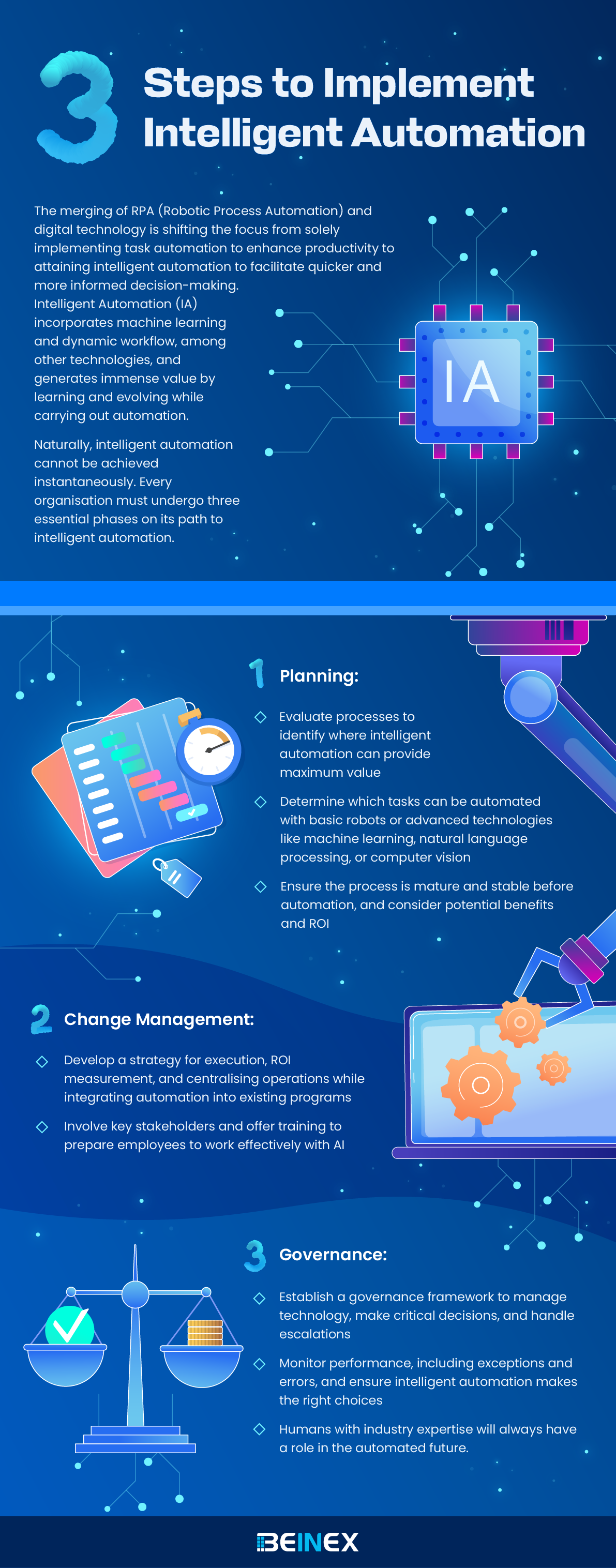
Three Steps to Implement Intelligent Automation(Infographic)

Preparing for AGI: What Leaders and Executives Need to Know
What is AGI (Artificial General Intelligence)?
Artificial General Intelligence (AGI) refers to an AI that, in theory, can think, learn, and understand more like a human. It is designed to perform any intellectual task a human can do. However, AGI remains a theoretical concept, and current AI systems have not yet achieved true cognitive abilities, reasoning skills, or emotional intelligence comparable to humans. Rapid advancements suggest that reaching a form of AGI is not beyond possibility. Given the unprecedented growth of AI in recent years, it's wise to stay informed and prepared.Generative AI vs. AGI vs. ASI: Understanding the Difference
Generative AI is a subset of deep learning that predicts responses based on extensive training data. These models, including ChatGPT and Midjourney, are powerful but still fundamentally narrow AI systems. They lack true understanding, common-sense reasoning, and emotional intelligence. Conversely, Artificial General Intelligence (AGI) is regarded as a strong form of AI. Like human intelligence, it would be self-aware, flexible, and capable of solving problems in various fields. AGI might learn, reason, and apply knowledge across domains without explicit training, in contrast to GenAI, which works within predetermined tasks. Even if AGI is yet theoretical, it has enormous potential to change society and industry. Beyond human intelligence, Artificial Super Intelligence (ASI) can tackle issues beyond human comprehension. For example, an ASI system might be able to create novel medicinal treatments or extremely efficient energy systems. Nonetheless, ASI is still primarily theoretical and a subject of discussion and assumption.GenAI vs. AGI vs. ASI: Key Differences
Here are the main differences between GenAI, AGI, and ASI:| Generative AI (GenAI) | Artificial General Intelligence (AGI) | Artificial Super Intelligence (ASI) |
|---|---|---|
| AI that generates text, images, audio, and code based on training data | AI with human-like reasoning, learning, and problem-solving across all domains. | AI that surpasses human intelligence and capabilities |
| Generates content, predicts patterns, and automates tasks | Understands, learns, and adapts like a human across multiple fields. | Thinks, learns, and innovates beyond human intelligence |
| Examples: ChatGPT, Midjourney, DALL-E, Bard | A self-learning AI that can pass human-level exams and perform diverse tasks. | An AI that can autonomously innovate, research, and make better decisions than humans. |
| Mimics creativity but lacks true understanding | Matches human cognitive abilities. | Beyond human intellectual capacity |
| Fully functional and widely adopted | Estimated timeframe is 2030–2050 (speculative). | Not yet possible with current technology |
AGI and Businesses: How Executives Can Prepare for AGI
The best way to keep up with new technology isn’t to wait until it arrives; it’s to prepare before it changes everything. Here are a few simple ways to get ready for Artificial General Intelligence (AGI):1. Stay Informed and Monitor AI Advancements
The first step in getting ready is to comprehend how quickly AI is advancing. Executives should keep an eye on new advancements in AGI, legal reforms, and AI research. Keeping tabs on start-ups, business leaders, and research organizations can yield insightful information.2. Invest in AI Skills
But there's no point in waiting for AGI to happen; smart leaders should be ready now. Leading businesses should invest in automation and artificial intelligence to gain a competitive edge. Developing AI expertise within your organization, whether through employing AI experts, educating employees, or implementing AI-powered technologies, will lay a strong foundation for future AGI integration.3. Develop a Robust Data Infrastructure
High-quality data is essential for AI to flourish. Businesses should ensure their data ecosystems are safe, organized, and ready for AI-driven insights. Adopting the retrieval-augmented generation (RAG) models and cloud-based AI solutions improves AI applications and prepares for more complex systems like artificial general intelligence.4. Adopt a Human-centric AI Approach
Even with AI's expanding capabilities, human monitoring is still crucial. "Human-in-the-loop" models, in which AI complements human decision-making rather than replaces it, should be given top priority by executives. Employee resistance to automation can be decreased, and productivity can be increased by teaching them how to work with AI tools.5. Address Ethical and Security Considerations
Ethical issues like bias, security, and data privacy are becoming increasingly urgent as AI develops. Executives must implement governance structures to ensure accountability and transparency in AI deployments. AGI readiness will also depend on how well cybersecurity threats and compliance laws are handled.6. Organize Teams for AI-driven Workflows
An AI-driven world may require adaptability that traditional organizational structures may not be able to provide. Employers should consider flexible workforce models in which staff members switch between projects regularly. AI literacy upskilling programs can facilitate employees' hassle-free transition into AI-augmented roles.7. Experiment with AI Investments
While AGI is still a way off, companies should start making calculated investments in AI research, automation driven by AI, and cognitive computing. When artificial intelligence (AGI) becomes economically viable, companies that invest in AI-driven innovation can become early adopters.The Business Impact of GenAI: Current Trends and ROI
While Generative AI (GenAI) is already revolutionizing industries with quantifiable return on investment, Artificial General Intelligence (AGI) is still a vision for the future. A 2024 Deloitte survey identified key sectors where organizations are experiencing notable advances: • Text Generation (83%) – Automating reports, document summarization, and marketing content. • Code Assistance (62%) – Helping developers write code efficiently with fewer errors. • AI-Powered Call Centers (56%) – Reducing customer service costs by up to 90%. • Image & Video Generation (55%) – Creating product simulations and marketing materials. Additionally, enterprises are increasingly adopting multi-model AI approaches, using a mix of open-source and proprietary models to tailor-made solutions and avoid vendor lock-in.The Future of Leadership in an AGI-Driven World
AGI might still be years away, possibly emerging between 2030 and 2050, but its impact will be massive. Proactive leaders can get ahead by using today’s AI, building flexible systems, and creating a culture of continuous learning. Companies that embrace AI now won’t just keep up; they’ll lead the way when machines start thinking more like humans. So, leaders, now’s the time to act.
Digital Transformation in Banking: The Golden Touch of RPA
The brick-and-mortar banking model faced an existential threat with the emergence of Fintech (financial technology), or new technology that aims to enhance and automate the delivery and use of financial services. And later, new-gen technology companies started to deliver these services on secure digital platforms at a lower cost, resulting in traditional banks adopting advanced technology too.
Most banks were apprehensive about adopting automation to the finance function. This concern is frequently centered on whether it is possible to replace existing systems entirely with automation. The core banking system is perhaps the best example. Automating ‘untouchable’ core functions is not necessary. Instead, it can deal with the issues that surround them. But rooting your digital transformation in all other banking processes in intelligent, digital workflows is feasible.
What is digital banking?
Digital banking involves digitising all traditional banking products, procedures, and activities to serve customers through online channels. Examples include obtaining bank statements, cash withdrawals, funds’ transfers, accounts management and checking opening deposit accounts, loan management, bill payment, cheque management, and transaction records monitoring.
With digital banking, all banking services are accessible round-the-clock on mobile phones, PCs, and other intelligent devices. Thanks to digital banking software, all traditional services are now easier to obtain, comprehend, and manage.
Leading banks in the UAE make significant financial investments in the digital transformation of their banking operations and launch digital-only banks in the country.
Pros of digital banking
Here are some of the most known benefits of digital banking:1. Scalability
Numerous functions provided by digital banks are just absent from traditional banks. This includes investing directly in stock markets and acquiring cryptocurrency and gold using the banking app. The user of digital banking can modify their security preferences, transaction caps, and even whether they wish to enable NFC or magnetic stripe transactions.
2. Personalisation
In digital banking, sophisticated personalisation tactics are powered by artificial intelligence (AI) and machine learning (ML). Customers can get timely financial solutions, interactive tools, and instructional resources from banks. Automatic budgeting, expenditure analytics, and savings reminders are a few technologies that can inform and engage customers.
3. Cost savings
Traditional banks spend a lot of time and expense on the checking and accounting processes. The elimination of unnecessary operations is what makes digital banking software's operational costs less expensive. With digital banking systems, banks may take on less labour by automating the procedures related to routine transactions. Because fewer persons and stages are required for transactions when technology is used, there is a lower chance of financial mistakes, and money transfers are more straightforward.
The touch of automation
Let’s also look at the most automated processes in the banking industry that have undergone complete digitization with the touch of automation.
1. Loan processing
RPA or Robotic Process Automation can reduce lengthy procedures that typically take months to as little as 10–15 minutes. Automation enables essential data extracted from customer-submitted documents to validate all details. Systems employ Machine Learning to make better-informed judgments based on data analytics supported by more straightforward statistical methods. Intermediary bots infer business logic and ask the user to correct any inaccurate entries to ensure safer loan judgments and automatic confirmation letter creation
2. Know Your Customer (KYC)
Not only is Know Your Customer (KYC) a necessary compliance procedure for any bank, but it is also the trickiest. To execute the customer checks, this process requires at least 150 and maybe thousands of FTEs.
According to Thomson Reuters, a small number of banks annually invest at least $500 million in KYC compliance. Banks have recently begun utilising RPA to gather and flawlessly check consumer information to cut costs and resources. Because of this, banks can now complete the KYC procedure with fewer resources and mistakes.
3. Anti-Money Laundering (AML)
One of the most data-intensive processes, AML, can be made simpler with some help from Robotic Process Automation (RPA). Implementing RPA has proven more efficient than labour-intensive traditional banking solutions in identifying suspicious banking transactions or automating repetitive operations.
4. Fraud Detection
Banks are concerned about enhancing their fraud detection system due to the rising banking fraud scenario. Banking fraud has increased since the introduction of cutting-edge technologies. Considering this, it is virtually hard for banks to manually review each transaction to spot fraud trends in real-time. RPA cleverly uses the "if-then" principle to spot any potential fraud and report it for prompt resolution with the relevant department.
5. Mortgage processing
Both banks and their clients find mortgage processing extremely labour-intensive and cumbersome. Before processing each loan request, banks manage their mortgage procedure for more than a month, going through several unnerving stages like job verification, credit checks, and inspection. The processing of mortgage loans could be severely delayed by even the slightest mistake made by either the customer or the bank.
But RPA has accelerated this process for banks. Robotics goes through a defined set of rules to eliminate potential bottlenecks and speed up mortgage processing.
Customer acceptance of digital banking services has rapidly increased throughout the UAE. According to bankers, the older generation, initially apprehensive, is now quickly adjusting, whereas younger clients are quick to accept digital offerings and digital-only platforms. Digital banks are drawing a lot of new consumers due to lower account maintenance expenses and improved deposit returns.
How Beinex can help you
Beinex is a Dubai-based digital transformation organisation anchored in innovation, creativity, and unrivalled customer service. Our extensive analytics modernisation and training services will empower you to construct an intelligent and dynamic banking enterprise. Our extensively experienced consultants enable a seamless digital experience for the banking industry.