How AI Decision-Making is Improving Enterprise Outcomes
Blog
Share 
An Ultimate Guide on Amazon Bedrock: How Businesses Can Turn Generative AI into Real Business Value
 11 December 2025
  Sumi S
 What is Amazon Bedrock?
Amazon Bedrock is a fully managed AWS service designed to help businesses quickly build and deploy generative AI applications. It offers access to a variety of high-performing foundation models from leading AI companies, including AI21 Labs, Anthropic, Cohere, and Stability AI, through a single, unified API.
What makes Bedrock especially appealing to enterprises and fast-growing businesses is that it takes the heavy lifting off their shoulders. There’s no need to manage model training infrastructure, scale servers, or worry about data exposure. You can just focus on building applications; AWS handles the rest.
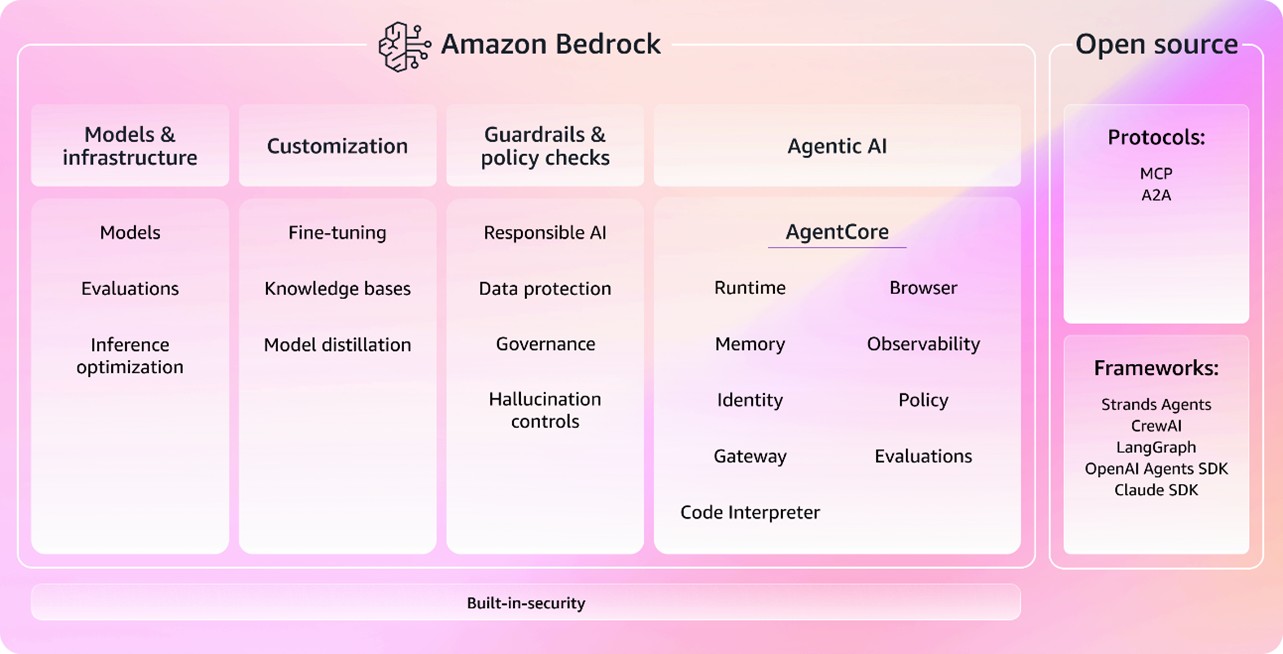 Source: AWS
Key Features of Amazon Bedrock
Let’s break down the key features powering AWS Bedrock:1. Access to Foundation Models
Amazon Bedrock offers ready-to-use models that are pre-trained, reliable, and production-ready, and are capable of tasks like:
- • Conversational AI and chatbots
- • Image generation
- • Text generation and summarization
- • Content classification and analysis
2. Secure Model Customization
Businesses can customize foundation models using their own proprietary data—without that data ever leaving their AWS environment. This is especially critical for industries, such as finance, healthcare, and government, where data governance and compliance matter.
3. Serverless Infrastructure
As Bedrock is completely serverless, there is no need to provision, manage, or scale infrastructure. Applications can also start small and scale instantly with demand, thereby making them ideal for both startups and large enterprises.
4. Single API Integration
Bedrock integrates seamlessly with existing AWS services and enterprise systems via a single API. This feature simplifies development and speeds up time-to-market.
5. Model Playground
AWS provides a Bedrock Playground, a visual interface where users can experiment with text, image, and chat models before deploying them into applications, making it helpful for teams evaluating use cases or testing outputs.
Top Benefits of Choosing Amazon Bedrock for Your Business
Amazon Bedrock stands out because it makes generative AI practical, not just impressive. Here are the top benefits organizations gain by adopting Amazon Bedrock:
Access AI Faster
Teams can start building generative AI applications without deep machine learning expertise, as it removes technical barriers.
Increased Efficiency
Businesses can prototype and deploy solutions faster, thereby accelerating innovation cycles instead of spending months building models from scratch.
Affordable AI Implementation
The cost of building AI capabilities can be significantly reduced by using pre-trained models, especially when compared to developing custom models.
Built for Scale
Bedrock supports enterprise-scale workloads while maintaining performance and reliability powered by AWS infrastructure.
Flexible Across Use Cases
From customer engagement to analytics and creative design, Bedrock supports a wide range of business needs on a single platform.
Real-World Use Cases for Amazon Bedrock
As you are now familiar with Amazon Bedrock, let’s understand how your business is going to benefit through some real-life use cases of Bedrock:
1. Customer Service Automation
Businesses can build AI-powered chatbots to handle order tracking, FAQs, and troubleshooting. It reduces response time, improves customer experience, and allows support teams to focus on complex issues.
2. Marketing and Content Creation
Marketing teams can generate blog drafts, social media copy, email campaigns, and product descriptions more quickly, freeing up time for strategy and creativity.
3. Product and Experience Personalization
Bedrock-powered applications can deliver personalized product recommendations and content, increasing engagement and conversion rates by analyzing customer behavior.
4. Analytics and Business Insights
Amazon Bedrock can summarize complex datasets, generate executive summaries, and highlight trends, making data easier to interpret for leadership teams.
5. Design and Creative Workflows
Design teams can use generative AI for image creation, branding concepts, and campaign visuals, speeding up ideation and iteration without replacing creative control.
Summing Up
If you are looking to move beyond experimentation and into real-world AI impact, Amazon Bedrock offers a practical, future-ready foundation. It can support you by providing:
- • Enterprise-grade security and compliance
- • Rapid deployment for competitive markets
- • Scalable solutions without operational complexity
For a free demo, connect with us: https://beinex.com/beinex-amazon-web-services/
Generative AI is increasingly becoming a practical business tool rather than just an experiment, used in customer interactions, marketing, decision-making, and design. At the core of this transition is Amazon Bedrock, Amazon Web Services’ managed service that enables organizations to build, customize, and scale generative AI applications using a single API (Application Programming Interface) without dealing with infrastructure complexity.
This article explains Amazon Bedrock’s features, benefits, and use cases.
This article explains Amazon Bedrock’s features, benefits, and use cases.
Related Articles

Measuring Data Culture Maturity: How to Evaluate and Maximize the Benefits of a Mature Data Culture
What is the Data Culture Maturity Model?
The Data Culture Maturity Model by Alation is a framework designed to guide organizations through various levels of data proficiency. It categorizes data culture maturity into distinct stages, allowing organizations to understand their current position, set achievable goals, and implement strategies to progress further. This model addresses data discovery, data governance, data literacy, and data leadership elements that collectively foster a robust data culture. Each phase in the model encourages organizations to embed data at the core of their operations, transforming it into a valuable resource for decision-making and competitive advantage.
Why is Data Culture Maturity Important?
Data culture maturity is crucial for leaders who recognize that a data-driven approach can be a differentiator in today's competitive market. For CDOs, CIOs, BI professionals, and business leaders, fostering a mature data culture means establishing a strong foundation for data-enabled innovation and agile decision-making. As data culture evolves, organizations can explore the benefits of data self-service, increase trust in data, and leverage data literacy to make decisions backed by concrete insights.
Empowering a Data Culture: Key Tenets
The Alation Data Culture Maturity Model comprises four core tenets that organizations should focus on to elevate their data culture: Data Search & Discovery, Data Governance, Data Literacy, and Data Leadership. Let’s explore each tenet and its role in building a mature data culture.
1. Data Search & Discovery
Data Search & Discovery is the foundation of any data culture. It focuses on enabling users to quickly and easily find, understand, and trust the data they need. Organizations with mature data search capabilities invest in technologies like data catalogs, which streamline data search through features like intuitive search, contextual data, and cross-platform integration. These tools reduce the time users spend searching for data, empowering analysts to focus on value-added tasks instead of answering repetitive data queries. Alation pioneered the data catalog concept, which has evolved into a comprehensive data intelligence platform. The modern data catalog supports not only data search and discovery but also functions like data governance and cloud migration. These capabilities create a data culture that encourages self-service and fosters a deeper understanding of the data available to all employees. Measuring Value: Data search maturity can be measured by the time saved on data searches, the frequency of data queries, and the volume of self-service analytics. Organizations can leverage these metrics to assess their return on investment (ROI) and the efficiency of their data catalog.2. Data Governance
Data Governance establishes the rules and policies that ensure data is managed responsibly and is readily accessible and secure. In a mature data culture, governance extends beyond compliance, enhancing data search and data literacy. Organizations with strong governance frameworks reduce the risk of regulatory fines, establish data trustworthiness, and improve data quality. Defining Data Governance: Data governance can be seen as the “authority and control” over data assets. This entails organizing policies, procedures, roles, and responsibilities to align with the company’s data goals. Alation emphasizes that governance must go beyond traditional definitions to include active governance, which fosters collaboration, defines common data language, and establishes shared processes. Measuring Value: Effective governance can be measured by the percentage of data assets that meet governance standards, the number of governance-related issues resolved, and regulatory compliance rates. This not only assures data quality but builds trust in data for decision-making.3. Data Literacy
Data Literacy is about ensuring that individuals at all levels can read, work with, analyze, and argue with data. This element focuses on equipping employees with the skills to understand and utilize data effectively, bridging the gap between raw data and actionable insights. Building data literacy involves training, creating a framework for collaboration, and promoting data-driven thinking. Building Data Literacy: Successful data literacy programs generally follow a step-by-step approach, starting with assessments, followed by targeted training, and promoting an internal culture of data use. Organizations can embed literacy initiatives in data catalogs, where employees can access learning resources, engage in discussions, and collaborate with subject-matter experts. Measuring Value: Data literacy maturity can be assessed by monitoring the percentage of catalog contributions from a broad base of users, showing a shift from “gut-based” to data-driven decision-making. Additionally, organizations can track the frequency of cross-departmental data collaborations as an indicator of a well-integrated data culture.4. Data Leadership
Data Leadership is the most vital element, acting as the catalyst that drives data culture maturity forward. Effective data leaders champion data initiatives, implement change management programs, and consistently highlight the connection between data and business outcomes. They focus on aligning data objectives with strategic goals, ensuring that data initiatives generate tangible business value. The Role of Data Leadership: Mature data leaders embed data in strategic planning, empower departments to utilize data in decision-making, and foster a data-driven mindset throughout the organization. They work to make data initiatives visible, promoting metrics and KPIs that reflect the value added by data maturity. Measuring Value: Organizations can measure data leadership through the number of data stewards and subject matter experts identified, the impact of data on key business outcomes, and the frequency of data-driven initiatives across departments. When leadership drives data culture, the organization benefits from enhanced innovation, agility, and competitive advantage.Articulating Business Value Through Data Maturity
One of the primary objectives of the Data Culture Maturity Model is to showcase how advanced data culture drives business outcomes. To demonstrate this, data leaders can tie maturity metrics to specific business cases, such as self-service analytics, regulatory compliance, and data democratization.
Self-Service Analytics
In organizations with high data culture maturity, self-service analytics is a practical application. With accessible data catalogs and robust data literacy programs, employees can independently search, analyze, and interpret data. This capability speeds up decision-making and fosters a sense of ownership in data-driven outcomes. Measuring Success: Key metrics include time saved in data discovery, the reuse of existing data reports, and improved analytics turnaround. Organizations with a mature self-service model also report a higher degree of cross-departmental data sharing, indicating a well-established data culture.Active Data Governance
Active data governance ensures that data is handled in a structured and compliant manner. This framework allows organizations to confidently share data, meet regulatory standards, and promote accountability. Cataloging data assets facilitates governance, giving leaders insight into who accesses data, where it’s used, and how it complies with policies. Measuring Success: Metrics such as compliance rates, the reduction of data-related risks, and the number of governance-compliant assets serve as valuable indicators. Strong governance fosters trust in data, enhancing organizational agility and data-driven decision-making.Cloud Data Migration
Cloud data migration initiatives also benefit from a mature data culture. When data is cataloged and governed effectively, migrating to the cloud becomes a streamlined process. Migrating to cloud-based platforms not only reduces infrastructure costs but enables scalable data access and faster analytics. Measuring Success: Metrics to gauge the success of cloud migration include the speed of migration, the reduction in storage costs, and the increased accessibility of data post-migration. A data-mature organization can better leverage cloud capabilities for innovation and resilience.Conclusion: Tying It All Together
The Alation Data Culture Maturity Model provides a comprehensive framework for organizations looking to elevate their data culture. By focusing on data search & discovery, governance, literacy, and leadership, companies can foster a data-centric environment where data is trusted, accessible, and utilized effectively. Measuring the maturity of these components helps organizations quantify their data culture and demonstrate the business value added at each stage. In partnership with Alation, Beinex delivers comprehensive data governance solutions that enhance discoverability, enforce robust access controls, and streamline data auditing processes. By leveraging Alation's industry-leading data intelligence platform, Beinex helps organizations optimize their data strategies, driving business growth and operational efficiency. Connect with us for the transformation you seek: https://beinex.com/data-governance/

Tableau AI and Tableau Pulse: Tableau's Dynamic Duo
Enter Tableau AI—the next evolutionary leap, simplifying data analysis to the point of asking a question. Powered by Einstein, Salesforce's AI, Tableau AI heralds a new frontier in effortless data exploration. Alongside this innovation comes Tableau Pulse, revolutionizing the data experience for all users within your organization, irrespective of their familiarity with data analytics.
Tableau AI
Tableau AI stands as a groundbreaking innovation, harnessing the advanced capabilities of generative AI to revolutionize and democratize the data analysis process. This next evolution of Tableau is grounded in the trusted and ethical foundations of Einstein, ensuring its reliability and safety for all users.
The true power of Tableau AI lies in its capacity to elevate every facet of the Tableau platform, driving performance, efficiency, and scalability to new heights.
Tableau AI empowers data analysts by automating analysis, preparation, and governance processes. It streamlines workflows, reduces technical barriers, and eliminates repetitive tasks. Using AI, it facilitates natural language calculations, suggests suitable visualizations, and generates data source descriptions.
Focused on aiding decision-making, Tableau AI distills meaningful insights from datasets, presenting them in plain language. It anticipates follow-up questions and helps break down data silos for effortless access to vital insights. Its conversational interface swiftly delivers essential insights, designed for both experts and non-experts in data analysis.
Tableau Pulse
Tableau Pulse introduces a transformative era in data interaction, making analytics accessible to everyone. Enabled by Tableau AI, this reimagined data experience is tailored for analytics consumers, delivering smart, personalized, and contextual insights seamlessly integrated into their workflow. It's a paradigm shift empowering every employee with the tools to make data-driven decisions effortlessly.
This evolution reshapes how individuals connect with data, fostering deeper, more meaningful engagements. Its goal? To elevate the entire organization, transcending the limitations of the 29% currently leveraging data for decision-making. Tableau Pulse is a game-changer, especially benefiting those pressed for time, seeking instant access to data for swift decisions, and desiring a deeper comprehension of the 'why' behind data, not just the 'how' and 'what.'
Experience the future of data interaction with Tableau Pulse, where insights become an inherent part of everyday workflows, empowering individuals across the organization to harness the full potential of their data effortlessly.
Streamline Your Focus with Metrics that Matter
Businesses grapple with vast volumes of information, often presenting reports in a standardized manner to accommodate entire teams. While this aids time-strapped analysts by minimizing the need for bespoke reports, it leaves end-users sifting through data to locate their relevant metrics—an arduous and time-consuming task.
Tableau Pulse revolutionizes this paradigm by seamlessly delivering personalized data summaries directly within your workflow. It introduces an intuitive, customized metrics homepage, allowing you to curate metrics aligned with your specific requirements. Say goodbye to the cumbersome process of filtering through multiple dashboards to find pertinent figures.
At the start of this example, Tableau Pulse presents a select set of metrics fitted to this specific user's focus.
These metrics are curated based on recent data trends identified by Tableau AI:
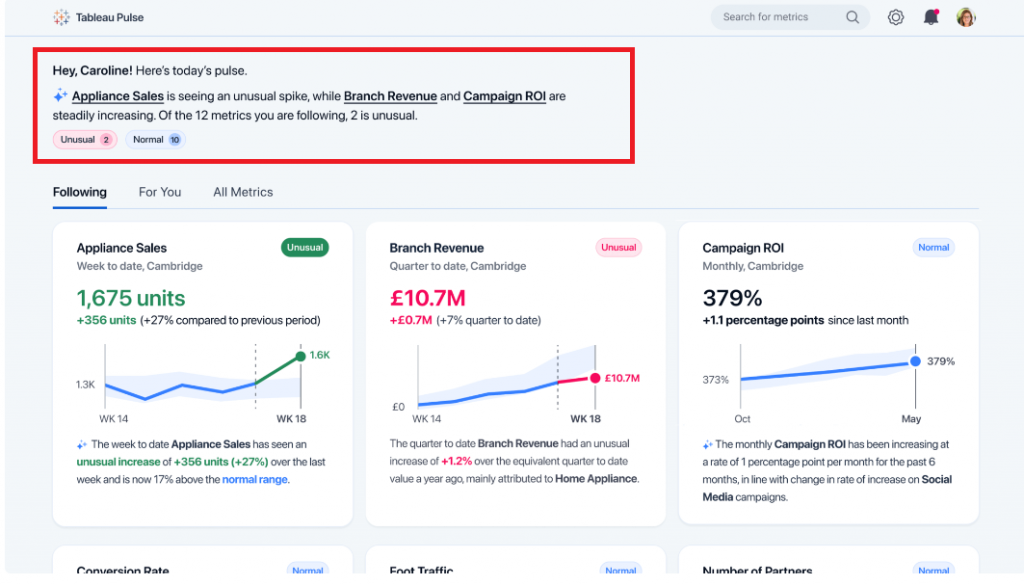 Source: https://www.tableau.com/blog/tableau-pulse-and-tableau-ai
Towards the bottom of this example, Tableau Pulse showcases the KPIs that this user has actively tracked. Within this section, Tableau Pulse provides the most recent metric value, a brief visual representation of the trend, and an AI-generated insight specifically pertaining to that metric:
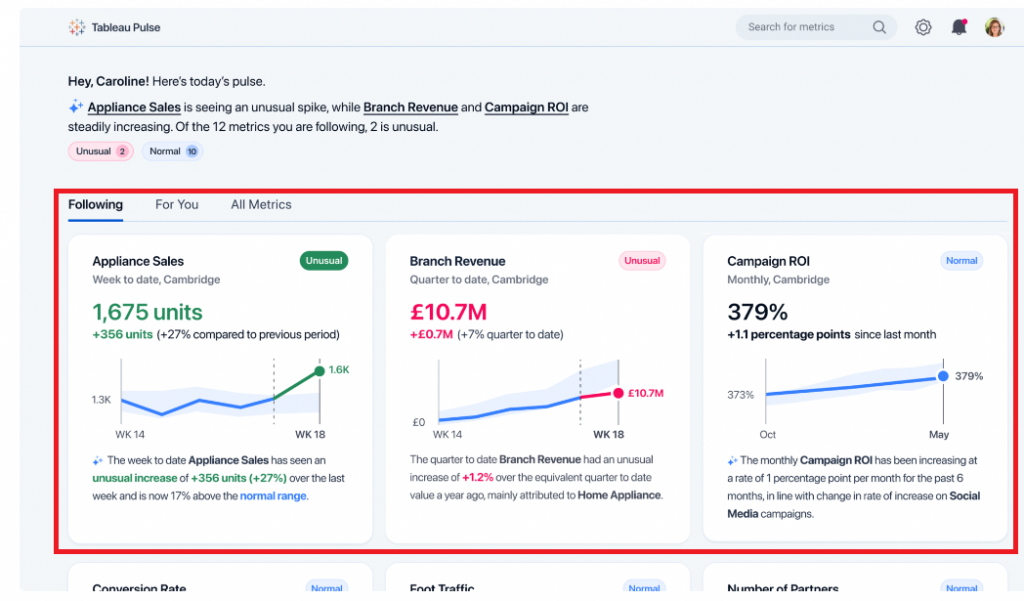 Source: https://www.tableau.com/blog/tableau-pulse-and-tableau-ai
Embed Relevant Data into Your Workflow
These days, professionals juggle various applications, which poses a challenge when tracking crucial KPIs. The continual shift between disparate tools not only consumes time but also disrupts workflow continuity.
Tableau Pulse heralds a transformative shift by integrating pertinent data directly into users' existing tools. This breakthrough ensures data detachment from specific dashboards, guaranteeing access to essential metrics without workflow interruptions. Insights are seamlessly captured within the tools where users spend the most time, eradicating the risk of missing critical information due to platform discrepancies. Additionally, this integration streamlines the scalability of insights across the organization, simplifying the process of visualizing, sharing, and collaborating on data by utilizing tools already familiar to everyone within the company.

Effortless Data Interpretation
Today's data interpretation can often entail a laborious and manual process. Users invest significant time analyzing data to unveil trends and insights while navigating the labyrinth of questions to pose to their datasets. This complexity invariably impedes decision-making speed and hampers overall productivity.
Tableau Pulse redefines data utilization by automating analysis and communicating insights in easily comprehensible, natural language formats. Initially, Tableau Pulse assumes the burden of uncovering the 'why' behind the 'what.' It autonomously identifies and generates insights, predicting the queries you might raise and even suggesting questions that may not have crossed your mind. Subsequently, Tableau AI succinctly summarizes these insights conversationally. This streamlined approach facilitates faster, informed decision-making, eliminating the need for extensive manual data analysis.
In the example below, Tableau Pulse extends its capabilities to address your data inquiries using natural language. Upon delving deeper into the "Appliance Sales" metric, Tableau Pulse was queried, "What is driving change in Appliance Sales?" In response, Tableau Pulse swiftly provided a concise answer along with a visual representation elucidating the factors influencing this change.

With the introduction of Tableau AI and Tableau Pulse, Tableau is set to revolutionize the industry once more, unveiling a fresh experience tailored for analytics consumers. This innovation aims to empower every individual to embrace a truly data-driven approach. Tableau AI and Pulse are reshaping how organizations engage with data, empowering decision-making, and fostering a more data-driven future.
A DEEP DIVE INTO TABLEAU 2019.3
TABLEAU CATALOG
What could be better than a feature that could provide better visibility and better data management at the same time, and also ensure that the right data is always used for analysis. This is possible with the new feature -Tableau Catalog.
 This feature provides a complete picture of the data and how each data is connected.
Another use of Tableau Catalog is linear and impact analysis. This not only shows which assets will change but also who will be affected by it, which makes work easier for many and avoids wastage of time.
EXPLAIN DATA
Tableau 2019.3 is up with a new Al-driven feature called the “Explain Data”, which helps people go from the “what” of the data to the “how” of it. With explain data, we can get an explanation for each unexpected value in the data by just a single click. On selecting the desired data point, the ‘explain data’(lightbulb) icon appears.
For each value there might be a number of explanations. Each of these explanations are checked and only the most likely ones are provided as visualizations.
This feature provides a complete picture of the data and how each data is connected.
Another use of Tableau Catalog is linear and impact analysis. This not only shows which assets will change but also who will be affected by it, which makes work easier for many and avoids wastage of time.
EXPLAIN DATA
Tableau 2019.3 is up with a new Al-driven feature called the “Explain Data”, which helps people go from the “what” of the data to the “how” of it. With explain data, we can get an explanation for each unexpected value in the data by just a single click. On selecting the desired data point, the ‘explain data’(lightbulb) icon appears.
For each value there might be a number of explanations. Each of these explanations are checked and only the most likely ones are provided as visualizations.
 Now these visualizations can be used for further explorations.
TABLEAU SERVER MANAGEMENT ADD-ON
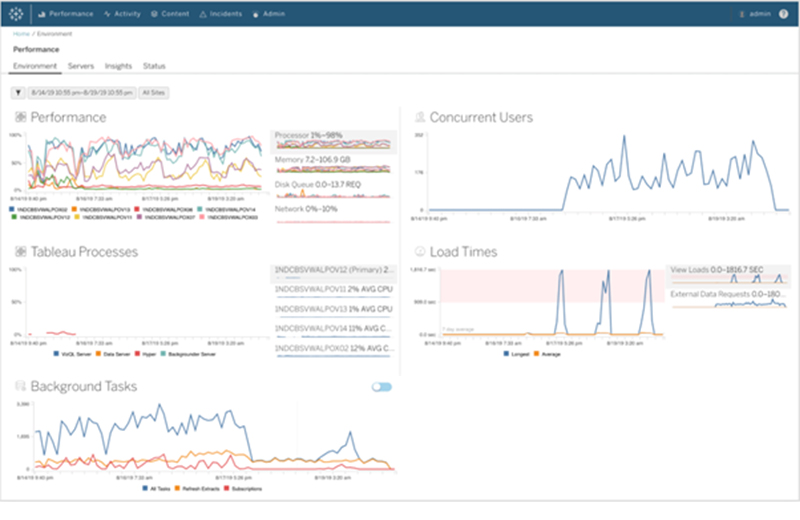
Organizations that run critical deployment of Tableau Server at a large scale, have mentioned concerns over manageability and scalability. They have been in search for tools that could organize the management process in an efficient way, which could save a lot of time. Tableau solved this problem by introducing the Tableau Server Management Add-on – a new feature designed to help organizations manage the deployment of Tableau Server. With this, they can quickly react to the changing needs of the business as well as save time by organizing the management process in the most efficient way. Tableau Server Management Add-on, which makes running the critical deployment of tableau at a large-scale server much simpler.
Now these visualizations can be used for further explorations.
TABLEAU SERVER MANAGEMENT ADD-ON
Organizations that run critical deployment of Tableau Server at a large scale, have mentioned concerns over manageability and scalability. They have been in search for tools that could organize the management process in an efficient way, which could save a lot of time. Tableau solved this problem by introducing the Tableau Server Management Add-on – a new feature designed to help organizations manage the deployment of Tableau Server. With this, they can quickly react to the changing needs of the business as well as save time by organizing the management process in the most efficient way. Tableau Server Management Add-on, which makes running the critical deployment of tableau at a large-scale server much simpler.
 The server management add-on feature can help in optimising the performance of deployment by customizing which nodes process background jobs such as extract refreshes and subscriptions and isolating these workloads, to specific nodes. This makes it easier to scale deployments to the needs of their organization.
This feature has a few tools, including two for better reliability and scalability and one for content migration, all of which helps the organizations to govern their data effectively.
If you are interested in learning more about the latest Tableau release and use cases, please contact us at training@beinex.com/ info@beinex.com and we would be happy to schedule a Tableau demo or training for you and your company.
The server management add-on feature can help in optimising the performance of deployment by customizing which nodes process background jobs such as extract refreshes and subscriptions and isolating these workloads, to specific nodes. This makes it easier to scale deployments to the needs of their organization.
This feature has a few tools, including two for better reliability and scalability and one for content migration, all of which helps the organizations to govern their data effectively.
If you are interested in learning more about the latest Tableau release and use cases, please contact us at training@beinex.com/ info@beinex.com and we would be happy to schedule a Tableau demo or training for you and your company.
This feature provides a complete picture of the data and how each data is connected.
Another use of Tableau Catalog is linear and impact analysis. This not only shows which assets will change but also who will be affected by it, which makes work easier for many and avoids wastage of time.
EXPLAIN DATA
Tableau 2019.3 is up with a new Al-driven feature called the “Explain Data”, which helps people go from the “what” of the data to the “how” of it. With explain data, we can get an explanation for each unexpected value in the data by just a single click. On selecting the desired data point, the ‘explain data’(lightbulb) icon appears.
For each value there might be a number of explanations. Each of these explanations are checked and only the most likely ones are provided as visualizations.
Now these visualizations can be used for further explorations.
TABLEAU SERVER MANAGEMENT ADD-ON
Organizations that run critical deployment of Tableau Server at a large scale, have mentioned concerns over manageability and scalability. They have been in search for tools that could organize the management process in an efficient way, which could save a lot of time. Tableau solved this problem by introducing the Tableau Server Management Add-on – a new feature designed to help organizations manage the deployment of Tableau Server. With this, they can quickly react to the changing needs of the business as well as save time by organizing the management process in the most efficient way. Tableau Server Management Add-on, which makes running the critical deployment of tableau at a large-scale server much simpler.
The server management add-on feature can help in optimising the performance of deployment by customizing which nodes process background jobs such as extract refreshes and subscriptions and isolating these workloads, to specific nodes. This makes it easier to scale deployments to the needs of their organization.
This feature has a few tools, including two for better reliability and scalability and one for content migration, all of which helps the organizations to govern their data effectively.
If you are interested in learning more about the latest Tableau release and use cases, please contact us at training@beinex.com/ info@beinex.com and we would be happy to schedule a Tableau demo or training for you and your company.
Note: The Server Management Add-on is not available for Tableau Online, as they manage everything from scaling, performance, and security on behalf of their Tableau Online customers. The Tableau Server Management Add-on can be separately purchased from the Tableau Server deployment.

Snowflake's Evolution: A Look at the New Features in 2024
1. Snowpark Container Services:
This innovative feature allows you to deploy and manage containers directly within Snowflake. Imagine leveraging secure and scalable infrastructure, similar to Kubernetes, without leaving the Snowflake environment. Use containers to build and run data products like large language models and full-stack applications. You can even utilize containers from the Snowflake marketplace or create custom ones for sharing.
Getting started is simple. Create a Docker image with your code and dependencies, push it to a Snowflake registry, and then create a service, job, or function using the Snowpark API. Snowflake handles the rest, including provisioning, scaling, and monitoring your containers.
2. Snowpark Model Registry:
Data scientists and ML engineers require a secure and efficient way to manage and deploy machine learning models. Snowpark Model Registry, currently in public preview, addresses this need by providing a native solution within Snowflake. This integrated registry allows you to register, manage, and use models and their metadata directly in the platform.
The benefits of the Snowpark Model Registry are numerous:
3. Streamlit in Snowflake for Azure:
Snowflake's commitment to platform flexibility is evident in its expansion to Azure. The general availability of Streamlit in Snowflake for Azure empowers Python developers to create data applications directly within the Snowflake environment. Streamlit simplifies the creation of interactive dashboards and data visualizations, bridging the gap between data and actionable insights for business teams.Here's how Streamlit in Snowflake for Azure benefits users:
4. Security Enhancements in Snowflake Horizon:
Security is paramount for any data platform. Snowflake Horizon takes data security to the next level with a range of enhancements:
These security enhancements within Snowflake Horizon empower organizations to meet stringent compliance requirements and safeguard their valuable data assets.
5. Snowflake Unistore:
Snowflake Unistore is a game-changer for working with both transactional and analytical data within a single platform, often referred to as Hybrid Transactional/Analytical Processing (HTAP). This feature introduces the 'hybrid' table type, supporting fast single-row operations.
Hybrid tables utilize a new row-oriented store within Snowflake, enabling functionalities typically associated with transactional data stores:
Snowflake's global services layer and query engine seamlessly manage the underlying row and column stores, allowing you to join hybrid and standard tables natively.
6. Snowflake Iceberg:
The Apache Iceberg format acts as a metadata layer for data files stored in open formats like Parquet and ORC. It enables querying this data using SQL, regardless of the specific query engine (Spark, Hive, Impala).
'Snowflake Iceberg' leverages this open format, allowing you to directly query data files stored in cloud storage services like S3 buckets. This eliminates the need to move or copy data into Snowflake while maintaining interoperability for users already working with that data location.
Snowflake Iceberg offers significant advantages over the existing external table type:
7. Document AI:
Typically, data systems struggle with unstructured data formats like PDFs. Snowflake's answer to this challenge is Document AI, a tool currently in private preview. It allows you to process any document and answer questions using natural language without requiring machine learning expertise.
Document AI draws power from Snowflake's first-party large language model (LLM) built on Applica's generative AI technology. This, combined with Snowflake's support for unstructured data (announced in June 2023), empowers you to store, query, and analyze all data types within the platform.
Document AI represents just one facet of Snowflake's vision for generative AI and LLMs, a dominant trend in 2023 that is poised to continue its dominance in 2024.
Looking Ahead
Snowflake started strongly in 2024 with exciting releases like Snowpark Model Registry, Streamlit in Snowflake for Azure, and security enhancements in Snowflake Horizon. These anticipated features position Snowflake as a frontrunner in the data cloud landscape, offering a comprehensive data management, analytics, and application development platform.
Beinex + Snowflake Partnership
Beinex is a Snowflake Services Partner Premier Tier, and the partnership reaffirms Beinex’s commitment to delivering exceptional data solutions and positions the company at the forefront of industry advancements. Harnessing the true potential of the data, partnership drives innovation and success in the digital era. Belonging to Snowflake Services Partner Premier Tier, Beinex leverages Snowflake’s advanced capabilities and seamlessly integrates them into its comprehensive data solutions.

Grow Your Business with Competitive Intelligence (CI)
What is Competitive Intelligence (CI)?
Competitive Intelligence (CI) is a systematic process for gathering, analyzing, and applying information about the competitive landscape in which a business operates. It equips organizations with valuable insights, helping them make strategic decisions, mitigate risks, and gain a competitive edge.
Competitive Intelligence services play a vital role in helping businesses gain a strategic advantage through the smart utilization of data and information. By gathering, analyzing, and applying information about the competitive landscape, CI equips organizations with valuable insights, enabling them to make data-driven decisions, mitigate risks, and ultimately outperform their competitors.
To learn more about the benefits of Competitive Intelligence, click here
Why Competitive Intelligence (CI) Matters in Business
In today's fast-paced business world, staying ahead is crucial, and Competitive Intelligence services can be the game-changer your business needs. Here's why Competitive Intelligence matters:
Informed Decision-Making
In the modern business landscape, decisions need to be grounded in data, not guesswork. CI services equip decision-makers with valuable insights that help them make well-informed choices. By analyzing competitor behavior, market trends, and consumer preferences, businesses can develop strategies that are not based on hunches but on hard evidence.
For example, consider a scenario where a tech startup is contemplating the launch of a new product. CI can provide insights into the competitive landscape, revealing what similar products are in development, their features, and their projected market reception. Armed with this data, the startup can make crucial decisions about product design, pricing, and marketing with a higher degree of certainty.
Anticipating Market Changes
The business world is in a constant state of flux. Markets evolve, consumer preferences shift, and disruptive technologies emerge. In this environment, businesses that can anticipate and adapt to change gain a significant advantage. CI allows organizations to do just that.
By monitoring industry trends, tracking competitor movements, and analyzing consumer behavior, businesses can identify early indicators of change. This insight provides a head start in adjusting strategies, launching new products, and capitalizing on emerging opportunities. It's the difference between reacting to change and proactively shaping the market.
For instance, an established retail chain with a robust CI process may spot the growing consumer interest in sustainable and eco-friendly products. Armed with this knowledge, the chain can pivot its product selection and marketing to cater to this demand, staying ahead of competitors who are slower to adapt.
Outsmarting the Rivals
Competition in business is not just a matter of survival; it's a race to outperform rivals. In this race, CI is the secret weapon that enables organizations to outmaneuver their competitors.
By gaining insights into competitors' strategies, strengths, and weaknesses, businesses can develop tactics to gain an edge. For example, a restaurant chain can analyze a competitor's menu changes, pricing strategies, and customer reviews to refine its own offerings and marketing approach. This allows for not only maintaining market share but also expanding it.
Moreover, CI is not just about reacting to competitors; it's also about predicting their moves. By understanding the future direction of the market and the strategies competitors are likely to employ, businesses can position themselves strategically. This foresight is a cornerstone of successful long-term planning.
Examples of Competitive Intelligence (CI) in Action
Competitive Intelligence services are used in various business aspects:
Market Research: Imagine a tech company that monitors competitors' product launches, pricing strategies, and customer reviews to refine its own offerings.
Competitor Analysis:A restaurant chain may analyze its competitors' menu changes, customer reviews, and marketing strategies to refine its own offerings.
Supplier and Vendor Insights:By employing CI, companies can assess their suppliers' performance, ensuring a streamlined supply chain.
Types of Competitive Intelligence
CI comes in various flavors, each with its own focus and strategic horizon:
Tactical CI:This short-term focus involves addressing immediate competitive threats and challenges. For example, a retailer may use tactical CI to respond to a competitor's sudden price drop.
Strategic CI:With a long-term view, strategic CI aims to identify trends, market shifts, and opportunities. An example is a global tech corporation analyzing market trends to position itself as a leader in a specific technology sector.
Product CI: This type focuses on tracking competitors' product development and launches, ensuring companies are aware of what's in the pipeline and can adjust their product roadmaps accordingly.
Pricing CI:It involves tracking competitors' pricing strategies and understanding how they position themselves in the market. Companies can then make informed pricing decisions.
The Role of Competitive Intelligence (CI) in Marketing
Incorporating CI into your marketing strategy is a game-changer. It allows you to align your marketing efforts with the competitive landscape and customer preferences, optimizing your strategies for success. Here's how to do it:
CI is more than a buzzword; it's a strategic imperative for businesses. By incorporating CI into your strategies, you can gain a competitive edge, make data-driven decisions, and secure your position in the market. Whether through market research, competitor analysis, or innovative marketing strategies, CI can be the key to success in today's fast-paced business world.
How Beinex Can Help You
Robust Competitive Intelligence is essential in strategising for your next move, enabling you to anticipate your competitors’ direction and future performance. Our data harvesting team validates the entire data manually before the CI application consumes it. Our clients can easily integrate our CI database with their actual transactional data.
Efficient, Competitive Intelligence analysis can give a significant boost to your strategy. Beinex provides comprehensive competitive intelligence solutions that help businesses gain a competitive edge in their industry. Supercharge your competitive strategy with Beinex!