How AI Decision-Making is Improving Enterprise Outcomes
Blog
Share 
Alteryx and Generative AI: The Alteryx Approach
 29 October 2024
  Sumi S
 1. Generative AI Features in Existing Products
Alteryx is proactively identifying areas where GenAI can improve the productivity and efficiency of its customers. These innovations are integrated into existing tools, such as Alteryx Designer, to streamline processes, automate routine tasks, and enhance the overall analytics experience. For example: OpenAI Connector: Users can now integrate GenAI directly into Alteryx Designer workflows to streamline communication and share data more effectively. AI-Generated Workflow Summaries: These summaries automate documentation processes, helping users enhance governance and auditability.
2. Enterprise-Ready Generative AI Platform
Alteryx’s GenAI platform enables businesses to create, train, and deploy custom AI models that operate securely within their organizational firewall. This approach ensures that data privacy and security are maintained while offering organizations the flexibility to tailor AI models to specific business needs. Alteryx also provides an environment for creating proprietary models that are customized to fit each organization’s workflows, making it easier to integrate AI-driven analytics into everyday operations.
3. New GenAI Applications and Interfaces
Data analytics is a collaborative process that involves various stakeholders, including analysts, data scientists, engineers, and knowledge workers. With Alteryx, these roles can now collaborate in real time through multi-modal analytics powered by GenAI. The flexibility to use different analytical tools—like SQL, Python, notebooks, or Alteryx workflows—opens doors for more seamless collaboration across different teams. GenAI applications like Magic Documents allow Alteryx users to automatically generate insight-rich reports in just a few clicks, drastically reducing time-to-insights and increasing productivity across business functions.
Introducing Alteryx AiDIN
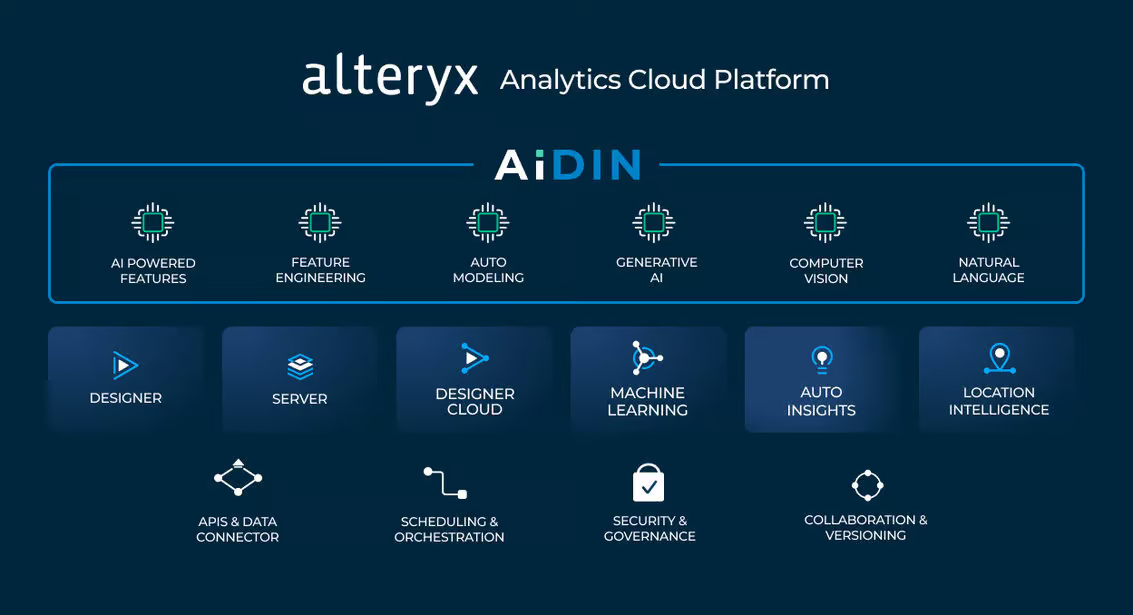
AiDIN is Alteryx's umbrella for all AI-related capabilities, combining existing AI features with cutting-edge GenAI innovations. Alteryx AiDIN enables users to leverage advanced AI models for analytics, whether it's extracting insights, automating tasks, or generating complex reports. Some of the key benefits include:
• Improved Time-to-Value: AiDIN accelerates the time it takes to derive insights from data, enabling quick decision-making for critical business tasks.
• Increased Operational Efficiency: By automating repetitive tasks, AiDIN frees up time for users to focus on higher-value activities.
• Enhanced Governance: Alteryx AiDIN ensures that AI capabilities meet stringent enterprise-grade governance and security standards.
 Source: https://www.alteryx.com/blog/alteryx-announces-generative-ai-capabilities
Data Security and Trust: The Alteryx AiDIN Commitment
A key concern in any AI-driven platform is data security and the integrity of AI-generated outputs. Alteryx AiDIN prioritizes these through: 1. Mitigating Hallucinations In generative AI, "hallucinations" refer to scenarios where AI models produce plausible but incorrect information. Alteryx has implemented stringent quality checks and continuous feedback mechanisms to minimize these errors. This ensures that businesses can rely on the outputs generated by AiDIN for decision-making. 2. Fact-Checking Mechanisms Alteryx AiDIN integrates fact-checking tools to verify AI-generated insights against actual source data. This added layer of validation helps organizations maintain the accuracy and reliability of their analyses. 3. Data Privacy and Security Alteryx ensures that data privacy is maintained at all stages of the AI process. AiDIN offers two key deployment options: Private Data Handling and SaaS. Both options provide robust encryption and ensure that sensitive data is securely managed within a customer’s ecosystem, giving businesses peace of mind as they adopt AI.
The Future of AI-Driven Analytics
The integration of GenAI into the Alteryx platform paves the way for smarter, more accessible analytics. With capabilities like OpenAI integration, Magic Documents, and enterprise-level model customization, Alteryx is enabling organizations to maximize the value of their data, improve efficiency, and foster a more collaborative analytics environment. By combining GenAI’s potential with trusted, secure analytics, Alteryx is redefining how enterprises interact with data—delivering faster insights and more impactful results across industries. Get in touch with us for a free demo: https://www.alteryx.com/designer-trial/free-30-days?
Generative AI (GenAI), the most groundbreaking technological advancement in recent years, offers transformative possibilities in data analytics. Alteryx, a leading player in analytics, is a forerunner in embracing GenAI to push the boundaries of enterprise analytics by incorporating these innovations into its platform. By doing so, Alteryx enhances the way organizations perform data analysis, ensuring customers experience seamless, AI-powered improvements.
At the heart of this transformation is Alteryx AiDIN, Alteryx's AI engine. AiDIN is a comprehensive set of AI and machine learning (ML) features that power Alteryx's analytics platform. The Alteryx approach to GenAI is guided by three strategic pillars, ensuring that generative AI capabilities are seamlessly embedded into their platform.
Related Articles
DATA MONETIZATION USING SNOWFLAKE
Most of the companies operating today are data-driven as they have started identifying the value of data. The value of data and data marketplaces are evolving with the growth of big data and data requirements of companies.
Understand your Data Offerings - What types of data or data services are you producing that would be valuable to other organizations?
Decide How to Price Data Products - What should be the pricing strategy followed, and how easy would it be to put into action?
Know About Data Sharing Methods - Which distribution channel should be selected for data sharing that adheres to GDPR and data governance policies?
Once you have decided on the data offerings and priced the data products, the key to successfully monetize your data is by sharing the data with the clients/ prospects. The customers and business partners would be eager to get data from you, especially if you can make the process easy and secure. Traditional data sharing technologies often use FTP, Cloud Storage, or API. These methods generally do have few disadvantages.
Data Marketplace
In simple terms, these are online marketplaces where we can buy and sell data of any sort. Data marketplaces offer several kinds of data from a wide range of different data sources. These data include Business Intelligence, demographics, research, and marketing data. Data types are structured and offered to clients by data providers. Providing buyers with more choice of high-quality data generates more engagement and encourages fair pricing between the sellers. Every company has the potential to earn revenue from the information it generates. In a recent study of more than 400 organizations, only 1 in 12 were monetizing their data to its fullest extent. Modern data monetization strategies can help you open brand new revenue streams. There are 3 key steps to monetize your data and drive new revenue streams.- Storage costs for both vendors and buyers
- ETL costs and effort
- Security vulnerabilities
- Service and support costs
- Latency and potential errors leading to poor customer experience
Snowflake & Data Monetization
Snowflake is an analytic data warehouse provided as Software-as-a-Service (SaaS). It provides a data warehouse that is faster, easier to use, and far more flexible than traditional data warehouse offerings. Snowflake allows companies to easily publish a variety of data sets that become immediately available for use or purchase for clients. Snowflake Data Exchange, a modern data sharing method, reduces the time to market and significantly influences customer success. Data Exchange is your own data hub for securely collaborating around data between a selected group of members that you invite. It enables providers to publish data that can then be discovered by consumers. The benefits of Snowflake Data Exchange over Traditional Data sharing Methods are:- Secure Data Sharing
- Exchange data within your organization between different business units. Collaborate with external parties such as vendors, suppliers, partners, and customers.
- Reduce Time to Market
- Break down data silos and reduce time to market.
- Interchange data with third-party vendors to help augment internal datasets.
- Break down data silos by scaling multiple data sets from different sources within your organization.
- Find and consume data on other Data Exchanges to get business insights.
- Speed of Processing
- Snowflake’s multi-cluster shared data architecture is designed to process enormous quantities of data with maximum speed and efficiency.
- All data processing horsepower within Snowflake is performed by one or more clusters of computing resources.
- Data is cached locally within computing resources, along with the caching of query results, to improve the performance of future queries.
- Cost Benefits
- The costs for sharing data with Snowflake are minimal and straightforward.
- Simply pay for the data you store, i.e., you only pay for what you use.
- Reduce extract, transform, load (ETL), and data pipeline maintenance costs.
- Control and Govern Access
- Managing membership
- Granting and revoking access to data through standard and personalized listings
- Auditing data usage
- Applying security controls to your data
Real-life Implementation
A famous telecom organization in Europe was sitting on large silos of data that they could not monetize properly because of the complex architecture of the data warehouse operations and data security challenges involved in the data sharing process. The company has Customer Daily Records (CDR) of its subscribers that contains location data of the users. This data can be used to identify the places people visit and help with building consumer profiles. The gathered data allows advertisers to target messages to specific users while tracking whether they visited a retail store after seeing a mobile ad. This helps them plan personalized marketing strategies and business goals based on demography profiles for targeted users. However, due to the data privacy policies of the European Union like GDPR, organizations were struggling to share data with their potential clients. The GDPR policy makes it mandatory for organizations to ensure that the customer's personal information is not shared with third parties without the customer's consent and involves hefty fines and penalties for the data breach. Even the data sharing process was a source of concern as the data was often shared in text/excel files because of the different database architecture of the clients. With growing data privacy concerns and challenges in creating datasets adhering to the GDPR policies, organizations are strictly asked not to share customer data with third parties. The current system architecture forced the organizations to employ a large number of resources to extract the data from the database system and ensure that customer data is not compromised at any point. The companies were evaluating the possibilities of a potential system that would help them monetize the data they currently hold. The introduction of Snowflake into the organizational architecture solved the data monetization problem and improved the overall data culture in the organization. The unique architecture of Snowflake separates the data storage and computation layer to enhance organizational productivity. The pay as you use policy of the Snowflake and the zero maintenance of infrastructure helped the organization phase out the complex on-premise solutions required to handle the huge data volume. Easy connectivity with the existing solutions used for data analytics practice and on the fly scalability of the computation layer helped the organization increase productivity. It also paves the way for seamless integration to the organization's architecture. The Data Marketplace of Snowflake ensured secure data sharing with third parties adhering to the GDPR policies. The in-built data security policies and features minimize the role of organizations to provide data privacy as well. This enables the organizations to make only those data points visible to end-users that they seemed apt for sharing. It also ensures that the data always resides in the organizational Snowflake database rather than on third-party databases. Moreover, the organizations could reach out to thousands of potential clients through Snowflake Data Marketplace without relying on any intermediatory sources. All this ultimately brings out the scope of using the existing data to drive revenue to the organization and highlights the importance of having a complete environment like Snowflake to capture, preserve, access, and transform data. Authors: Rahul Vijayan, Firdous Maqbool
Top 3 Advanced Analytics Techniques to Gather Consumer Behavioural Insights
When you gather consumer insights, you will learn about how your prospects interact with your marketing platforms, sales team, support personnel, and product. Your team is equipped with this crucial information, so you can make informed judgements about the efforts they should be making.
The environment of analytics, business intelligence (BI), and data science is changing at an accelerated rate due to increased consumerization of analytics technology and the demand for communities. The introduction of tools like UPI has effectively integrated small and medium-sized businesses into the financial system. The ability to prove creditworthiness through payments placed straight into current accounts has increased for firms.
The goal of marketing has always been to influence consumers. The core purpose of marketing is to alter behaviour, whether it be to encourage the purchase of a new product or merely to increase brand recognition in a crowded marketplace. Therefore, it makes sense for your marketing measurement plan to be centred on the behaviours that bring in money for your company. You can improve the return on investment of your marketing spend by better understanding your market by researching important customer behaviours. The understanding that analysis needs to be more focused on marketing indicators rather than the conventional web metrics like site visits, time on site, bounce rate, etc. that we've grown so accustomed to has also matured along with digital analytics.
It goes without saying that as consumers are exposed to more online and physical marketing channels across more devices, the complexity of tracking keeps growing. But it's critical to keep up with the most recent trends and statistics. The advantages are many. It helps to achieve a more precise understanding of the ways media platforms and devices affect behaviour and financial outcomes. A comprehensive view of how various channels interact and function within your media mix and at various phases of the funnel can also be achieved. Finally, the accumulation of information for scenario modelling and budgeting to enhance ROI and optimise the media mix. Although high-end enterprise clients still have access to the most sophisticated attribution analysis tools, recent acquisitions and mergers indicate that mid-market and small firms will likely use these techniques more frequently in the near future.
Any firm that wants to excel at client interaction must have real-time analytics. While businesses of all colours have been substantially investing in technologies to better understand their customers, most of them miss out on the opportunity because of outdated IT systems and deeply ingrained structures and processes. It is no longer enough to just collect client data in your CRM software without figuring out how to interpret it. A successful firm must have a sizable, devoted customer base. However, how can you build such a customer base? You must be intimately familiar with your target market to build and keep consumer loyalty. You will need consumer behaviour analytics for this to better understand them and increase sales.
The necessity to concentrate on consumers' requirements is one thing all organisations have in common. To meet the expectations of the consumer, a thorough understanding of their needs and desires is necessary. Long-term success depends on giving your team the tools they need to gather data on client behaviour. To optimise customer journeys, it is essential to gain insight into the motives and actions of customers. Start utilising customer insights for the expansion of your organisation with Advanced Analytics.
The environment of analytics, business intelligence (BI), and data science is changing at an accelerated rate due to increased consumerization of analytics technology and the demand for communities. The introduction of tools like UPI has effectively integrated small and medium-sized businesses into the financial system. The ability to prove creditworthiness through payments placed straight into current accounts has increased for firms.
The goal of marketing has always been to influence consumers. The core purpose of marketing is to alter behaviour, whether it be to encourage the purchase of a new product or merely to increase brand recognition in a crowded marketplace. Therefore, it makes sense for your marketing measurement plan to be centred on the behaviours that bring in money for your company. You can improve the return on investment of your marketing spend by better understanding your market by researching important customer behaviours. The understanding that analysis needs to be more focused on marketing indicators rather than the conventional web metrics like site visits, time on site, bounce rate, etc. that we've grown so accustomed to has also matured along with digital analytics.
The key advanced analytics techniques that help to understand consumer behaviour are enlisted below:
- Identifying Revenue-oriented Metrics and ROI
- Understanding the Importance of Multi-Channel Attribution
- User-centric Monitoring
Identifying Revenue-oriented Metrics and ROI
Understanding how user behaviour on your site translates into money for your company is a crucial point. In other words, are visitors who do particular actions on your website more likely to buy something? The majority of the time, the response is a stunning yes! You can monetize all on-site behaviours by assigning a monetary value to them, even if the behaviour does not immediately result in a sale. The first step is to identify the key customer engagement points and track customers who have taken the desired actions. From there, a simple calculation may be created to calculate the income they produce. Based on this you can calculate your ROI.Understanding the Importance of Multi-Channel Attribution
Multi-channel attribution has an important part to play here. It is the process of identifying marketing interactions in a customer journey that finally leads to conversions.It goes without saying that as consumers are exposed to more online and physical marketing channels across more devices, the complexity of tracking keeps growing. But it's critical to keep up with the most recent trends and statistics. The advantages are many. It helps to achieve a more precise understanding of the ways media platforms and devices affect behaviour and financial outcomes. A comprehensive view of how various channels interact and function within your media mix and at various phases of the funnel can also be achieved. Finally, the accumulation of information for scenario modelling and budgeting to enhance ROI and optimise the media mix. Although high-end enterprise clients still have access to the most sophisticated attribution analysis tools, recent acquisitions and mergers indicate that mid-market and small firms will likely use these techniques more frequently in the near future.
User-centric Monitoring
User's "session” starts when a person joins the website and ends when they leave; this has been the primary unit of measurement for traditional web metrics. The growth of technology and the popularity of mobile devices, have, however, given marketers, in general, a new "demand." We now want to be able to track users as they interact with our sites through different channels and analyse their behaviour as they switch between different devices. Modern analytics software is driven by the need to continuously follow individual user behaviour across sessions and devices in addition to gathering data from all these different channels and devices. Understanding these various behavioural patterns is crucial for both developers and marketers to customise messaging and user experiences across a variety of channels and devices.How to Gather Customer Insights Using Advanced Analytics
Marketing professionals all over the world are utilising analytics, which allows them to gain insights and create customised marketing messages. But, how? In what ways do data analytics and big data assist marketers in creating tailored ads based on consumer behaviour? How can you take advantage of the opportunity to make use of current data and improve consumer understanding?Any firm that wants to excel at client interaction must have real-time analytics. While businesses of all colours have been substantially investing in technologies to better understand their customers, most of them miss out on the opportunity because of outdated IT systems and deeply ingrained structures and processes. It is no longer enough to just collect client data in your CRM software without figuring out how to interpret it. A successful firm must have a sizable, devoted customer base. However, how can you build such a customer base? You must be intimately familiar with your target market to build and keep consumer loyalty. You will need consumer behaviour analytics for this to better understand them and increase sales.
The necessity to concentrate on consumers' requirements is one thing all organisations have in common. To meet the expectations of the consumer, a thorough understanding of their needs and desires is necessary. Long-term success depends on giving your team the tools they need to gather data on client behaviour. To optimise customer journeys, it is essential to gain insight into the motives and actions of customers. Start utilising customer insights for the expansion of your organisation with Advanced Analytics.
Beinex Offerings
Advanced Analytics services from Beinex explain the why and how of change in your enterprise – the top line, bottom line behaviours and everything in between, from your organisational data. Enhance efficiency and expand your market share and presence. Make the most out of Advanced Analytics by partnering with the right people. Beinex!
AWS vs AZURE vs GCP: THE LEADING CSPs FROM A COMPARATIVE LENS
Benefits of Cloud Computing
Worldwide Vendor Market Share
 Sourced from: Cloud Market Share Q2 2023: AWS, Microsoft, Google Battle | CRN
AMAZON WEB SERVICES (AWS)
Amazon Web Services is the most extensive and widely adopted cloud platform worldwide, offering over 200 fully featured services across global data centres. AWS is used by millions of customers, including fast-growing startups, major enterprises, and prominent government agencies, to reduce costs, enhance agility, and accelerate innovation.
The USPs of AWS
Popular Customers of AWS
Netflix:Netflix relies on AWS for most of its computing and storage requirements, including analytics, databases, recommendation engines, video transcoding and numerous functions utilizing over 100,000 server instances on the AWS platform.BMW Group: BMW Group leverages AWS to acquire the agility and flexibility necessary for democratizing data usage and expediting innovation.
Philips: Philips is an early adopter of AWS that utilizes AWS services to manage the Philips HealthSuite Platform, ensuring scalability, cost-effectiveness, and regulatory-compliant solutions.
Salesforce: Salesforce shares a global strategic relationship with AWS, utilizing AWS compute, storage and AI solutions to create and deploy innovative business applications.
Pinterest: The exabyte data platform of Pinterest is hosted exclusively on AWS, managing log search and analytics that surpass 1.7TB. This implementation has led to a 30% reduction in operational costs.
Coca-Cola: After its migration to AWS, Coca-Cola has reduced operational costs by 40% and IT ticket volume by 80%.
Regions & Availability
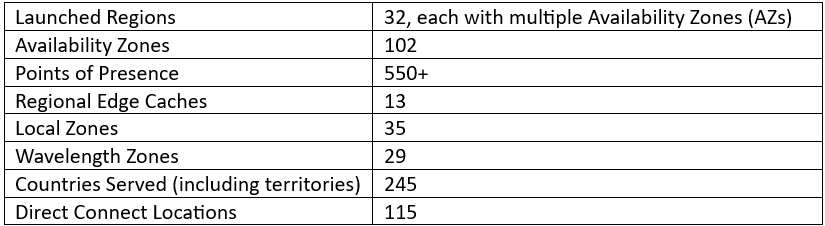
AWS boasts the most expansive global cloud infrastructure. Gartner has acknowledged the AWS Region and Availability Zone framework as the endorsed strategy for operating enterprise applications demanding high availability.
The AWS Cloud covers 102 Availability Zones across 32 geographic regions worldwide, with disclosed intentions to introduce an additional 15 Availability Zones and 5 AWS Regions in Germany, Canada, Thailand, Malaysia and New Zealand.
MICROSOFT AZURE
The Azure cloud platform encompasses over 200 products and services crafted to empower you to bring innovative solutions to fruition, addressing current challenges while shaping the future. It offers the flexibility to build, run, and manage applications across various clouds, on-premises, and at the edge, utilizing the tools and frameworks as per your preferences.
The USPs of Microsoft Azure
Popular Customers of Microsoft Azure
New York City Department of Environmental Protection (DEP): DEP uses a Microsoft infrastructure specifically designed with modern security considerations. With the solution in the cloud, Microsoft manages disaster recovery, reducing the necessity for maintaining certain skill sets in-house. CCC Group: CCC Group utilizes Azure Data Lake and Data Warehouse to collect, store, and segment data. Panasonic Connect Co: Panasonic Connect Co maximizes the benefits of PaaS services such as Azure IoT Hub, Synapse Analytics, and Azure Kubernetes Services. Hamburg Commercial Bank: Hamburg Commercial Bank opted for Microsoft Azure Virtual Desktop to achieve improved performance, reliability, and enhanced interoperability with other Microsoft technologies previously invested in. Barnsley Hospital NHS Foundation Trust: Barnsley Hospital NHS Foundation Trust adopted a new, integrated platform using Power Platform and Microsoft Teams for video consultations. During the COVID-19 pandemic lockdowns, the Trust rapidly deployed Microsoft Teams to facilitate remote work and staff collaboration.Regions & Availability:
Microsoft operates highly secure data centre facilities globally, forming a distributed infrastructure that sustains thousands of online services. This expansive, globally distributed infrastructure prioritizes sustainability, bringing applications closer to users, ensuring data residency, and providing customers with comprehensive compliance and resiliency options.
As of March 2023, Microsoft Azure boasts 160 active data centres spread across 60 regions worldwide. These Azure regions, defined by geographical areas, house one or more physical Azure data centres. Operating within a latency-defined perimeter, these data centres are strategically positioned to deliver optimal performance and security to users.
Azure leads with over 60 announced regions, surpassing all other cloud providers. It is accessible in 140 countries, showcasing a global presence that sets it apart in cloud computing.
GOOGLE CLOUD PLATFORM (GCP)
Google Cloud, also called Google Cloud Platform, offers computing resources dedicated to developing, deploying, and operating web applications. While its cloud infrastructure supports applications like Google Workplace, GCP primarily serves as a platform for constructing and managing custom applications. These applications can subsequently be published on the web, leveraging the extensive capabilities of its hyperscale data centre facilities.
The USPs of the Google Cloud Platform
Popular Customers of the Google Cloud Platform
Etsy: Utilizing the collaborative tools offered in Google Workspace, Etsy meets the evolving needs of sellers and buyers innovatively, fostering continued growth and enhancing the sustainability of its operations. X (formerly Twitter): Twitter's complete shifting of its ad analytics data platform to Google Cloud granted developers increased agility, allowing them to configure existing data pipelines more easily and build new features acceleratedly. Airbus Defence and Space: Airbus Defence and Space's Intelligence business line employs Google Cloud to construct a scalable online platform, enabling customers to access petabytes of satellite imagery in real-time.Regions & Availability
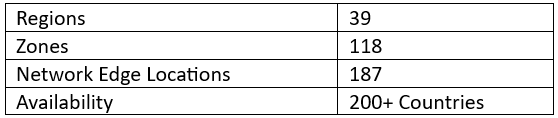
Google Cloud provides global coverage through regions distributed worldwide, ensuring low cost, minimal latency, and optimal application availability for customers.
Follow the link to have a look into a tabular comparison of the solutions provided by the CSPs: AWS, Azure and GCP. https://cloud.google.com/docs/get-started/aws-azure-gcp-service-comparison

Snowflake for Optimizing Big Data Workloads
The Snowflake data platform is built for efficiency, scalability, and ease of use. It supports unlimited Virtual Data Warehouse clusters, enabling real-time data sharing for optimal performance. Designed with simplicity, Snowflake requires minimal management or tuning and offers limited performance tuning options. The blog gives you a walkthrough of optimizing big data workloads with Snowflake and making the most of the platform to enhance performance.
Understanding Big Data
Big data is an immensely large and diverse dataset, with structured, semi-structured, and unstructured data that expands exponentially over time. Technological advances like AI, IoT, etc., stimulate the rapid proliferation of big data. Given their increasing volume, velocity, and variety, traditional data systems can't store, process, and analyze big data. In 2021, Gartner used volume, velocity, and variety to define the attributes of big data. Volume: It indicates the high volume of big data gathered from diverse sources continuously. Velocity: It is the speed at which data is collected and needs to be processed and analyzed. Variety: It refers to the diverse nature of data (structured, unstructured, and semi-structured) collected from various sources. In addition, big data can also be defined by the following: Veracity: It is about the accuracy and quality of big data, implying the potential of data to be inconsistent, unreliable, and error-prone. Variability: It indicates the inconsistency and fluctuations in data over time. Value: It is about the relevance and usefulness of the data you collect to add value to your business. However, platforms like Snowflake, AWS, and Google Cloud help businesses manage big data at a rate needed to leverage its power. The application of big data extends to advanced analytics, predictive modeling, and machine learning, enabling businesses to make informed decisions.The Benefits of Big Data
• Facilitates informed and strategic decisions by discovering patterns and insights from analyzing big data. • Helps mitigate risks better and easily with actionable insights from analyzing voluminous data • Boosts customer experiences by deriving useful insights from diverse data, enabling the comprehension, personalization, and optimization of user experience. • Gives businesses a competitive edge and enhances agility by analyzing data in real-time and expediting the further processes with data-driven insights. • Boosts efficiency by employing big data analytical tools that generate faster insights and assist in saving costs and time. • Integrates automated, real-time data streaming with advanced data analytics to continuously gather data, discover new insights and growth opportunities.Optimizing Big Data Workloads with Snowflake
Snowflake, a cloud-based data warehousing platform, offers scalable and flexible solutions for big data workloads. Here are some of the ways in which Snowflake optimizes performance when managing big data workloads. Warehouse Scaling: By configuring several warehouses based on file size and employing auto-scale capabilities, Snowflake can help stop timeouts and boost processing speed. Snowflake provides flexible scaling options (scale up and scale out) to fit your escalating data requirements. Scaling up refers to expanding the warehouse size to manage more workloads and is ideal for data workloads needing more resources. Scaling out is about adding more warehouses to enhance capacity by distributing workloads, and it is better suited to handle multiple workloads simultaneously. Snowflake also offers a warehouse of various sizes, organized into T-shirt sizes (X-Small, Small, Medium, Large, X-Large, 2X-Large, 3X-Large, 4X-Large, 5X-Large, and 6X-Large). The range of sizes makes choosing the right warehouse for your needs seamless and allows you to scale up or down as required. Besides, Snowflake's architecture enables you to decouple storage and compute resources, that is, scale your compute and storage independently while lowering costs and optimizing performance and resource utilization. Storage Optimization: The columnar storage engine of Snowflake helps optimize storage by reducing storage costs and enhancing query performance. Besides, leveraging Snowflake's automatic compression lowers storage costs and improves data transfer times. Micro-partitions are also important, allowing for efficient storage and querying of large datasets. The storage optimization faculty of Snowflake offers a powerful and flexible foundation for efficiently managing diverse data, including structured data, semi-structured data, and unstructured. It also ensures your data is accessible and never becomes a bottleneck. Snowflake has redundant data storage; it stores multiple data copies across various servers and locations, ensuring multiple workloads can run concurrently without resource contention, and your data is always available. Query Optimization: Snowflake's query acceleration features, like query result caching and materialized views, can be harnessed to boost query performance greatly. Materialized views store data physically and precompute complex queries, boosting performance. What makes it different from the traditional views is that it offers the capability to precompute data based on materialized view queries, expediting and streamlining access to complicated data. The automation and the routine refresh capabilities ensure the data is updated, eliminating the need for manual intervention. Snowflake's materialized views offer granular control over data management and scalability, simplifying the process and enhancing flexibility compared to the traditional materialized views. Also, queries can be optimized by utilizing efficient query patterns and specifying only the columns required. Techniques like Common Table Expressions help optimize joins and subqueries. Query performance can also be optimized by filtering data early, lowering operation counts, preventing unnecessary sorts, and using window functions. Data Loading Optimization: Snowflake's bulk loading capabilities, like Snowpipe and COPY INTO, enable the efficient loading of extensive datasets, optimizing data loading. Snowflake Functions and Snowflake Tasks, the transformation and processing faculties of Snowflake, run data processing and transformation during loading. Snowpipe offers scalable and serverless architecture and facilitates real-time data ingestion, processing, and integration with platforms like Kafka. With Snowpipe, you can stream data into Snowflake in real time, enabling immediate analysis and decision-making. Dynamic Tables and Streams: Dynamic Tables and Streams in Snowflake facilitate real-time data processing and analysis. Dynamic Tables make storing and managing structured and semi-structured data flexible and scalable. Streams enable real-time data ingestion and processing. By incorporating these features, Snowflake allows users to capture, process, and analyze changing data effortlessly, assisting in real-time analytics, IoT data processing, and machine learning. Resource Optimization: Right-sizing your warehouse optimizes resources by preventing over-provisioning or under-provisioning resources, ensuring the resources are sized right for the data workload. Snowflake's auto-suspend and auto-scaling features adjust warehouse size automatically based on the demand. Monitoring and optimizing resource usage by tracking resource utilization and optimizing data workload results in enhanced performance and cost efficiency. Search Optimization in Snowflake: Snowflake Search Optimization is a robust query optimization service that helps boost the performance of specific lookup and analytical queries that retrieve small subsets of data from large datasets. When enabled on a table, the search optimization service generates a Search Access Path, an additional dataset that tracks the micro-partitions where table values are stored. This mechanism significantly enhances query efficiency by minimizing the number of partitions scanned during table operations, eliminating the need to search through all partitions. Data Partitioning: To access relevant data quickly and decrease the volume of data analyzed during queries, data can be segmented based on specific criteria or keys. Managing big data workloads and large datasets in Snowflake comes with a few challenges, such as issues in query performance and data loading delays. However, effective strategies like employing Snowpipe for efficient data loading, advanced SQL techniques, and warehouse configuration for improved query performance help overcome the challenges. The advantages of using Snowflake for big data workloads include: • Seamless scaling to manage voluminous data • Attaining faster query performance and real-time insights • Streamlining data management and lowering administrative burdens • Facilitating data democratization and self-service analyticssea • Foster business growth and competitive edge through data-driven decisions. By leveraging Snowflake, businesses can optimize their big data workloads and achieve greater scalability, performance, and cost-efficiency.
Digital Twins: A Thin Line Between Reality and Virtuality
An actual representative and one fascinating example of digital transformation is the use of "digital twins," which are virtual reproductions of real-world things that have been given artificial intelligence and real-time data. The ‘thing’ can be anything under the moon, from a jet engine to a car. The physical asset's connected sensors gather data that can be transferred onto the virtual model. Now, anyone seeing the digital twin can see essential details regarding how the physical object is faring in the real world. They can, however, be interpreted in various ways, which tends to conceal their accurate, practical application.
A digital equivalent for a physical entity serves as the foundation for digital twins. Every business connection with its clients involves physical elements, from the automotive to the agricultural industries. With the help of digital twins, businesses will be able to extend the advantages of the software world to their physical assets, better meeting the needs of their digital customers.
How do digital twins get to know everything?
The digital data, twins gather from specialists with in-depth topic expertise from other similar assets, helps them learn on their own. After being created, the twins have sensors that enable it to take in any input from its physical twin. This can be used to identify potential problems, gain knowledge, gather feedback on a product, and more. Additionally, they include and use past data to polish their simulations.
The digital twin's architecture
Customarily, digital twins have three layers:
- A connectivity layer that uses SCADA, the Internet of Things, or historians
- A modelling and simulation layer may include a wide range of tools, including artificial intelligence (AI), industry simulators (thermodynamic, fluid-dynamic, chemical, and more), and AI.
- A layer for insight and visualisation that can be created online, with analytics software, or even with mixed reality
The final layer of these three is called "learning feedback," which enables the use of expert feedback and historical data to alter the behaviour of digital twins and the dependability of the physical twin.
Who stands to gain?
Digital twins can contribute to increased productivity in massive engines and intricate machinery. Like industrial settings with cooperative machine systems, digital twins are excellent in enhancing process efficiency. Those sectors that work on large-scale items or projects have the most success with digital twins. Digital twin technology has been used in Formula 1 racing to streamline the competition. Any racing or sports team could employ the digital twin to use a virtual twin in determining areas for strategy and progress.
Consider real estate as another example; a digital twin would link all systems and provide accurate insights and the capacity to evaluate the process. Managers would then be able to refine their plans, improving the structure's viability and effectiveness. Additionally, it would result in lower expenses.
Last but not least, the digital twin notion in healthcare refers to the development of computer models of diseases or even a virtual human body. Customised medications or therapies might be created using a medical twin for each patient. The following industries are going to reap the maximum benefits of digital twins:
- Engineering (systems)
- Automobile manufacturing
- Aircraft production
- Railcar design
- Building construction
- Manufacturing
- Power utilities
- Real estate
- Sports and Racing
- Healthcare
1.Enhance the user experience
Data is essential to comprehend the past, know the present, and anticipate the future. The foundation of any effective user experience programme is effective data management. Digital twins use IoT to collect real-time data from the physical environment. The information gathered is continually analysed, examined, and learned to provide valuable insights. With real-time analytics, businesses may successfully implement user-centric programs.
2.High-quality, innovative products
A competitive advantage that separates the leader from the followers is innovation. Physical asset innovation necessitates significant R&D expenditures. Design, testing, and operation require specialised knowledge due to the high cost of failures. These creative roadblocks can be solved with the help of digital twins. Enterprises can work with the user community to create high-quality offerings in a simulated environment that combines real-time information.
3.Enhance business processes
In terms of consumer annoyance, broken processes and bureaucracy would be at the top. The orchestration, knowledge management, and technological architecture are fragmented and siloed due to the complexity of modern business operations. The numerous systems and processes are brought together under one roof using digital twins, which act as a meta-layer. Digital twins are essential for knowledge management, training, and process optimisation in the complicated future. Additionally, simulations and visualisations support better process management and human learning.
4.Operative flexibility
Operational agility will affect an organisation’s top and bottom lines in a highly competitive marketplace. Black-box algorithms, the enormous amounts of information gathered, and the need for quicker judgments all work against human operators. Digital twins allow a range of diagnostic and prognostic capabilities by utilising enormous amounts of data, technology, and scenario. The human operators can re-enter the process and find strategies for being competitive and flexible.
5.Information security
Information security is a challenge that comes with all the data. Open source, collaborative learning, and knowledge sharing have never had a more compelling argument. We can't advance if data breaches are happening more frequently. Trusted stakeholders could collaborate on a platform provided by digital twins to share information and gain from it. Digital twins can also act as a layer of concealment to protect the confidentiality of the data.
6.Upgraded R&D
Utilising digital twins produces a wealth of data regarding expected performance results, facilitating more efficient product research and creation. Before beginning production, businesses can use this data to gain insights that will help them make the necessary product improvements.
7.Greater effectiveness
Digital twins can aid in monitoring and mirroring production systems even after a new product has entered production to reach and maintain peak efficiency throughout the manufacturing process.
8.Product life cycle
Digital twins can also assist producers in determining how to handle products that have reached the end of their useful lives and require final processing, such as recycling or other actions. They can decide which product materials can be gathered by utilising digital twins.
9.The Future Course
The market for digital twins is increasing, which suggests that even if they are already used in many different industries, demand will persist for a while. The need for digital twins was worth USD 3.1 billion in 2020. It may continue to snowball until at least 2026, rising to a projected USD 48.2 billion, according to specific industry observers.
According to IDC, global spending on products and services that facilitate digital transformation will amount to US$1.97 trillion in 2022, growing at a CAGR of 16.7%. Businesses are transforming the structure of their work to put the client first. Enterprises are taking more significant risks than ever in every aspect of business, from product design to marketing, sales, and even post-sales. Enterprises can use digital twins as a strategy to accomplish the goals of their initiatives for digital transformation.