How AI Decision-Making is Improving Enterprise Outcomes
Blog
Share 
Alation Data Catalog: The Key to Unlocking Effective Modern Data Governance
 14 January 2025
 Subbayya
Challenges in Data Governance
Organizations often face challenges aligning with business goals to ensure data quality, security, and visibility. Alation's Data Catalog centralized data management and enhances accessibility, helping businesses address the data governance challenges by managing data in line with the policies and standards. Some of the challenges in data governance are as follows: • Issues in Data Quality: This happens due to incorrect or insufficient data in the system, which can result in expensive errors and affect decision-making. Enterprises must follow continuous monitoring to ensure high data quality and maintain trust in data assets. • Struggling with Data Silos: For effective data governance, organizations must break down data silos as the separate storing of data across departments could hinder data accessibility and sharing, resulting in inefficiencies. • Concerns about Compliance and Security: To avoid sensitive data breaches, organizations must comply with the regulations and standards and enforce strong security measures. Ignoring the compliance requirements can result in reputational damage, legal consequences, and hefty penalties.
More About Data Catalog
A Data Catalog is a warehouse of data assets that improves comprehension, governance, discovery, use, and management of data. It helps unify extensive and intricate data ecosystems into a single hub and breaks down silos, leveraging data the right way. The centralized view of enterprise data assets provided by the data catalog allows leaders to effectively drive cross-collaboration and scale data usage. Despite being a data repository, a modern data catalog assists in making business processes more data-driven. From enhancing operational efficiency to boosting customer experience to making strategic decisions, a data catalog is equipped to make the most of the data. A data catalog facilitates business decisions by letting people locate, understand, and trust the required data. Some of the fundamental functionalities and features of a data catalog are as follows: • Managing metadata: Brings together metadata from diverse sources into a centralized platform and offers a comprehensive picture of data across your enterprise. • Automating data discovery and search: Employs advanced search capabilities (search by tags, keywords domains, natural language, etc.), AI, and ML to locate and access relevant data assets. • Ensuring data quality: Allows data customers to understand data quality and build trust in the data through documentation of quality regulations, displaying data quality metrics, and quality profiling. • Tracking data lineage: Tracks the data flow from its source to destination, mapping the critical data aspects throughout the organization during the transformation. It also includes metadata about the transformation and data assets, enabling impact analysis. • Fortifying data governance: Enables data classification to assign suitable policies for ensuring compliance with regulations.
How Alation's Data Catalog Strengthens Modern Data Governance
Companies with data catalogs are more likely to acquire and retain customers and achieve profitability than those that do not have one. The following aspects elaborate on how Alation unlocks smarter data governance with its data catalog. • Breaking down data silos and centralizing data access: The Alation Data Catalog helps businesses struggling with data silos by centralizing data access and enabling easy data discovery and retrieval from a unified platform. Centralizing facilitates collaboration between departments by eliminating barriers between them. The enhanced collaboration enables effortless sharing of data assets and insights, fostering better decision-making and collaboration. • Managing metadata: Metadata management is paramount to data governance. With Alation Data Catalog, users can access powerful metadata management capabilities to handle data regulations, relationships, and definitions effectively. It allows users to understand and gain trust and confidence in their data assets. With features like end-to-end data lineage, automated metadata harvesting, and policy enforcement, Alation ensures data accuracy, accessibility, and compliance. • Enhancing data quality through Data Profiling and Cleansing: Data quality stays crucial for any organization to ensure trustworthy analytics and reporting. The Alation Data Catalog's data profiling and cleansing tools help detect inconsistencies and inaccuracies in data, helping enterprises maintain high data quality standards. • Guaranteeing compliance and security: With the Alation Data Catalog, compliance, and security can be ensured by implementing access controls and permissions. It entails protecting sensitive and confidential information by enabling the restriction of data access based on roles. • Fortifying data security: The comprehensive audit trails and monitoring offered by the Alation data catalog are important for data security as they facilitate tracking data usage and changes over time. It also helps identify possible breaches and unauthorized access, enhancing accountability and transparency across the enterprise. • Making progress through continuous monitoring: Conducting routine audits to evaluate compliance and data quality is vital for ensuring data governance remains effective and adaptive to the dynamic requirements. Alation Data Catalog's monitoring tools offer insights into the use of data and the likelihood of serious security breaches, enabling informed decisions about policy modifications. It is important for businesses to invest in training programs for data users as they help them understand the functions of data catalog and apply the best practices. With the Alation Data Catalog, businesses can promote collaboration and maintain data integrity and safety. Alation's holistic approach to data governance builds a trustworthy and accountable culture. The Alation Data Catalog functions as a powerful enabler, equipping enterprises to thrive in a data-driven world by streamlining complex governance tasks and promoting a culture of data literacy. In partnership with Alation, Beinex equips businesses with the support to fulfill data governance requirements while streamlining implementation and saving time. Connect with us for a demo: Beinex - Beinex: Your Trusted Alation Partner in Dubai, UAE, MEA, KSA & UK for Data Intelligence
For businesses to use data correctly and handle it efficiently, it is important to have a robust and effective data governance framework. Data governance addresses key aspects of an organization, such as defining data, the accuracy level required for its use, data discovery, accessibility, and how to use it. These aspects help build the governance principles and rules, ensuring the data quality throughout its life cycle. Data governance is beyond compliance; it entails the policies, roles, processes, metrics, and standards that ensure organizational data is utilized effectively and efficiently. The modern approach to data governance involves setting a framework for data-driven decisions, from improving data quality to building the trust factor among people.
Alation, the data catalog and intelligence platform, offers a centralized framework for setting and implementing data policies, helping enterprises achieve data governance. The blog explores how Alation helps businesses boost data quality, ensure data integrity, and adhere to privacy regulations.
Related Articles
TABLEAU 2020.3 NEW FEATURES – TOP PICKS
I’ve always been a huge Tableau fan as they never fail to impress me by bringing out new exciting features in every release. Tableau has yet again released a new version after a thorough research based on people’s experience, thoughts, and comments.
As a result, Tableau 2020.3 has an exciting feature with respect to Predictive modelling functions, especially useful to advanced analytics geeks. There are so many other new features which everyone will appreciate – such as IN operator for calculations, Search improvements in data pane, Data quality warnings on Tableau Server and many more!
Here are my top picks from the list.
The IN Operator
The much-awaited feature for the SQL lovers. The IN operator is a shorthand replacement for multiple OR functions. By using IN operator, we will be able to create concise calculation fields instead of never-ending lines of ‘OR’.
Let’s look into a simple use case by assuming that I am interested to know the sales value of ‘Apple Products’ compared to all other products, then I can use IN operator to with IF statement to group the products to “Apple Product” and “Other Products”
IF [Product Name] IN (‘Apple iPhone 5′,’Apple iPhone 5C’,’Apple iPhone 5S’) THEN “Apple Products” ELSE “Other Products” END
Predictive Modelling Function
Now the predictive genes would be happy to see more features on the prediction module of Tableau. With the added advantages of the functions MODEL_QUANTILE and MODEL_PERCENTILE, now the prediction function goes beyond the existing trendline analysis. Both the functions will help to build a model that understands how your data is distributed around a best-fit line.
MODEL_QUANTILE is a table calculation that returns a target value at a specified percentile, based on other predictors MODEL_PERCENTILE is a table calculation that returns the probability of the expected value being less than or equal to the observed mark, based on other predictors
 Search improvements in Data pane
While developing business specific dashboards, we need to create several calculations and its needs to be adjusted or new calculations needs to be created from existing calculations as per the business unit’s requirements.
With the newly added Search improvement feature, our lives are made easy by searching or filtering specific filed based on field name, type, or comments.
Search improvements in Data pane
Write to external databases in Tableau Prep
Write to external databases in Tableau Prep
The wow moment for prep is here with the introduction of the ability to output to a database. In all previous versions of Prep, we have been able to write to an extract file or csv, and now from the latest 2020.3 introduces the ability to output to a database. Currently supported databases are SQL Server, MySQL, PostgreSQL, Amazon Redshift, Snowflake, Oracle, and Teradata.
As shown in the below example, result from the flow can be saved to a data base table from the output step by choosing “Database table” option, specify your server connection (with login credentials) , choose the data base and then the table.
And now, Write to database will power the analytics journey by helping to solve the issues related to, data sources, data security and data governance
Open or Upload Workbooks On The Web within Tableau Server
Sharing your work and exploring insights from others just got easier. You can now open a Tableau workbook or upload it straight to the web without having to use Tableau Desktop. Simply select the workbook (.twb or .twbx) you want to upload and publish directly to your site on Tableau Server or Online. Only users with the appropriate publishing permissions will have the ability to upload content.
Open or Upload Workbooks On The Web within Tableau Server
Three refresh options are available, they are
Earlier prep was used mainly for
Set Data Quality Warnings on Tableau Server
Data quality warnings make it possible to let users know when a data asset is flagged, whether because the data is under maintenance, it’s stale, or some other reason. With high visibility data quality warnings, not only let users know about the issue but make sure they do not miss it.
Are you interested in learning more about Tableau’s new features or the features? Are you a Tableau user and would like to become a Tableau Champion?
If the answer to the above questions is a big “YES”, Please contact us at training@beinex.com/ info@beinex.com and we would be happy to schedule a Tableau demo or training for you and your company.
Search improvements in Data pane
While developing business specific dashboards, we need to create several calculations and its needs to be adjusted or new calculations needs to be created from existing calculations as per the business unit’s requirements.
With the newly added Search improvement feature, our lives are made easy by searching or filtering specific filed based on field name, type, or comments.
Search improvements in Data pane
Write to external databases in Tableau Prep
Write to external databases in Tableau Prep
The wow moment for prep is here with the introduction of the ability to output to a database. In all previous versions of Prep, we have been able to write to an extract file or csv, and now from the latest 2020.3 introduces the ability to output to a database. Currently supported databases are SQL Server, MySQL, PostgreSQL, Amazon Redshift, Snowflake, Oracle, and Teradata.
As shown in the below example, result from the flow can be saved to a data base table from the output step by choosing “Database table” option, specify your server connection (with login credentials) , choose the data base and then the table.
And now, Write to database will power the analytics journey by helping to solve the issues related to, data sources, data security and data governance
Open or Upload Workbooks On The Web within Tableau Server
Sharing your work and exploring insights from others just got easier. You can now open a Tableau workbook or upload it straight to the web without having to use Tableau Desktop. Simply select the workbook (.twb or .twbx) you want to upload and publish directly to your site on Tableau Server or Online. Only users with the appropriate publishing permissions will have the ability to upload content.
Open or Upload Workbooks On The Web within Tableau Server
Three refresh options are available, they are
Create table- if the table is an already existing one, it will be deleted
Append to Table –Without impacting the existing records, data will be added as new records
Replace Data – This selection will Replaces data in the existing table.
Preparing data so that it can be used in extract refresh of exiting tableau dashboards
Generic data preparations and export to csv
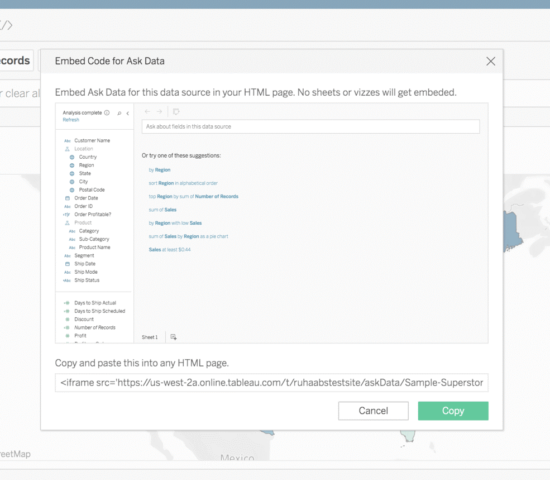
TABLEAU 2019.3 – WHAT TO EXPECT?
Tableau 2019.3 – What to Expect?
Tableau’s mission has always been to develop and deliver what customers ask. With Tableau server’s latest version 2019.3 (in beta now), it has brought out many exciting features like embedding Askdata, maintenance message, extract encryption at rest and more. Let us have a look at some of these upcoming features.
Ask Data improvements
I love to see when Tableau listens to customer feedback and continue to work on those asks. Ask Data is one of the most waited features in Tableau server’s previous releases and customers have asked if it can be embedded on other portals. With this release we can embed Ask Data into other company portals and let people ask questions.

Extract Encryption at Rest
Tableau cloud already provides volume encryption at rest and we already know that. Now with Tableau server, you will have the flexibility to have the encryption at REST for extracts. Server admins can enforce encryption of all extracts on their site or allow users to specify encryption for their published extracts.

It gives multiple options to enable this. We can have it for all the extracts or let user decide which extracts should be encrypted.
PDF attachment to subscriptions
It sounds very simple. But attaching pdf while sending the subscription was never an easy task. Tableau has made it easy now.

While creating a subscription, you can mention whether it should be an image or PDF or both.
Passwordless Tableau Server upgrades, node addition
As a server specialist, I know how tedious it is to enter password on a command prompt screen where you don’t see any characters getting typed. Often it goes wrong and we must reinitiate the process. With 2019.3, we can upgrade tableau server to next version with out manually entering the password or we can add new node without a password.

Adding a new node to the cluster no longer requires the username/password, if the bootstrap file you have created was in the last two hours.
Export to what you want
Exporting to PowerPoint will have all the sheets and sometimes we don’t need this. If you are a user who wants to export specific sheets in the workbook, this feature covers you. Now you have the option to select the sheets that you want to export.

And many more capabilities like new search results page, context filters on web, content sharing improvements, new product language Italian, etc. Beinex is a digital transformation organization en-rooted with ideas, innovation and unparalleled customer service. Our mission is to transform the way individuals and the organizations work with the data through innovation and experience.
If you are interested in learning more about the latest Tableau release and use cases, please contact us at training@beinex.com/ info@beinex.com and we would be happy to schedule a Tableau demo or training for you and your company.
The features shown above are currently in beta release and these might or mightn’t be available in the actual release.

Reining in the Horses is So Simple! Leverage the Sales Growth with Intent Data(Infographic)

Just Go Wild: Beinex Offsite Visit to Munnar
We all boarded after breakfast from Edapally into the buses waiting as planned. Our journey to Munnar resembled the long-lost college trips, filled with songs, dances and ‘Antaksharis’. Finally, we reached our destination passing vast expanses of tea estates and dewy mountains.
Munnar is an exotic place with a breath-taking landscape and scenic spots. The chilly hill station stole our minds with its exotic flora and fauna. Our team stayed in a luxury resort: Mountain Club. The cottages chosen for us resembled the colonial architecture from the bygone era. The bedrooms were cosy, with a balcony open to the rustic surroundings.
The lunch was a luxurious affair that included starters to desserts. We used the mealtime to get to know more about each other. Then, we all attended the motivation speech by Sibu Varghese which was quite insightful, followed by an interactive session. Then, we interacted with and introduced each other. Personal interaction creates tight bonds and has an integral role in team building. We all broke the ice by sharing our stories and telling jokes. It was fun to get to know each other.
 In the evening, we had a wild-theme based gala party, and all got dressed up in sync with the theme, ‘Just Go Wild’. It was fun to watch everyone from the Manager to the employees dressed up in the same theme. We had an exhilarating DJ party manned by Darryl Gaulbert which made us all shake a leg to the tune. We danced and roared to the music. It was indeed wild!
The following day after breakfast, we met our founder Indumon Das, who had a chat with us regarding the journey of Beinex and his vision. It inspired us all to have a dream and pursue it fearlessly. Some of us accessed the infinity pool late afternoon and had great fun swimming and playing pool ball.
It was a blissful evening based on an ethnic wear theme. We competed for the best ethnic outfit of the evening. The different hues and styles made the evening stunning. Everyone flaunted the traditional wear in style. We had a musical evening with a live barbeque and a sumptuous dinner.
Finally, the day of leaving Munnar dawned; March 19. We all had breakfast in the morning and packed our backpacks. Most of us were pretty reluctant to leave Munnar as we were not ready to lose the bond we created together. Nonetheless, we vowed to stay connected. We boarded the buses around 10 AM and waved goodbye to Munnar.
When we reached Edapally in the evening, a surprise goody bag was waiting. It was an impressive and admirable gesture from our firm. Beinex has a culture of nurturing growth and spreading positivity, and employees’ comfort is the priority here.
 Yes, we had a fantastic time together. After this retreat, our rejuvenated and motivated minds are ready to bounce back to work with enhanced spirit. We are looking forward to more team building sessions in the future to meet each other more often.
In the evening, we had a wild-theme based gala party, and all got dressed up in sync with the theme, ‘Just Go Wild’. It was fun to watch everyone from the Manager to the employees dressed up in the same theme. We had an exhilarating DJ party manned by Darryl Gaulbert which made us all shake a leg to the tune. We danced and roared to the music. It was indeed wild!
The following day after breakfast, we met our founder Indumon Das, who had a chat with us regarding the journey of Beinex and his vision. It inspired us all to have a dream and pursue it fearlessly. Some of us accessed the infinity pool late afternoon and had great fun swimming and playing pool ball.
It was a blissful evening based on an ethnic wear theme. We competed for the best ethnic outfit of the evening. The different hues and styles made the evening stunning. Everyone flaunted the traditional wear in style. We had a musical evening with a live barbeque and a sumptuous dinner.
Finally, the day of leaving Munnar dawned; March 19. We all had breakfast in the morning and packed our backpacks. Most of us were pretty reluctant to leave Munnar as we were not ready to lose the bond we created together. Nonetheless, we vowed to stay connected. We boarded the buses around 10 AM and waved goodbye to Munnar.
When we reached Edapally in the evening, a surprise goody bag was waiting. It was an impressive and admirable gesture from our firm. Beinex has a culture of nurturing growth and spreading positivity, and employees’ comfort is the priority here.
Yes, we had a fantastic time together. After this retreat, our rejuvenated and motivated minds are ready to bounce back to work with enhanced spirit. We are looking forward to more team building sessions in the future to meet each other more often.
What’s New in Tableau 2025.1: AI-Powered Insights, Multilingual Support, Private Connectivity, and More
Tableau 2025.1 at a Glance
- • Converse with Tableau Agent in six new languages using conversational AI.
- • Connect Tableau Cloud to AWS data securely with Private Connect.
- • Track KPIs on the go with a redesigned Pulse mobile homepage.
- • Programmatically access published data sources using VizQL Data Service.
- • Explore new features early with Tableau Cloud preview websites.
Let’s dive into the new updates in Tableau 2025.1:
1. Tableau Agent Multilingual Support
Perform multilingual data analysis. It is now possible for users to converse with Tableau Agent (and Tableau Pulse!) in French, Italian, German, Spanish, Japanese, and Portuguese. More people can now access conversational analytics in their native language.
With conversational AI, the Tableau Agent helps users navigate from data curation to exploration and accelerates all phases of analysis with generative AI. Additionally, because it is based on the Einstein Trust Layer, businesses can be assured that their data will remain safe, secure, and accessible only as intended.
2. Private Connect for Tableau Cloud
Use a dedicated, private connection to safely link Tableau Cloud to AWS data. Private Connect establishes a secure connection between Tableau Cloud and AWS data, ensuring your data remains private and is not made publicly available.
3. Revamped Tableau Pulse Homepage on Mobile
The redesigned Tableau Pulse mobile homepage enhances users' ability to engage with data on the go. With a side-by-side view of at least three key metrics, it allows for instant comparison and faster insight generation.
The clean, intuitive interface enables users to easily spot patterns, track trends over time, and take action quickly, without needing to dig through dashboards. Whether you're monitoring sales, operations, or customer engagement, Pulse ensures your most important KPIs are always within reach.
4. API for VizQL Data Services
VizQL Data Service is an innovative API that allows you to access published data sources in Tableau through programmatic queries rather than visualizations. Designed to maximize the versatility of your Tableau assets beyond traditional visualization, VizQL Data Service helps you tap into the analytic power of your data model anywhere.
It facilitates automating data processes by allowing you to run programmed queries directly on your data sources. By utilizing pre-existing Tableau connectivity and data models, you may more effectively design sophisticated, data-driven apps. You can now utilize your data models in any context, breaking free from the confines of visual tools.
5. Tableau Cloud Preview Websites
Tableau administrators can stay ahead of the curve by gaining early access to upcoming updates through release preview sites. This allows teams to test new features in advance, understand functional changes in a hands-on environment, and evaluate how updates will affect their organization’s unique dashboards and workflows—ensuring a smooth transition when the full release goes live.
In a Nutshell
The Tableau 2025.1 release brings a bunch of exciting updates to make working with data easier, smarter, and more secure. Now you can chat with Tableau Agent in multiple languages, get help with data prep and analysis using natural language, and connect securely to your AWS data using Private Connect. The refreshed Pulse homepage on mobile lets you track and compare key metrics at a glance, helping you make faster decisions wherever you are. Plus, with the new VizQL Data Service, developers can now access and use data directly, without relying on traditional dashboards. And if you're a Tableau admin, you get early access to test new features before they go live, so your team is always ready for what’s next.
Source: https://www.tableau.com/en-gb/2025-1-features