How AI Decision-Making is Improving Enterprise Outcomes
Blog
Share 
AI Governance in the UAE: Compliance, Data Governance & Responsible AI
 11 September 2026
 Subbayya
AI governance in the UAE now means three concrete things for any business operating here: mapping AI use cases against the UAE AI Charter's 12 principles, building an AI-enabled data governance framework that satisfies the Federal Personal Data Protection Law, and putting board-level oversight in place before a regulator asks for it. Enterprises that treat these as one connected program, not three separate compliance checklists, move faster and face less rework later.
What Is AI Governance and Why Does It Matter for UAE Businesses?
AI governance is the set of policies, controls, and accountability structures that determine how an organisation designs, deploys, and monitors AI systems. In the UAE, it matters because the regulatory runway is closing fast: the UAE AI Charter, released in July 2024, was described by KPMG as "more than a set of guidelines" but "a precursor to formalized AI regulations" for the region. Businesses that align early gain a practical head start, not just a reputational one.
What Are the Key Components of an AI Governance Framework?
A working framework rests on five pillars: model risk assessment, data lineage and quality controls, human oversight, transparency and explainability, and incident response. Each pillar needs an owner, a metric, and an audit trail; without these, AI compliance becomes a document exercise rather than an operational one.
AI Governance and Compliance: What Businesses Need to Consider
AI governance and regulatory compliance now intersect directly with data law. The Federal PDPL (Decree-Law No. 45 of 2021) applies to any entity processing UAE residents' data, and full compliance is required by 1 January 2027. Businesses operating in the UAE’s financial free zones, such as the Dubai International Financial Centre (DIFC) and Abu Dhabi Global Market (ADGM), must also navigate separate data protection regimes. These can differ from federal requirements, creating a “regulatory patchwork” for cross-border AI processing.
How AI-Enabled Data Governance Supports Responsible AI
An AI-enabled data governance framework does more than catalogue data; it flags bias at the training-data stage, tracks consent and automates data protection impact assessments before a model touches personal data. Regulators now expect this by design: PDPL guidance requires Data Protection Impact Assessments (DPIA) for AI projects, automated profiling, and large-scale surveillance to be documented and audit ready.
AI Risk Management: From Model Risk to Regulatory Compliance
Model risk doesn't stop at accuracy. It extends to drift, explainability gaps, and third-party model dependencies. A growing dimension of this risk is shadow AI: employees using AI tools the organisation hasn't approved or provisioned, often through personal accounts rather than enterprise-managed platforms. Unlike enterprise accounts, personal accounts typically fall outside data residency controls, usage logging, and vendor agreements, creating compliance exposure that sits entirely outside the model inventory. Mapping each risk category to a specific regulatory obligation- PDPL, the AI Charter's fairness principle, or sector rules in financial free zones- turns risk management from a theoretical exercise into an auditable control set.
AI Governance and Board-Level Oversight
Board-level engagement is shifting from optional to expected. A 2025 CEO Outlook found UAE leaders are "advancing a model of growth where people, technology, and governance move together," with responsible AI adoption named as a direct driver of that model. Boards that receive quarterly AI risk reporting are better positioned when formal regulation lands.
How AI Governance Can Automate Compliance Monitoring
Manual compliance monitoring cannot keep pace with model updates or shifting data flows. A growing category of purpose-built AI governance tools: model risk dashboards, policy-as-code engines, and automated audit trail generators, has started to address this operationally. Continuous monitoring, which tracks model behaviour, data drift, and policy adherence on an ongoing basis rather than at periodic intervals, is increasingly the baseline expectation for mature governance programs, not an optional enhancement. Automated monitoring- continuous bias testing, real-time data lineage tracking, and policy-as-code enforcement- turns AI compliance into a running process instead of a periodic audit, reducing both cost and exposure.
AI Governance in the UAE: Local Regulations and Global Standards
AI governance UAE frameworks increasingly mirror global standards while retaining regional specificity. Globally, frameworks such as the EU AI Act, the NIST AI Risk Management Framework (AI RMF), ISO/IEC 42001—the international standard for AI management systems—and GDPR have become the primary reference points for enterprise governance programs. The UAE's approach draws selectively from this body of work, particularly on risk classification, transparency obligations, and data protection principles, while calibrating requirements to regional economic and jurisdictional priorities.
A 2025 report on the UAE AI Charter highlights its alignment with global principles of safety, human oversight, fairness, transparency, and accountability, while reflecting the UAE’s regional priorities. This dual alignment is deliberate: it lets multinational operators use one control framework across markets while still meeting local expectations.
How Businesses Can Build an AI Governance Framework
- Start with an inventory of every AI system in production or pilot.
- Map each to the Charter's 12 principles and to PDPL data-handling obligations.
- Assign risk owners, define escalation paths, and schedule board reporting.
- Treat this as a living framework, reviewed each time a new model or data source is introduced, not a one-time compliance sprint.
Best Practices for Responsible AI Adoption in the UAE
AI governance best practices for enterprises include maintaining a live model inventory, running DPIAs before deployment, embedding human review in high-stakes decisions, and auditing vendor AI tools with the same rigour as in-house systems. Underpinning all of these is AI literacy, ensuring employees across functions understand what the AI tools they use are doing, what risks they carry, and what governance guardrails apply to them. Governance frameworks that exist only within the compliance function rarely survive contact with day-to-day operations; building an AI-aware culture across the organisation is what makes them stick. Together, these practices form the backbone of responsible AI governance for UAE businesses operating across free zones and federal jurisdiction alike.
Building AI Governance That Holds Up to Scrutiny
AI governance compliance in the UAE is no longer a future obligation; it is an active operating requirement shaped by the AI Charter, the Federal PDPL, and free-zone data laws working in parallel. Organisations that build a unified framework now, rather than reacting to each regulation separately, will spend less time on remediation and more time on innovation.
Beinex helps enterprises across the UAE design and operationalise AI governance and data governance frameworks, from data lineage and DPIA automation to board-level risk reporting, so responsible AI adoption is built in from day one.
Talk with us about assessing your current AI governance maturity.
Related Articles

Beinex: A Great Place to Work for the Second Consecutive Time!
At Beinex, we cultivate an exceptional atmosphere for work, learning, and professional growth. Our ethos revolves around a positive culture infused with passion, creating a self-sustaining cycle of success. This unique blend makes working at Beinex both meaningful and enjoyable. The atmosphere exudes a cool vibe, where supporting and respecting each other's individuality is ingrained in our cultural fabric.
Great Place to Work Survey Scores
Our recent Trust Index© results are in, revealing an impressive score of 83! This score reflects the percentage of employees who shared positive responses (rated 4 or 5 on a 5-point scale) to the 59 statements in the survey. It serves as a testament to the trust and positivity within our workplace, showcasing the strength of our team and organizational culture.
Notably, our Trust Index© Feedback on the Credibility of Management stands tall at 85, highlighting the high level of trust and confidence our employees have in the leadership team.
The active participation and honest feedback during the survey were instrumental in achieving these outstanding scores. It's inspiring to witness the alignment of our values and the positive impact it has on the overall trust within our organization.
Here's a brief overview of the key dimensions that contributed to our success:
Respect for People:
Fairness at the Workplace:
Pride:
Camaraderie Between People:
We would also like to express our gratitude to the Great Place to Work® Institute for their rigorous assessment, helping us understand and enhance our workplace culture.
Our Journey Onwards!
Moving forward, we will continue working together to maintain and build upon this foundation of trust. Your dedication, commitment, and contributions have been instrumental in cultivating a positive workplace environment, and we are grateful for each one of you.
Let's continue our journey of success and maintain Beinex as not just a workplace but a great place to work!
About the Great Place to Work Institute
The Great Place to Work® Institute stands as a prominent global management research and consulting firm committed to empowering organisations to achieve their business objectives through the establishment of superior workplaces. Collaborating with over 10,000 organisations worldwide annually, they specialize in assisting companies in creating and sustaining High-Trust, High-PerformanceTM cultures.
During the assessment process, the institute gauged the perceptions of Beinex's employees using the Great Place to Work® Trust Index© Employee Survey. Additionally, they delved into the distinctive culture of our organisation through the Culture Brief© and Culture Audit©, offering invaluable insights that contribute to the continuous enhancement of our workplace environment.

Reactive vs Proactive AI Governance: Why Enterprises Must Go Beyond Compliance
Enterprise AI adoption is accelerating, but governance maturity is not keeping pace. According to a 2025 research report by Infosys on Responsible Enterprise AI in the Agentic Era, 95% of enterprises reported AI-related incidents in the last two years, while only 2% met the " responsible AI “gold standard readiness levels. Another 2025 study on the state of AI security found that 70% of organizations still lack optimized AI governance frameworks.
This gap explains why enterprises can no longer treat AI governance as a compliance checkbox. Beyond avoiding regulatory penalties, governance today is about ensuring reliability, accountability, security, transparency, and business resilience as AI becomes embedded into core operations.

Data Blending for Spatial Analytics in Just 6 Steps Using Alteryx
What is Spatial Analysis?
Spatial analysis is the art and science of extracting insights from data that has a geographic component. Think of it as giving your data a physical address! Traditionally, this involved complex Geographic Information Systems (GIS) software. But today, spatial analysis is more accessible than ever, thanks to data science and machine learning.
Pinpointing locations on a map is just the first step. Spatial analytics goes far beyond that, offering a powerful lens to understand how relative location impacts your business. It allows you to see the bigger picture: how customers, stores, services, and other factors interact with each other geographically.
This magic happens by blending spatial data (think zip codes, store addresses) with your existing data sets (sales figures, customer demographics). By analyzing these combined datasets, you gain a wealth of insights that can transform your decision-making process.
What Spatial Analytics Can Do for You
Here's how spatial analytics can help you understand and optimize key areas:
- • Customer Behavior and Inventory: Analyze nearby consumer buying habits for specific products and services. This allows you to customize inventory and service experiences at each location based on local demand.
- • Strategic Location Planning: Optimize your location strategyby determining how the proximity of competitors or existing locations impacts new site expansion. You can also understand how far customers are typically willing to travel for your product or service.
- • Improved Customer Experiences: Ensure service availabilityand minimize service gaps by strategically locating key hubs within an appropriate distance from each other. This translates to a smoother and more efficient experience for your customers.
- • Targeted Marketing: Drive efficiencies in your marketing programs by customizing your offerings to match demographic purchasing preferences in specific locations. This targeted approach allows you to reach the right audience with the right message.
- • Import and Unify: Easily bring in various datasets, regardless of format.
- • Effortless Geocoding: Transform addresses and other location data into usable geographic coordinates with a few clicks.
- • Spatial Blending: Combine your location data seamlessly with traditional datasets for a holistic view.
- • Advanced Analytics Made Simple: Perform complex spatial analyses without needing specialized coding skills.
- • Data Enrichment: Boost your insights by adding demographic, firmographic, or industry-specific data to your spatial datasets.
- • Visualize and Explore: Discover hidden patterns and relationships through interactive maps and visualizations.
- • Gather Data: Gather all the data sets you need for your analysis, from customer information to market demographics.
- • Translate Your Addresses: Use Alteryx's geocoding tools to transform addresses and other location data into usable geographic coordinates.
- • Define Your Trade Zone: Create a virtual boundary to analyze specific locations based on radius
- • Blend Datasets Together: Seamlessly combine your spatial data with traditional datasets to create a comprehensive picture of customer-location relationships.
- • Use Advanced Spatial Analytics for Additional Insights: Perform complex spatial analyses within Alteryx's user-friendly interface, unlocking hidden insights without needing specialized coding skills.
- • Visualize and Share Your Findings: Prepare your data for reports and interactive visualizations that effectively communicate your insights. Alternatively, export the data for further analysis or integration with downstream processes.
How Alteryx Enables Data Blending for Spatial Analytics
Forget complex GIS! Alteryx's no-code tools make spatial analysis a breeze, unlocking location intelligence for all data users. Optimize resources, plan assets, manage logistics, and more - all in a user-friendly platform.
Alteryx offers an intuitive workflow that streamlines the entire process:
A 6-Step Recipe for Blending Spatial Data in Alteryx
Alteryx makes blending spatial data with your existing information a breeze. Here's a step-by-step guide to get you started:
Find a detailed 6-step guide for blending spatial data using Alteryx:
1. Gather Data
Alteryx's Input tool lets you grab data from anywhere – spreadsheets, databases, even social media! Just connect to your desired sources, and Alteryx will get your data ready for spatial exploration.

2. Turn Addresses into Locations:
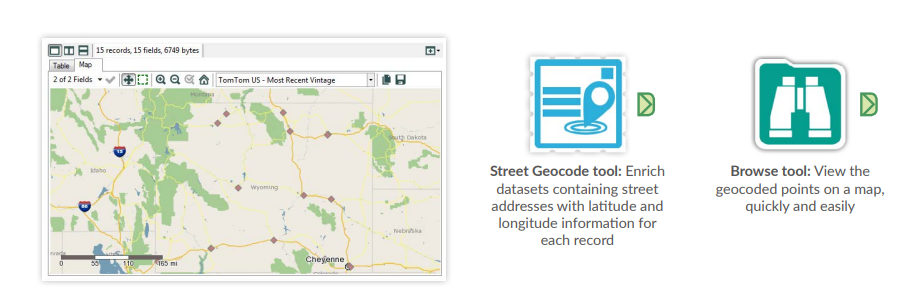
The Street Geocode tool in Alteryx quickly transforms your standard addresses (like customer locations or branch sites) into geographic coordinates (latitude and longitude). This "spatializes" your data, adding a new data point for each location.
In this example, we'll use it to geocode both customer and site data.
3. Define Your Trade Zone:
The Trade Area tool lets you see what's happening within a specific area around each location. For example, you can create a 10-minute drive time polygon. This "draws" a zone around each location, encompassing all areas reachable within a 10-minute drive using the road network.

4. Blend Datasets Together:
The Spatial Match tool lets you see how different sets of locations relate to each other. For instance, you can use it to find out how many customers live within (or outside) the 10-minute drive time zone you created for each location. It essentially compares your customer data points (spatial points) with the trade area polygons (spatial objects) to identify matches based on spatial relationships (like "contains" or "intersects").

5. Use Advanced Spatial Analytics for Additional Insights
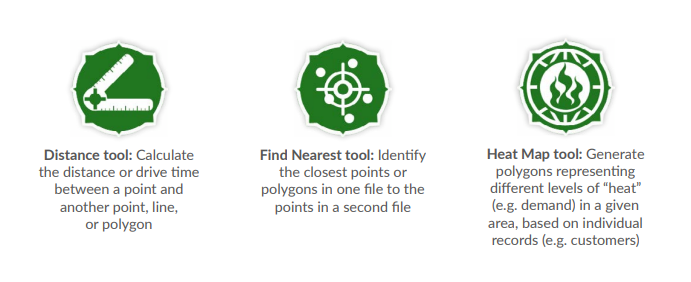
Alteryx offers a range of additional tools for advanced spatial analysis, making it accessible to users beyond data specialists. Additional tools include:
6. Visualise and Share Your Findings:
Alteryx doesn't just help you crunch data - it enables you to share your insights clearly.
Visualize Your Success: Overlay data on detailed maps or satellite imagery using advanced mapping tools.
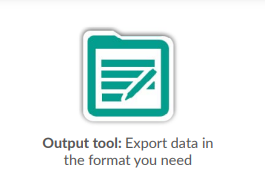
Spread the Knowledge: Export your analysis in various formats like Excel, ESRI, or even Tableau and Qlik for seamless integration with other data workflows and presentations.
Beinex + Alteryx Offerings
As a Premier Alteryx partner, we have extensive experience and a proven track record of success. Our team is highly skilled in Alteryx solutions and can help you unlock the full potential of this powerful platform.
Contact us today to learn more about how Alteryx and our partnership can take your business to the next level.
Image Source: https://community.alteryx.com/pvsmt99345/attachments/pvsmt99345/general-discussions/2303/2/Spatial_Cookbook_Victa.pdf

Grow Your Business with Competitive Intelligence (CI)
What is Competitive Intelligence (CI)?
Competitive Intelligence (CI) is a systematic process for gathering, analyzing, and applying information about the competitive landscape in which a business operates. It equips organizations with valuable insights, helping them make strategic decisions, mitigate risks, and gain a competitive edge.
Competitive Intelligence services play a vital role in helping businesses gain a strategic advantage through the smart utilization of data and information. By gathering, analyzing, and applying information about the competitive landscape, CI equips organizations with valuable insights, enabling them to make data-driven decisions, mitigate risks, and ultimately outperform their competitors.
To learn more about the benefits of Competitive Intelligence, click here
Why Competitive Intelligence (CI) Matters in Business
In today's fast-paced business world, staying ahead is crucial, and Competitive Intelligence services can be the game-changer your business needs. Here's why Competitive Intelligence matters:
Informed Decision-Making
In the modern business landscape, decisions need to be grounded in data, not guesswork. CI services equip decision-makers with valuable insights that help them make well-informed choices. By analyzing competitor behavior, market trends, and consumer preferences, businesses can develop strategies that are not based on hunches but on hard evidence.
For example, consider a scenario where a tech startup is contemplating the launch of a new product. CI can provide insights into the competitive landscape, revealing what similar products are in development, their features, and their projected market reception. Armed with this data, the startup can make crucial decisions about product design, pricing, and marketing with a higher degree of certainty.
Anticipating Market Changes
The business world is in a constant state of flux. Markets evolve, consumer preferences shift, and disruptive technologies emerge. In this environment, businesses that can anticipate and adapt to change gain a significant advantage. CI allows organizations to do just that.
By monitoring industry trends, tracking competitor movements, and analyzing consumer behavior, businesses can identify early indicators of change. This insight provides a head start in adjusting strategies, launching new products, and capitalizing on emerging opportunities. It's the difference between reacting to change and proactively shaping the market.
For instance, an established retail chain with a robust CI process may spot the growing consumer interest in sustainable and eco-friendly products. Armed with this knowledge, the chain can pivot its product selection and marketing to cater to this demand, staying ahead of competitors who are slower to adapt.
Outsmarting the Rivals
Competition in business is not just a matter of survival; it's a race to outperform rivals. In this race, CI is the secret weapon that enables organizations to outmaneuver their competitors.
By gaining insights into competitors' strategies, strengths, and weaknesses, businesses can develop tactics to gain an edge. For example, a restaurant chain can analyze a competitor's menu changes, pricing strategies, and customer reviews to refine its own offerings and marketing approach. This allows for not only maintaining market share but also expanding it.
Moreover, CI is not just about reacting to competitors; it's also about predicting their moves. By understanding the future direction of the market and the strategies competitors are likely to employ, businesses can position themselves strategically. This foresight is a cornerstone of successful long-term planning.
Examples of Competitive Intelligence (CI) in Action
Competitive Intelligence services are used in various business aspects:
Market Research: Imagine a tech company that monitors competitors' product launches, pricing strategies, and customer reviews to refine its own offerings.
Competitor Analysis:A restaurant chain may analyze its competitors' menu changes, customer reviews, and marketing strategies to refine its own offerings.
Supplier and Vendor Insights:By employing CI, companies can assess their suppliers' performance, ensuring a streamlined supply chain.
Types of Competitive Intelligence
CI comes in various flavors, each with its own focus and strategic horizon:
Tactical CI:This short-term focus involves addressing immediate competitive threats and challenges. For example, a retailer may use tactical CI to respond to a competitor's sudden price drop.
Strategic CI:With a long-term view, strategic CI aims to identify trends, market shifts, and opportunities. An example is a global tech corporation analyzing market trends to position itself as a leader in a specific technology sector.
Product CI: This type focuses on tracking competitors' product development and launches, ensuring companies are aware of what's in the pipeline and can adjust their product roadmaps accordingly.
Pricing CI:It involves tracking competitors' pricing strategies and understanding how they position themselves in the market. Companies can then make informed pricing decisions.
The Role of Competitive Intelligence (CI) in Marketing
Incorporating CI into your marketing strategy is a game-changer. It allows you to align your marketing efforts with the competitive landscape and customer preferences, optimizing your strategies for success. Here's how to do it:
CI is more than a buzzword; it's a strategic imperative for businesses. By incorporating CI into your strategies, you can gain a competitive edge, make data-driven decisions, and secure your position in the market. Whether through market research, competitor analysis, or innovative marketing strategies, CI can be the key to success in today's fast-paced business world.
How Beinex Can Help You
Robust Competitive Intelligence is essential in strategising for your next move, enabling you to anticipate your competitors’ direction and future performance. Our data harvesting team validates the entire data manually before the CI application consumes it. Our clients can easily integrate our CI database with their actual transactional data.
Efficient, Competitive Intelligence analysis can give a significant boost to your strategy. Beinex provides comprehensive competitive intelligence solutions that help businesses gain a competitive edge in their industry. Supercharge your competitive strategy with Beinex!

Preparing for AGI: What Leaders and Executives Need to Know
What is AGI (Artificial General Intelligence)?
Artificial General Intelligence (AGI) refers to an AI that, in theory, can think, learn, and understand more like a human. It is designed to perform any intellectual task a human can do. However, AGI remains a theoretical concept, and current AI systems have not yet achieved true cognitive abilities, reasoning skills, or emotional intelligence comparable to humans. Rapid advancements suggest that reaching a form of AGI is not beyond possibility. Given the unprecedented growth of AI in recent years, it's wise to stay informed and prepared.Generative AI vs. AGI vs. ASI: Understanding the Difference
Generative AI is a subset of deep learning that predicts responses based on extensive training data. These models, including ChatGPT and Midjourney, are powerful but still fundamentally narrow AI systems. They lack true understanding, common-sense reasoning, and emotional intelligence. Conversely, Artificial General Intelligence (AGI) is regarded as a strong form of AI. Like human intelligence, it would be self-aware, flexible, and capable of solving problems in various fields. AGI might learn, reason, and apply knowledge across domains without explicit training, in contrast to GenAI, which works within predetermined tasks. Even if AGI is yet theoretical, it has enormous potential to change society and industry. Beyond human intelligence, Artificial Super Intelligence (ASI) can tackle issues beyond human comprehension. For example, an ASI system might be able to create novel medicinal treatments or extremely efficient energy systems. Nonetheless, ASI is still primarily theoretical and a subject of discussion and assumption.GenAI vs. AGI vs. ASI: Key Differences
Here are the main differences between GenAI, AGI, and ASI:| Generative AI (GenAI) | Artificial General Intelligence (AGI) | Artificial Super Intelligence (ASI) |
|---|---|---|
| AI that generates text, images, audio, and code based on training data | AI with human-like reasoning, learning, and problem-solving across all domains. | AI that surpasses human intelligence and capabilities |
| Generates content, predicts patterns, and automates tasks | Understands, learns, and adapts like a human across multiple fields. | Thinks, learns, and innovates beyond human intelligence |
| Examples: ChatGPT, Midjourney, DALL-E, Bard | A self-learning AI that can pass human-level exams and perform diverse tasks. | An AI that can autonomously innovate, research, and make better decisions than humans. |
| Mimics creativity but lacks true understanding | Matches human cognitive abilities. | Beyond human intellectual capacity |
| Fully functional and widely adopted | Estimated timeframe is 2030–2050 (speculative). | Not yet possible with current technology |